Just because you went through a foreclosure doesn’t mean you can’t buy a home again. Basically, this means that many mortgage programs will require you to wait a while before you can get approved for another home loan. How long you need to wait depends on the type of mortgage you apply for, your credit recovery, and whether there were documented extenuating circumstances. In general, conventional loans have the longest waiting period after foreclosure. In contrast, FHA, VA, and USDA loans may allow borrowers to qualify sooner. Lenders will also review your credit scores, debt-to-income ratio, re-established payment history, and overall financial stability before approving a new mortgage. This guide explains mortgage foreclosure in mortgage qualification, the waiting times for different loan options, and how you can increase your chances of getting approved again.
Understanding Foreclosure in Mortgage Qualification: Conventional and Government-Backed Loan Guidelines

What Is Foreclosure, and How Does It Affect Mortgage Qualification?
A foreclosure happens when months of missed payments force a lender to seize the home to recover what it is owed. That harsh step chips away at your credit rating, usually shaving off between 100 and 300 points, and then sticks to your report for seven long years. Because every mortgage company watches your credit like a hawk, the stain slows approvals and can even knock you out entirely in the short term. Still, foreclosure in mortgage qualification is not impossible; lenders build in longer waits and tougher standards to ensure your finances are firmer.
Key Factors Lenders Consider After a Foreclosure
After a foreclosure, lenders want to see that enough time has passed and that your finances have improved. In most cases, they look at three things first: how long it has been since the foreclosure was completed, whether you have rebuilt your credit, and whether your current income supports a new mortgage payment. They also review your debt-to-income ratio, your savings, and your recent payment history. If you have a major hardship, such as job loss, illness, or another documented event beyond your control, some loan programs may offer more flexibility. But in most cases, the waiting period is still the first rule that matters most.
Conventional Loan Guidelines After Foreclosure
Conventional loans usually have the strictest waiting period after a foreclosure. Most borrowers must wait 7 years before qualifying again, though documented extenuating circumstances may shorten that timeline in some cases. Lenders will also want to see that your credit has recovered, that your debt is under control, and that you have enough funds for the required down payment and, if needed, reserves. Because conventional loans are less flexible after a major housing event, many borrowers recovering from foreclosure first look at FHA, VA, or USDA loans before returning to conventional financing later.
Credit Score Standards
- Minimum Score: Most conventional loans require at least 620, but lenders may expect 660 or better.
- Post-Foreclosure: Once the dust settles, a score of 680 or higher is often necessary to show real credit recovery.
Down Payment and DTI
- Down Payment: Most new homebuyers put down at least 3%.
- A 5% to 20% bump is also normal.
- After a foreclosure, lenders may ask for 10% or more, especially if tough circumstances were involved.
- DTI Ratio: Lenders love a debt-to-income ratio of 36% or less.
- They’ll stretch it to 43% or even 50% with excellent credit, big savings, or steady extra income.
Additional Requirements
- Documentation: Include a short letter that explains the foreclosure and any backup, like job-loss papers or medical bills.
- Re-established Credit: Show on-time payments for credit cards or car loans since the foreclosure to prove rebuilding.
- Financial Reserves: Two to six months’ worth of monthly mortgage costs tucked away in the bank is often needed to show steady finances.
Example of How Foreclosure Waiting Periods Work
Here is a simple example. If a foreclosure was completed in July 2022, a borrower may become eligible again in July 2025 with FHA or USDA financing, in July 2024 with a VA loan in many cases, or in July 2029 with a conventional loan if no exception applies. The timeline can vary depending on the loan program, the foreclosure date, and whether the borrower meets all credit and income criteria. This is why it’s important to verify the waiting period for foreclosure in mortgage qualification for your particular loan type, rather than assuming that all mortgage programs follow the same schedule.
Buy Again After Foreclosure With Flexible Loan Options
FHA, VA, and alternative lenders offer second chances. We’ll guide you through the requirements.Government-Backed Loan Guidelines for Borrowers with a Foreclosure
FHA, VA, and USDA loans give more room than conventional mortgages, so borrowers with a past foreclosure often favor them. Below are the specific rules for each program.
FHA Loan Guidelines After Foreclosure
FHA loans are often among the first options borrowers consider after a foreclosure because the waiting period is generally shorter than for conventional financing. In most cases, borrowers must wait 3 years after a foreclosure is completed before applying for a new FHA loan. FHA loans can be an excellent option for borrowers working to rebuild their credit and who may not have a substantial down payment. Many homebuyers opt for FHA loans because their credit standards tend to be more forgiving than those of conventional loans. If you have a solid credit score, you might not need to put down as much money when securing a loan. However, if your score is lower, especially in cases where a foreclosure in mortgage qualification comes into play, you will likely need to provide a larger down payment.
VA Loan Guidelines After Foreclosure
VA loans can be a strong option for eligible veterans, active-duty service members, and qualified surviving spouses who have experienced a foreclosure. In many cases, the waiting period is shorter than for conventional loans, typically around 2 years from the foreclosure completion date. One of the biggest advantages of a VA loan is that eligible borrowers may qualify with no down payment. VA loans may be especially attractive for buyers with restored credit and stable income after a past housing event. Lenders will still review credit, income, and residual income, but VA financing is often more forgiving than conventional loans.
USDA Loan Guidelines After Foreclosure
USDA loans may help eligible buyers return to homeownership after foreclosure if they are purchasing in a qualified rural area. In most cases, the waiting period is three years after the foreclosure is completed. USDA loans are meant for folks who earn low to moderate incomes. They can offer 100 percent financing, meaning no down payment may be required. They may be a good fit for borrowers who meet income limits, want to buy in an eligible rural location, and have had enough time to rebuild their credit after foreclosure.
Comparing Government-Backed Loan Options After Foreclosure
FHA, VA, and USDA loans tend to offer more favorable terms for those facing foreclosure in mortgage qualification than conventional loans do. These government-backed loans usually have shorter waiting periods and more lenient credit requirements. The right option for you really comes down to a few things: whether you qualify, where you’re buying your home, your credit status, and how much cash you have for closing costs.
Steps to Qualify for a Mortgage After Foreclosure
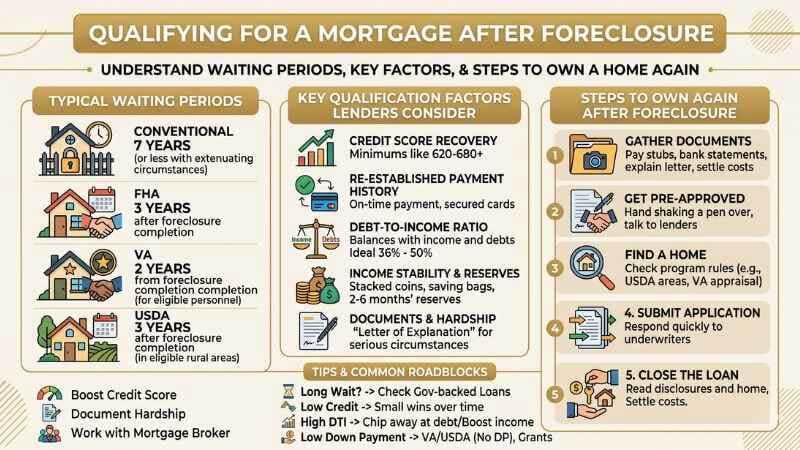 Ready to seek a mortgage after losing a home to foreclosure? Follow these steps to strengthen your application: Check the waiting period. Each loan type- conventional, FHA, VA, or USDA- has a clock that starts on the day your foreclosure is filed.
Make timely payments, cut credit card balances below 30 percent of your limit, and avoid new credit pulls. A secured card can help if your credit is still shaky. Lower your debt-to-income ratio by paying off high-interest loans or boosting your monthly earnings.
Depending on the lender, aim for a DTI below 36 to 43 percent, forgiving a bit of that past stumble. Set aside enough cash for the up-front costs. Conventional loans often need 3 to 20 percent down, FHA loans demand at least 3.5 percent, VA and USDA loans ask for zero, yet all buyers must plan for closing fees that run 2 to 5 percent of the loan amount.
Step-by-Step Process for Buying a Home After Foreclosure
Gather Your Papers. Before anything else, pull together your most recent pay stubs, tax returns, at least two months of bank statements, and a brief letter explaining what happened during the foreclosure. If you faced extra problems, like a job loss or medical bills, include those documents too.
Foreclosure In Mortgage Qualification: Get Pre-Approved
Reach out to several lenders and request a pre-approval. This quick check will tell you how much house you can afford and flag any red flags early. Side-by-side comparisons will point you toward the best interest rates and terms.
Choose the Right Home
Look for properties that meet the lender’s rules. For example, USDA loans only cover homes in rural areas, and VA mortgages require a specific appraisal.
Submit Your Application
Once you find a house, complete the application with all the paperwork. Underwriters will ask more questions, so reply fast to keep things moving.
Close the Loan
Read the loan estimate and closing disclosure carefully, settle any required closing costs, and then sign the final papers. Then, the keys are yours.
Tips to Improve Your Chances of Approval Post-Foreclosure
Boost Your Credit Score
If you’re going conventional, aim for at least 680. For FHA and similar loans, 620 to 640 usually works. Check your report often, fix errors, and pay bills on time.
Document Extenuating Circumstances
Clear proof, like hospital records or a layoff letter, may shorten the waiting period from a full three years. Keep copies ready.
Work with a Mortgage Broker
A good broker knows lenders that accept post-foreclosure applications and can save you time and effort.
Consider Government-Backed Loans
FHA, VA, and USDA loans have shorter wait times and easier credit rules, making them attractive first stops after foreclosure.
Before You Apply for a Home Loan
- Build financial reserves: Set aside 2 to 6 months’ mortgage payments.
- This cushion proves to lenders you can weather money surprises, like job loss or repairs.
- Complete housing counseling: FHA loans often ask for this course, and showing you did it signals to lenders that you take your finances seriously.
- Plus, you may pick up tips that save you money later.
Common Roadblocks and Workable Fixes
- Long Wait Time: Conventional lenders may make you wait up to 7 years after a foreclosure.
- Fix: Check FHA, VA, or USDA loans that let you reapply in 2 to 3 years, or share proof of special hardship to shorten the gap.
- Low Credit Score: After foreclosure, scores often stay low.
- Fix: Pay bills on time, keep balances low, and avoid new big debts.
- Steady, small wins will lift your score over the months.
- High DTI Ratio: Lenders hesitate if your debt consumes too much of your income.
- Fix: Chip away at small loans, roll multiple debts into one, or start a side gig to boost earnings.
- Insufficient Down Payment: Scraping together a big upfront payment feels impossible.
- Fix: VA and USDA loans require no down payment, while FHA and conventional options may offer local grants or second mortgages to cover part of the gap.
Foreclosure Doesn’t Mean You Can’t Own a Home Again
Understand the lending guidelines and how to rebuild your credit to qualify.Why Choose Conventional vs. Government-Backed Loans Post-Foreclosure?
When considering loans after a foreclosure in mortgage qualification, it’s essential to weigh the pros and cons of conventional versus government-backed options. Conventional loans generally offer lower interest rates and do not require significant upfront mortgage insurance costs, but they require a 7-year waiting period and higher credit scores. In contrast, government-backed programs, including FHA, VA, and USDA loans, offer a shorter waiting period of 1 to 3 years post-foreclosure for mortgage qualification, accept borrowers with lower credit scores, and may require little to no down payment. However, these alternatives do include monthly insurance or a small guarantee fee. Ultimately, your decision should be based on your credit health, financial situation, and specific eligibility factors, such as military service or plans for rural homeownership.
Judgments
Borrowers with outstanding Judgments can qualify for mortgage loans:
- Judgments need to be paid in full before mortgage loan approval, and/or be clear to close
- On refinance mortgages, judgments can be paid at closing
- Judgments do not have to be paid in full to qualify for mortgage loans
- Borrowers can get a written payment agreement with the judgment creditor and have three months seasoning to qualify for a mortgage with judgments
- The monthly payment on the judgment needs to be included in the debt-to-income ratio calculations
Cannot pre-pay three months’ payments on judgments upfront to meet three months’ seasoning requirements.
Alternative Mortgage Options After Foreclosure
Some borrowers might consider alternative mortgage options if they haven’t yet met the waiting period requirements for FHA, VA, USDA, or conventional loans, especially in cases involving mortgage foreclosure during mortgage qualification. These options, commonly known as non-QM loans, may have different credit, down payment, and risk-based pricing standards compared to traditional mortgage programs. However, non-QM loans may not be suitable for every borrower, as they often come with higher interest rates, larger down payment requirements, or stricter reserve conditions. Therefore, it’s essential for borrowers to carefully compare these alternative loans with standard options and assess the long-term costs before proceeding. For most homebuyers, the best starting point is to verify whether they meet the waiting period for a government-backed or conventional mortgage before exploring other financing avenues.
Special Rules When Foreclosure Was Part of a Bankruptcy
In certain situations, the timing of foreclosure in mortgage qualification may be handled differently if the mortgage debt was part of a previous Chapter 7 bankruptcy. The waiting time can change based on the type of loan you’re looking at and how your previous housing situation was handled. Given that these rules can be more intricate than typical foreclosure guidelines, borrowers in this scenario should have their cases thoroughly examined based on the type of loan they intend to pursue.Final Thoughts on Foreclosure in Mortgage Qualification
Final Thoughts About Foreclosure in Mortgage Qualification
Experiencing a foreclosure doesn’t necessarily eliminate your chances of becoming a homeowner again. The key factors that influence this are the type of loan you seek, the time elapsed since the foreclosure was finalized, and how effectively you have worked to improve your credit and financial situation since then.
When it comes to foreclosure in mortgage qualification, conventional loans typically impose the longest waiting periods. On the other hand, FHA, VA, and USDA loans might provide a quicker route back to homeownership for qualifying borrowers.
It’s essential to assess your timeline, credit profile, and loan options to determine which mortgage program best aligns with your circumstances. If you have questions regarding the waiting period after a foreclosure or the loans available to you, consulting with a mortgage expert can prove invaluable. They can evaluate your unique situation and clarify your options in a clear, understandable way.
Frequently Asked Questions About Foreclosure in Mortgage Qualification:
How Long After a Foreclosure Can I Qualify for a Mortgage Again?
The waiting period depends on the type of loan. In many cases, conventional loans require the longest wait, often up to seven years, while FHA and USDA loans are commonly three years, and VA loans are often two years after foreclosure completion. Some exceptions may apply if there were documented extenuating circumstances. This is one of the most important rules in foreclosure in mortgage qualification because the timeline often determines which loan programs are even available to you.
Can I Get an FHA Loan After a Foreclosure?
Yes, many borrowers can qualify for an FHA loan after a foreclosure once the waiting period has passed. FHA is often one of the first options borrowers consider because it is usually more flexible than conventional financing regarding credit requirements and down payment requirements. Your lender will still review your full financial profile, including recent payment history, income, and debt.
Can I Get a VA Loan After a Foreclosure?
Yes, eligible veterans, active-duty service members, and some surviving spouses may qualify for a VA loan after foreclosure. In many cases, the wait is shorter than for conventional loans. VA financing may also be attractive because eligible borrowers can often buy with no down payment. However, lenders still review credit, income, and residual income.
Does a Foreclosure Hurt My Credit Score and Mortgage Approval Chances?
Yes, a foreclosure can significantly damage your credit and make mortgage approval harder for a period of time. But it does not always prevent you from buying again in the future. Lenders usually want to see re-established credit, on-time payments after the foreclosure, and a stable income before approving a new mortgage. For many borrowers, improving credit is a major part of foreclosure in mortgage qualification.
Can I Buy a House Sooner After Foreclosure if I had Extenuating Circumstances?
Possibly. Certain loan programs might let you skip some of the waiting time if your foreclosure happened because of something serious you couldn’t control, like getting really sick, losing a family member who was a main earner, or losing your job unexpectedly. The exact rules vary by loan type and lender review, so borrowers should not assume they automatically qualify for an exception.
What is the Easiest Mortgage Program to Qualify for After a Foreclosure?
There is no single best program for everyone, but many borrowers recovering from foreclosure first look at FHA or VA loans because they often have shorter waiting periods and more flexible credit standards than conventional financing. USDA may also be an option for eligible rural homebuyers. The right choice depends on your credit score, income, and location.
This article about “Foreclosure In Mortgage Qualification Lending Guidelines” was updated on April 13th, 2026.