A VA credit dispute does not automatically disqualify a borrower from getting a VA loan. VA does not have a blanket rule requiring every disputed account to be removed before approval. The lender must review the account, the reason for the dispute, and the borrower’s overall credit history. Legitimate disputes involving inaccurate information may be considered differently from unpaid debts, collections, or judgments, and individual lenders may have stricter requirements than VA itself.
How VA Credit Dispute Guidelines Work
A VA credit dispute is reviewed as part of the borrower’s overall credit history. VA does not automatically require every disputed account to be removed or paid before the loan can close. The underwriter looks at why the account is disputed, whether the debt is legitimate, the account’s status, and whether it affects the borrower’s ability to repay the mortgage. If the underwriter does not consider a disputed debt because the Veteran has a bona fide or legal defense, the reason should be documented on VA Form 26-6393, Loan Analysis.
Does VA Require Credit Disputes to Be Removed?
VA does not have a blanket guideline requiring borrowers to remove all active disputes from their credit reports. A lender may consider a Veteran’s bona fide or legal defense involving an unpaid debt unless the debt has already been reduced to judgment. The lender is responsible for reviewing the circumstances and documenting its credit decision.
VA Guidelines vs. Lender Requirements
Some lenders have stricter credit requirements than the VA’s minimum standards. This is called a lender overlay. For example, a lender might ask you to remove certain dispute comments or provide more documents before they approve your loan. This does not always mean the VA requires the dispute to be removed. You should find out if a dispute-related condition comes from VA guidelines, automated underwriting results, or the lender’s own policy.
AUS Findings and Disputed Accounts
VA-approved automated underwriting systems give a risk rating, but they do not make the final decision on your VA loan. The lender is still responsible for the final decision and for checking the information entered into the system. If a disputed account affects your reported debts, negative credit, or other important information, it may need extra review. In some cases, the VA requires lenders to explain any negative credit and document how they assessed your creditworthiness.
Bona Fide and Legal Credit Disputes on VA Loans
VA gives underwriters room to consider a Veteran’s bona fide or legal defense involving an unpaid debt. This is different from simply placing an accurate collection account into dispute in an attempt to improve a credit profile.
Incorrect Accounts
A dispute may be legitimate when the borrower has evidence showing that the reported information is inaccurate or incomplete. Examples can include:
- An account that does not belong to the borrower
- An incorrect balance
- Payments reported incorrectly
- An account that should have been updated or removed
- Duplicate reporting of the same debt
Consumers can dispute incorrect or incomplete information with both the credit bureau and the reporting company.
Identity Theft or Unauthorized Accounts
An account opened through identity theft should not be treated the same as an unpaid debt that legitimately belongs to the borrower. The borrower should document the identity theft issue and follow the appropriate credit reporting procedures. The FTC directs consumers dealing with identity theft to IdentityTheft.gov for a recovery plan and supporting documentation.
Documenting the Dispute
A lender may ask you for documents to support your explanation, especially if the disputed account could affect the credit decision. Useful documentation may include creditor correspondence, payment records, account statements, identity theft documentation, court records, or other evidence supporting the borrower’s position. If the underwriter decides not to consider the unpaid debt because of an acceptable bona fide or legal defense, VA requires that the reasoning be documented in the Loan Analysis.
Don’t Remove a Credit Dispute Without a Mortgage Review
Removing a dispute can sometimes change your credit score or create new underwriting issues. Get guidance before making changes to your credit report.Medical Collections and Credit Disputes
VA gives identifiable medical collections more favorable treatment than ordinary collection accounts.
An identifiable medical collection or medical charge-off that has not been reduced to a judgment or lien may generally be disregarded by the lender. VA does not require these accounts to be paid as a condition of approval, and the lender does not need to obtain an explanation for them.
This treatment comes from the nature of the medical debt, not simply because the account has an active dispute. Once a medical debt has been reduced to a judgment or lien, the standard medical-collection treatment no longer applies.
Non-Medical Collections With an Active Dispute
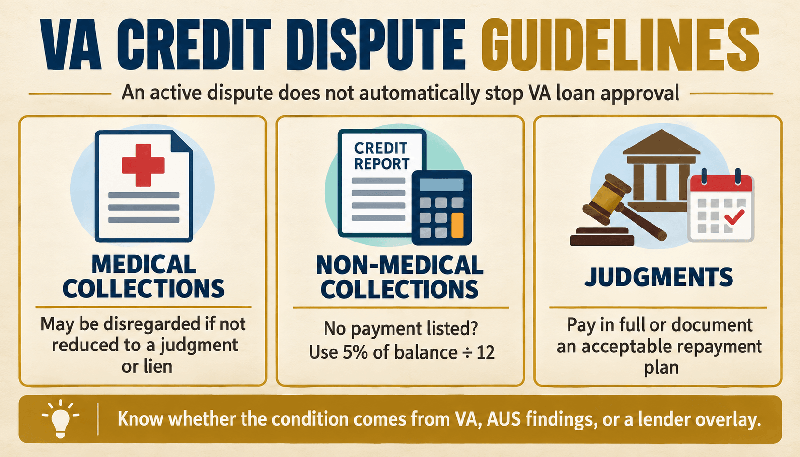
A disputed non-medical collection is not automatically excluded simply because a dispute comment appears on the credit report. The lender must evaluate the account as part of the borrower’s overall credit history unless the underwriter accepts a documented bona fide or legal defense. If the credit report or repayment agreement shows a minimum monthly payment, the lender generally uses that amount. If no payment arrangement has been established, current VA guidance calls for a qualifying payment equal to 5% of the outstanding collection balance divided by 12 months. For example, a $6,000 collection would produce a $25 monthly qualifying payment: $6,000 × 5% ÷ 12 = $25 The calculated payment is included in the borrower’s debt-to-income ratio and residual-income analysis. It does not mean the borrower must make that exact payment to the collection agency. VA does not automatically require an isolated non-medical collection to be paid before closing when the borrower’s overall credit is acceptable. However, the underwriter must address the collection and explain why the positive factors in the loan file outweigh the additional credit risk on VA Form 26-6393, Loan Analysis.
Disputed Charge-Off Accounts
In most cases, a charge-off does not need to be paid to close a VA loan. The lender must evaluate the charge-off along with all other information in the borrower’s credit report to determine whether there is additional risk. If a charge-off is being disputed because the borrower believes the debt is in error or was not incurred by them, the underwriter will review documentation presented to support that position. Medical charge-offs have unique considerations. Unresolved medical charge-offs that have not been reduced to judgments or liens are generally disregarded in accordance with VA guidelines. Paying an old charge-off before applying will not erase the payment history. VA will review the borrower’s overall credit history, not just whether an old derogatory account is now showing a zero balance.
Judgments and Disputed Debts
A court judgment is treated differently from a VA credit dispute. VA’s policy states that when a debt has been converted to a judgment, the underwriter may no longer consider the borrower’s defense to the unpaid debt as a legal or bona fide defense. An acceptable judgment must either be fully paid or have an approved payment agreement with a track record of on-time payment. VA typically considers 12 on-time payments as a satisfactory payment history. In rare cases, an underwriter may allow a history of fewer than 12 payments, provided the judgment is recent, and the borrower has documented prior efforts to address the judgment and payments. In such cases, the underwriter must provide the rationale on VA Form 26-6393.
How Credit Disputes Can Affect VA Loan Approval
A credit dispute does not automatically prevent approval for a VA loan. However, the lender, in their underwriting review, will analyze the following underwriting issues:
- Does the credit reporting agency’s debt belong to the borrower?
- Is the debt reporting credit balance accurate?
- What are the reasons for the dispute?
- Does the debt have a monthly obligation?
- Are there judgments, or does the debt have liens?
- Does the account reflect poor credit management?
For each dispute that affects a credit decision, lenders often ask for documentation or provide a written explanation. An active dispute may affect how an account is treated by a credit-scoring model, but a score change is not guaranteed. Removing a dispute could raise, lower, or leave the score unchanged. The lender may also need to obtain an updated credit report and rerun the AUS. Ultimately, a lender doesn’t base a credit decision on an account dispute. The lender’s credit decision relies on the borrower’s entire credit report.
Should You Remove a Credit Dispute Before Applying for a VA Loan?
Borrowers don’t have to remove a legitimate dispute for a mortgage.
Unscrupulous reporting, errors, or information that just doesn’t belong on your credit report should be disputed. Legitimate disputes are the credit bureau’s and the furnisher’s responsibility.
Credit repair is different. If you place a valid derogatory item in dispute, you may have to address the dispute for the lender’s review to be complete. A lender may pause the underwriting decision until it receives enough information to evaluate the disputed account. The borrower may be asked to provide an explanation, supporting documents, an updated credit report, or evidence that the dispute has been resolved.
What Happens if a Lender Requires a Credit Dispute to be Resolved?
The first thing to find out is why a lender is requiring an active dispute to be resolved. It isn’t always due to a VA requirement. The requirement may be part of the lender’s underwriting decisions, or it may be due to a ruling by the automated underwriting software. If the account has been falsely reported, the borrower may have to submit documentation to the credit bureau and furnisher to dispute it. When an account is found to be correct by the lender, and the lender requires that the dispute notation be removed, the borrower may need to contact the credit bureau or the creditor and request that the dispute be withdrawn. After the credit report is updated, the lender may need to request a new credit report or redo the automated underwriting. The updated account may affect credit scores and automated underwriting and could result in unintended changes to findings. Do not add, withdraw, or change a credit dispute during the mortgage process without first speaking with your loan officer. A change may affect the credit score, AUS findings, qualifying debts, or underwriting conditions.
VA Manual Underwriting With Disputed Accounts
Manual underwriting may be an option when a VA loan cannot receive an acceptable automated underwriting recommendation, but it does not automatically resolve a credit dispute. The underwriter still has to review the disputed account, the borrower’s explanation, payment history, overall credit profile, debt obligations, and residual income. If the borrower has a legitimate defense involving an unpaid debt, the underwriter may consider the supporting documentation and explain the decision on VA Form 26-6393. A lender may also have its own requirements for manually underwritten VA loans. Borrowers should not assume that switching from automated to manual underwriting means an active dispute can automatically remain unresolved.
Hypothetical VA Credit Dispute Examples
These examples are simplified and do not guarantee VA loan approval.
Example 1: Incorrect Collection Account
A Veteran’s credit report shows a $2,500 collection that belongs to another person with a similar name. The borrower disputes the account and provides documentation showing it is not their debt. Rather than automatically requiring the dispute to be removed, the underwriter can review the supporting evidence and determine whether the account should affect the credit decision.
Example 2: Medical Collection
A borrower has a $1,800 medical collection that has not been reduced to a judgment or lien. Under VA guidelines, an identifiable medical collection may generally be disregarded. The borrower is not automatically required to pay the account before closing simply because it appears on the credit report.
Example 3: Accurate Non-Medical Collection in Dispute
A borrower has a $4,000 collection that legitimately belongs to them, but was placed into dispute during credit repair. The dispute notation does not make the debt disappear. The lender must still evaluate the collection and may require it to be addressed in accordance with its underwriting procedures. If there is no established monthly payment, the applicable VA calculation for the outstanding collection may also need to be considered.
Example 4: Disputed Debt With a Judgment
A borrower disputes an unpaid debt, but the creditor has already obtained a court judgment. The judgment cannot be treated the same way as an ordinary disputed account under VA’s bona fide or legal-defense provision. The borrower will generally need to satisfy the judgment or establish an acceptable repayment arrangement before the loan can move forward.
Final Thoughts on VA Credit Dispute Guidelines
A VA credit dispute does not automatically stop a borrower from qualifying for a VA mortgage. The important issue is why the account is disputed and how it affects the borrower’s overall credit profile.
Legitimate disputes involving inaccurate information, identity theft, or other documented defenses should be reviewed on their merits. Medical collections, non-medical collections, charge-offs, and judgments can each receive different treatment under VA guidelines.
Borrowers should also separate VA requirements from lender overlays. If one lender requires every dispute to be removed, that does not necessarily mean VA has the same rule. Before changing or withdrawing a legitimate credit dispute, have the loan file reviewed to understand the effect on the credit report, score, and underwriting decision.
FAQs About VA Credit Disputes
How Long Does a Credit Bureau Have to Investigate a Dispute?
A credit reporting company generally has 30 days to investigate. The period may extend to 45 days in certain situations, including when the consumer submits additional information during the investigation.
What Can I Do if a Credit Bureau Does Not Resolve My Dispute?
If an investigation does not resolve the disagreement, a consumer can ask the credit bureau to include a statement explaining the dispute in the credit file and future credit reports. This does not require a VA lender to disregard the account, but it gives the borrower an opportunity to document their position.
How Recent Does a Credit Report Have to Be for a VA Loan?
VA generally requires credit reports and other credit verifications to be no more than 120 days old when the loan closes. For new construction, the allowable period is generally 180 days. A lender may need to obtain updated credit information when the mortgage process extends beyond these periods.
Do I Have to Tell a VA Lender About a Debt That Is Not on My Credit Report?
Yes. Borrowers are expected to disclose their debts and obligations even when an account does not appear on the credit report. If the lender discovers an undisclosed obligation through bank statements, pay stubs, the loan application, or another source, the lender must investigate it and resolve any discrepancies before closing.
Can a Non-Borrowing Spouse’s Debt Affect a VA Loan?
It can be in a community property state. When applicable, the liabilities of a non-borrowing spouse may have to be considered even though the spouse will not be obligated on the VA mortgage. Current VA guidance states that the non-purchasing spouse’s credit history itself does not generally need to be considered, but the spouse’s liabilities must be reviewed to determine the household’s obligations.
Does a Co-Signed Loan Have to Count Against a VA Borrower?
Not always. A debt the borrower co-signed may be excluded from qualifying obligations when the lender documents that someone else is making the payments, the account is current, and there is no reason to believe the borrower will have to take over the payments. The lender should have evidence supporting the exclusion rather than relying solely on the borrower’s statement.
Can a Debt Assigned to an Ex-Spouse Still Hurt VA Loan Qualification?
A debt assigned to an ex-spouse through a divorce decree generally does not have to be charged against the VA borrower, even if the account later becomes delinquent. The lender should review the divorce decree or other legal documentation showing that responsibility for the debt was assigned to the former spouse.
This article about “VA Credit Dispute Guidelines for Disputed Accounts” was updated on September 21st, 2026.