FHA loans with low credit scores in Nebraska may help eligible borrowers purchase a primary residence. Borrowers with a credit score of 580 or higher may qualify with 3.5% down, while scores from 500 through 579 generally require at least 10% down. Approval also depends on income, monthly debts, recent payment history, available funds, property eligibility, and the lender’s underwriting requirements.
Nebraska FHA Credit-Score and Down-Payment Requirements
FHA loans with low credit scores in Nebraska follow federal HUD guidelines, but individual lenders may set stricter requirements. Your credit score impacts the minimum down payment, but approval also relies on your income, debts, payment history, available funds, and the property itself.
Credit Score of 580 or Higher
Borrowers with an FHA Minimum Decision Credit Score of 580 or higher may qualify for maximum financing, which generally allows a 3.5% down payment on a home purchase. Meeting the 580 threshold does not guarantee approval. The lender must still determine that the borrower can afford the mortgage and that the borrower meets all other FHA underwriting requirements.
Credit Score From 500 Through 579
Borrowers with credit scores from 500 through 579 are generally limited to 90% loan-to-value financing. This means they must make a down payment of at least 10% of the home’s adjusted value. Although HUD permits FHA financing within this score range, not every lender offers it. Some lenders establish higher minimum credit scores or require additional documentation, reserves, or stronger recent payment history.
Credit Score Below 500 or No Traditional Credit Score
A borrower with an FHA Minimum Decision Credit Score below 500 is not eligible for standard FHA-insured financing. Improving the credit score to at least 500 may create a possible path to FHA eligibility, although the borrower must still meet the lender’s other requirements. Having no traditional credit score is different from having a score below 500. A borrower without a credit score may still be considered for FHA financing through manual underwriting. The lender may develop a nontraditional credit history based on documented payments, such as rent, utilities, insurance, or other recurring obligations permitted under HUD’s FHA guidelines. Regardless of the score, borrowers should compare lender requirements before assuming they qualify or are ineligible. FHA establishes the minimum program rules, while the lender makes the final underwriting decision.
What Lenders Review Beyond Your Credit Score
Qualifying for FHA loans with low credit scores in Nebraska involves more than meeting FHA’s minimum score requirement. The lender evaluates the complete application to determine whether the borrower has sufficient stable income, manageable debt, acceptable recent credit history, and documented funds to purchase the home.
Recent Payment History
Recent payment history often carries more weight than credit problems from several years ago. The lender will review late payments on rent or a mortgage, credit cards, auto loans, student loans, and other accounts. One isolated late payment may not automatically cause a denial. However, repeated or recent late payments can raise concerns about the borrower’s readiness to manage a mortgage. A borrower who experienced a temporary hardship should be prepared to explain what happened, when it ended, and why the problem is unlikely to happen again. Manual underwriting may require a closer review of housing and other payment history.
Collections, Charge-Offs, and Disputed Accounts
FHA guidelines do not always require collection accounts or charge-offs to be paid before closing. The lender must still review the type, age, balance, and circumstances surrounding each account. Depending on the total collection balance and available documentation, the lender may need to include a monthly payment in the borrower’s debt-to-income ratio. Disputed derogatory accounts can also affect underwriting. A dispute may prevent an automated underwriting system from accurately evaluating the borrower’s credit risk. In some cases, the dispute must be resolved, or the file may need to be manually underwritten. Borrowers should not remove legitimate disputes or pay collections without first speaking with their loan officer, because either action could change their credit score.
Income, Employment, Debts, and Available Funds
The lender must verify that the borrower has stable, documented income that is reasonably expected to continue. Income may come from employment, self-employment, Social Security, disability benefits, retirement, or other eligible sources. A two-year history with the same employer is not always required, but employment gaps, recent job changes, or variable income may require additional documentation. The lender will also calculate the borrower’s debt-to-income ratio using the proposed housing payment and recurring monthly debts. Credit cards, auto loans, student loans, alimony, child support, and other obligations may affect the amount the borrower can qualify to borrow. Funds needed for the down payment and closing costs must come from acceptable, documented sources. Bank statements may be reviewed for large deposits, overdrafts, and recently borrowed money. Eligible gift funds or approved down-payment assistance may be permitted when properly documented. FHA establishes minimum standards through HUD Handbook 4000.1, but the lender makes the final underwriting decision and may apply additional requirements.
Automated Approval Versus Manual Underwriting
FHA lenders commonly submit a mortgage application through an automated underwriting system that uses FHA’s TOTAL Mortgage Scorecard. The system evaluates the borrower’s credit, income, assets, debts, and other risk factors before issuing a recommendation. An automated approval is not a final loan approval, but it can allow the lender to follow FHA’s automated underwriting requirements. A low credit score does not automatically require manual underwriting. Some borrowers seeking FHA loans with low credit scores in Nebraska may receive an automated approval when the rest of the application is strong.
When a Low-Score Borrower May Need Manual Underwriting
Manual underwriting may be required when the automated underwriting system issues a Refer recommendation, the borrower has no traditional credit score, or the lender must downgrade an automated approval under FHA guidelines. A file may also require closer review when it contains recent late payments, disputed derogatory accounts, limited credit history, or information that was not included accurately in the automated submission. In manual underwriting, a human underwriter assesses the borrower’s capacity and intent to repay the mortgage. The review may include housing-payment history, employment stability, income, debts, reserves, and explanations for past credit problems. Manual underwriting does not mean automatic approval or denial. The borrower must meet the FHA’s manual underwriting requirements, and some lenders may not offer this option due to their own overlays.
Compensating Factors That May Strengthen the File
HUD recognizes specific compensating factors that may help support a manually underwritten loan with higher qualifying ratios. Depending on the application, these may include:
- Verified cash reserves remaining after closing
- A minimal increase from the borrower’s current housing payment
- No discretionary debt
- Documented additional income that was not used as effective qualifying income
- Sufficient residual income remaining after taxes, housing costs, debts, and estimated household expenses
A compensating factor must meet FHA’s documentation requirements. For example, simply having money in a bank account does not automatically constitute adequate reserves, and earning occasional overtime does not necessarily constitute significant additional income. Compensating factors cannot correct an otherwise ineligible loan or erase serious unresolved credit concerns. They help the underwriter evaluate the overall strength of a file that already meets FHA’s basic requirements. Final approval remains subject to HUD Handbook 4000.1 and the lender’s underwriting standards.
2026 FHA Loan Limits in Nebraska
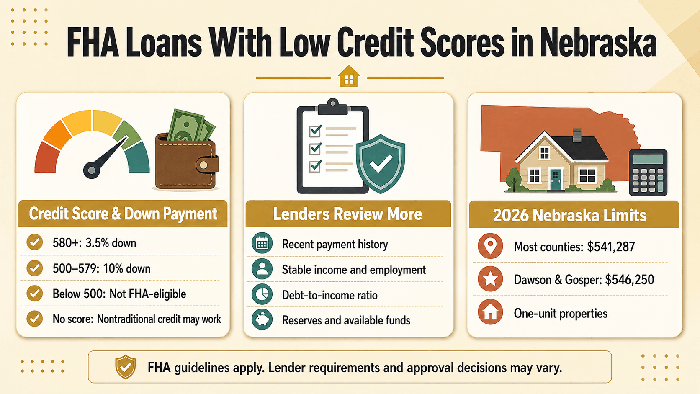 FHA loan limits establish the maximum base loan amount HUD will insure. The limits apply to FHA case numbers assigned from January 1 through December 31, 2026. They vary by the Nebraska county where the property is located and by whether the home has one, two, three, or four units. These limits apply to all eligible borrowers, including buyers seeking FHA loans with low credit scores in Nebraska. A higher county limit does not mean a borrower will automatically qualify for that amount. Income, debts, credit history, down payment, and property value still determine the final loan amount.
One- Through Four-Unit FHA Limits
Most Nebraska counties use the 2026 national low-cost limits:
- One-unit property: $541,287
- Two-unit property: $693,050
- Three-unit property: $837,700
- Four-unit property: $1,041,125
FHA financing may be used for an eligible property with up to four units when the borrower meets HUD’s occupancy requirements. A buyer purchasing a two- to four-unit property must generally occupy one unit as a primary residence.
County-Specific Differences
Most Nebraska counties, including Douglas, Lancaster, Sarpy, Hall, and Scotts Bluff, use the national FHA floor. However, Dawson and Gosper counties have higher limits for 2026:
- One-unit property: $603,750
- Two-unit property: $772,900
- Three-unit property: $934,250
- Four-unit property: $1,161,050
The applicable limit is based on the property’s county, not the borrower’s current residence or the lender’s location. Buyers should confirm the limit using HUD’s FHA Mortgage Limits lookup before making an offer, as limits are updated annually.
How the Maximum Base Loan Amount Is Calculated
For a standard FHA purchase, the maximum base loan amount is generally the lesser of:
- The FHA loan limit for the county and the number of units, or
- The permitted loan-to-value percentage applied to the home’s adjusted value
The adjusted value is generally the lower of the purchase price, after any required adjustments for inducements to purchase, or the appraised property value. For example, if an eligible borrower buys a one-unit Nebraska home for $300,000 and the property appraises for at least that amount, maximum 96.5% financing would produce a base loan amount of $289,500. A borrower with a credit score from 500 to 579 is generally limited to 90% financing, which would result in a maximum base loan amount of $270,000 at the same adjusted value. If the calculated amount exceeds the county limit, the county limit caps the base FHA loan. You can typically finance the upfront mortgage insurance premium along with the base loan amount, but closing costs and other expenses are separate. Final calculations remain subject to the lender’s underwriting and current HUD FHA loan-limit requirements.
FHA Loans With Low Credit Scores in Nebraska—See If You Qualify
A low credit score does not always mean you cannot buy a home. We’ll review your credit, income, debts, down payment, and payment history to confirm your FHA options in Nebraska.Nebraska Down-Payment Assistance Through NIFA
FHA loan limits set the maximum base loan amount available for a home purchase. The limit depends on the Nebraska county where the home is located and the number of units in the property. Before shopping for a home, check HUD’s current FHA Mortgage Limits lookup for the county and property type you are considering. Buyers in Nebraska might get support from an agency called NIFA – short for Nebraska Investment Finance Authority. First-time purchasers who meet requirements can pair its Homebuyer Assistance Program with FHA loans. This aid could cover part of what you pay upfront plus expenses at closing. A secondary loan is involved, capped at five percent of the house cost right now. Rules are set around income levels along with how much a property can cost. Each detail must line up with current guidelines or it won’t work out.
FHA Loans After Bankruptcy, Foreclosure, or Late Payments
Bankruptcy, foreclosure, or past late payments do not always prevent someone from qualifying for an FHA loan. Borrowers seeking FHA loans with low credit scores in Nebraska must satisfy the applicable waiting period and show that the financial problem has been resolved. The lender will also review the borrower’s recent payment history, income, debts, and ability to manage the proposed mortgage payment.
FHA Loans After Chapter 7 Bankruptcy
A borrower may generally qualify for FHA financing once at least two years have passed from the Chapter 7 bankruptcy discharge date. During that period, the borrower should have either reestablished acceptable credit or refrained from taking on new credit obligations. An exception may be possible when at least 12 months—but fewer than two years—have passed since discharge. The borrower must document that the bankruptcy resulted from extenuating circumstances beyond their control, demonstrate responsible financial management, and show that the problem is unlikely to happen again. Approval under an exception is not automatic and generally requires manual underwriting.
FHA Loans During or After Chapter 13 Bankruptcy
A borrower may be considered for an FHA loan while still making Chapter 13 payments. At least 12 months of the repayment period must generally have passed, all required plan payments must have been made on time, and written permission from the bankruptcy court may be required to enter into the mortgage transaction. Borrowers who recently completed a Chapter 13 plan may also qualify, but the lender must determine the correct underwriting method based on the discharge date and the automated underwriting findings. Some lenders impose waiting periods or other requirements beyond FHA’s minimum rules.
FHA Loans After Foreclosure
The standard FHA waiting period after a foreclosure is generally three years. The lender must identify the event’s official completion or property-transfer date and measure the waiting period to the FHA case number assignment date. A shorter waiting period may be allowed if the foreclosure was due to circumstances beyond the borrower’s control and the borrower has since rebuilt their credit. A decline in property value or an inability to sell the previous home generally does not qualify by itself as an extenuating circumstance.
How Recent Late Payments Affect FHA Approval
Recent late payments can matter more than older credit problems, especially when they involve rent, a mortgage, auto loans, or other installment debts. The underwriter will review how late the payments were, how often they occurred, what caused them, and whether the borrower has returned to a stable payment pattern. One late payment does not always cause an FHA denial. However, repeated late payments or recent housing delinquencies may result in a Refer recommendation, manual underwriting, additional documentation, or a requirement to establish a longer record of on-time payments. Borrowers should provide a clear explanation supported by documents when late payments resulted from a temporary hardship, such as an involuntary loss of income or a serious medical event. A letter of explanation alone cannot replace an acceptable recent payment history. FHA waiting periods and credit requirements are governed by HUD Handbook 4000.1. Individual lenders may apply stricter overlays, so borrowers should have their complete credit history reviewed before assuming they are eligible or must continue waiting.
FHA Property and Appraisal Requirements
The home must meet FHA property requirements before the loan can close. The FHA appraisal confirms the home’s value and identifies conditions that could affect its safety, security, soundness, or marketability. Major concerns, such as significant roof damage, exposed electrical hazards, or a nonworking heating system, may need to be addressed before closing. An FHA appraisal is not a full home inspection. Buyers should still consider a separate home inspection to better understand the home’s condition, maintenance needs, and possible repair costs before completing the purchase.
How to Strengthen an FHA Application Before Applying
Before applying, review your credit report for errors, make every payment on time, and avoid taking on new debt. Paying down credit card balances may also help improve your overall credit profile and reduce your monthly debt obligations. Gather recent pay stubs, bank statements, tax documents, and proof of funds for the down payment and closing costs. Stable income, documented assets, and a consistent payment history can help make an FHA application stronger, even when your credit score is lower. FHA lenders review the full financial picture, not the score alone.
FHA Versus Conventional Financing
FHA and conventional mortgages can both finance a primary residence, but they evaluate risk differently. FHA financing may be more suitable for borrowers with lower credit scores, smaller down payments, or past credit problems. Conventional financing may cost less for borrowers with stronger credit, a larger down payment, or enough equity to avoid private mortgage insurance. Borrowers comparing conventional financing with FHA loans with low credit scores in Nebraska should evaluate the complete loan, not only the interest rate or minimum down payment.
Credit Score and Underwriting Differences
FHA regulations allow a 3.5% down payment with a minimum required credit score of 580. Scores from 500 through 579 generally require at least 10% down. FHA also provides a manual underwriting path for certain borrowers who do not receive an automated approval or do not have a traditional credit score. Conventional credit requirements depend on the loan program, underwriting method, and automated findings. In 2026, it is no longer accurate to say that every conventional loan requires a minimum credit score of 620. Fannie Mae does not establish a minimum score for loan case files that receive an eligible Desktop Underwriter assessment. Freddie Mac does not require a minimum Indicator Score for mortgages receiving an Accept risk class from the Loan Product Advisor. However, this does not mean every borrower with a score below 620 will qualify for a conventional loan. Manually underwritten loans, certain loan products, mortgage insurance companies, and individual lenders may have separate minimum-score requirements. The automated underwriting system must still determine that the overall application presents an acceptable risk.
Down Payment and Mortgage Insurance
Some eligible conventional borrowers may purchase a one-unit primary residence with as little as 3% down. FHA requires at least 3.5% down payment for borrowers with scores of 580 or higher and at least 10% down payment for borrowers with scores from 500 to 579. FHA loans generally require an upfront mortgage insurance premium and an annual mortgage insurance premium collected through the monthly payment. For most FHA loans with an original loan-to-value ratio above 90%, annual mortgage insurance premiums continue for the term of the loan. When the original LTV is 90% or lower, annual mortgage insurance generally lasts 11 years. Conventional loans may require private mortgage insurance when the down payment is below 20%. Unlike FHA mortgage insurance, borrower-paid PMI may be canceled once the loan meets applicable balance, payment history, property value, and servicing requirements. Under federal law, eligible borrowers can request cancellation of PMI when their principal balance drops to 80% of the home’s original value.
Which Loan May Be the Better Choice?
FHA financing may be worth considering when a borrower has a lower credit score, needs flexible underwriting, or has a shorter waiting period after certain major credit events. Conventional financing may be more attractive when the borrower has stronger credit, qualifies for favorable risk-based pricing, or wants mortgage insurance that may be removed without refinancing. The lowest advertised rate does not always produce the lowest-cost mortgage. Borrowers should compare the following on the Loan Estimates issued on the same day:
- Interest rate and APR
- Discount points and lender fees
- Down payment and total cash to close
- Upfront and monthly mortgage insurance
- Total monthly payment
- Estimated five-year borrowing cost
The better program depends on the borrower’s complete financial profile, the property, and how long the borrower expects to keep the mortgage. A side-by-side review of FHA and conventional Loan Estimates provides a more reliable comparison than choosing a loan based solely on the rate or credit score requirement.
Nebraska FHA Approval Example
The following example shows how FHA loans with low credit scores in Nebraska may work when a borrower meets HUD’s minimum requirements but does not satisfy another lender’s credit-score overlay. It is for educational purposes only and does not represent an actual borrower or guarantee approval. A Nebraska homebuyer wanted to purchase a one-unit primary residence in Douglas County for $210,000. The borrower had a Minimum Decision Credit Score of 548, stable W-2 employment for more than three years, and a gross monthly income of $6,200. The credit score had fallen due to older medical collections and two late credit card payments from more than 18 months earlier. However, all rent, installment, and revolving payments had been made on time during the most recent 12 months. The first lender required a minimum credit score of 580 and could not approve the application. That requirement was the lender’s overlay—not FHA’s minimum guideline.
How the FHA Loan Was Structured
Because the borrower’s credit score was between 500 and 579, the maximum loan-to-value ratio was 90%. The financing was structured as follows:
- Purchase price: $210,000
- Required 10% down payment: $21,000
- Base FHA loan amount: $189,000
- Verified gross monthly income: $6,200
- Estimated total housing payment: $1,650
- Other recurring monthly debts: $850
- Estimated total debt-to-income ratio: approximately 40%
- Verified reserves after closing: approximately four monthly mortgage payments
The $189,000 base loan amount was well below the 2026 one-unit FHA limit for Douglas County.
Why the File Could Be Approved
The automated underwriting system issued a Refer recommendation, so the loan required manual underwriting. The underwriter reviewed the borrower’s complete financial history rather than relying solely on the 548 credit score. The application was strengthened by stable employment, manageable debt, 12 months of on-time payments, documented funds for the down payment and closing costs, and cash reserves remaining after closing. The borrower also provided a written explanation and supporting documents showing that the earlier credit problems resulted from a temporary hardship that had ended. Before final approval, the lender would still need to verify the borrower’s income, employment, assets, housing history, credit obligations, and source of funds. The property would also need to appraise at an acceptable value and meet FHA requirements. This example shows why a denial from one lender does not always mean the borrower is ineligible for FHA financing. The borrower must still meet HUD guidelines, but a lender that offers manual underwriting and does not impose a higher minimum credit score may reach a different decision after reviewing the complete file.
Final Thoughts on FHA Loans with Low Credit Scores in Nebraska
A low credit score does not automatically end your opportunity to buy a home. FHA loans with low credit scores in Nebraska may be available when you have stable income, manageable debts, an acceptable recent payment history, documented funds, and a property that meets FHA requirements.
FHA permits eligible borrowers with credit scores of 580 or higher to purchase with 3.5% down. Scores from 500 through 579 generally require at least 10% down. Borrowers who don’t get automated approval may still qualify through manual underwriting, based on their complete application and the lender’s criteria.
Before applying, avoid taking on new debt, keep all accounts current, review your credit reports for errors, and gather your income and asset documents. If another lender denied your application because of a credit score overlay, consider getting a second opinion from a lender experienced in lower-credit FHA loans and manual underwriting. Contact Gustan Cho Associates to have your credit, income, debts, down-payment funds, and recent payment history reviewed. A mortgage professional can explain which FHA guidelines apply to your situation and help you understand the next steps toward buying a home in Nebraska.
Frequently Asked Questions About FHA Loans in Nebraska
Do I Have To Be A First-Time Homebuyer To Qualify For An Fha Loan In Nebraska?
No. First-time and repeat buyers may qualify for FHA loans with low credit scores in Nebraska. The home generally must be your primary residence, and you must meet the lender’s credit, income, and underwriting requirements. Down-payment assistance programs may have separate first-time-buyer rules.
Do FHA Loans in Nebraska have Income Limits?
Standard FHA loans generally do not have maximum income limits. However, you must document enough stable income to afford the mortgage and other debts. Nebraska assistance programs, including certain NIFA options, may impose household income and purchase price limits.
Can the Seller Pay My FHA Closing Costs?
Yes. A seller or interested individual may contribute as much as 6% of the sale price toward eligible closing costs, prepaid expenses, and discount points. This contribution cannot exceed your actual eligible costs or cover your required down payment.
Can a Co-Signer Help Me Qualify for an FHA Loan with Bad Credit?
FHA permits eligible non-occupying co-borrowers and co-signers in certain transactions. The lender will review that person’s credit, income, debts, and federal-debt status, and the co-borrower becomes legally responsible for the mortgage. The relationship between the borrowers and the property type may affect the available loan-to-value ratio.
Can I Use an FHA Loan to Buy a Manufactured Home in Nebraska?
Potentially. FHA offers financing for qualifying manufactured homes, but the home must meet HUD construction, installation, foundation, occupancy, title, and property requirements. Lender requirements may also be stricter for manufactured-home financing.
Can an FHA Loan Finance a Nebraska Fixer-Upper?
Yes. An FHA 203(k) loan can combine the home’s purchase price and eligible renovation expenses into one mortgage. The property, proposed repairs, contractor documentation, appraisal, and completed value must satisfy program requirements. Not every FHA lender offers 203(k) financing.
Do Student Loans with a $0 Payment Affect FHA Qualification?
Usually, FHA underwriting requires the lender to include student loan debt when calculating your debt-to-income ratio, even if the credit report shows a $0 monthly payment. When no payment is reported, the lender may need to use a percentage of the outstanding balance under current FHA rules. Income-driven repayment documents can help the lender determine the correct qualifying payment.
This article about “FHA Loans With Low Credit Scores in Nebraska” was updated on August 12th, 2026.