Final Mortgage Underwriter Approval Before Clear to Close: What Borrowers Must Know
This guide covers final mortgage underwriter approval prior to clear to close. The mortgage process is a true process that takes time. Delia Jones, a dually licensed mortgage loan originator and real estate agent of Gustan Cho Associates says the following about final mortgage underwriter approval before a clear to close:
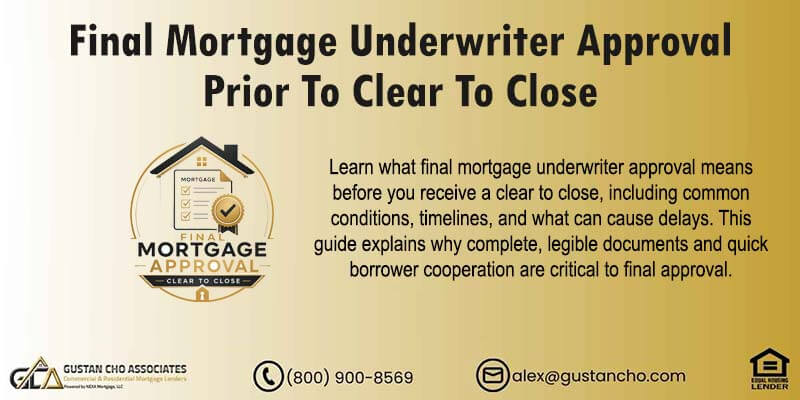
Final Mortgage Underwriter Approval is explained before Clear to Close. Learn conditions, timelines, and what can delay your loan approval.
It is important that all documents are legible and complete, with no missing pages. The mortgage process requires teamwork. Borrowers must fully cooperate on documents and paperwork requested by the mortgage processor. In the following paragraphs, we will cover final mortgage underwriter approval prior to clear to close.
Final Mortgage Underwriter Approval Process Explained
A mortgage processor is assigned to the file once the borrower turns in the real estate purchase contract. The mortgage processor is the quarterback of the whole process and everything overseas from when she is assigned to the clear to close.
Final Mortgage Underwriter Approval is explained before Clear to Close. Learn conditions, timelines, and what can delay your loan approval.
A great processor will be nit-picky and very detailed. If the mortgage processor asks for detailed information, please understand she is on your side, and it is better to deal with her than the mortgage underwriter.
The Start Of The Mortgage Process Leading To The Final Mortgage Underwriter Approval

The loan application and qualifying process starts with the loan officer qualifying borrowers.
Once pre-approved, the loan officer will issue the pre-approval letter. Armed with a pre-approval letter, home buyers can enter into a real estate purchase contract. Once the contract is submitted to the loan officer, the official mortgage process starts.
Steps Before Clear to Close on a Mortgage
Mortgage loan conditions, such as updated bank statements, updated paycheck stubs, and other updated docs, may be minor. After getting the final mortgage underwriter approval, the next step is clear to close.
Getting the Final Mortgage Underwriter Approval is the goal in the mortgage process. The Final Mortgage Underwriter Approval will come with conditions.
Mortgage Underwriters are the ones who issue a clear to close. A clear to-close means the lender is ready to prepare the closing docs and fund the loan. Things can go wrong after getting the Final Mortgage Underwriter Approval.
What Is Final Mortgage Underwriter Approval?
Final Mortgage Underwriter Approval represents the final major step before a loan is cleared to close. At this stage, the underwriter reviews all updated documentation, verifies that all conditions are satisfied, and confirms compliance with agency and lender requirements. For borrowers, this stage marks the transition from conditional to full approval, contingent upon successful completion of final quality checks.
Final Underwriter Approval Before Clear to Close—Know What Comes Next
You’re close, but the final review can still trigger last-minute conditions. Get a clear checklist of what underwriters verify next—and how to avoid delays before your Clear to CloseWhy Final Mortgage Underwriter Approval Matters
The Last Check Before Closing
Final Mortgage Underwriter Approval ensures that no significant changes have occurred since initial approval. Lenders verify that income, credit, employment, and assets remain stable.
Protects the Lender and Borrower
This step not only ensures regulatory compliance but also protects borrowers from potential post-closing issues. It promotes accuracy and minimizes the risk of unexpected complications.
Conditional Approval vs Final Mortgage Underwriter Approval
What Is Conditional Approval?
- Conditional approval indicates that the loan is preliminarily approved, pending fulfillment of specific requirements, typically involving the provision of additional documentation or clarifications.
What Changes With Final Approval?
Final Mortgage Underwriter Approval means:
- All underwriting conditions are satisfied.
- The file meets all mortgage guidelines.
- The loan is ready for Clear to Close.
This stage constitutes a critical component of the overall mortgage process.
Common Conditions Cleared Before Final Approval
Income and Employment Verification
Lenders typically re-verify employment, often immediately prior to closing. Employment changes at this stage may delay or result in the denial of approval. Additionally, large deposits may require a detailed explanation.
Credit Review
Lenders may refresh the credit report to identify new debts or missed payments. Acquiring new debt or missing payments can jeopardize approval. All condition requirements must be met, and the property title must be free of legal encumbrances.
What Happens During Final Mortgage Underwriter Approval
File Re-Review by Underwriter
- The underwriter conducts a comprehensive review of the loan file to confirm that no material changes have occurred since conditional approval.
Final Quality Control Checks
- Many lenders conduct internal quality control checks to verify that the loan complies with FHA, VA, USDA, or Conventional program guidelines.
Verification of No Material Changes
This includes:
- No new credit accounts
- No major bank withdrawals
- No employment changes
Even minor changes can result in processing delays.
How Long Does Final Mortgage Underwriter Approval Take?
Typical Timeline in 2026
Most final approvals are completed within 24 to 72 hours, depending on the lender’s workload and the complexity of the loan file.
Factors That Affect Timing
- Missing documents
- Last-minute conditions
- Appraisal or title delays
- Loan type (FHA, VA, Conventional, Non-QM)
If all required documentation is submitted promptly and accurately, the approval process is typically expedited.
What Happens After Final Mortgage Underwriter Approval?
Clear to Close Issued
Upon receipt of final approval, the lender issues a Clear to Close, indicating that the loan is ready for closing.
Closing Disclosure Preparation
The Closing Disclosure is provided to borrowers at least three business days prior to the scheduled closing date.
Loan Funding and Closing
After all documents are signed, the loan is funded and the purchase transaction is finalized.
What Can Go Wrong Before Clear to Close?

New Debt or Credit Changes
- Opening new credit accounts or financing major purchases may jeopardize loan approval.
Employment Changes
- Employment changes, even those resulting in higher compensation, can delay or even lead to loan denial.
- Unexplained deposits or withdrawals may prompt additional scrutiny from the lender.
Concerns For The Lender
- A single late payment may trigger a lender’s re-evaluation of the loan file.
- Review your file again.
The Loan Estimate Versus The Closing Disclosure
A Loan Estimate or LE is the initial disclosure borrowers receive with tentative closing costs. Loan Estimates will normally have inflated closing costs. This is because lenders do not know the exact closing costs. Rates are normally not locked so that loan officers may disclose a higher rate.
The Loan Estimate Clear to Close Mortgage Process Timeline
The reason why Loan Estimates have been overly disclosed is that lenders want to make sure of the worst-case scenario. Underwriters want to qualify borrowers with higher fees and costs. If borrowers get qualified with higher closing costs estimates and the fees/costs turn out lower, they are still qualified.
The Closing Disclosure
If borrowers get qualified with lower costs/fees, which are higher, they may no longer qualify. This is the main reason closing costs are overly disclosed on the Loan Estimate. The Closing Disclosure has the final numbers stated on the form. Closing Disclosures are not issued unless the mortgage rate is locked. The cash-to-close on the final closing disclosure is the number borrowers must bring to the closing table.
When Is The Final Mortgage Underwriter Approval Issued
The initial mortgage loan approval will be conditional approval by the underwriter. The conditional loan approval has a long list of conditions such as appraisal, verification of employment, IRS 4506T Income Verification, and many others. After conditions get turned in, mortgage underwriters will issue updated conditional approvals.
Final Mortgage Underwriter Approval Explained Before Clear to Close
After two or three steps, the final mortgage underwriter approval will be issued with final conditions for a clear to close. Getting the final mortgage underwriter approval means a lot. The borrower is very close to the finish line. The clear to close is the finish line of the mortgage progress. The mortgage underwriter issues the clear to close after she has cleared all conditions of the conditional loan approval.
Ready for Clear to Close? Let’s Finish Strong
Send your scenario or start your application. We’ll guide you through final underwriting approval and help you reach Clear to Close without surprisesSteps To Clear To Close And Home Loan Closing
There are steps left after the Mortgage Underwriter Approval before closing. The lender will conduct a final review before the mortgage underwriting issues a clear to close. Documents will be double-checked. Older docs will need updated docs required. A final soft credit report will be pulled. Some lenders have QC reviews before clear to close—final verbal verification of employment.
Mortgage Underwriting Final Approval Checklist
Mortgage Rate needs to be locked. A clear to close will be issued once the mortgage underwriter gets updated docs. Once a clear to close is issued, the file gets assigned to the closing department.. Final Closing Disclosure will state the cash-to-close. Clear to close means the lender is ready to prepare final closing documents and send them to the title company. Clear to close means that the lender is ready to fund the loan.
Scheduling The Home Closing
The title company is in charge of arranging the closing date. The title agent will notify both buyers and sellers of the time and location of the closing. The title agent quarterbacks the closing with the lender, buyers, and sellers.
Tips To Ensure Smooth Final Mortgage Underwriter Approval
Keep Your Finances Stable
- Avoid making significant financial changes until the loan has officially closed.
Respond Quickly to Lender Requests
- Delays frequently result from failure to submit required documentation on time.
Do Not Purchase High Ticket Items
- Refrain from financing large purchases such as furniture, vehicles, or other high-value items.
Communication
- Maintain regular communication with the loan officer to facilitate a smooth approval process.
Final Mortgage Underwriter Approval for Different Loan Types
FHA Loans
- FHA loans may require additional documentation, particularly for manual underwriting or recent credit changes.
VA Loans
- VA loans typically require documentation of entitlement and sufficient residual income.
Conventional Loans
- Conventional loans emphasize credit score, debt-to-income ratio, and loan-to-value ratio.
- QM loans may require extensive verification of assets or income, especially for self-employed borrowers.
Final Thoughts
Final Mortgage Underwriter Approval is the final step before being cleared to close. Maintaining financial stability and responding promptly to lender requests are essential. Understanding these requirements can reduce stress and smooth path to homeownership
When Does Ownership Change From Home Seller To Buyer
Lenders send closing docs to the title company about a day or two before closing. The title agent sets the final numbers. After reviewing all numbers and the final closing disclosure, the lender will wire funds. After the loan funds, the buyers receive the keys to their new home purchase. Sellers receive proceeds from the sale.
Frequently Asked Questions Final Mortgage Underwriter Approval Prior To Clear To Close
How Long After Final Mortgage Underwriter Approval Is Clear To Close?
In most cases, Clear to Close is issued within 24 to 48 hours of Final Mortgage Underwriter Approval, depending on the lender’s processing times.
Can A Loan Be Denied After Final Mortgage Underwriter Approval?
Yes, although rare. If there are major changes, such as job loss, new debt, or credit issues, a loan can still be denied before Clear to Close.
What Is The Difference Between Clear to Close and Final Approval?
Final Mortgage Underwriter Approval means the underwriter has approved the loan. Clear to Close means the lender is ready to schedule closing and fund the loan.
Do Lenders Check Employment After Final Approval?
Yes. Many lenders conduct a final verbal employment verification right before closing.
Can I Make Purchases After Final Mortgage Underwriter Approval?
It is strongly recommended that you not make any large purchases or open new credit accounts until after closing.
Avoid Last-Minute Red Flags Before Final Approval
Final underwriting may re-verify employment, assets, and credit. Get a quick “safe to close” checklist so you don’t accidentally delay your closing