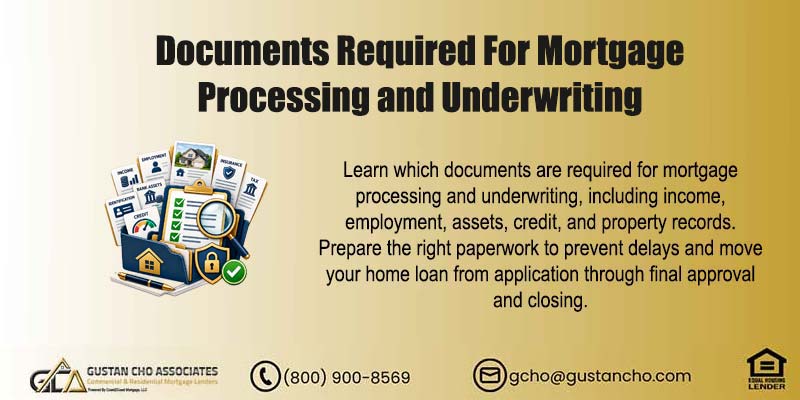
Quick Answer: Documents Required for Mortgage Processing and Underwriting
To avoid delays and get to closing on time, submit a complete, legible, all-pages-included document package before your loan file goes to underwriting. Most borrowers will need photo ID, proof of income and employment, 60 days of asset statements, debt details, and property paperwork (a purchase contract or a current mortgage statement). If you’re self-employed, using gift funds, or have recent credit events (bankruptcy/foreclosure/divorce), expect extra documentation and clear paper trails.
What You’ll Learn
- The difference between mortgage processing vs. underwriting (and what happens first)
- The core documents almost every borrower needs (ID, income, assets, debts, property)
- The most common missing items that trigger underwriting conditions (and how to avoid them)
- Extra documentation for self-employed/1099, gift funds, rental income, and divorce situations
- How to submit documents the right way (file naming, all pages, timelines, and update rules)
- A simple strategy to close faster by getting “underwriter-ready” before submission
What Comes First: Underwriting or Processing?
Processing vs. Underwriting (simple explanation)
- Processing = collecting, labeling, and verifying your paperwork (income, assets, property, credit items).
- Underwriting = the risk decision: the underwriter checks whether the documents prove you meet the loan guidelines and whether the property supports the loan amount.
A file usually moves faster when it’s complete before underwriting—including every page, even blank ones, because lenders must show the statement is unaltered.
Processing and Underwriting Mortgage Process
The processing and underwriting stages are the two main steps your mortgage loan application will go through to be evaluated by the lender. Processing comes first and involves collecting and organizing all the necessary documents and information from you, such as proof of income, employment history, asset statements, credit reports, and property details.
The loan processor will check that all the information is correct and meets the lender’s requirements. They may also contact third parties, such as appraisers and title companies, for additional information.
Once the processing stage is complete and all the required documents are in order, the loan file is submitted to the underwriter. The underwriter evaluates your creditworthiness and the risk associated with the loan. During the review process of your loan application, various factors such as your financial information, credit history, property appraisal, and other relevant information will be considered to determine whether your application can be approved.
In summary, processing is the first step in the mortgage loan process, where the lender collects and verifies all the necessary documents and information. Discover the essential documents required for mortgage processing and underwriting in 2025.
Our complete checklist covers income proof, asset statements, and more to help you navigate home loan approval smoothly and avoid common delays.
What are the Underwriting Requirements for a Mortgage?
Mortgage underwriting encompasses several key requirements that borrowers must meet to secure a loan. One critical aspect is the credit score, with different loan types having varying minimum score thresholds. Income verification is essential, typically requiring documentation such as pay stubs, tax returns, and W-2 forms.
At the same time, self-employed individuals may need additional proof of income. Lenders also verify employment status to ensure stability and the capacity to repay the loan.
The debt-to-income (DTI) ratio is another crucial factor when comparing monthly debt payments to gross income; each loan program has its DTI limits. Additionally, borrowers must demonstrate sufficient assets for the down payment, closing costs, and reserves as per lender specifications. Property appraisal ensures the property’s value aligns with the loan amount and lending guidelines.
What are the 4 C’s Required for Mortgage Underwriting?
The “4 C’s” are fundamental pillars in mortgage underwriting, guiding lenders in assessing a borrower’s creditworthiness and suitability for a mortgage.
- First is “Credit,” examining the borrower’s credit history, payment patterns, outstanding debts, and credit score.
- A strong credit profile with timely payments and a good score indicates a lower risk for lenders.
- Next is “Capacity,” which evaluates the borrower’s ability to repay the mortgage, considering their income, employment stability, and debt-to-income ratio (DTI).
- A stable income and manageable DTI are favorable indicators for loan approval.
- The third C, “Collateral,” focuses on the purchased property, ensuring its value aligns with the loan amount and serves as adequate security.
- Property condition, location, and market value are assessed through a property appraisal.
- Finally, “Capital” evaluates the borrower’s financial reserves and assets, including savings, investments, and down payment funds.
- Having sufficient capital demonstrates financial stability and reduces lender risk.
By considering these 4 C’s comprehensively, lenders can make informed decisions about loan approvals and terms. At the same time, borrowers can understand the key factors influencing their mortgage eligibility.
Importance of Documents Required For Mortgage Processing and Underwriting
As mentioned, in order for the mortgage process to run smooth and get to the closing table on time is to have complete documents required for mortgage. Every borrower’s file is unique and different.
Not everyone will need the exact documents. However, there are basic documents required for mortgage processing on all files.
Depending on the individual borrower, additional documents required for mortgage processing will be required. Borrowers with bankruptcy, foreclosure, short sale, judgments, divorce will need this paperwork.
Master Checklist: Documents Required for Mortgage Processing
Identification
- Government-issued photo ID (unexpired)
- SSN card or SSA-89 (if lender requests) / ITIN documentation (if applicable)
Income (W-2 borrowers)
- Most recent 30-day pay stubs
- Last 2 years W-2s
- If used: bonus/overtime/commission history (often 2 years)
Assets (down payment + closing + reserves)
- Last 60 days bank statements (all pages) for accounts used
- Retirement/investment statements, if funds/reserves will be counted
Housing history (if relevant)
- Lease agreement and proof of on-time rent (when required by program/underwriter)
Debts
- Explanation/statement paperwork if a debt isn’t showing correctly (deferred student loans, disputes, etc.)
Property (purchase vs refinance)
- Purchase: fully executed contract + addenda, EMD proof, title/agent contact info
- Refinance: current mortgage statement, insurance declarations page, property tax info (if requested)
Add-on Documents (only if they apply)
Gift funds
- Signed gift letter + donor ability evidence + transfer/receipt paper trail
Self-employed / 1099 / rental income
- Last 2 years personal + business returns (all schedules)
- YTD profit & loss (and sometimes balance sheet)
- K-1s if applicable
Divorce/child support/alimony
- Divorce decree/court order + proof of receipt (commonly 12 months) if using as income
Bankruptcy/foreclosure
- Discharge papers and/or recorded documents as requested
- Letter of explanation for the event + re-established credit (if needed)
Want a Fast Mortgage Approval? It Starts With the Right Paperwork
We’ll walk you through every document you need—step-by-step. Talk to a Loan Officer and Get Your Personalized Checklist
ID Verification Documents Required For Mortgage
All lenders will need the identification of borrowers. Lenders can only accept certain documents to validate the ID Verification Requirements. Here are the acceptable forms of ID Verification:
- Valid Driver’s License issued by a state that is not expired
- Military Identification
- Valid U.S. Passport
- Social Security Card – If you are missing your social security card, your loan officer will be able to send you an SSA-89 form
- This form verifies the name and social security number with the Social Security Administration’s records
- Green Card issued by U.S. INS
- ITIN
- VISA
Property Information Documents on Purchase and Refinance
Refinance Transactions
- Recent Mortgage Statement
- Mortgage Note and closing documents
- Copy of insurance contact information, declaration page, and phone number of insurance agent/company
- Recent Utility Bill under borrowers name with both the service and mailing address
Purchase Transactions
- Copy of the signed real estate sales contract including all riders, buyers and sellers agents, and title company information
- Copy of earnest money check and verification of the deposit placed on the home
Income
- Copies of recent pay stubs for the most recent 30-day period
- Copies of w-2 forms for the past two years from employer
- Names and address for all employers in the last two years
- Most recent two years federal income tax returns if applicable
Self Employed or 1099 Wage Earners
Borrowers Who Are Self Employed Borrowers or are Commission or Rental Income or Royalty Wage Earners the following apply: Complete income tax returns for the last two years. Need to complete tax returns that are signed. Provide and include all attached schedules and statements.
Year to date profit and loss statement and balance sheet. K-1’s for all partnerships. S-Corporations for the last two years and most K-1’s are not attached to 1040s.
Completed and signed Federal Partnership (1065). Or Corporate Income Tax Returns (1120) including all schedules, statements, and addenda for the prior two years. This is required only if your ownership position is 25% or greater.
Child Support and Alimony Wage Earners
Child Support or Alimony Income can be used as qualified income as long as the continuation of income will be likely for the next three years: Provide divorce decree/court order. Divorce decree needs to state the award amount. Need to provide documentation of receiving child support and/or alimony for the past 12 months.
Social Security and Pension Income
Social Security or Pension Income can be used as qualified income. NON-Taxable income can be grossed up 15% to 25% depending on the loan program: Provide social security awards letter or pension awards letter
Documents Required For Mortgage on Asset Documentation For Down Payment and Closing Costs
If the sale of an existing home is applicable, need to provide closing docs. If the property is listed but not sold, need to provide listing agreement. Provide settlement statement if sold.
Savings, checking or money market funds or all asset accounts with funds that will be used for closing needs to be provided. 60 days of bank statements or printouts.
Stocks and bonds statements if borrowers are going to need asset information of qualified funds. Gift funds by donor need to have donor sign gift letter and 30 days of donor’s bank statements. Lenders will provide a gift letter. Know mortgage processing and underwriting requirements in 2025? Our checklist includes proof of income, asset statements, and more to help you navigate loan approvals while avoiding delays at every step with the industry’s practices.
Documents Required For Mortgage Processing and Underwriting
Taking out a mortgage is a major step in achieving your goal of owning a house. However, the entire mortgage application process and the documentation that needs to accompany the application can become quite daunting. You can be a first-time home buyer or refinancing an existing loan.
In any case, knowing the documents needed for mortgage processing and underwriting is created to ensure your seamless experience. These documents help lenders ascertain your financial position, income, and credit history to provide you with a loan.
This article will explain how to compile information and provide you with enough knowledge regarding the documents needed for the mortgage application. Each step will be coupled with the requirements of initial processing and with an advanced level of underwriting. Doing this will help you manage those funds. You will expedite approved legislation and provisions for your desired framework, promoting the intended positivity in the landscape.
Mortgage Processing, the First of Many
The mortgage processing process involves your lender first examining your application and collecting and processing the basic financial information needed. In this case, the process is mainly aimed at properly gathering and filing the primary documents for mortgage approval to ensure you are eligible for underwriting.
Steps Involved In the Mortgage Process
As soon as you make the application, a loan processor contacts you regarding documentation. Anticipate simple requests regarding identification and finances. The process takes a week or two, but the fewer documents a mortgage has, the more time it takes. Pro tip: Scan every document in digital form and arrange it in folders for easy and quick submission.
Why Processed Documents Are Crucial For The Loan Timeline
In the beginning, documents are used mostly to set the groundwork for the rest of the process. These documents are crucial to creating a Loan Estimate, which lists the predicted costs and terms. Absent items can set the closing date over a week later than the original date.
The Mortgage Underwriting Process: A More Detailed Look
- The core of the mortgage journey is the underwriter.
- In this stage, the underwriter assesses risk by evaluating the applicant’s finances.
- More detailed underwriting documents for mortgage loans are typically needed in this stage.
- The differences between processing documents and underwriting them.
- Borrowers often tend to confuse the two bodies of work for the same thing.
- The difference here is that processing involves gathering the required materials, as underwriting is more complex and involves checking with the credit provider and appraisals.
- About two weeks or more are needed to complete the process.
- This stage highlights the importance of maintaining the applicable mortgage underwriting requirements.
How Underwriting Impacts Your Approval Odds
Underwriting can assess documents in depth and offer conditional approvals quickly for what appear to be well-organized submissions. On the contrary, a mismatch of documents, like unreported debts, may signal a request for clarification, resulting in stagnation.
Essential Documents for Mortgage Processing: Your Starting Checklist
Suitably fill out the application to commence the mortgage process efficiently using these core documents needed for mortgage processing.
Identification and Personal Information Documents
To start, build the case to prove who you are with the following documents:
- Emergency ID, Bank Identification Card, and other valid documents.
- Social Security Number (SSN) and Individual Taxpayer Identification Number (ITIN).
- Photocopy of a valid utility bill and/or a signed rental lease agreement to establish a current address.
- These documents are needed to comply with federal laws and manage fraud risks.
Affirmation of Income for Mortgage Applications
Provide stable and verifiable copies of the documents below and an adequate answer to the request of the bank:
- Pay stubs for the last 30 days, or 2 months for some firms.
- Current W-2 for the past 2 years.
- 1099 forms (if you are a contractor or freelance worker).
- Additionally, some banks or other financial institutions may request direct deposit slips for freelancers or gig workers.
Employment Record and Verification Evidence
Show stability in the job with:
- Details for current and past employers (last 2 years).
- Employment verification letter (if applicable).
- Your most recent transcripts, if applicable.
- Self-employed applicants may need to provide a business license for this section.
Liability Document: Proving Your Reservable Funds
Documented proof for down payment and reserve funds.
- Bank statements for checking and saving accounts (last 2-3 months, all pages).
- Statements for the last quarter for all retirement accounts (401k, IRA, etc.).
- If applicable, please include bonds and/or certificates of deposit.
Credit and Debt Document
While lenders pull your credit report, you can provide:
- Evidence supports the rental payment length (lease copy plus 12 months of canceled checks).
- Divorce decree/court order in case of Alimony/Child support, which are deducted from the income.
- This helps effortlessly determine the debt-to-income ratio.
Extra Documents for Advanced Underwriting: More Than What is Required
The second stage of approval, processing, is more straightforward. Underwriting, however, requires more in-depth and sensitive information. The mortgage underwriting documents provided here aim to resolve major issues and unique circumstances.
Thorough Tax Returns and Financial Statements
Some things are unchangeable:
- Federal taxes Form 1040 for two years and the rest of the required schedules.
- For self-employed people and owners of the business: Profit and loss statements for the previous twelve to twenty-four months and business tax returns.
- People on Social Security benefits have to provide an award letter as well.
Documentation for Gift Funds and Property
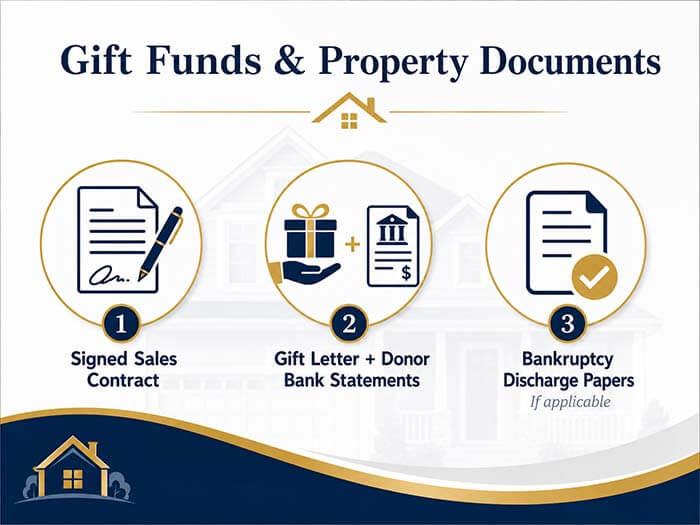
Purchase loan information:
- The sales contract has a signature from your real estate agent.
- A gift letter from the donor, along with the donor’s bank statements, stating that it’s a gift and repayment is not required.
- If your bankruptcy is over, send discharge papers.
Additional Underwriting Documentation
Make your set of documents for additional circumstances:
- For income from renting: Lease contracts and tax returns for two years with depreciation.
- Student loans: Deferment letters.
- Co-borrowers: For each of them, all of the documents above.
Underwriters check all the other documents to provide a full risk evaluation.
Most Common Underwriting Conditions (And How to Clear Them Fast)
Even a strong borrower can get a conditional approval. “Conditions” are the underwriter’s follow-up requests to confirm that income, assets, debts, and the property meet guidelines. The fastest closings happen when you anticipate these items and submit them before underwriting asks.
1) Updated Pay Stubs or Verification of Employment (VOE)
- Why it happens: Underwriters need the most current proof that you’re still employed and earning what was stated.
- How to clear it: Upload your most recent pay stub(s) and respond promptly if the lender requests a verbal or written VOE.
2) Bank Statements Missing Pages or “Large Deposit” Explanations
- Why it happens: Missing pages look like altered statements; large deposits must be sourced.
- How to clear it: Provide all pages (including blanks). For large deposits, provide a paper trail (deposit slip, check copy, bill of sale, payroll documentation, transfer documentation, etc.).
3) Gift Funds Documentation and Transfer Paper Trail
- Why it happens: Underwriters must confirm it’s a true gift and the donor has the ability.
- How to clear it: Provide a signed gift letter, donor statement(s), and documentation showing the transfer into your account (wire receipt/canceled check + your updated statement).
4) Letters of Explanation (LOE) for Credit Events or “Red Flags”
- Why it happens: Recent late payments, collections, credit disputes, inquiries, job gaps, address changes, or prior bankruptcy/foreclosure often require context.
How to clear it: Write a short LOE that states what happened, when, why, and what changed. Include supporting documents when possible.
5) Student Loans, Child Support/Alimony, or Undisclosed Debts Affecting DTI
- Why it happens: Underwriters must calculate accurate debt-to-income (DTI) using the required rules.
- How to clear it: Provide current statements, deferment/repayment terms, court orders (if applicable), and proof of payment when requested.
6) Self-Employed Income: P&L, Business Returns, or K-1s
- Why it happens: Business income can fluctuate, so underwriters validate stability and trending.
- How to clear it: Submit complete tax returns (all schedules), K-1s, and a current year-to-date P&L (and sometimes balance sheet).
7) Appraisal Conditions (Repairs, Safety Items, or Value Questions)
- Why it happens: The property must meet program standards and support the loan amount.
- How to clear it: Complete required repairs, provide re-inspection receipts, and respond quickly if the underwriter requests comps or appraisal clarifications.
8) Title and Insurance Conditions
- Why it happens: Lenders must confirm a clear title and proper coverage (homeowners/flood if required).
- How to clear it: Provide your insurance declarations page, agent contact info, and resolve any title issues promptly through the title company.
- Pro Tip: The #1 way to reduce conditions is to submit a complete package upfront—clean PDFs, all pages, clear labels, and no missing signatures.
Tighten your credit file before underwriting
Explain inquiries, disputes, or past issues with clear Letters of Explanation
How to Submit Your Organized Mortgage Documents
To help you with the effective submission of your documents, use the following optimization strategies:
- Use a secure portal or application from your lender for your document uploads.
- Ensure you properly identify each document (for example, “Pay Stubs_Jan-Feb 2025.pdf”).
- Keeping the originals and providing certified copies when necessary is better.
- If your financial situation changes after submission, you must update the documents.
- A well-organized mortgage document checklist can help reduce the days needed for permit processing.
Common Mistakes to Avoid When Preparing Mortgage Documents
Avoid mistakes that may impact an approval:
- Do not file completed tax returns (provide all schedules).
- Not signing gift letters.
- Providing bank statements that are months old instead of the most recent.
- I do not understand self-employment, such as not separating personal from business expenses.
- Check for mistakes to mitigate the risk of rejection by the lender.
Mortgage Approval Timeline: From Documents to Closing
You can expect:
- Processing: Up to 14 days for document collection.
- Underwriting: Up to 21 days.
- Total: 30-45 days, provided there are no delays.
If there are no delays, promptly providing the documents will be most beneficial.
FAQ: Documents Required For Mortgage Processing and Underwriting
What Documents do Mortgage Underwriters Ask for?
Most underwriters ask for photo ID, proof of income (pay stubs, W-2s, tax returns), asset statements (bank/investment), debt details, and property documents (purchase contract or mortgage statement).
How Many Months of Bank Statements do You Need for a Mortgage?
Many lenders typically request the most recent 2 months (about 60 days) of bank statements—and they often require all pages, even blank ones, to show the statements are complete.
Do I Need to Provide Tax Returns to Get Approved for a Mortgage?
Sometimes. Many borrowers provide W-2s/pay stubs, but tax returns may be required depending on your loan type, income type (self-employed, commission, rental), or if the lender needs more documentation to verify income.
What Does the Underwriter Verify During Underwriting?
Underwriters review credit, income/employment, assets, and the property (including appraisal and title/insurance basics) to confirm the loan meets program and lender requirements.
What are “Underwriting Conditions” on a Mortgage?
Conditions are follow-up document requests after the underwriter’s initial review—commonly updated pay stubs, missing statement pages, sourcing large deposits, gift fund paper trails, or letters of explanation for credit/income gaps.
What Causes a Mortgage File to Get Delayed in Underwriting?
The biggest delays usually come from missing pages, unverified deposits, incomplete tax returns/schedules, slow third parties (appraisal/title/VOE), or late responses to conditions.
Can I Use Gift Money for My Down Payment—and What Documents are Required?
Often yes, but you’ll typically need a signed gift letter and a clear paper trail showing the donor had the funds and how the money moved to you (wire/check/transfer + updated statements).
What Documents do Self-Employed Borrowers Need for Mortgage Underwriting?
Self-employed borrowers often need two years of personal and (if applicable) business tax returns, a year-to-date profit and loss statement, and sometimes other business financials, depending on the loan and income complexity.
Do I Need Proof of Rent Payments to Qualify for a Mortgage?
Sometimes. Certain situations (limited credit history, specific loan programs, or manual underwriting) may require verification of rent, such as a lease plus proof of on-time payments.
How Long Does Mortgage Underwriting Take if My Documents are Complete?
It varies by lender volume and loan complexity, but underwriting can move much faster when your documentation is complete and promptly updated when requested.
Debt-To-Income Ratio Calculations
Mortgage underwriters need borrowers’ liability information to calculate DTI. This includes student loans, child support, alimony and all debt information. All minimum monthly debt reporting on the credit report will be counted. Public records such as judgments and tax-liens not reporting on the credit report will be discovered. Gustan Cho Associates offers government and conventional loans with no overlays. Contact us at 800-900-8569 or email us at gcho@gustancho.com .
Avoid delays and close faster. See What Paperwork You Need for a Smooth Mortgage Process
This article about “Documents Required For Mortgage Processing and Underwriting” was updated on March 4th, 2026.
Be Prepared for Underwriting—Start With the Right Docs
From pay stubs to tax returns—we’ll explain what and why. Get a Clear Guide to Mortgage Document Requirements