In this guide, we will cover mortgage guidelines after bankruptcy. Mortgage guidelines after bankruptcy do not categorically prevent homeownership. Eligibility depends on the type of bankruptcy, discharge or dismissal date, recent payment history, prior foreclosure, and the chosen mortgage program.
Getting a mortgage after bankruptcy depends on the type of bankruptcy, loan option, credit, and lender overlays. Mortgage guidelines after bankruptcy vary among FHA, VA, USDA, conventional, and non-QM loans.
Some applicants must observe waiting periods, while others may qualify during active Chapter 13 repayment. Mortgage eligibility depends on agency rules, underwriting method, lender criteria, applicant income, debts, assets, and property characteristics. This guide explains the waiting periods for FHA, VA, USDA, conventional, and non-QM loans after Chapter 7 or Chapter 13 bankruptcy. In the following paragraphs, we will cover mortgage guidelines after bankruptcy on home purchase.
Mortgage Approval After Bankruptcy is Not Guaranteed
In some cases, it is possible to get a mortgage after bankruptcy. FHA or VA financing may be available two years after a Chapter 7 discharge, while conventional loans usually require a four-year waiting period after discharge or dismissal. Some government-backed loans may be available during an active Chapter 13 if at least 12 months of payments have been made and court or trustee approval obtained. USDA and non-QM loans have distinct waiting periods, with eligibility based on individual circumstances rather than just the bankruptcy date.
Mortgage Guidelines After Bankruptcy on Home Purchase Transactions
Five Issues Tend to Govern a Borrower’s Eligibility:
- Which chapter was filed: Chapter 7, 11, or 13?
- Was the case discharged, dismissed, or is it still active?
- Which of the FHA, VA, USDA, conventional, or non-QM guidelines governs?
- Was a mortgage or foreclosure included in the bankruptcy?
- What is the borrower’s credit, income, debts, reserves, and payment history?
- Even if agency bankruptcy guidelines are met, lenders may deny applications based on their own criteria.
- A loan officer should review credit and bankruptcy history thoroughly before issuing formal preapproval.
How Soon Can You Get a Mortgage After Bankruptcy?
There is not always a set waiting period for getting a mortgage after bankruptcy.
Mortgage After Chapter 7 Bankruptcy
Typically, Chapter 7 bankruptcy allows the discharge of qualifying debts after nonexempt assets are administered.
The Common Mortgage Waiting Periods Associated with Chapter 7 Include:
- FHA: usually 2 years after discharge
- VA: usually 2 years after discharge
- USDA: usually 36 months, but may vary with the Guaranteed Underwriting System and credit exceptions
- Conventional: usually 4 years after discharge or dismissal
- Non-QM: programs may be available with no agency waiting period
- The waiting period typically begins on the date of discharge or dismissal, not the initial filing date.
- Additional waiting periods may apply due to other foreclosures or deed transfers.
Mortgage During Chapter 13 Bankruptcy
Chapter 13 allows borrowers with a steady income to repay debts through a court-approved plan, providing a clear path to financial recovery.
The FHA, VA, and USDA May Allow for the Issuance of a Mortgage During an Active Chapter 13 When a Borrower Has:
- Made all required plan payments on time
- Completed the required payment history (usually 12 months)
- Gained court or trustee permission, when required
- Shown enough income to support the bankruptcy payment and a new mortgage
- Met the required manual or automated underwriting guidelines
Manual Underwriting Mortgage Guidelines After Bankruptcy
If you apply for a mortgage during Chapter 13, lenders usually use manual underwriting. They will look closely at your payment history, job, finances, and any challenges to decide if you are ready to buy a home.
Purchasing Property After Chapter 13 Bankruptcy
FHA and VA loans are often more flexible than other options after you complete a Chapter 13 plan. If your discharge was recent, be prepared for a manual review or additional lender requirements.
Fannie Mae Requires:
- A Two Year Wait Period After Chapter 13 Discharge
- A Four Year Wait Period After Chapter 13 Bankruptcy Is Dismissed
- According to Freddie Mac, a 24-month recovery period is acceptable after discharge.
- However, a 48-month recovery period is acceptable after a bankruptcy dismissal
Mortgage After a Dismissed Chapter 13
A dismissed Chapter 13 bankruptcy means the process was not completed. Lenders usually see this less favorably than a completed and discharged bankruptcy.
They May Consider:
The Reason for Case Dismissal
- The Resumption of Collection Efforts by Creditors
- Future Bankruptcy Filings
- Payment History and Outstanding Collections
- Obligations for Mortgage, Taxes, and Judgments
- The Establishment of Credit History
- Usually, you must wait four years after dismissal unless special circumstances apply.
FHA Loan Requirements Post-Bankruptcy
Many people choose FHA loans after bankruptcy because they have flexible credit rules and require a lower down payment.
FHA Loan After Chapter 7 Bankruptcy
FHA requires at least 2 years to pass after a borrower’s Chapter 7 bankruptcy discharge.
During That Time, Borrowers Can Also Show the Following:
- Re-established satisfactory credit; or
- Choose not to open accounts with new credit
- Did not make new late payments
- Did not incur additional late payments
- Showed that the financial situation is not likely to occur again
- If you can show that you faced special circumstances beyond your control and managed your finances well afterward, you might qualify for an FHA loan after 12 to 24 months.
- These cases are exceptions and must be documented.
- Chapter 13 bankruptcy does not fully prevent you from getting an FHA loan.
The Lender Usually Needs to Show That:
- 12 months or more of the repayment period have passed
- The repayment period has been paid in full
- The bankruptcy court has allowed the borrower to enter into the mortgage transaction while the bankruptcy case is still pending
- The borrower meets the FHA manual-underwriting standards
- A lender may also require the bankruptcy trustee to confirm the repayment amount and provide a satisfactory history.
FHA Loan After Chapter 13 Discharge
For Chapter 13 cases, FHA does not set a strict 2-year waiting period after discharge. However, if your discharge was recent, your application may need a manual review. To qualify as a borrower, one must meet FHA’s criteria for credit, income, debt-to-income ratio, finances, housing history, and eligible properties. Certain lenders may even set their own waiting periods, separate from those set by the FHA.
Get Your Homebuying Timeline After Bankruptcy
FHA, VA, USDA, Conventional, and Non-QM loans have different waiting periods after Chapter 7, Chapter 13, foreclosure, or short sale. Get a clear timeline based on your exact dates.FHA Credit Score and Down Payment
A Lender’s Specific Credit and Payment Terms per FHA May Include:
- A minimum down payment of at least 3.5% with a credit score of no less than 580.
- A minimum down payment of at least 10% with a credit score of no less than 500 and greater than 579.
- Even if you have the required credit score or down payment, you must still meet all bankruptcy-related rules to be approved.
VA Mortgage Guidelines After Bankruptcy
The VA does not set an overarching minimum credit score. The lender determines whether the veteran has an acceptable credit risk and sufficient residual income after all monthly obligations are met.
VA Loan After Chapter 7 Bankruptcy
VA Guidelines Advise a Two-Year Waiting Period After Chapter 7 Bankruptcy, with the Possibility of an Approximate One-Year Period if:
- The borrower has acceptable credit.
- The circumstances were not in the borrower’s control.
- The borrower has shown satisfactory self-discipline.
- This exception requires the underwriter’s approval and must be backed by solid documentation.
VA Loan During Chapter 13 Bankruptcy
A borrower may be eligible for a VA loan after making a year of Chapter 13 payments as agreed and obtaining approval from the trustee. VA Guidelines consider the borrower’s credit re-established after the successful conclusion of the plan for purposes of the bankruptcy review, subject to full underwriting.
VA Bankruptcy with a Foreclosure
If a property is included in a Chapter 7 Bankruptcy, VA guidelines state that the waiting period is the later of the bankruptcy discharge date or the foreclosure date. If the foreclosure has been unusually delayed, the underwriter should contact the appropriate VA Regional Loan Center.
USDA Mortgage Guidelines After Bankruptcy
- In addition to bankruptcy, USDA Guaranteed Loans have income and property-location requirements that affect eligibility.
USDA Loans After Chapter 7 Bankruptcy
According to USDA guidelines, the discharge of a Chapter 7 bankruptcy filed more than 36 months prior to the application is not considered negative credit.
A GUS Accept recommendation (or Accept with Full Documentation) means a file may be considered acceptable even if the discharge occurred within the last 36 months.
In general, a manually underwritten file with a decision of Refer (or Refer with Caution) typically requires a documented credit exception if the discharge of Chapter 7 occurred within the last 36 months.
USDA Loan During Chapter 13 Bankruptcy
For Chapter 11, 12, or 13 Bankruptcies That are Still Active, USDA Generally Requires:
- Each bankruptcy plan payment must be made timely
- Permission of the court or trustee, as appropriate
- Consideration of the bankruptcy payment as part of the loan application and analysis for compliance
- For files submitted manually, the lender must generally document that at least 12 months of the bankruptcy plan have elapsed.
USDA Loan After Chapter 13 Bankruptcy
A completed bankruptcy plan that has been discharged may not require a credit exception if at least 12 months have passed. Generally, a manually underwritten loan application for a plan completed less than 12 months ago will require a credit exception.
Conventional Loan After Chapter 7 or Chapter 11
Fannie Mae Normally Expects:
- A period of four years after the Chapter 7 or 11 discharge or dismissal
- A period of two years, when qualifying extenuating circumstances are documented
- Extenuating circumstances must be nonrecurring, outside of the borrower’s control, and must have caused a sudden, substantial, and prolonged decline in income or an increase in financial obligations of the borrower.
Conventional Loan After Chapter 13
Fannie Mae Normally Expects:
- A period of two years after the discharge
- A period of four years after the dismissal
- A period of two years after the dismissal, when documented qualifying extenuating circumstances are claimed
- There is no extenuating circumstance exception that shortens the required waiting period of two years after the discharge of Chapter 13.
Multiple Bankruptcy Filings
- Fannie Mae typically requires a 5-year waiting period when a borrower has more than one bankruptcy filing in the past 7 years.
- This period can be shortened to three years if the most recent filing was due to documented extenuating circumstances.
- Bankruptcy filings by two different borrowers will not be considered a multiple bankruptcy filing under this guideline..
Mortgage Included in Bankruptcy Versus a Later Foreclosure
Discharging liability on a mortgage through bankruptcy does not transfer ownership to the lender. The property can remain in the borrower’s name until it is sold, surrendered by deed in lieu, or transferred through foreclosure. How long you must wait for a new mortgage depends on the loan program you choose.
Traditional Treatment
According to the Fannie Mae Selling Guide, the bankruptcy waiting period may apply if the lender shows that the bankruptcy discharged the mortgage debt. Otherwise, the lender needs to use the longer waiting period for bankruptcy or foreclosure.
FHA Treatment
The FHA guidelines measure the foreclosure period from the date the title is transferred from the borrower. If the borrower’s foreclosure occurred years after the mortgage was discharged, both the foreclosure and the discharge should be reviewed before assuming the borrower is eligible to proceed with the FHA mortgage.
VA Treatment
In cases involving the same property, the VA guidance uses the bankruptcy discharge date or the foreclosure sale date, whichever is later. Since treatment varies by program, at the time of preapproval, the borrower must submit the discharge order, bankruptcy schedules, mortgage statements, and the recorded deed or foreclosure documents.
Can You Get a Mortgage Right After Bankruptcy?
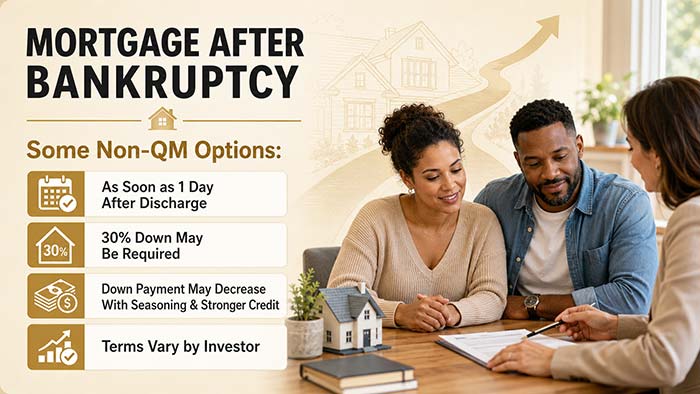
Most traditional loans require a waiting period or a strong repayment history. However, some non-QM and portfolio loans may be available soon after your bankruptcy is discharged. Non-QM mortgages don’t follow traditional mortgage guidelines. Instead, they follow guidelines set by individual investors.
Gustan Cho Associates offers non-QM mortgages one day out of bankruptcy and foreclosure. However, non-QM loans with no waiting period requirements require a 30% down payment.
As the bankruptcy seasons from the discharge date, the down payment requirement becomes less and less. With the combination of higher credit scores and bankruptcy seasoning over a year, homebuyers can qualify for non-QM mortgage loans one day after bankruptcy with a 20% down payment.
How High Are Mortgage Rates After Bankruptcy
Mortgage rates after bankruptcy have no impact on home loans. Mortgage rates offered to individuals with better credit histories. without bankruptcies are the same as those who filed bankruptcy. The impact of bankruptcy on your ability to secure a mortgage and the interest rate you’ll receive depends on various factors, including the type of bankruptcy you filed, how much time has passed since the bankruptcy discharge, and your overall creditworthiness.
What Are Loan Level Pricing Adjustments
Loan-level pricing adjustments are commonly referred to as LLPAs. LLPAs are pricing adjustments lenders charge borrowers with layered risks. For example, borrowers with lower credit scores are considered riskier borrowers. Therefore, lower credit score borrowers with get a pricing hit depending on how low the credit scores are.
To get par mortgage rates with no loan-level pricing adjustments, borrowers will need a 740 credit score, 20% down payment, lower debt to income ratios, and other positive factors.
Condominiums are considered riskier investments than single-family homes. Multi-family properties are considered riskier investments than single-family homes so LLPAs will apply. Lenders can have pricing adjustments for many factors. However, there are no pricing adjustments on mortgage rates after bankruptcy, foreclosure, deed in lieu of foreclosure, short sale. In the following sections, we will cover mortgage rates ater bankruptcy on government and conventional loans.
Loan Level Pricing Adjustments on Mortgage Rates
Whenever consumers hear mortgage rates, the rates quoted are par rates for borrowers with 740 plus credit, 20% down payment, low DTI, and other positive factors. The par rate is the starting point on mortgage rates. Depending on the profile of the borrower and the property, the LLPAs apply. Here are typical Loan Level Pricing Adjustments charged by mortgage companies:
- Credit Scores
- Loan to value
- Type of property (Condo, Multi-Family, Manufactured Home versus SFH)
- Loan amount (Under $200,000 loan balances have LLPAs)
- State the property is located
- Debt to income ratios
- Manual versus automated underwriting system approval
- Escrow versus non-escrow (LLPAs apply on non-escrowed)
When shopping for mortgage rates, lenders need to take LLPAs into account prior to quoting rates and terms. Rebuilding your credit and financial standing after bankruptcy is a gradual process, but with time and responsible financial behavior, you can improve your creditworthiness and increase your chances of qualifying for a mortgage with more favorable terms.
Factors That Do Not Affect Mortgage Rates
Prior derogatory credit tradelines do not factor into mortgage rates. Derogatory tradelines are factored in borrower’s credit scores but not mortgage rates. For example, mortgage rates after bankruptcy, foreclosure, deed in lieu of foreclosure, a short sale will be the same as borrowers without these prior events. Late payments, outstanding collections, repossessions, prior loan modifications, charged-off accounts do not affect mortgage rates
Mortgage Guidelines After Bankruptcy on Traditional and Non-QM Loans

Mortgage Guidelines After Bankruptcy on Non-QM Home Loans
Non-QM mortgages one day out of bankruptcy require a 20% to 30% down payment is required. The amount of the down payment is dependent on the borrower’s credit score. Mortgage rates are determined by borrowers’ credit scores and down payment. In this article, we will discuss and cover mortgage guidelines after bankruptcy on home purchase.
Hiring real estate attorneys is not a common practice in most states. However, most home buyers and sellers in Illinois normally hire real estate attorneys to represent them on real estate transactions.
A sharp attorney will have a keen eye in making sure their clients are protected in their real estate transactions. In the event the subject property has flaws such as foundation damage, mold, or other defects that were not noticed during the first walkthrough, they should be protected prior to closing.
Can I Decide Not To Hire an Attorney for My Home Purchase?
Hiring an attorney for your home purchase or if you are selling your home as a seller is by no means mandatory. Even in states where the common practice is to have an attorney represent each side, there is no law stating homebuyers and sellers need to be represented by an attorney.
Gustan Cho Associates will not endorse or recommend a law firm or real estate attorney unless we have done business with them.
Homebuyers and homeowners can choose any real estate attorney of their choice. It is always recommended that clients feel comfortable with the law firm they decide to represent their legal transaction.
Here are a Few Requirements for These Non-QM Mortgages:
- Larger down payment
- Higher interest rates/increased loan pricing
- More cash reserves
- A minimum credit score
- Complete bankruptcy documentation
- Explanation of the bankruptcy filing
- No addition of late payments after the discharge
- Stricter property/occupancy requirements
- The claim of “no waiting period” does not guarantee loan approval.
- Lenders must still confirm that the borrower has the ability to repay the loan.
Credit Score Necessary for a Mortgage
After the waiting period is only one step after bankruptcy. You also need to meet your lender’s credit score and program requirements to qualify for a mortgage. a mortgage.
Some of the Things Underwriters Look at Are:
- Credit score
- Post-bankruptcy payment history
- Credit utilization
- Open collections
- Housing payment history
- Disputed accounts
- Accounts of the authorized user
- Recent credit inquiries
- Number of accounts managed successfully and paid on time.
- Opening multiple new accounts or incurring additional debt may negatively impact credit, whereas responsible management of a few accounts can improve credit standing.
- Do not dispute accounts with negative credit that are accurate.
- Having several credit disputes will inhibit automated underwriting and may need to be removed prior to closing.
Income and Debt-to-Income Ratios After Bankruptcy
Even after bankruptcy, lenders will carefully review your income and debts before approving your mortgage. Lenders must ensure that borrowers have reliable and well-documented sources of income. Required documents will vary based on the income type.
Examples Include:
- Pay stubs and W-2s
- Personal and business tax returns
- Bank statements
- Social Security or pension award letters
- Disability income documentation
- Child support or alimony documentation
- Profit-and Loss statements for self-employment
- Bankruptcy schedules and payment records
- When income documentation is incomplete or unsubstantiated, lenders may significantly discount that income.
- Regardless, the lender will still calculate the borrower’s debt-to-income ratio based on the proposed mortgage payment and qualifying monthly liabilities.
- For Chapter 13 bankruptcies, the lender must include the proposed Chapter 13 payment.
- The lender may exclude that payment only when another documented treatment is permissible under the guidelines.
What Documents Do Lenders Require of Bankruptcy File
Submitting your full bankruptcy file at the start can help speed up the underwriting process.
A Lender Could Ask For:
- Bankruptcy petition
- Complete bankruptcy schedules
- Discharge or dismissal order
- Chapter 13 repayment plan
- Payment history from the trustee
- Debt approval from the court or trustee
- Evidence of what mortgage debts were discharged
- Short sale/foreclosure/deed in lieu documents
- Record showing transfer of title
- Bankruptcy explanation letter
- Evidence of extenuating circumstances, if any
- The most recent credit report
- Income and asset documentation
- Verification of rent or mortgage payment
- The loan program and specifics of the case determine what documentation is required.
- Always pay your bills on time and meet every deadline to improve your chances of getting approved for a mortgage.
- Late payments after bankruptcy can signal ongoing financial problems.
- Make sure you pay your rent, installment loans, and Chapter 13 payments on time.
- Keep your credit card balances low to improve your credit utilization and strengthen your credit profile.
Debt That Is Not Necessary Must Not Be Incurred
Hold off on taking on new debt, such as car loans, extra credit cards, or co-signing, until after your mortgage is approved.
The Down Payment and Reserves
Showing you have savings left after closing shows you are financially stable and can strengthen your application, especially if manual underwriting is required. Use payment methods like checks or electronic transfers, because cash is hard to verify.
Bankruptcy and Credit
Check your credit report to make sure discharged debts are incorrectly marked as incorrect and fix any errors, supporting with documentation. Before you start looking for a home, get a full preapproval that reviews your bankruptcy paperwork, credit, income, assets, debt-to-income ratio, and waiting periods. Avoid relying on a quick verbal prequalification, as it may miss important details.
Impact of Lender Overlays on Mortgages After Bankruptcy
The FHA, VA, USDA, Fannie Mae, and Freddie Mac are the governing agencies for mortgage loans. These agencies set the general guidelines that must be followed. However, mortgage companies add their own guidelines, called lender overlays.
These Can Include:
- Increased minimum credit scores
- Extended bankruptcy waiting periods
- Decreased maximum debt-to-income ratios
- No manual underwriting
- Additional reserve requirements
- No active Chapter 13 bankruptcies
- More conservative treatment of recent late payments
- More restrictive recent employment requirements.
- Meeting agency guidelines does not guarantee approval because individual lenders may have stricter rules.
- If one lender denies your application, another may still approve it.
Example of Mortgage Approval After Bankruptcy
This is only an example and does not guarantee approval. Maria’s Chapter 7 discharge was just over two years ago. Since then, she has made all of her rent payments and other credit obligations. With a middle mortgage score of 642 and stable W-2 income, her debt-to-income ratio is sufficient, and she has adequate funds for an FHA down payment and reserves.
- Maria is likely to meet the FHA’s basic requirements to satisfy the bankruptcy waiting period.
- However, Lender A has a four-year Rule and requires a 660 credit score, and the application is denied.
- Lender B relies on FHA’s requirements, and also on the absence of that credit score policy.
- With her income, credit, and assets, and after assessing her bankruptcy and the automated underwriting results, Lender B may be in a position to provide the loan.
- The loan will only be approved if it passes full underwriting, the property is evaluated, and all lender requirements are met on time.
Mortgage Errors to Avoid After Bankruptcy
Home Buyers After Bankruptcy Need to Avoid These Mistakes:
- Counting the waiting period from the date of filing versus the date of discharge
- Forgetting a post-bankruptcy foreclosure
- Thinking dismissing a Chapter 13 goes the same as a discharge
- Applying without the necessary court or trustee permissions
- Getting new credit just before preapproval
- Chapter 13 or rent payments being made late
- Disputing valid accounts during the mortgage process
- Submitting bankruptcy documentation in part
- Changing jobs or income prior to closing
- Thinking all lenders have the same guidelines
Mortgage Eligibility After Bankruptcy: Things to Consider
Bankruptcy can give you a fresh start, but you will need to show that your finances are stable before getting a mortgage. Lenders look for steady income, manageable debt, good credit, and signs that you are ready for a new home loan.
It is also important to see which other qualifications must be met, depending on whether the bankruptcy is filed under Chapter 7 or 13, whether the case is discharged or dismissed, whether a foreclosure has occurred, and what else the lender requires.
If one lender denies your mortgage application, you may still qualify with another lender if you meet agency guidelines. To explore your mortgage options, contact a licensed loan officer at Gustan Cho Associates. A full mortgage approval will show if you qualify for other programs.
How Can I Get Approved For Government and Conventional Loans After Bankruptcy or a Housing Event
After experiencing bankruptcy and foreclosure, obtaining a government-backed or conventional loan for a home can be challenging, but it is not impossible. The specific requirements and waiting periods can vary based on the type of loan, the lender’s policies, and your financial situation. Here’s an overview of the typical waiting periods and considerations for obtaining these types of loans after bankruptcy and foreclosure.
Get Approved Today for a Mortgage with Gustan Cho Associates
There is a two-year waiting period to qualify after the Chapter 13 discharge date to qualify for Conventional loans. The waiting period is four years after the Chapter 13 dismissal date to qualify for conventional loans.
There is a four-year waiting period to qualify for a conventional loan with a prior mortgage part of bankruptcy from discharged date of bankruptcy.
The foreclosure needs to be finalized. If you are trying to qualify for Bankruptcy with no overlays contact us at Gustan Cho Associates at 262-627-1965 or text for faster response. Or email us at gcho@gustancho.com. The team at Gustan Cho Associates is available 7 days a week, on evenings, weekends, and holidays.
Frequently Asked Questions About Buying a House and Mortgage Guidelines After Bankruptcy
Can I Go House Shopping a Year After a Chapter 7 Bankruptcy?
It is possible, but it will be difficult. FHA will allow 12-24 months if qualifying extenuating circumstances are provided. Approval from the VA is possible after 1 year of credit rebuilding if extenuating circumstances beyond the borrower’s control occurred. Some of the non-QM programs can be used.
Will a Larger Down Payment Reduce the Bankruptcy Waiting Period?
Unfortunately, larger down payments will not affect the waiting periods for the FHA, VA, USDA, Fannie Mae, or Freddie Mac. However, it can be used to strengthen a file and help the borrower qualify for a different non-QM program.
Will I Be Eligible for an FHA Loan Right After My Chapter 13 Discharge?
An extended waiting period after discharge of a Chapter 7 loan does not apply to FHA. It is more likely that the FHA loan will require manual underwriting, that the waiting period will be determined by the lender, and that additional restrictive measures could be added.
Will I Need to Get Permission from My Trustee in Order to Buy a House While I Am in Chapter 13?
While Chapter 13 is still active, permission from the court or bankruptcy trustee will be required if the borrower wants to take on new mortgage debt. This will vary depending on the court, the type of repayment plan, and the loan program.
Will My Mortgage Application be Denied if I Have Old, Discharged Collections?
A debt that has been discharged should not be considered an active personal financial obligation. However, inaccurate reporting to credit agencies, new collections, and liens will affect your chances of securing mortgage approval.
Does My Spouse’s Bankruptcy Impact My Mortgage Application?
If your spouse has taken out a loan in your name, or you have joint debts that your spouse is declaring in a bankruptcy proceeding, it will affect the mortgage application. In the case of community-property debt, a lender will examine the full context of ownership and debt in conjunction with state law, rather than rely solely on the name that appears on the bankruptcy.
Can I Refinance a Mortgage After Declaring Bankruptcy?
Yes, the purchase and refinance transactions are subject to the same general bankruptcy waiting-period regulations, except that cash-out refinances, loan-to-value ratios, and payment history may be subject to additional restrictions.
Will I Have to Pay a Higher Mortgage Rate After Declaring Bankruptcy?
If you are declaring bankruptcy, this will not trigger an automatic interest rate adjustment on an agency loan after the waiting period. The interest rate will depend on your credit score, the loan program, the level of the down payment, the type of property, and the current market, among other factors. There will be risk-based pricing on non-QM loans if taken out shortly after bankruptcy.