In this blog, we will discuss and cover HUD waiting period guidelines after Chapter 13 on FHA loans. Why is it many lenders say there is a one or two-year waiting period after Chapter 13 discharge date? This is what many home buyers who are in a Chapter 13 Bankruptcy Repayment Plan want to know. Many homebuyers are getting conflicting reports from various lenders regarding the HUD waiting period guidelines after Chapter 13 on FHA loans.
Many of our viewers are getting mixed answers from lenders when asked about qualifying for an FHA Loan after Chapter 13 Bankruptcy discharge date.
When applying for an FHA loan after a Chapter 13 bankruptcy, HUD (the U.S. Department of Housing and Urban Development) must follow specific waiting period guidelines. These guidelines help determine when an individual can apply for an FHA loan post-bankruptcy. In the following paragraphs, we will cover an overview of what you need to know about HUD waiting period guidelines after Chapter 13 on FHA loans.
HUD Waiting Period Guidelines After Chapter 13 Bankruptcy

HUD Waiting Period Guidelines During Chapter 13 Bankruptcy: Court Approval
Obtaining court approval typically requires demonstrating good payment performance and the ability to manage the additional financial obligation.
After Chapter 13 Discharge
Immediate Eligibility after Discharge: Once your Chapter 13 bankruptcy has been discharged, FHA loan guidelines allow you to apply for a mortgage immediately, without a waiting period. This is contingent on making all required payments on time during the bankruptcy period. Manual Underwriting: Manual underwriting is required for these loans. This means a loan officer will review your application carefully, considering factors like credit history, employment stability, and current income.
Credit Considerations
Credit History Review: Lenders will examine your credit history post-bankruptcy to ensure that you have maintained a good credit standing, which includes not incurring new credit obligations that could negatively impact your ability to repay the mortgage. Compensating Factors: Strong compensating factors, such as a stable job history, a low debt-to-income ratio, and a solid savings account, can improve your chances of loan approval under manual underwriting.
Documentation
Proof of Timely Payments: You must provide documentation that all payments under the Chapter 13 plan were made on time for at least one year. Court Discharge Papers: You must also provide your bankruptcy discharge documentation to prove that the court has officially released you from the bankruptcy.
Counseling and Financial Management
HUD Counseling:
It’s advisable to undergo HUD-approved housing counseling. This can help prepare you for managing a mortgage post-bankruptcy and ensure you are fully aware of your financial commitments.
Key Takeaway
Applying for an FHA loan after a Chapter 13 bankruptcy is feasible and may be easier than after a Chapter 7 due to the repayment plan involved with Chapter 13. Demonstrating financial stability and responsible credit management during and after the bankruptcy is crucial to gaining approval for a new loan. Always consult with a mortgage advisor who understands the specifics of FHA loans post-bankruptcy to guide you through the application process.
Chapter 13 Bankruptcy and FHA Loans: What are the Waiting Periods HUD Establishes?
Borrowers often believe that all Chapter 13 bankruptcies prevent them from obtaining FHA loans and buying homes. Some borrowers may qualify, while others are making payments under a Chapter 13 plan, and others may become eligible only after a discharge is granted.
The most important things to know are the HUD waiting period after Chapter 13, the differences between automated and manual underwriting, and any other requirements the lender may impose.
When comparing lenders, HUD’s FHA guidelines are more borrower-friendly than most lenders’. However, just because you meet the basic HUD requirements does not mean the loan will be approved. The new mortgage must also be supported by your payment history, income, debt-to-income ratio, housing payment history, bankruptcy paperwork, and your financial recovery.
Quick Answer: FHA Loan Eligibility After Chapter 13 Bankruptcy?
If you wish to qualify for an FH A loan, you must satisfy the following conditions.
- First, stay under the Chapter 13 repayment plan.
- The repayment plan must last for at least 12 months.
- During that period, all payments must be made on time.
- In addition, the Chapter 13 Bankruptcy court must provide permission for the mortgage loan.
On Chapter 13 Discharges
Following a Chapter 13 discharge, HUD does not require the same two-year waiting period mandated after a Chapter 7 discharge. Chapter 13 discharges that are less than two years old may require manual underwriting or a downgrade of automated underwriting.
On Chapter 13 Dismissals
Discharge and dismissal are not synonymous. In the case of a dismissal, the lender must consider the reason for dismissal, the borrower’s outstanding obligations, the borrower’s current credit standing, and whether the borrower continues to meet the FHA credit standards.
HUD refers to Handbook 4000.1 as the primary source for the FHA Single Family Housing Policy. Under the current guidance from HUD, Chapter 13 does not disqualify a borrower
if at least 12 months of the repayment period have passed, payments have been made on a timely basis, all required payments have been made, and the borrower has obtained permission from the court to make the payments if the case is still active.
Chapter 13 Bankruptcy
Chapter 13 bankruptcy is used by individuals with a regular source of income to reorganize some or all of their indebtedness through a court-confirmed plan. This type of plan is typically for a period of three to five years. In contrast to Chapter 7, which typically involves the discharge of all or a portion of a debtor’s debts without a lengthy repayment plan, Chapter 13 requires that the debtor make regular payments to the bankruptcy trustee, who carries out the plan.
This Chapter is Popular Among Consumers Wanting to do the Following:
- Catch up on missed mortgage payments.
- Avoid losing their home to foreclosure.
- Reorganize their secured and unsecured debts.
- Pay back their tax debts.
- Retain property that may be lost in a different bankruptcy chapter.
- Develop a detailed plan for repayment of their debts based on their disposable income.
- Since Chapter 13 shows payment history over time, the FHA may allow someone to qualify for a loan even if the Chapter 13 plan has not yet been completed.
Chapter 13 Bankruptcy and the HUD Waiting Period
After a Chapter 13 Bankruptcy, the HUD waiting period varies depending on whether the bankruptcy is still active, has been discharged, or dismissed. The three cases are not the same and will result in different FHA underwriting.
FHA Loans and Active Chapter 13
A Person is Eligible for an FHA-Insured Mortgage if the Following is True:
- The person has completed at least 12 months of the repayment plan by the time the FHA case number is assigned.
- The debtor has made all required payments to the bankruptcy court during the repayment plan.
- The debtor has made all required payments to the bankruptcy court and has a satisfactory payment history.
- The debtor has received permission from the bankruptcy court to incur the mortgage debt.
- The person meets all other requirements of the FHA and/or the other lender.
- In this case, the FHA uses manual underwriting.
- The underwriter will have to review the complete credit profile as part of the underwriting process.
The year-long stipulation refers to the repayment period and not to the number of months that have elapsed since the bankruptcy petition was filed. Usually, a lender will confirm the payment history and the plan start date either through the trustee or by reviewing the bankruptcy paperwork.
HUD Waiting Period Guidelines After Chapter 13 versus Overlays by Lenders
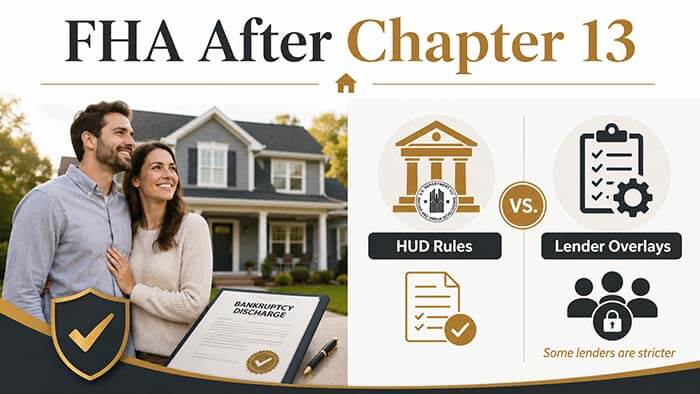
We will clarify in qualifying HUD waiting period guidelines after Chapter 13 on FHA loans. There are two different types of guidelines. The most important guidelines you need to pay attention to are HUD waiting period guidelines after Chapter 13 Bankruptcy. Lenders can have different guidelines.
Homebuyers will qualify for a mortgage after Chapter 13 Bankruptcy with no waiting period after Chapter 13 Bankruptcy discharge date.
Any FHA loans with less than two year seasoning after Chapter 13 bankruptcy, it needs to be a manual underwrite. All lenders need to make sure borrowers meet the HUD waiting period guidelines after Chapter 13 Bankruptcy. However, lenders can have higher lending requirements that are above and beyond the HUD waiting period guidelines after Chapter 13 Bankruptcy on FHA loans.
How Can I Find a Lender That Has No Overlays and Will Go Off the HUD Waiting Period Guidelines After Chapter 13 Bankruptcy
Homebuyers can qualify for an FHA Loan during and after Chapter 13 Bankruptcy. We will cover when homebuyers can qualify for an FHA loan during Chapter 13 Bankruptcy.
Unfortunately, many borrowers are told conflicting statements by lenders. Many borrowers think all FHA lenders have the same guidelines.
However, this is not true. Some loan officers do not know the HUD waiting period guidelines after Chapter 13 Bankruptcy because they work for a mortgage company with overlays. There is no waiting period to qualify for an FHA loan after Chapter 13 per HUD Waiting Period Guidelines After Chapter 13.
When Can I Qualify for an FHA Loan After Filing Chapter 13 Bankruptcy
Borrowers can qualify for an FHA Loan During the Chapter 13 Bankruptcy Repayment Period one year into their Chapter 13 Bankruptcy Repayment Plan. The borrower will need the approval of their Chapter 13 Bankruptcy Trustee which is not a problem. I have never seen a case where Chapter 13 Bankruptcy Trustee does not approve the borrower of a home loan. This holds true as long as they were able to afford the monthly mortgage payment.
HUD Credit Guidelines for Chapter 13 Bankruptcy Borrowers
A borrower needs to have been timely will all of their monthly payments since the start of their Chapter 13 Bankruptcy Repayment. The borrower needs verification of rent which is 12 months of canceled checks of their rent payment, and 12 months of bank statements showing timely monthly mortgage payments. If the borrower has been renting from a registered property management company, then a VOR form completed by the property management company which the form is provided by the lender can be used in lieu of the 12 month canceled checks and/or bank statements. The mortgage file needs to be manually underwritten. Compensating Factors are required.
Buying a Home After Chapter 13? We Can Help You Understand the HUD Waiting Period Guidelines for FHA Loans!
Contact us today to learn about the HUD waiting period for FHA loans and how we can help you get approved.HUD Waiting Period Guidelines After Chapter 13 on Applying for an FHA Loan After or Before Discharge
Is It Better To Apply For FHA Loan After Chapter 13 Bankruptcy Discharge? This is where many borrowers get really confused by the answers being told by various lenders. Many borrowers are told that they would qualify for an FHA loan while in Chapter 13 Bankruptcy Repayment Plan. However, they DO NOT qualify for an FHA loan after Chapter 13 Bankruptcy discharge unless they pass a two-year waiting period. Does this make sense? For most of us, this does not make sense. There are many lenders that will require a waiting period after a Chapter 13 Bankruptcy discharge date of one to two years.
Applying for an FHA Loan After Chapter 13 Discharge
HUD does not have a blanket policy requiring all borrowers to wait 2 years after the Chapter 13 discharge. A borrower can apply shortly after the discharge in the following situations:
- All plan payments were made in full and on time
- There have not been any significant new derogatory credit events
- The borrower can provide proof of a stable and sufficient income
- The reason(s) for the bankruptcy will not happen again
- The borrower satisfies the FHA debt-to-income and credit guidelines
- The lender has the capacity and is willing to do the necessary underwriting
- A Chapter 13 discharge that occurred under two years earlier may result in a file being downgraded for manual underwriting, rather than being approved as a result of the FHA’s TOTAL Mortgage Scorecard.
- It is important to note that just because there is no mandated waiting period from HUD, that does not mean there are no underwriting standards.
FHA Loan Two Years After Chapter 13 Discharge
When two years have passed after the Chapter 13 discharge, and if the borrower’s credit and financial profile are in good standing, then an automated underwriting approval would be more likely. Automated approvals would streamline certain parts of the process; however, the FHA and lender eligibility rules will still apply. The lender will still need to confirm income and employment, review the applicant’s assets and liabilities, and the eligible property, among other requirements that will be evident from the automated underwriting.
FHA Loans After Chapter 13 Dismissal
A Chapter 13 dismissal occurs when the bankruptcy court closes the case without granting the debtor a discharge of their eligible debts. This may occur due to one or more of the following reasons:
- The debtor failed to make the required payments to the plan
- The debtor filed for voluntary dismissal
- The debtor failed to file the required documents
- The plan could not be confirmed
- The debtor failed to comply with court instructions
- The case was converted to a different chapter of bankruptcy
- A Chapter 13 dismissal may allow creditors to initiate collection activity.
- The debtor may also have a number of unpaid debts that are past due, charged-off, or subject to judgment.
HUD Guidelines on Chapter 13 Dismissal vs Discharge
The Department of Housing and Urban Development’s provision in Chapter 13 is based on satisfactory performance under the repayment plan. Therefore, the debtor should not assume that treatment that is flexible and is provided after the successful Chapter 13 discharge is also provided after a Chapter 13 dismissal. Some items that the lender will review include (i) the dismissal order and date, (ii) the case dismissal reason, (iii) affected debts and current balances, (iv) late payments, and (v) any judgments, liens, and collections, and (vi) the debtor’s reestablished credit and written explanation and the assessment of the financial hardship and the likelihood of reoccurrence.
Does an FHA Loan During Chapter 13 Require Manual Underwriting?
In most cases, if the borrower is in an active Chapter 13 plan, the FHA loan must be manually underwritten. Manual Underwriting empowers the FHA underwriter to review the borrower’s entire financial picture. The underwriter will evaluate the borrower’s credit score, the reason for bankruptcy, the borrower’s payment history, the stability of the borrower’s income, remaining cash reserves, the borrower’s housing/payment history, and the underwriter’s assessment of the borrower’s ability to repay the proposed loan.
What an FHA Manual Underwriter Reviews
An underwriter may review:
- Chapter 13 trustee payment history
- The borrower’s current rent or mortgage payment history
- The borrower’s employment and income history and stability
- The borrower’s debt-to-income ratio
- The borrower’s cash reserves after closing
- Payment shock
- Recent credit inquiries and new accounts
- Collections and judgments
- Past credit problems and explanations
- Bankruptcy hardship and new late payments after bankruptcy
- Just because a borrower has a low credit score does not mean the borrower will be unable to repay a mortgage.
- On the other hand, late payments and unstable finances will make mortgage repayment more difficult, even if the basic HUD waiting-period requirement is met.
Chapter 13 and Trustee Approval or Court Approval to Qualify for an FHA Loan
In active Chapter 13 cases, the borrower must obtain the trustee’s written permission to incur the proposed mortgage debt. Depending on the bankruptcy district and its local procedure, approval may be:
- Granted by the bankruptcy judge or Chapter 13 trustee
- A court order
- A motion to incur new debt
- Some other written authorization that the lender and the bankruptcy court will accept
- Before the borrower makes an offer on a Chicago home or executes a contract with enforceable time constraints, the borrower should consult their bankruptcy attorney.
An Attorney Might Require the Following Information:
- Proposed purchase price
- Estimated FHA loan amount
- nterest rate
- Estimated monthly principal and interest
- Estimated monthly property taxes
- Estimated monthly homeowners’ insurance
- Estimated FHA mortgage insurance
- Estimated monthly homeowners’ association dues
- Estimated cash to close
- Approval must be in the format the lender requires. Approval cannot be a verbal statement from the borrower or trustee.
Documents Needed to Obtain an FHA Loan During or After Chapter 13
After a bankruptcy, loan applicants will need to furnish more documentation than applicants without a bankruptcy on their record.
Banking Documentation
The lender could ask for:
- A Chapter 13 petition
- Bankruptcy documentation
- A confirmed plan
- Trustee payment history
- A discharge order, if applicable
- A dismissal order, if applicable
- An application to take on new mortgage debt
- Bankruptcy attorney contact info
- A written statement explaining the cause of the bankruptcy
Income and Employment Documentation
This Will Vary by Employment Type. This Could Include:
- The most recent pay stub
- The last 2 years of W-2 forms
- The last 2 years of personal and business taxes for self-employed borrowers
- Pay stub income verification
- Social Security or pension award letters
- Documents to substantiate any overtime or bonus income
- A year-to-date profit-and-loss statement
- Bank statements showing business cash flow
- Documentation of overtime, bonus, or commission income
Asset and Housing Documentation
This can include the most recent bank statements, a letter of earnest money, a gift letter and proof of donor, a verification of rent, canceled rent checks, rent history from a property manager, a current mortgage payment history, proof of homeowners’ insurance, documentation of cash reserves, etc. Those looking to purchase real estate in Chicago should plan for closing costs, property insurance, association dues, and property taxes. These taxes can alter the total housing payment and the FHA debt-to-Income ratio.
Verification of Rent After Chapter 13 Bankruptcy
Rental history can be vital in FHA manual underwriting to demonstrate the borrower’s ability to pay monthly housing expenses.
The Lender May Verify the Most Recent 12 Months of Rent Through the Following:
- canceled checks
- bank statements
- records of electronic payments
- rent verification performed by an independent property management company
- landlord payment history with acceptable documentation
- Rent paid to a private landlord or family member may require additional documentation compared to rent paid to a professional property management company.
- Rent payments made in cash without a receipt or a record on a bank statement may be hard to document.
- Borrowers who would like to apply for an FHA mortgage should make their payments in a manner that can be documented.
How Payment Shock Affects FHA Approval
Payment shock measures the gap between a borrower’s present monthly housing cost and their future housing cost after the mortgage loan is approved. Let’s say a borrower is currently paying $1,200 in monthly rent, but the borrower proposes an officially approved monthly mortgage payment of $2,400; the payment shock is considered substantial.
The Monthly FHA Payment Typically Includes:
- Mortgage principal
- Mortgage interest
- Property taxes
- Homeowners insurance
- FHA mortgage insurance
- Flood insurance, if applicable
- Homeowners association dues
- Payment shock is not an automatic disqualifier for the borrower; however, during manual underwriting, it may be more of a concern and pose a greater risk in cases where the borrower has a high debt-to-income ratio, limited cash reserves, and has recently filed for bankruptcy.
Compensating Factors for FHA Manual Underwriting
Compensating factors are positive financial attributes of a borrower that may outweigh the greater risk presented in other areas of the borrower’s financial profile.
Compensating Factors May Be:
- Documented cash reserves
- Small increase in housing cost
- Additional income
- Savings
- Low credit utilization
- Long-term employment
- Good rent history
- Good credit history
- Higher residual income
- Ability to pay higher housing costs
- Compensating factors must be fully documented.
- Providing a cash reserve and declaring the borrower as a financially responsible party does not meet the requirement.
- Payment shock is measured in relation to the borrower’s credit profile and documented compensating factors.
- It is crucial to note that a cash reserve may support a good rent history, but both factors will be considered when determining the greater risk presented in other areas of the borrower’s financial profile.
FHA Credit Score Requirements Following Chapter 13
FHA guidelines generally allow for maximum financing with a credit score of 580 and above. A credit score of 500 to 579 generally requires a minimum down payment of 10%.
Individual mortgage lenders may implement their own policies and set credit score requirements higher than those set by the FHA.
The CFPB states that, unlike many conventional mortgage products, FHA loans are likely to allow a lower credit score and a lower down payment. However, the overall cost and availability of the product will depend on the particular borrower and their situation.
After Chapter 13, Certain Credit Score Minimums Will Allow for an Application; However, an Underwriter Will Consider the Following, Among Other Things:
- Recent payment history
- Derogatory accounts that remain unpaid
- History of payments for housing
- Bankruptcy incurred new obligations.
- How credit is used
- Judgments and liens
- Income and its stability
- Funds available after closing
Late Payments During a Chapter 13 Repayment Plan
HUD mandates timely and satisfactory performance of required payments during the bankruptcy repayment period. A late trustee payment can create a serious underwriting concern. The lender may determine any of the following:
- The payment was late.
- The delay was caused by a payroll issue.
- There is an error in the trustee ledger.
- The payment was made during an allowed grace period.
- There was a modification of the plan.
- The borrower subsequently cured the delinquency.
- Borrowers are advised to request the trustee payment ledger early in the mortgage process.
- They should clear up any issues with the bankruptcy attorney or the trustee prior to the final underwriting of the FHA loan.
HUD Waiting Period Guidelines After Chapter 13: How Can I Get FHA Loan Approval
FHA Guidelines on qualifying for an FHA loan after a Chapter 13 Bankruptcy discharged date are manual underwrites if the discharge has not been seasoned for at least two years. HUD, the parent of FHA, does not require any waiting period after a Chapter 13 Bankruptcy discharge date. If the Chapter 13 Bankruptcy discharge has not been seasoned for two years, then the file needs to be a manual underwrite and manual underwriting guidelines apply.
HUD Waiting Period Guidelines After Chapter 13 and Eligibility for FHA Loan Approval?
Verification Of Rent is required on all manual underwriting and payment shock will be considered a compensating factor. No late payments during and after a Chapter 13 Bankruptcy. Re-established credit after the discharge date is a must. Compensating Factors are required for borrowers with high debt-to-income ratios.
Being Told by a Lender You Do Not Meet HUD Waiting Period Guidelines After Chapter 13 on FHA Loans
If borrowers are told they do not qualify because they do not meet the mandatory waiting period after Chapter 13 Bankruptcy, remember they may not qualify with the lender they consulted with but that does not mean they do not qualify for an FHA loan. There are no waiting period requirements after Chapter 13 Bankruptcy discharge. Please contact us at Gustan Cho Associates at 800-900-8569 or text for a faster response. We do not have any overlays on FHA loans after a Chapter 13 Bankruptcy discharge date. Or email us at gcho@gustancho.com.
Is It Better to Qualify for a FHA Loan Before or After Chapter 13 Discharged?
Is It Better To Apply For FHA Loan After Chapter 13 discharge? Most would say it would be better to qualify for an FHA loan after a Chapter 13 Bankruptcy discharge rather than during a Chapter 13 Repayment Period. However, it is normally better to qualify for an FHA loan during a Chapter 13 Bankruptcy repayment period. The reason is that the payments that you are making to your creditors are considered credit tradelines.
Re-Establishing Credit After Chapter 13 Bankruptcy
Once Chapter 13 Bankruptcy has been discharged, all of those credit tradelines are closed. This holds true unless you have revolving and/or open installment accounts, you will no longer have any more credit tradelines. It will shun you out with many lenders. This is because many lenders will have overlays on credit tradelines. Many lenders will not approve borrowers for an FHA Loan without three credit tradelines that have been seasoned for at least one year. Some require two-year seasoned credit tradelines.
Qualifying for a Mortgage with Lender with No Overlays
This is why it is better to apply for an FHA loan while in Chapter 13 Bankruptcy Repayment Period than after a Chapter 13 Bankruptcy discharge.
At Gustan Cho Associates., we have no Lender Overlays so it does not matter whether you are applying for an FHA loan while in a Chapter 13 Repayment or After Chapter 13 discharged date.
If you have any questions in qualifying for a mortgage during or after a Chapter 13 discharged date and need to qualify for an FHA Loan with a lender with no overlays, please contact Gustan Cho Associates at 1-800-900-8569 for text for a faster response. Or email us at gcho@gustancho.com.
FAQ: HUD Waiting Period Guidelines After Chapter 13 on FHA Loans
What are the HUD Waiting Period Guidelines for Applying for an FHA Loan During Chapter 13 Bankruptcy?
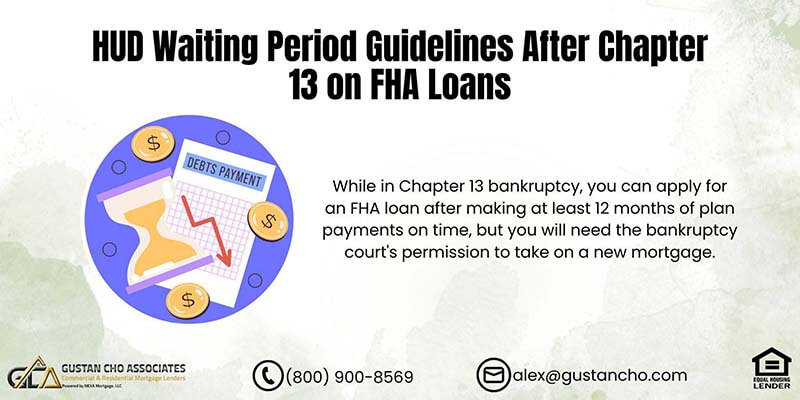
While in Chapter 13 bankruptcy, you can apply for an FHA loan after making at least 12 months of plan payments on time, but you will need the bankruptcy court’s permission to take on a new mortgage.
Can I Apply for an FHA Loan Immediately After My Chapter 13 Bankruptcy is Discharged?
Yes, once your Chapter 13 bankruptcy has been discharged, you can apply for an FHA loan immediately, provided you made all required payments on time during the bankruptcy period. Manual underwriting will be required.
What Factors Do Lenders Consider During Manual Underwriting After Chapter 13 Bankruptcy?
Lenders will review your credit history, employment stability, current income, and other factors such as your debt-to-income ratio and savings. Strong compensating factors can enhance your loan approval chances.
What Documentation is Required When Applying for an FHA Loan After Chapter 13 Bankruptcy?
You must provide documentation of timely payments under the Chapter 13 plan for at least one year, as well as your bankruptcy discharge papers.
Why Do I Receive Conflicting Information From Different Lenders About FHA Loan Eligibility After Chapter 13?
Different lenders may have higher lending requirements known as overlays, which are above the basic HUD guidelines. It’s important to consult multiple lenders to understand their specific requirements.
Is Applying for an FHA Loan During or After the Chapter 13 Repayment Period Better?
Applying during the Chapter 13 repayment period can be advantageous, as ongoing payments to creditors are considered credit tradelines, which can help establish your creditworthiness.
What is Required if My Chapter 13 Bankruptcy Discharge is Recent and I Want an FHA Loan?
Suppose the discharge is less than two years old. In that case, the loan application must undergo manual underwriting, and various compensating factors will be considered.
What Does it Mean if a Lender Says I Do Dot Meet HUD Waiting Period Guidelines After Chapter 13 on FHA Loans?
This likely means the lender has overlays that require a waiting period after Chapter 13 discharge, even though HUD does not mandate such a waiting period. Look for lenders without overlays.
How Can HUD-Approved Housing Counseling Help Me?
Undergoing HUD-approved housing counseling can prepare you for managing a mortgage post-bankruptcy and ensure you fully understand your financial commitments.
How Can I Find a Lender That Does Not Use Overlays and Adheres Strictly to HUD Guidelines?
Research and contact different mortgage companies, like Gustan Cho Associates, that explicitly state they have no overlays on FHA loans after a Chapter 13 Bankruptcy discharge.