
FHA manual underwriting is required when the Automated Underwriting System returns a “Refer” finding or when FHA rules require the loan to be downgraded from automated to manual review. Under the FHA manual underwriting mortgage guidelines, an underwriter evaluates the borrower’s credit history, income, debts, housing-payment history, cash reserves, and eligible compensating factors. Manual underwriting does not mean automatic denial. Borrowers may still qualify when their fi
le meets FHA’s debt-to-income limits and documentation requirements. However, some lenders impose stricter credit scores, DTI, or reserve requirements called lender overlays.
What FHA Manual Underwriting Means
FHA manual underwriting means a human underwriter reviews the complete mortgage application instead of relying solely on an Automated Underwriting System (AUS) approval. This usually happens when the AUS returns a “Refer” finding or when FHA rules require the lender to downgrade the loan from automated to manual underwriting. Under the FHA manual underwriting mortgage guidelines, the underwriter evaluates the borrower’s:
- Income and employment stability
- Monthly debts and debt-to-income ratio
- Credit and payment history
- Housing payment or rent history
- Available cash reserves
- Eligible compensating factors
Manual underwriting does not allow a lender to overlook FHA requirements or approve income that cannot be properly documented. Instead, it allows the underwriter to evaluate the borrower’s overall financial profile using HUD’s manual underwriting standards. A manually underwritten FHA loan is not automatically a high-risk loan or a denial. Borrowers with an AUS Refer finding may still qualify if they meet the applicable credit, DTI, housing-payment, reserve, and documentation requirements. Individual lenders may also impose stricter requirements known as lender overlays.
When an FHA Loan Must Be Manually Underwritten
An FHA loan generally requires manual underwriting when the FHA-approved Automated Underwriting System (AUS) returns a “Refer” finding. A Refer finding is not a denial. It means the application must be reviewed by a qualified human underwriter in accordance with the FHA manual underwriting mortgage guidelines. A loan that initially receives an “Accept” or “Approve” finding may also need to be downgraded to manual underwriting when information discovered during processing materially changes the borrower’s risk profile. Examples may include:
- Significant differences between the application and supporting documents
- Credit obligations or financial information that the AUS did not evaluate
- Certain disputed derogatory credit accounts
- Mortgage-payment delinquencies that require a manual downgrade
- Recent bankruptcy, foreclosure, or other serious credit events requiring an FHA exception
- Information indicating that the borrower may not be able to repay the loan as presented
A high debt-to-income ratio by itself does not automatically require manual underwriting. If the AUS evaluates the correct information and issues an eligible approval, the loan may remain eligible for automated underwriting. When manual underwriting is required, the lender must document the borrower’s income, debts, credit history, housing-payment history, reserves, and eligible compensating factors. The borrower must satisfy FHA’s manual underwriting standards as well as any additional lender requirements or overlays.
FHA DTI Limits by Credit-Score Category
For manually underwritten FHA loans, HUD evaluates two debt-to-income ratios:
- Front-end ratio: Proposed monthly housing payment divided by effective monthly income
- Back-end ratio: Housing payment plus recurring monthly debts divided by effective monthly income
Under the FHA manual underwriting mortgage guidelines, the maximum ratios depend on the lowest qualifying credit score and the borrower’s eligible compensating factors.
Credit Scores From 500 to 579—or No Credit Score
Borrowers with a minimum decision credit score from 500 to 579 are generally limited to:
- 31% front-end ratio
- 43% back-end ratio
The same 31/43 limit generally applies to borrowers without a traditional credit score. Compensating factors cannot be used to increase these ratios. However, an eligible energy-efficient home may qualify for FHA’s 33/45 stretch ratios. When a borrower has no credit score, income from a non-occupant co-borrower cannot be used to calculate the qualifying ratios.
Credit Scores of 580 or Higher
Borrowers with a minimum decision credit score of 580 or higher may qualify under one of the following ratio categories:
- 31/43: No compensating factors required
- 37/47: Requires one eligible compensating factor
- 40/40: Permitted when the borrower has no discretionary debt
- 40/50: Requires at least two eligible compensating factors
Eligible compensating factors may include documented cash reserves, a minimal increase in housing payment, qualifying residual income, or significant additional income not included as effective income. The exact factors that may be used depend on the applicable ratio category. These ratios are maximum FHA limits, not guaranteed approval thresholds. The underwriter must still determine that the borrower has acceptable credit, stable qualifying income, sufficient funds, and the ability to make the proposed mortgage payment. Individual lenders may also impose lower DTI limits through lender overlays.
High DTI or Credit Issues? FHA Manual Underwriting May Help
Manual underwriting looks at the full borrower profile, not just the AUS result. We’ll help you understand what needs to be fixed, explained, or documented.Official FHA Compensating Factors
Compensating factors are documented financial strengths that may allow a borrower with a minimum decision credit score of 580 or higher to exceed FHA’s standard 31% housing ratio and 43% total DTI ratio. Under the FHA manual underwriting mortgage guidelines, HUD recognizes only specific factors for this purpose.
Verified Cash Reserves
The borrower may use verified funds remaining after closing as a compensating factor when the reserves are equal to at least:
- Three total monthly mortgage payments for a one- or two-unit property
- Six total monthly mortgage payments for a three- or four-unit property
Gift funds, borrowed money, equity in another property, and cash received from a cash-out refinance do not count toward this threshold.
Minimal Increase in Housing Payment
The proposed mortgage payment must not exceed the borrower’s current housing payment by more than $100 or 5%, whichever is less. The borrower must also document a 12-month housing-payment history with no more than one 30-day late payment. This factor cannot be used when the borrower does not have a current housing payment.
Residual Income
Residual income is the money remaining each month after taxes, housing expenses, recurring debts, estimated utilities, and certain job-related expenses are deducted from household income. The remaining amount must meet or exceed the applicable requirement based on the property’s region and household size.
Significant Additional Income Not Used to Qualify
Documented overtime, bonus, part-time, or seasonal income may qualify when:
- The borrower has received it for at least one year
- The income is reasonably likely to continue
- Including it would reduce the qualifying ratios to no more than 37/47
Income from a non-borrowing spouse or another person who is not obligated on the mortgage cannot be used. This factor is available only with another compensating factor when approving ratios above 37/47 and up to 40/50.
No Discretionary Debt
A borrower with a credit score of 580 or higher may qualify for ratios up to 40/40 when the proposed housing payment will be the borrower’s only unpaid monthly obligation. The borrower must have established credit in their own name for at least 6 months and can document that revolving accounts have been paid in full each month for the previous 6 months. No discretionary debt is a separate 40/40 category; it is not one of the factors used to reach 37/47 or 40/50. Compensating factors must be verified, documented, and recorded by the underwriter. They cannot overcome unacceptable credit, insufficient income, or another unmet FHA requirement. Borrowers with scores from 500 to 579—or without a credit score—generally cannot use compensating factors to exceed 31/43.
Required Reserves vs. Reserves as a Compensating Factor
Required reserves and compensating-factor reserves are not the same. Under the FHA manual underwriting mortgage guidelines, required reserves are the minimum funds a borrower must have after closing. A higher reserve balance may be used as an official compensating factor to support debt-to-income ratios above the FHA’s standard 31/43 limits.
Minimum Required Reserves
For a manually underwritten FHA loan, the lender must generally verify:
- One month’s worth of principal, interest, taxes, and insurance (PITI) for a property with one or two units.
- Three months of PITI for a three- or four-unit property
- Two months of PITI for a one-unit property with an accessory dwelling unit, when rental income from the ADU is used to qualify
These reserves are a basic eligibility requirement. Simply meeting the minimum does not make reserves a compensating factor.
Reserves Used as a Compensating Factor
To count verified reserves as an official compensating factor, the borrower must have at least:
- Three total monthly mortgage payments for a one- or two-unit property
- Six total monthly mortgage payments for a three- or four-unit property
These are total reserve thresholds, not additional amounts added to the minimum requirement. For example, three months of eligible reserves on a one-unit property can satisfy both the one-month minimum and the three-month compensating-factor requirement. Reserves are generally calculated after subtracting the funds required to close. Gifts, borrowed funds, equity in another property, and cash received at closing from a cash-out refinance cannot be counted toward the compensating-factor threshold. Having additional reserves does not automatically approve the loan. The funds must be verified and documented, and the underwriter must identify them as a compensating factor. Borrowers with credit scores below 580—or without a credit score—generally cannot use reserves to exceed the standard 31/43 ratios.
Housing-Payment and Rent Verification
For a manually underwritten FHA loan, the lender must verify the borrower’s housing-payment history for the previous 12 months. Under the FHA manual underwriting mortgage guidelines, this review helps the underwriter determine whether the borrower has consistently managed rent or mortgage payments.
Acceptable Verification Methods
The lender may document the borrower’s housing history through:
- The borrower’s credit report
- A verification of rent received directly from an independent landlord
- A verification of mortgage received directly from the loan servicer
- Canceled checks covering the most recent 12 months
If the borrower had more than one residence during the 12 months, the lender may need documentation covering each housing arrangement.
Late Housing Payments
FHA generally considers the payment history satisfactory when the borrower has made all housing and installment-debt payments on time during the previous 12 months. A late rent or mortgage payment does not necessarily create an automatic denial, but it requires additional analysis. The underwriter must determine whether the delinquency resulted from:
- A disregard for financial obligations
- An inability to manage debt
- Documented extenuating circumstances
Any explanation must be consistent with the borrower’s credit report, bank statements, and other information in the mortgage file. Individual lenders may apply stricter requirements through lender overlays.
Borrowers Who Pay Rent in Cash
Paying rent in cash is not automatically prohibited. However, the borrower must still provide acceptable evidence of the housing-payment history. Direct verification from an independent landlord may satisfy FHA requirements, although a lender may request canceled checks, bank statements, receipts, or other supporting records. When the landlord is a family member or has another identity of interest with the borrower, the lender generally needs independent evidence showing that the rent was actually paid.
Borrowers Living Rent-Free
A borrower living rent-free is not exempt from housing-history documentation. The property owner must verify:
- That the borrower lives at the property without paying rent
- How long the borrower has lived there rent-free
Having no current housing payment does not automatically disqualify the borrower. However, the underwriter must consider the increase from no housing expense to the proposed mortgage payment. A rent-free borrower also cannot use a minimal increase in housing payment as an FHA compensating factor.
Credit History, Collections, Charge-Offs, and Judgments
Under the FHA manual underwriting mortgage guidelines, the underwriter reviews the borrower’s overall credit pattern instead of making a decision based on one isolated late payment or derogatory account. Housing expenses receive the most weight, followed by installment debts and revolving accounts.
Satisfactory Credit History
A borrower may generally be considered to have an acceptable payment history when:
- All housing and installment-debt payments were made on time during the previous 12 months
- There were no more than two 30-day late mortgage or installment payments during the previous 24 months
- There was no major derogatory revolving credit during the previous 12 months
For revolving accounts, a major derogatory credit occurs when a payment is over 90 days late or when there are three or more payments over 60 days late. If the borrower does not meet these standards, the underwriter must determine whether the late payments resulted from disregard for financial obligations, an inability to manage debt, or documented extenuating circumstances. An approval outside the satisfactory-credit standard generally requires evidence that the delinquency resulted from extenuating circumstances.
Collection Accounts
Outstanding collection accounts do not automatically disqualify a borrower. However, the borrower must provide a letter explaining each collection, supported by documentation consistent with the rest of the loan file. The underwriter must explain why the loan remains acceptable. When nonmedical collection balances total $2,000 or more, the lender must use one of the following options:
- Verify that the collections will be paid before or at closing
- Document a payment arrangement and use the agreed payment in the DTI calculation
- Use 5% of each outstanding collection balance as the monthly payment when no payment arrangement exists
FHA does not require every collection to be paid simply because it appears on the credit report. However, an individual lender may impose a stricter payoff requirement as an overlay.
Charge-Off Accounts
A charge-off is a debt the creditor has written off as a loss. FHA does not require an outstanding charge-off balance to be paid or included in the borrower’s DTI calculation. For manual underwriting, the underwriter must still evaluate why the charge-off occurred. The borrower must provide a documented letter of explanation, and the lender must record its reason for approving the loan despite the account.
Outstanding Judgments
Court-ordered judgments generally must be paid or resolved before or at closing. A judgment may be considered resolved without being paid in full when:
- The borrower has a valid payment agreement with the creditor
- At least three scheduled payments were made on time
- The payments were not prepaid to satisfy the three-month requirement
- The judgment will not take priority over the FHA-insured mortgage lien
- The agreed monthly payment is included in the borrower’s DTI ratio
Judgments against a non-borrowing spouse in a community-property state may also need to be resolved unless state law excludes the obligation. Collections, charge-offs, and judgments do not always prevent FHA approval. The final decision depends on the cause of the derogatory credit, the borrower’s recent payment pattern, the supporting documentation, and any lender overlays.
Chapter 7, Chapter 13, and Foreclosure Rules
Bankruptcy or foreclosure does not permanently prevent a borrower from obtaining an FHA loan. Under the FHA manual underwriting mortgage guidelines, eligibility depends on the type of credit event, the date it occurred, the borrower’s payment history, and whether the financial hardship is likely to recur.
FHA Loans After Chapter 7 Bankruptcy
A borrower may generally qualify for FHA financing when at least two years have passed between the Chapter 7 discharge date and FHA case number assignment. The borrower is required to have either rebuilt satisfactory credit or decided against taking on new credit responsibilities. A borrower may be considered between one and two years after discharge when documented extenuating circumstances exist:
- Were beyond the borrower’s control
- Caused the bankruptcy
- Have been resolved
- Are unlikely to happen again
The borrower must also demonstrate an ability to manage financial obligations responsibly after the bankruptcy. Divorce by itself is not an extenuating circumstance unless the bankruptcy resulted from debts incurred by a former spouse.
FHA Loans During or After Chapter 13 Bankruptcy
A borrower can be eligible for an FHA loan even if they are currently making payments under a Chapter 13 repayment plan when:
- At least 12 months of the repayment period have elapsed
- All required bankruptcy payments were made on time
- The borrower has written permission from the bankruptcy court to obtain the mortgage
- The borrower otherwise meets FHA’s credit, income, and DTI requirements
An FHA loan involving an active Chapter 13 bankruptcy generally requires manual underwriting. A loan must also be downgraded to manual underwriting when the Chapter 13 bankruptcy was discharged less than two years before the FHA case number assignment. The lender must verify the payment history and determine that the circumstances leading to bankruptcy are unlikely to recur. Some lenders impose additional requirements, such as higher credit scores or longer payment histories.
FHA Loans After Foreclosure
A borrower is generally not eligible for a new FHA loan until three years have passed since the foreclosure or deed-in-lieu of foreclosure. The waiting period is measured from the assignment of the FHA case number. It begins when the title is transferred out of the borrower’s name—not necessarily when the foreclosure process began, or a related bankruptcy was discharged. An exception may be possible when the foreclosure resulted from documented extenuating circumstances beyond the borrower’s control and the borrower has since reestablished acceptable credit. Divorce is not normally an exception. However, an underwriter may consider a case in which the borrower was current when the property was awarded to a former spouse, who later allowed it to enter foreclosure. A job transfer or inability to sell a property generally does not qualify as an extenuating circumstance. If a mortgage was included in bankruptcy, but the property was later foreclosed, the three-year foreclosure waiting period generally applies from the date the title was transferred. The bankruptcy discharge date does not replace the foreclosure completion date. These are FHA’s minimum standards and do not guarantee approval. The underwriter must still evaluate the borrower’s recent credit history, housing payments, qualifying income, debts, and overall ability to repay. Lenders may apply stricter waiting periods or credit requirements through lender overlays.
Income and Employment Documentation
Manual underwriting does not allow a lender to use income that cannot be verified. Under the FHA manual underwriting mortgage guidelines, all qualifying income must be legal, properly documented, reasonably likely to continue, and calculated in accordance with HUD requirements. The underwriter generally reviews pay stubs, W-2 forms, tax returns, employment verifications, and other records relevant to the borrower’s income type. The lender must also confirm the borrower’s current employment close to the loan’s closing date.
Salary and Hourly Income
For salaried borrowers whose earnings are stable and likely to continue, the lender may generally use the current salary. For hourly employees:
- A current hourly rate may be used when the number of hours does not vary.
- Variable-hour income is generally averaged over the previous two years.
- A shorter averaging period may be permitted when the borrower has a documented pay increase and meets FHA requirements.
Overtime, Bonus, Tip, and Commission Income
Variable earnings require an established history and a reasonable expectation that they will continue. Over time, bonus and tip income is generally acceptable when the borrower has received it for two years. Income received for less than two years may sometimes qualify when it has been earned consistently for at least one year and is likely to continue. Commission income may be considered when the borrower has earned it for at least one year in the same or a similar line of work. The lender must average the income in accordance with FHA requirements and investigate any significant decline.
Part-Time and Seasonal Employment
Part-time income may generally be used when the borrower has worked the job without interruption for the previous two years and the employment is likely to continue. Seasonal income may qualify when the borrower has worked in the same line of seasonal employment for the previous two years. The lender must average the income and document that the borrower is likely to be rehired for the next season.
Employment Gaps and Recent Job Changes
Changing employers does not automatically disqualify a borrower. The underwriter considers whether the new position provides stable income and whether it is in the same or a related occupation. When a borrower has been out of work for six months or longer, FHA generally requires the borrower to:
- Be employed in the current position for at least six months
- Document a two-year work history before the employment gap
Education, vocational training, or military service may help document the borrower’s background when entering a new profession.
Self-Employment Income
Self-employed borrowers generally need a two-year history of operating the business. A borrower with one to two years of self-employment may be considered when they previously worked for at least two years in the same or a related occupation. Depending on the business structure and circumstances, documentation may include:
- Personal and business tax returns
- A year-to-date profit-and-loss statement
- A balance sheet
- Business license or third-party verification
- Additional records are needed to confirm that the business remains active and profitable
A lender cannot use projected, inconsistent, or undocumented income simply because the loan is manually underwritten. The underwriter must determine that the income is stable, calculated correctly, and sufficient to support the mortgage payment and other monthly obligations.
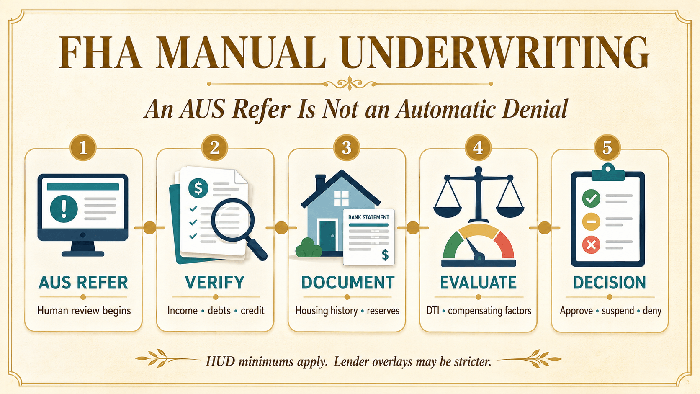
What Happens After an AUS Refer Finding
An Automated Underwriting System (AUS) Refer finding is not a loan denial. It means the system did not issue an automated approval, so the application must be evaluated by a qualified underwriter in accordance with the FHA manual underwriting guidelines.
Review the Information Submitted to AUS
The loan officer and processor first review the AUS findings and verify that the borrower’s income, assets, debts, credit history, and other application details were entered correctly. Correcting a legitimate error may produce a different AUS result. However, accurate debts cannot be omitted, and income or assets cannot be overstated to obtain approval.
Confirm Eligibility for Manual Underwriting
The lender determines whether the borrower meets FHA’s basic requirements and whether the company offers manual underwriting. Some FHA-approved lenders do not manually underwrite loans or impose stricter requirements known as lender overlays.
Collect Additional Documentation
A manually underwritten file may require documents such as:
- A 12-month rent or mortgage payment history
- Bank statements verifying required reserves
- Letters explaining late payments or derogatory credit
- Collection-account or judgment payment agreements
- Bankruptcy or foreclosure documents
- Updated income and employment records
- Evidence supporting eligible compensating factors
The exact documentation depends on the borrower’s credit, income, housing history, and financial circumstances.
Complete the Manual Review
The underwriter evaluates the borrower’s:
- Qualifying income and employment history
- Monthly debts and applicable DTI limits
- Credit and housing-payment history
- Funds required to close
- Post-closing reserves
- Eligible compensating factors
- Ability to afford the proposed mortgage payment
Manual underwriting permits a complete human review, but it does not allow the lender to overlook HUD requirements or use undocumented income.
Receive an Underwriting Decision
After reviewing the file, the underwriter may:
- Approve the loan with conditions
- Suspend the application while requesting additional documentation
- Deny the loan if it does not meet FHA requirements
Most approvals initially include conditions, such as updated pay stubs, additional bank statements, written explanations, or proof that a judgment or other required obligation has been resolved. An AUS Refer finding makes the approval process more detailed, but it does not end the borrower’s opportunity to qualify. A borrower who satisfies FHA’s manual underwriting requirements and the lender’s applicable overlays may still receive final approval and close on the loan.
GCA Manual-Underwriting Case Example
The following anonymized example shows how a borrower may qualify after receiving an AUS Refer finding. Certain details have been changed to protect the borrower’s privacy. A borrower applied for an FHA loan with:
- A 603 qualifying credit score
- A 38% housing ratio and 48% total DTI ratio
- Four months of verified reserves after closing
- A 12-month rental history with no late payments
- Current rent of $1,650
- A proposed mortgage payment of $1,715
The AUS returned “Refer,” so the file required review under the FHA manual underwriting mortgage guidelines. Because the borrower’s ratios exceeded 37/47, the underwriter needed at least two eligible compensating factors to consider ratios up to 40/50. The file included two documented strengths:
- The new housing payment was only $65, or about 4%, higher than the current rent, meeting the FHA’s minimum housing payment increase requirement.
- The borrower had four months of eligible reserves, exceeding the three-payment threshold for a one-unit property.
The underwriter also reviewed the borrower’s income, debts, rental history, bank statements, and explanation for earlier credit problems. The loan received conditional approval, subject to updated pay stubs, proof of reserves, and final employment verification. After the borrower provided the requested documents, the conditions were cleared, and the FHA loan closed. This example shows why an AUS Refer finding is not necessarily a denial. The file still had to satisfy HUD requirements, but documented compensating factors allowed the underwriter to consider the borrower’s complete financial profile. Results vary, and lenders may impose stricter requirements through overlays.
Lender Overlays vs. FHA Minimum Requirements
FHA establishes the minimum requirements for loans insured by the Federal Housing Administration. However, FHA-approved lenders may apply stricter internal rules called lender overlays. These additional requirements help lenders manage risk but are not part of HUD’s minimum standards. Under the FHA manual underwriting mortgage guidelines, a borrower may satisfy HUD requirements yet still be declined by a particular lender due to an overlay. Common lender overlays may include:
- Requiring a credit score of 580, 600, or 620 when FHA permits scores as low as 500 with a 10% down payment
- Refusing to manually underwrite loans after an AUS Refer finding
- Setting DTI limits below FHA’s maximum manual-underwriting ratios
- Requiring more reserves than HUD requires
- Requiring collections or charge-offs to be paid when FHA does not require a payoff
- Applying stricter standards to recent late payments
- Requiring longer waiting periods after bankruptcy or foreclosure
- Declining active Chapter 13 bankruptcy loans, even when the borrower meets the FHA requirements
- Requiring additional rent-verification documentation
An overlay can make FHA requirements more restrictive, but it cannot be used to waive or weaken a HUD requirement. Lenders must also apply their policies consistently and comply with federal fair-lending laws. A denial from one lender does not necessarily mean the borrower is ineligible for FHA financing. Borrowers should ask whether the decision was based on a HUD requirement or an individual lender overlay. Another FHA-approved lender may offer manual underwriting with fewer additional restrictions, although meeting FHA’s minimum requirements never guarantees approval.
Final Thoughts About FHA Manual Underwriting Mortgage Guidelines
An AUS Refer finding does not automatically mean an FHA loan will be denied. It means a human underwriter must review the borrower’s complete financial profile in accordance with the FHA manual underwriting guidelines.
Approval depends on documented income, acceptable credit and housing-payment history, applicable DTI limits, required reserves, and any eligible compensating factors.
Manual underwriting does not waive HUD requirements, but it may give borrowers with past credit problems or an active Chapter 13 bankruptcy another path to homeownership. Because lenders may impose stricter overlays, a denial from one mortgage company does not always mean the borrower is ineligible for FHA financing. Borrowers should determine whether the issue comes from HUD guidelines or the lender’s internal rules before giving up. Every application is different, and satisfying FHA’s minimum requirements does not guarantee approval.
Frequently Asked Questions About FHA Manual Underwriting
How Long Does FHA Manual Underwriting Take?
There is no fixed HUD timeline. The initial review may take several business days, but the complete process can take longer if the underwriter requests additional documents or explanations. The lender’s workload, appraisal, title work, and the borrower’s response time may also affect closing.
Does Manual Underwriting Affect the FHA Interest Rate?
FHA does not establish a separate interest rate for manually underwritten loans. Mortgage rates are set by individual lenders and may vary based on the borrower’s credit profile, loan terms, market conditions, and lender pricing. Comparing Loan Estimates from different lenders can help borrowers assess rates and fees.
Is an FHA Appraisal Required With Manual Underwriting?
Yes, an FHA appraisal is generally required when purchasing a home, regardless of whether the loan is approved automatically or requires manual underwriting. The appraisal evaluates the property’s value and whether it meets FHA’s minimum property requirements. Some FHA streamline refinances may not require a new appraisal.
How Are Student Loans Calculated During FHA Manual Underwriting?
All outstanding student loans must generally be included in the borrower’s DTI calculation. The lender uses the payment reported on the credit report or an actual documented payment when it is greater than zero. If the reported payment is zero, the lender generally uses 0.5% of the outstanding balance as the monthly obligation. HUD Mortgagee Letter 2021-13
Can the Seller Pay Closing Costs on a Manually Underwritten FHA Loan?
Yes. The seller and any other interested entities can typically provide up to 6% of the sale price to cover qualifying closing costs, prepaid expenses, and discount points. Seller concessions cannot be used to satisfy the borrower’s minimum required investment.
Can Down-Payment Assistance Be Used With FHA Manual Underwriting?
Down-payment assistance may be permitted when it comes from an eligible program and is properly documented. The assistance must meet FHA requirements and any rules imposed by the assistance provider. Some lenders may restrict which programs they accept.
Can an FHA Refinance Be Manually Underwritten?
Yes. Certain credit-qualifying FHA refinance transactions may be manually underwritten when required. However, non-credit-qualifying FHA streamline refinances follow different eligibility and documentation requirements and generally do not require a complete credit underwriting review.
This article about “FHA Manual Underwriting Mortgage Guidelines” was updated on July 23rd, 2026.
