

Quick answer: VA home loan requirements are qualifying military service (or surviving spouse eligibility), a Certificate of Eligibility (COE), satisfactory credit, sufficient qualifying income, and a home you intend to buy. The lender will also consider your debts, residual income, available entitlements, and the property. Eligible buyers can buy with no down payment and no monthly mortgage insurance. However, a COE in itself won’t get you approved. The lender is entitled to apply any additional requirements they see fit.
Who Is Eligible for a VA Home Loan?
Your eligibility is based on your service dates, duty status, how long you served, and the circumstances of your discharge. Some surviving spouses can also qualify.
| Applicant | General eligibility considerations |
|---|---|
| Current active-duty service member | At least 90 continuous days of active service |
| Veteran | Requirements depend on service dates; many veterans who served from August 2, 1990, onward need 24 continuous months, the full qualifying period ordered, or an applicable exception |
| National Guard member | Qualifying active-duty service or six creditable years, with applicable service or discharge conditions |
| Reserve member | Qualifying active-duty service or six creditable years in the Selected Reserve, with applicable conditions |
| Surviving spouse | Eligibility depends on the veteran’s circumstances and the VA’s surviving-spouse rules |
The common rule of “90 days during wartime or 181 days during peacetime” does not cover every veteran’s situation. In some cases, shorter service counts, especially if you have a service-connected disability. Check the VA’s official service-eligibility requirements or request a COE rather than relying on a general service-time rule.
What Does Your Certificate of Eligibility Confirm?
Your Certificate of Eligibility, or COE, documents your eligibility for the VA home loan benefit and provides entitlement information. You can request a COE through VA.gov, through a participating lender, or by mail. Veterans commonly need a DD214. Active-duty applicants generally provide a statement of service. National Guard, Reserve, and surviving-spouse applicants may need different supporting records. A COE does not verify your income, approve your credit, or establish that a particular home qualifies. Those reviews are part of the mortgage application.
Full Entitlement Versus Remaining Entitlement
With full entitlement, VA does not impose a county-based loan limit. Your borrowing amount still depends on lender approval, qualifying income, debts, and the property’s value. If some entitlement remains tied to another VA loan or a prior loss, county loan limits can affect the guaranty calculation and whether a down payment is needed. Ask the lender to review your actual COE before estimating your zero-down buying power. The entitlement amount printed on it is not simply the amount you can borrow.
What Credit Score and Payment History Do You Need?
VA doesn’t have a single universal minimum credit score. Individual lenders can set their own minimums, so a lender’s minimum shouldn’t be treated as VA policy.
Underwriters will also look at how you’ve managed your obligations. Recent mortgage/rent payments, any installment loans, any revolving accounts, and explanations for any derogatory credit will all be relevant beyond the score.
Collections don’t necessarily require payoff in every file. Judgments, delinquent federal debt, and unremitted credit issues all require individual review. Paying a balance doesn’t wipe the payment history associated with it.
What if You Have a Prior Bankruptcy?
Bankruptcy does not automatically prevent a VA purchase. Chapter 7 cases generally involve reviewing time since discharge and re-established credit; two years is a common benchmark, with limited exceptions. During an active Chapter 13 plan, VA permits favorable consideration after at least 12 months of satisfactory plan payments and approval of the new credit by the trustee or bankruptcy judge. Other qualification requirements still apply. For the detailed process, see the section on qualifying for a VA loan during Chapter 13 bankruptcy.
What Income and Employment History Must Be Documented?
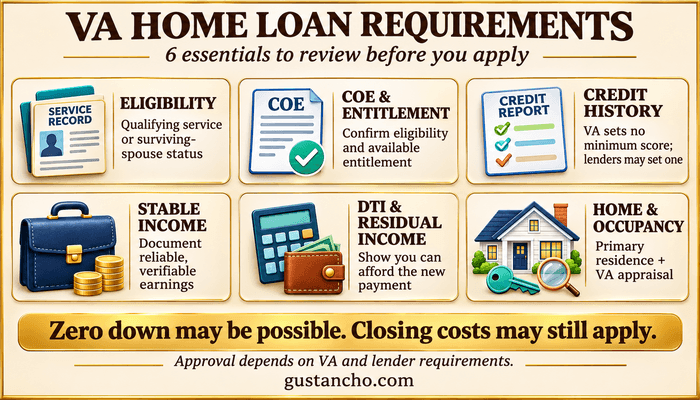
Qualifying income must be verifiable, stable, reliable, and reasonably expected to continue. It may come from employment, self-employment, military pay, retirement, or other eligible sources. Lenders generally review your most recent 2 years of history, but VA does not require 2 years with the same employer. A job change or employment gap requires analysis of the circumstances and current income stability. Self-employed borrowers and applicants using variable earnings may need additional documentation. The amount deposited into an account is not automatically the income available for qualifying. See our VA employment history guidelines for job changes, gaps, and different income types.
How Do DTI and Residual Income Affect VA Approval?
VA underwriting considers both debt-to-income ratio and residual income. They measure different aspects of affordability.
Debt-to-Income Ratio
DTI compares qualifying monthly obligations, including the proposed housing payment, with gross qualifying monthly income. Monthly qualifying debt payments ÷ gross qualifying monthly income × 100 = DTI For example:
| Item | Monthly amount |
|---|---|
| Gross qualifying income | $7,500 |
| Proposed total housing payment | $2,200 |
| Other qualifying debt payments | $1,000 |
| Total qualifying obligations | $3,200 |
| Calculated DTI | 42.7% |
VA underwriting standards use 41% as a benchmark requiring additional consideration when exceeded. It is not an automatic maximum. The example’s 42.7% ratio does not, by itself, establish approval or denial.
Residual Income
Residual income is the money left for family support after applicable deductions. The calculation considers taxes, housing expenses, debts, and other required expenses, including dependent care and estimated maintenance and utilities. The guideline depends on household size, region, and loan amount. It is more detailed than subtracting a mortgage payment and credit-card bills from gross income. For DTI above 41%, residual income at least 20% above the applicable guideline can remove the need for a separate supervisory justification under VA rules. It does not guarantee approval or overcome an otherwise unsatisfactory credit profile.
When Is Manual Underwriting an Option?
Lenders may use an automated underwriting system, or AUS, to evaluate the application. An approval recommendation remains subject to verification and the system’s conditions.
A Refer result may require manual underwriting, in which an underwriter evaluates the file against the applicable VA standards. Some files also require a manual review after additional information is discovered.
VA manual underwriting should not be described using FHA’s fixed front-end and back-end DTI tiers. The review considers creditworthiness, qualifying income, residual income, debts, and the complete circumstances. Ask whether the lender offers this review. Our guide to manual underwriting and DTI explains the distinction further.
What Homes Meet VA Purchase Requirements?
Common eligible options include a one-unit home, a two- to four-unit property where you occupy a unit, and a condominium in a VA-approved project. Manufactured homes and construction transactions have additional requirements and may not be offered by every lender.
Occupancy
A VA purchase is for a primary residence. You have to meet the relevant occupancy certification and timing requirements. There are certain provisions that allow for active-duty deployment or active-duty occupancy by a qualifying spouse or dependent child. You should discuss those circumstances before applying. A property used solely as a vacation home or an investment will not meet the VA’s normal purchase occupancy requirements.
Appraisal and Property Condition
The lender obtains a VA appraisal to establish an opinion of value and determine whether the property meets the applicable minimum property requirements (which relate to safety, soundness, and sanitation). An appraisal is not a substitute for a home inspection. VA recommends an independent inspection to help identify defects and repair needs. If the appraised value is below the contract price, possible options include renegotiating the price, requesting a supported reconsideration of value, or paying the difference with acceptable funds. Property-condition issues may need to be resolved before closing.
How Much Cash Do You Need to Buy With a VA Loan?
A zero down payment does not necessarily mean zero cash is needed.
A down payment may be required because of remaining entitlement, a price above the VA value, or lender requirements. Other expenses can include closing costs, prepaid taxes, homeowners insurance, and escrow deposits. VA’s lack of monthly mortgage insurance does not eliminate the need for homeowners insurance.
Some borrowers also owe a one-time funding fee, while qualifying borrowers are exempt from it. For fee charts, calculations, payment options, and refunds, see understanding the VA funding fee. Request an estimate showing your total monthly housing expense and cash needed to close before setting your purchase budget. If you already own a home and want to replace an existing mortgage, use our separate VA refinance guidelines.
What Documents Should You Prepare for VA Preapproval?
The documents you need will depend on your income, service status, and credit history.
| Category | Commonly requested records |
|---|---|
| VA eligibility | COE and applicable service or surviving-spouse documents |
| Employment income | Recent pay stubs, W-2 forms, and employment verification |
| Other qualifying income | Applicable tax returns, award letters, or supporting income records |
| Assets | Recent account statements and documentation of funds needed to close |
| Housing and credit issues | Housing-payment records, explanations, and applicable bankruptcy or debt-resolution documents |
Before you rely on a preapproval letter, check with the lender to see what they have actually verified. If the estimate is based on unverified information, it is less reliable than one that comes from a full review of your documents. After you choose a home, your approval will also depend on the property, the appraisal, the title, and the final underwriting review. If you take on new debts, your income changes, or your financial details are updated, your approval could change before closing.
What Should You Do if Another Lender Denies Your VA Loan?
Start with the specific reason. A credit score overlay, insufficient qualifying income, existing federal debt and an ineligible property all have different solutions. Ask which requirement hasn’t been met and whether it’s a VA requirement or one that the lender has imposed as part of their own policy. Then determine the practical next step which will be one of the following: fix the information that’s inaccurate, document the income, pay down the debt, adjust the housing budget or simply allow time to re-establish the credit. Another lender may have different requirements of course, but they can’t get around the VA eligibility and repayment requirements. Gustan Cho Associates can look at the stated reason for the denial and the available lender options. A second review is an opportunity to look at the file, not a guarantee of approval.
Frequently Asked Questions About VA Home Loan Requirements
Do You Have to Be a First-Time Homebuyer?
No. VA purchase financing is not restricted to first-time buyers. Previous homeownership does not disqualify you. Your eligibility, available entitlement, current finances, and intended occupancy determine whether a new purchase can qualify.
Can a Non-Veteran Spouse Be on the Loan?
Yes. An eligible veteran can generally apply with a non-veteran spouse. The lender reviews the applicants’ qualifying income, debts, and credit. The spouse does not need separate military eligibility to participate as the veteran’s spouse.
Are Cash Reserves Required?
There is no single reserve amount that applies to every VA purchase. Specific VA or lender requirements can apply. For example, using prospective rents from a multi-unit property to qualify generally requires six months of mortgage-payment reserves and evidence supporting the applicant’s ability to manage the rentals.
Can You Close Using a Power of Attorney?
VA permits a properly prepared power of attorney, subject to its requirements and applicable state law. Have the lender and settlement provider review the document early. A general document may not include all the transaction-specific authority and consent needed.
How Long Does a VA Preapproval Last?
The lender determines the validity period and may require updated financial documents or credit information. Check the expiration date on the letter and ask what is needed to renew it. A valid preapproval still does not guarantee final loan approval.
Final Thoughts About VA Home Loan Requirements
VA home loan requirements focus on three main things: if you qualify for the benefit, if you can repay the mortgage, and if the home meets the program’s standards. Check your COE and entitlements early, get a financial review in writing, and review all your housing costs. This approach gives you a more accurate budget than just looking at your credit score or zero-down offers.
VA Home Loans For Each Individual State:
Alabama | Arkansas | Alaska | Arizona | California | Colorado | Connecticut | Delaware | Florida | Georgia | Hawaii | Idaho | Illinois | Kentucky | Louisiana | Maine | Maryland | Michigan | Minnesota | Mississippi | Missouri | Montana | Nebraska | New Hampshire | New Jersey | Nevada | New Mexico | North Carolina | North Dakota | Ohio | Oklahoma | Pennsylvania | Rhode Island | South Carolina | South Dakota | Tennessee | Texas | Washington | Utah | Oregon| Vermont | Virginia | Washington DC | Washington | West Virginia | Wisconsin | Wyoming | Puerto Rico | Massachusetts | New York
This article about “VA Home Loan Requirements: Eligibility, Credit, Income, and Property Rules” was updated on October 30th, 2026.
