
You may still qualify for a VA loan with poor credit because the Department of Veterans Affairs does not set a minimum credit score requirement. However, lenders still have to determine that you are a satisfactory credit risk. Approval depends on more than your FICO score. Lenders may review your recent housing history, income, debts, residual income, payment history, reasons for past credit problems, and whether the loan receives automated approval or requires manual underwriting. Some lenders also have their own minimum credit-score requirements or investor overlays.
Is There a Minimum Credit Score Required by the VA?
The Department of Veterans Affairs has no set minimum credit score for VA loans. The lender must determine whether the applicant is an acceptable credit risk based on the entire loan file.
This means that applicants with lower credit scores cannot assume that VA financing is out of the question. A credit score is only one aspect of the loan application and is not the sole component that determines the application outcome.
Certain lenders will have their own credit score minimums. These requirements are normally viewed as lender or investor overlays. Veterans with poor credit who are looking for a VA loan may benefit from a lender that adheres to VA standards rather than applying credit score overlays.
How Do Lenders Evaluate Poor Credit on a VA Loan?
VA underwriting focuses on applicants’ payment history. A lender must evaluate the entire credit report rather than deny a loan based on a single late payment. An underwriting decision may consider the following:
- Recent payment history
- Mortgage or rental payment history
- Collection and charge-offs
- Revolving and installment debt
- Bankruptcy and/or foreclosure
- Improvement in credit after financial setbacks
- Stability and history of employment
- DTI ratio
- Residual Income
Poor credit may also be a factor. Continuing poor credit may have a different effect than timely payments and the fulfillment of obligations. The question is whether the borrower can afford and wants to pay the new mortgage payment.
Can You Get a VA Loan if Your Credit Score is Between 500 and 619?
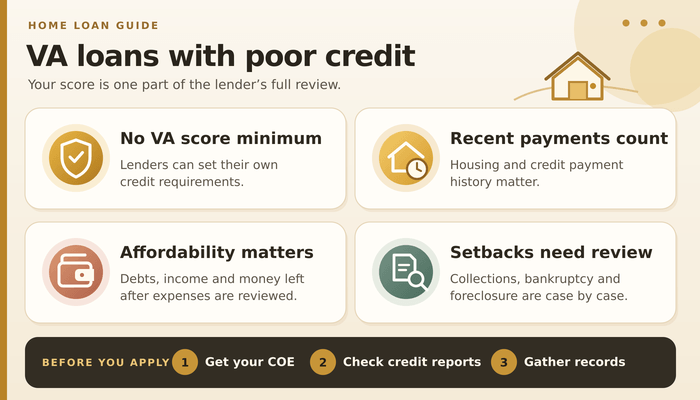
VA Loans will approve credit scores below 619, but do not always set a minimum credit score for applicants. The difficulty is not meeting the VA credit score requirement, but finding lenders that approve mortgages at that credit score.
A lower-credit VA loan usually receives more scrutiny. Lenders will consider recent payment history, the history of all housing payments, residual income, debt levels, employment history, and the reason for the credit score issues.
Not every borrower with a credit score of 500 will be approved, and a credit score of 619 does not mean automatic approval. Applicants with lower credit scores can be approved if they have no financial issues and can afford the new mortgage payment.
Automated vs. Manual Underwriting
VA loan reviews can either be automated or, in some cases, manual.
Automated Underwriting
In automated underwriting, lenders review the mortgage application, credit information, and other financial and loan information. An approved finding through automated underwriting lessens the documentation requirements. The lender is still responsible for verifying that the borrower and the loan meet VA’s requirements.
Manual Underwriting
Some VA loan files require manual underwriting. With manual underwriting, lenders can review the borrower’s actual credit circumstances beyond the automated suggestion. In situations of recent credit issues, lenders may request additional underwriting documents. Manual underwriting is not a way around VA guidelines. A borrower would also have to meet income requirements, maintain acceptable credit, have sufficient residual income, and obtain a loan that is prudent given the overall credit situation.
Do Recent Late Payments Prevent VA Loan Approval?
A recent late payment does not automatically end a VA loan application. The lender reviews when it occurred, how serious it was, whether other payments were late, and what the borrower has done since. The lender may request an explanation and supporting documents. Mortgage lates can also change how the loan is underwritten. Under the VA Lenders Handbook, Chapter 4, Topic 8, an automated Accept/Approve finding must be manually downgraded to Refer when a mortgage has more than one 30-day late payment in the past 12 months. For a Refer file with that history, the handbook requires a written explanation. A Refer finding calls for further underwriting; it is not, in itself, a denial.
Why Housing Payment History Matters for a VA Loan
Rent and mortgage payments help a lender assess how you have handled housing costs. If your automated underwriting result is Refer and you have rental history, the VA Lenders Handbook, Chapter 4, Topics 7 and 8 call for documentation of the most recent 24 months through the landlord, credit report, or canceled checks. For an Accept/Approve result, the handbook does not require separate verification of rent. Tell your lender if you rented for less than 24 months or lived without paying rent so the file accurately explains your housing history. Mortgage payment history is reviewed separately, including outstanding, assumed, or recently paid-off mortgages when applicable.
VA Loan Guidelines for Collections, Charge-Offs, and Judgments
Collections and charge-offs do not automatically deny a VA loan. They are considered on a case-by-case basis.
Medical Collections
VA offers lenders the flexibility of not requiring the borrower to pay identifiable medical collections and medical charge-offs that have not become judgments or liens.
Non-Medical Collections
An unpaid nonmedical collection does not automatically prevent VA loan approval. The lender must review the collection and the borrower’s overall credit history. If the collection has no established payment arrangement, VA’s August 2026 guidance calls for a calculated monthly payment equal to 5% of the outstanding balance divided by 12. For example, a $6,000 collection would count as $25 per month under that calculation. A collection with an established payment arrangement requires review of its documented payment terms. Paying a collection just before applying does not erase the earlier credit history.
Judgments
A court judgment requires a different review from an ordinary collection. Under the VA Lenders Handbook, Chapter 4, Topic 7, the judgment must be paid in full or placed on a repayment plan with a history of timely payments. VA generally considers 12 payments evidence of re-established credit. That is not an absolute minimum in every case. If the judgment was filed only a few months ago and the borrower promptly began a repayment plan, an underwriter may document and justify a shorter history. The lender must still assess the borrower’s overall credit.
Denied for a VA Loan Because of Poor Credit? Get a Second Opinion
Some lenders apply stricter credit overlays than others. We’ll review your credit, DTI, residual income, AUS findings, and VA loan options to see what may still work.VA Debt-to-Income Ratio and Residual Income
VA reviews both your debt-to-income ratio (DTI) and your residual income. DTI compares your proposed housing payment and other monthly debts with your qualifying income. VA uses 41% as its standard, but a DTI above 41% does not automatically mean denial.
What Is Residual Income?
Residual income is the money left each month after taxes, the proposed housing payment, debts, and other required expenses are accounted for. VA compares that amount with a guideline based on household size, region, and loan amount. When DTI exceeds 41% and residual income is at least 20% above VA’s applicable guideline, VA does not require the specified second-level review and written justification for the higher ratio. This is not automatic approval. The lender must still determine that the borrower has acceptable credit and can afford the loan.
Can You Get a VA Loan After Bankruptcy?
Bankruptcy does not automatically rule out a VA loan. The lender reviews the type of bankruptcy, when it occurred, what caused it, and how you have handled credit since then. These are credit-review guidelines, not promises of approval.
After Chapter 7 Bankruptcy
Under the VA Lenders Handbook, Chapter 4, Topic 7, a Chapter 7 bankruptcy discharged more than two years before closing may be disregarded in the credit review. If the discharge was one to two years ago, the lender must closely evaluate whether you have re-established satisfactory credit and whether verified circumstances beyond your control caused the bankruptcy. A discharge within the past 12 months generally makes it difficult to establish that you are a satisfactory credit risk.
During Chapter 13 Bankruptcy
A borrower in an active Chapter 13 plan may receive favorable consideration after satisfactorily making at least 12 months’ worth of plan payments, provided the trustee or bankruptcy judge approves the new credit. The lender must still review the borrower’s credit, income, debts, and ability to make the proposed mortgage payment.
VA Loans After Foreclosure, Short Sale, or Deed in Lieu
A past foreclosure does not automatically disqualify a borrower. VA directs lenders to review what happened and how credit has been re-established. A foreclosure finalized more than two years before closing may be disregarded. A foreclosure finalized one to two years before closing requires a closer review of subsequent payment history and verified circumstances beyond the borrower’s control. VA treats a short sale or deed in lieu based on the circumstances. If the borrower kept the mortgage payments current before transferring the property and communicated voluntarily with the servicer, a waiting period from the transfer date may not be necessary. The lender still reviews the full credit file. When a bankruptcy and property transfer occur together, the handbook directs lenders to use the later of the bankruptcy discharge or title transfer when assessing the start of re-established credit.
What If the Previous Loan Was a VA Loan?
A foreclosure, short sale, or deed in lieu of a previous VA-guaranteed mortgage may adversely affect a Veteran’s remaining eligibility. To see the remaining entitlement, the lender must review the current Certificate of Eligibility. Prior loss of VA entitlement may reduce the available entitlement for a borrower who otherwise meets the mortgage criteria.
VA Loan Eligibility and Certificate of Eligibility
Applicants for VA mortgages must be eligible for the VA home loan benefit to have their credit considered for a VA Loan.
A Certificate of Eligibility (COE) provides the applicant’s VA service information and indicates the VA entitlement available. Veterans, active-duty service members, some National Guard and Reserve members, and surviving spouses may be eligible. Qualifying service depends on when and how the applicant served.
Borrowers can request a COE from the VA or have their lender request it on their behalf. Veterans will need to provide their DD214, while active-duty service members will need a statement of service. Having a COE does not mean loan approval. The borrower must meet VA and lender standards for credit, income, occupancy, and the requested loan amount.
Common Reasons a Low-Credit VA Loan Gets Denied
Just having a low credit score does not result in a denial for a VA Loan. Denials are more common when the rest of the loan file does not support approval. Common problems:
- Many recent extended payment deadlines
- Problems with the payment of mortgages or rent
- Credit problems recur after bankruptcy or foreclosure.
- Lack of sufficient income
- High month-to-month commitments
- Low residual monthly income
- Significant increase from the existing housing payment to the proposed mortgage payment
- Unsettled judgments or serious credit obligations with a high level of concern
- Income or employment that cannot be sufficiently documented
- An AUS Refer finding for loan underwriting.
- Lender or investor overlays that are stricter than VA guidelines
A single late payment that occurred years ago is significantly different from a pattern of late payments that occurred in the months prior to the application. The same applies to credit scoring. Someone with a credit score of 560 may present a very high level of credit risk if they have high levels of commitment and a poor credit history, while someone with a credit score of 560, a low level of commitment, stable employment, and a satisfactory credit history may present a low level of credit risk. A poor credit history may justify a VA loan denial. However, VA loans may also consider other factors, such as residual income, if the credit score is considered marginal.
Steps to Take Before Applying for a VA Loan With Poor Credit
Borrowers with credit problems should have their files reviewed in full. Improvement of credit should not take many months or years. The following steps should be taken:
- A VA Certificate of Eligibility must be obtained to determine eligibility and available entitlement.
- Ensure that all three credit reports are obtained to review for late payments, collections, charge-offs, judgments, disputed accounts, and incorrect information.
- Do not automatically pay collections. Do not assume that payment of an account is warranted to receive VA approval, and do not assume that payment will positively impact your credit score.
- Be prepared to document your housing payment history. Be prepared to show the results of rent or mortgage payments when required.
- Be prepared for some potential scrutiny of your underwriting if there will be a significant increase in your proposed housing payment.
- Your lender must evaluate your proposed payment relative to your income and the total of your monthly debts to determine whether the proposed purchase price is justified.
- Be prepared to gather applicable bankruptcy or foreclosure documentation. The documentation you may need will depend on the borrower’s history and may include discharge documents, a history of the Chapter 13 payment plan, trustee approval, foreclosure documents, etc.
- Be aware that newly incurred debt will affect your credit score, DTI, and underwriting, so do not make any new purchases.
A borrower must understand that an improved FICO score is just one of the steps required for credit approval. There are other important factors and underwriting considerations, such as recent payment history and a lender overlay that may be understood to go beyond the VA guidelines.
Example: Two Veterans With the Same 570 Credit Score
Two veterans apply for VA loans, each with a 570 credit score. The first has older collections following a period of financial hardship. Since then, they have made payments on time, maintained a stable income, and shown sufficient residual income to cover the proposed mortgage payment. This veteran may have a stronger application, but the lender must review the complete file before making a decision.
The second veteran also has a 570 score but has missed several recent payments, has an unresolved judgment, and cannot document enough stable income to support the new payment. The veteran with the more recent credit problems may face greater difficulty qualifying.
The score is the same in both examples. Their payment histories and ability to afford the loan are different.
Final Thoughts on Getting a VA Loan With Poor Credit
Poor credit should not automatically prevent eligible veterans and service members from getting VA loans reviewed. VA sets no minimum credit score, but a borrower must demonstrate the ability and desire to repay the loan. Credit history, housing history, income, debts, residual income, bankruptcy or foreclosure history, and lenders’ requirements all impact the mortgage decision. Having a complete loan file reviewed is the biggest factor in determining if a low score will deter ownership. Borrowers who have been denied a mortgage due to poor credit, high DTI ratios, collections, bankruptcies, or lender overlays may consider a second-mortgage review to see if there is another VA lending option.
Frequently Asked Questions About VA Loan With Poor Credit
Can I Get a VA Loan if I have no Credit Score?
Possibly. VA does not generally treat the absence of a credit history as a negative factor. A lender may review verifiable payments on accounts that do not appear on a traditional credit report. The lender must still determine whether you are an acceptable credit risk, and its own requirements may apply.
Can I Buy a Home with a VA Loan and no Down Payment if My Credit is Poor?
Poor credit does not, by itself, create a VA down-payment requirement. A no-down-payment purchase may be possible if you qualify, have enough entitlement, and the price is no higher than the appraised value. You may still need money for closing costs. If you have reduced entitlement, a lender may require a down payment.
Will My Spouse’s Poor Credit Prevent Me from Getting a VA Loan?
Not automatically. If your spouse applies with you, the lender reviews both borrowers. If you apply alone, whether the lender must consider a non-borrowing spouse’s debts can depend on community property rules. Ask the lender to explain whose income and debts it used and how it assessed the application.
Will Applying with Several VA Lenders Hurt My Credit Score?
You can evaluate different lenders even if your credit isn’t flawless. The Consumer Financial Protection Bureau states that multiple mortgage credit checks within a 45-day window count as one inquiry for credit scoring. Compare the Loan Estimates and each lender’s credit requirements.
Does Poor Credit Increase the VA Funding Fee?
No. VA bases the funding fee on factors such as the loan type and amount, whether you have used the benefit before, and how much you put down. Credit score is not a VA funding-fee factor. Your lender’s interest rate and other loan costs can still vary. Certain borrowers, like those with VA compensation for a service-connected disability, do not have to pay the fee.
Can VA Disability Compensation Help Me Qualify if My Credit is Poor?
VA disability compensation may count as qualifying income when the lender verifies that you receive it and evaluates whether it is expected to continue. It can help demonstrate that you can afford the payment, but it does not erase credit problems or guarantee approval. Tell your lender about the benefit and provide the requested VA documentation.
This article about “VA Loan With Poor Credit: What Lenders Check in 2026” was updated on September 24th, 2026.
