
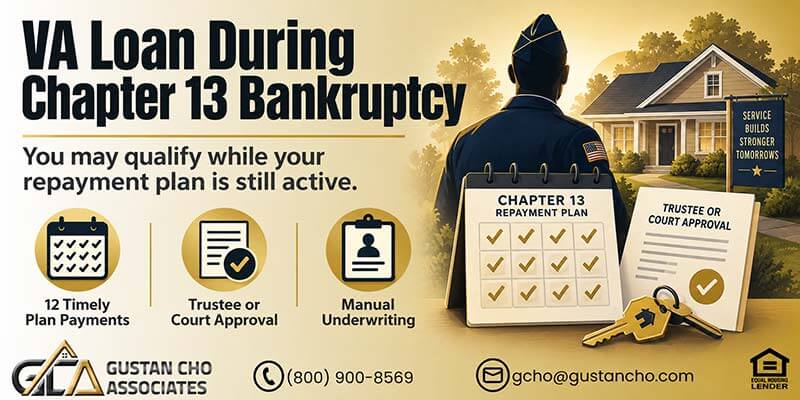
Many Veterans are often told they must wait until their Chapter 13 bankruptcy is discharged before applying for a VA loan. That is not always the case. According to VA guidelines, a borrower may still receive consideration even while in an active Chapter 13 repayment plan.
A Chapter 13 bankruptcy does not need to be discharged before a borrower qualifies for a VA loan. Lenders may consider the application favorably if the borrower has made at 12 months of on-time payments and has received approval from the trustee or the bankruptcy judge.
An active Chapter 13 case usually requires permission from the trustee or the bankruptcy court. The loan will also typically go through underwriting. This means an underwriter will carefully review the borrower’s credit history, income, debts, residual income, housing-payment history, and overall ability to repay the mortgage.
Approval is not guaranteed. The borrower must still meet all VA eligibility requirements and the lender’s own underwriting standards. Some lenders also apply overlays which’re extra conditions that are stricter, than the basic VA rules.
VA Loan During Chapter 13 Bankruptcy: Guidelines for Veterans
If you are in Chapter 13 bankruptcy, you might still qualify for a VA loan before your bankruptcy is fully discharged. The VA Lender’s Handbook says that if you have made at twelve on‑time payments on your Chapter 13 plan and the bankruptcy trustee or judge gives approval then a VA loan could be on the table for you. I understand how stressful this can be. I hope this helps you see the path forward. This difference matters.
Some Veterans are told they must finish Chapter 13 or wait years after bankruptcy to get a mortgage, but the VA’s official guidance does not require this. However, qualifying is not automatic.
The lender still needs to make sure you are a good credit risk and that you have enough verified and leftover income to afford the new mortgage payment.
Can You Qualify and Get Approved for a VA Loan During Chapter 13 Bankruptcy?
If you have made at least 12 months of on-time Chapter 13 payments and your trustee or judge approves, you may be considered for a VA mortgage even if your bankruptcy is still active. The lender will still need to review your income, credit, debts, property, and your ability to repay the loan?
Yes, borrowers in an active Chapter 13 bankruptcy repayment plan can qualify and get approved for an FHA loan during an active Chapter 13 bankruptcy, one year after filing and having made 12 timely monthly payments.
If you are in an active Chapter 13 bankruptcy, you are not automatically disqualified from getting a VA-backed mortgage if you meet the other requirements. Chapter 13 bankruptcy. It states that when borrowers have satisfactorily made at least 12 months of Chapter 13 payments, and the trustee or bankruptcy judge approves new credit, the lender may extend favorable consideration to the borrower. This means you do not have to finish your Chapter 13 case before starting the mortgage process. However, being considered for a VA loan is not the same as being approved. You still need to meet all the lender’s requirements.
The Lender Must Still Evaluate the Complete Loan File, Including:
- VA eligibility and Certificate of Eligibility
- Chapter 13 payment history
- Trustee or bankruptcy court authorization
- Employment and qualifying income
- Current debts
- Housing expense
- Credit history since filing for bankruptcy
- Residual income
- Debt-to-income ratio
- Assets and funds needed for closing
- VA appraisal and property eligibility
- Any additional underwriting conditions
Does a VA Eligibility Guarantee a VA Loan?
Keep in mind that being eligible for a VA loan does not mean you will be approved. Even if you have a Certificate of Eligibility a private lender must look at your credit your income, your debts your history of repaying money and your overall ability to pay back the mortgage.
When you are applying for a VA loan while in Chapter 13 bankruptcy your payment history is very important. The lender might look at your situation favorably if you have successfully made at least 12 months of payments, under your Chapter 13 plan and if the bankruptcy trustee or court agrees to the new mortgage debt. You also need to meet all the VA underwriting requirements that the lender has.
The lender will need to check whether you have made the required payments on time and in full. Chapter 13 bankruptcy is different from Chapter 7.
A borrower in Chapter 13 follows a repayment plan and makes scheduled payments to the bankruptcy trustee. I have seen many people manage this carefully.
A consistent repayment history can help. Making your payments on time shows you are working through your financial issues and may be able to handle a new mortgage payment without documentation. You should get an official record of your Chapter 13 payments rather than relying solely on your bank statements.
VA Loan During Chapter 13 Bankruptcy? You May Still Qualify
Eligible veterans and service members may be able to qualify for a VA loan during an active Chapter 13 plan with acceptable payment history, trustee or court approval, and manual underwriting.What Happens if You Made a Late Payment During Chapter 13 Repayment Plan
If one of the previous 12 payments was made after the scheduled trustee payment date, the lender may ask for supplementary documentation or an explanation. Whether the payment history satisfies the lender’s interpretation of the VA requirement depends on the actual bankruptcy record and the underwriting review. Do not hide or try to explain away a late payment. Give the lender all the documents they ask for and let them review your situation.
Bankruptcy Judge Approval for a VA Mortgage
Making 12 months of satisfactory Chapter 13 payments is only part of the process. The VA Lender’s Handbook also calls for approval of the new credit by the bankruptcy trustee or bankruptcy judge. This rule is important because getting a mortgage can change your monthly expenses and financial situation while you are still in a Chapter 13 repayment plan.
What Does a Bankruptcy Trustee Approval Mean?
The borrower generally needs authorization permitting the proposed mortgage transaction. The exact procedure can vary by bankruptcy district, trustee, case, and local court practice. Some cases may involve written authorization from the trustee. Others may require a motion and a formal court order. The mortgage lender does not control how this approval process works. Borrowers should work with their bankruptcy attorney to find out the right steps for their situation.
Requesting Trustee Approval for an FHA Loan During an Active Chapter 13 Repayment Plan?
It’s usually best to talk to an experienced loan officer about your mortgage options before asking your bankruptcy attorney to get final approval.
A Trustee or Court May Need Information Such As:
- Proposed purchase price
- Estimated mortgage amount
- Estimated principal and interest
- Property taxes
- Homeowners insurance
- HOA dues, when applicable
- Approximate total housing payment
- Proposed funds required at closing
- Expected mortgage terms
Getting your mortgage qualification details first can help prevent your attorney from submitting a request with numbers that might change later.
VA Loan During Chapter 13 Bankruptcy Requires Manual Underwriting?
If you are in an active Chapter 13 bankruptcy, your loan may require more review by an underwriter than a typical automated approval process. The lender might manually underwrite your VA loan application depending on your situation and their process.
The more important point for borrowers is that VA allows lenders to evaluate qualifying Veterans who remain in an active Chapter 13 plan when the VA Chapter 13 requirements are met.
If one bank denies your application, it does not always mean the VA program itself does not allow the mortgage. Some lenders have stricter credit rules than the VA’s basic guidelines. These extra rules are called lender overlays. One lender may One lender might not accept active Chapter 13 bankruptcies, but another lender with more experience in these cases may review your application using VA guidelines.
Minimum Credit Score During Chapter 13?
The Department of Veterans Affairs (VA) does not set a universal minimum credit score for VA-backed home loans. Each lender can set its own minimum score and credit rules. Important correction to information sometimes found online suggesting that VA itself requires a 580, 600, 620, or other specific FICO score. Those numbers may represent lender requirements. They are not a universal VA minimum credit-score rule.
Credit Still Matters
Even without a VA minimum score, your credit history still matters. The underwriter must evaluate whether the borrower represents an acceptable credit risk. If you apply for a VA loan while you are in Chapter 13 bankruptcy the lender will examine how you have managed your credit and bills since you filed. Any recent late payments, collections, overdrafts, additional unpaid debt or new credit taken without approval can raise concerns even if your Chapter 13 payments have been on time. I have seen lenders ask about these details.
VA Residual Income Can Be Especially Important

VA underwriters pay close attention to your leftover income after bills, known as residual income. Residual income is the money you have left each month after paying your main bills and estimated home expenses. VA’s published underwriting guidance states that residual VA guidelines say that underwriters should look at your residual income along with other credit factors. If you do not have enough residual income, your loan could be denied. Underwriting a borrower who is already making payments under a Chapter 13 repayment plan.
VA Debt-to-Income Ratio Is Not a Simple Hard Cap
The commonly discussed VA debt-to-income benchmark is 41%. Many people talk about a 41% debt-to-income ratio for VA loans, but VA does not use this number as a strict cutoff for approval or denial. It is used as a guide and says it is secondary to residual income. Ratios above 41% receive additional scrutiny, with the underwriting analysis considering residual income and the borrower’s overall credit profile.
So, You Should Not Assume the Following:
- “Over 41% DTI means I cannot get a VA loan.”
They Also Should Not Assume:
- “VA has no DTI guidelines.”
Neither of these statements is correct about how VA underwriting works. The entire financial profile matters.
What Documents May Be Needed for a VA Loan During an Active Chapter 13 Bankruptcy?
Every situation is different, but you should expect to provide more paperwork than you would for a regular VA mortgage.e VA mortgage.
Common Documentation May Include:
Chapter 13 Bankruptcy Documents
- The lender may request the bankruptcy petition, schedules, repayment plan, amendments, trustee payment history, and other applicable bankruptcy documents.
Chapter 13 Payment History
- The lender will need documentation supporting the required satisfactory repayment history.
Trustee or Court Authorization
- The loan file will need evidence that taking on the new mortgage obligation is authorized, as required for the bankruptcy case.
Income Documentation
- Depending on the borrower’s employment and income sources, documentation may include pay stubs, W-2s, tax returns, employment verification, military income documentation, retirement income documentation, disability income documentation, or other evidence.
Bank and Asset Statements
- The lender may need documentation covering funds for closing, deposits requiring explanation, reserves when relevant to underwriting, and other assets used in the transaction.
Housing History
The lender may evaluate the borrower’s current housing expense and housing payment history when relevant to the underwriting. The documents you need will vary with your loan and, with what the underwriter discovers. Do not assume that every lender will ask for the paperwork. I advise you to keep a list of common documents and be prepared for variations.
VA Loan During Chapter 13 With Bankruptcy and Low Credit Scores Often Goes Together, But a Low Score Does Not Tell the Whole Story
An underwriter reviewing a Veteran in Chapter 13 is trying to determine the borrower’s current financial behavior. A borrower who filed for bankruptcy after a major financial hardship but has since established stable employment, maintained satisfactory Chapter 13 payments, avoided new delinquencies, and demonstrated sufficient residual income presents a different risk profile from a borrower who continues to accumulate late payments after filing. That’s why it’s important to rebuild your financial stability while you are making Chapter 13 payments.
Prevent New Late Payments While Preparing for a VA Loan
If you make a late payment right before applying for a mortgage, it can cause problems. Lenders review your Chapter 13 payment history to see if you have shown better financial habits.
Veterans Preparing for a VA Mortgage Should be Particularly Careful With:
- Chapter 13 payments
- Rent or mortgage payments
- Auto loans
- Credit cards
- Student loans
- Child support or other court-ordered obligations
- Newly opened credit accounts
If you had a real, documented reason for a late payment, give the lender the paperwork they ask for instead of leaving it out
Should You Open New Credit During Chapter 13?
Do not take on new debt unless you know your bankruptcy plan allows it, and you have the needed approval. If you are in Chapter 13, you are following a court-supervised repayment plan. Getting a new loan or credit card without approval can make both your bankruptcy and mortgage process more complicated. Questions about what the bankruptcy plan permits should be directed to the borrower’s bankruptcy attorney. Mortgage professionals can explain the loan process, but they cannot give you legal advice about your Chapter 13 case.
What Happens After Chapter 13 Is Completed?
VA’s guidance distinguishes a successfully completed Chapter 13 repayment plan from a borrower who has not yet established a satisfactory repayment history.
The VA Lender’s Handbook states that when borrowers have finished making all Chapter 13 payments satisfactorily, the lender may conclude that satisfactory credit has been re-established.
This is important because it means you do not always have to wait two years after finishing Chapter 13, as some people claim. The VA’s guidance is more flexible. However, finishing Chapter 13 does not guarantee you will be approved for a mortgage. The lender will still review your current credit, income, debts, VA eligibility, property, and your ability to repay the loan.
VA Loan During Chapter 13 Versus Chapter 7 Bankruptcy
Chapter 7 and Chapter 13 should not be treated as interchangeable when discussing VA mortgage guidelines. Chapter 13 includes a repayment plan and contains specific VA guidance allowing favorable consideration after at least 12 months of satisfactory plan payments with trustee or bankruptcy judge approval. Chapter 7 involves a different bankruptcy process and underwriting analysis. If you are looking for information about an active Chapter 13, make sure to follow the specific Chapter 13 rules instead of using general bankruptcy waiting periods from other types of bankruptcy.
Can You Buy a House While the Chapter 13 Case Is Still Open?
Potentially, yes. That is one of the main benefits of understanding the actual VA Chapter 13 guidelines. You may not have to wait several more years just because your Chapter 13 case is still open.
The Central Questions Become Whether the Borrower Has:
- Established the required satisfactory Chapter 13 repayment history.
- Obtained the necessary trustee or court authorization.
- Met VA eligibility requirements.
- Demonstrated satisfactory credit behavior.
- Documented stable qualifying income.
- Shown sufficient residual income.
- Met the lender’s complete underwriting requirements.
- Selected a property that meets VA requirements.
How to Prepare Before Applying for a VA Loan During Active Chapter 13 Bankruptcy
Getting prepared can help you avoid delays in the loan process during an active Chapter 13 bankruptcy. Start by getting your Chapter 13 payment history and checking it for any missed or late payments. Next, speak with your bankruptcy attorney about the procedure your trustee or the bankruptcy court uses when a debtor seeks mortgage financing.
The goal is not simply to get the mortgage you can qualify for. The goal is to get a VA mortgage that fits your Chapter 13 plan and still leaves you money each month for your regular expenses.
Next gather your income, employment details, housing information, assets, bankruptcy records and credit documents. Having these ready will help you move forward with confidence. It also helps to have a mortgage professional review your estimated new housing payment before you seek final approval from the trustee or the court.
Reasons VA Loans During Chapter 13 Run Into Problems
A common problem is applying with a lender that does not accept active Chapter 13 cases under their own rules. Other issues can include recent credit problems, insufficient qualifying income, unstable employment, inadequate residual income, unverified funds needed for closing, property problems, or difficulty obtaining the required bankruptcy authorization.
A denial, therefore, if your loan is denied, the lender should tell you the reason why the problem is just the lender’s own policy and not a VA rule; another VA lender might look at your loan differently.
But if the issue is a VA rule or your financial situation, switching lenders will not fix the problem. A lender overlay is an additional rule that a lender adds to the basic VA guidelines. A lender may establish its own minimum credit score or decline applicants who are still in an active Chapter 13 bankruptcy case, even though VA guidance provides a path to favorable consideration once the applicable requirements are met.
What Makes You Qualified on a VA Loan During an Active Chapter 13 Bankruptcy
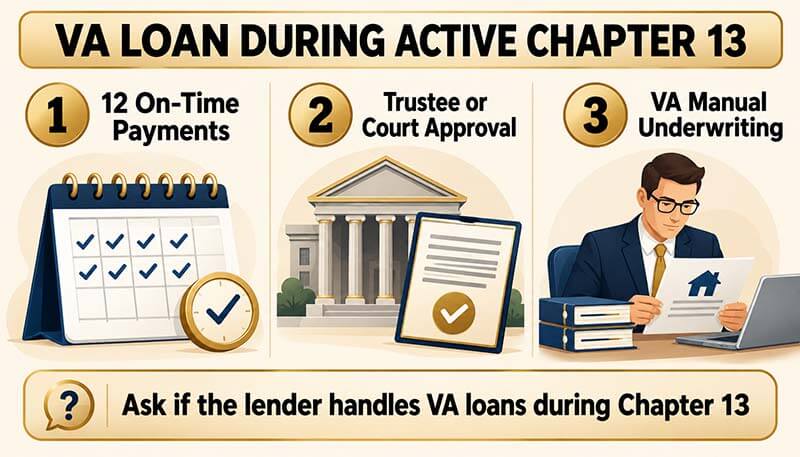
Borrowers should therefore ask a very specific question: When you contact a lender, be sure to ask this specific question who are currently in an active Chapter 13 repayment plan after they have established 12 months of satisfactory payments and obtained trustee or court approval?”
- That question is more useful than simply asking if the lender offers VA loans.
- VA-backed mortgages offer many benefits to eligible Veterans, service members, and some surviving spouses.
- VA loans are made without a down payment.
- The program also does not establish a universal minimum credit score, although lenders may establish their own requirements.
- The Veteran must still meet the lender’s credit and income standards. The property must also meet VA requirements.
- The VA guaranty protects the lender if a borrower defaults.
- This government guarantee helps participating lenders offer VA financing terms that can be especially helpful for borrowers.
Keeping things transparent and having all your documents organized can make this process smoother. Tackle each step one at a time. This approach will help you move closer to securing a VA loan even while going through Chapter 13 bankruptcy. Remember communication is key. Keep your documents ready. Stay patient during the underwriting process. These small steps make a difference.
Working With Gustan Cho Associates on a VA Loan During Chapter 13 Bankruptcy
Gustan Cho Associates works with borrowers who may have more complicated mortgage profiles, including Veterans currently in Chapter 13 bankruptcy. The first step is to review the full situation rather than focus on a single credit score or the word “bankruptcy.” The mortgage team can review your Chapter 13 history, income, debts, residual income, credit estimated housing payment, VA eligibility and other factors that affect mortgage qualification. They can help determine what financing options are available to you. Any legal questions, about bankruptcy should be handled by your bankruptcy attorney and trustee. They are the people to guide you through those concerns.
Final Takeaway: A Chapter 13 Bankruptcy Does Not Automatically End Your VA Home Buying Plans
The Most Important Point for Veterans is Simple:
- An active Chapter 13 bankruptcy does not automatically mean you must wait until bankruptcy discharge to pursue a VA mortgage.
- Current VA guidance provides a path for favorable consideration after a borrower has satisfactorily made at least 12 months of Chapter 13 payments and the bankruptcy trustee or judge approves the new credit.
- From there, the lender must determine whether the Veteran qualifies based on the complete loan file.
- That includes income, employment, credit history, debts, residual income, housing expense, VA eligibility, bankruptcy documentation, and the property being financed.
- Borrowers who have been turned down elsewhere should find out whether the denial resulted from an actual VA guideline, their financial qualifications, or an individual lender’s overlay before assuming they are ineligible for a VA mortgage.
Frequently Asked Questions About a VA Loan During Chapter 13 Bankruptcy
How Long Must I Be in Chapter 13 Before Applying for a VA Loan?
Most lenders look for a solid 12 months of on-time Chapter 13 payments. That said, individual lenders might have their own rules, so it’s better to double-check.
Will a VA Loan Affect My Bankruptcy Plan?
A VA loan can get approved if it won’t mess with your repayment plan. Both the bankruptcy court and the trustee will peek at your budget to ensure the new mortgage won’t stretch your finances too thin.
Can I Use a VA Loan to Refinance in Chapter 13?
Yes, a VA Interest Rate Reduction Refinance Loan, or IRRRL, can work, but you must get the bankruptcy court’s OK first. You’ll also have to show that the new loan saves money or makes your situation easier.
Can I get a VA loan During Chapter 13 Bankruptcy?
If you have been in a Chapter 13 bankruptcy plan for a year made 12 on-time payments. Got approval from your trustee you might be eligible for a VA loan.
What Are the Basic Eligibility Requirements for a VA Loan During Chapter 13 Bankruptcy?
To qualify you need to have been in the repayment plan for one year made payments for the past 12 months and have trustee approval.
Do I Need Trustee Approval to Get a VA Loan During Chapter 13 Bankruptcy?
Yes trustee approval is needed to get a VA loan during Chapter 13 bankruptcy. They make sure you are in a position to take on a mortgage.
What Documents Do I Need to Apply for a VA Loan During Chapter 13 Bankruptcy?
You will need proof of on-time payments a trustee approval letter, proof of income and a VA Certificate of Eligibility.
How Does Manual Underwriting Affect My Application for a VA Loan During Chapter 13 Bankruptcy?
Manual underwriting means a look at your financial situation, which can be helpful because automated systems might not understand Chapter 13 cases.
What is the VA Funding Fee, and Do I Have to Pay It?
The VA Funding Fee is a one-time cost to help support the VA loan program. Most veterans pay this fee, which can be added to the loan amount.
What is The Impact of Taking a VA Loan on My Chapter 13 Bankruptcy Plan?
Taking a VA loan during Chapter 13 bankruptcy might mean changes to your repayment plan so it is important to talk with your trustee.
Can My Credit Score Affect My Chances of Getting a VA Loan During Chapter 13 Bankruptcy?
Yes, a minimum credit score of 580 is usually needed, though higher scores can help with approval and better loan terms.
Are There Specific Lenders That Offer VA Loans During Chapter 13 Bankruptcy?
Yes ,some lenders focus on providing VA loans during Chapter 13 bankruptcy. These lenders understand the rules and can help you through the process.
Is There a Waiting Period After Chapter 13 Bankruptcy Discharge to Qualify for a VA Loan?
After a Chapter 13 bankruptcy discharge there is no waiting time to qualify for a VA loan. However, the loan must be manually underwritten if bankruptcy occurs within the last two years.
If you have any questions about VA loan during Chapter 13 bankruptcy, please contact us at 800-900-8569. Text us for a faster response. Or email us at gcho@gustancho.com. The team at Gustan Cho Associates is available 7 days a week, on evenings, weekends, and holidays.
This Guide About VA Loan During Chapter 13 Bankruptcy: What You Need to Know Was Updated on September 27, 2026.
