When Is Rental Verification Required? (Quick Answer for Borrowers)
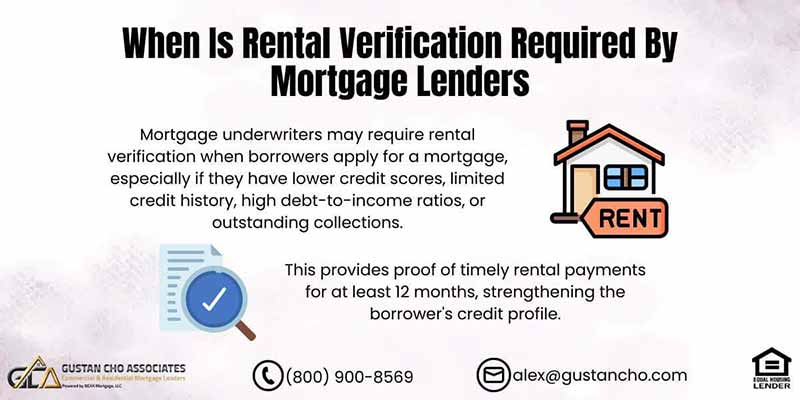
If you’re buying a home, you may be wondering when is rental verification required during the mortgage process. In plain English: lenders request rental verification (also called Verification of Rent or VOR) when they need proof that you’ve consistently paid your housing payment on time—especially if your file needs a closer look.
Rental verification is most commonly required when your loan is going through manual underwriting (a human underwriter reviews your file instead of relying only on an automated approval), or when there are risk factors like lower credit scores, limited credit history, higher debt-to-income (DTI) ratios, or recent late payments. A strong 12-month rent history can act as a compensating factor and help you prove you’re ready to handle a mortgage payment.
In this guide, you’ll learn when rental verification is required, which loan situations trigger it, what documents lenders accept (checks, bank statements, management-company VOR forms, and some digital payment records), and what to do if you’ve been paying rent in cash or living rent-free. By the end, you’ll know exactly how to prepare your rent history so it supports your approval instead of slowing you down.
What Is Rental Verification?

Rental verification is a process where mortgage lenders confirm your history of paying rent on time. It’s like providing proof that you’ve been consistently paying housing expenses. Rental verification is an extremely strong credit tradeline that will add strength to the mortgage loan borrower’s credit profile.
When is rental verification required? It’s usually needed when applying for a loan, and lenders want proof of timely rent payments. Verification of rent (VOR) can strengthen your mortgage application, especially if you have lower credit scores, recent late payments, or limited credit history.
In most cases, lenders will ask for documentation like:
- 12 months of canceled checks showing rent payments
- Bank statements with rent payments clearly marked
- A signed Verification of Rent (VOR) form from a property management company or landlord
This process helps lenders assess your ability to manage a monthly mortgage payment and ensures you’re financially prepared for homeownership.
When Is Rental Verification Required?
So, when is rental verification required? Rental verification is typically required under the following circumstances:
- Manual Underwriting:
- FHA and VA loans allow manual underwriting, a more detailed review of your finances. Rental verification becomes mandatory if your loan application is downgraded to manual underwriting due to factors like a high debt-to-income (DTI) ratio, low credit score, or recent late payments.
- Low Credit Scores or Limited Credit History:
- Borrowers with credit scores below 620 or those with a thin credit file may need to provide proof of on-time rent payments.
- High DTI Ratios:
- If your DTI ratio is high, lenders may require rental verification as a compensating factor to strengthen your application.
- Recent Derogatory Credit:
- Suppose you have recent collections, charge-offs, or late payments. In that case, rental verification can demonstrate your ability to manage housing payments despite prior financial challenges.
- First-Time Homebuyers:
- First-time buyers may need a 12-month rent history to reassure lenders of their ability to transition to a mortgage payment.
Streamline your rent payments
Explore options for paying cash to your property management company
Manual Underwriting for Rental Verification
Manual underwriting is a process in which a human underwriter reviews your loan application rather than relying solely on automated systems. This approach is especially important for borrowers with unique financial situations, such as those who have had recent late payments or those living rent-free with family.
The main reason manual underwriting occurs is to provide a comprehensive evaluation of a borrower’s financial circumstances, ensuring that all relevant factors are considered. This detailed review can lead to better outcomes for borrowers who may not fit the standard mold. For example, if automated systems reject your application due to recent late payments, manual underwriting allows for a thorough assessment that might still qualify you for a loan.
At Gustan Cho Associates, if you’re living rent-free with family, this requirement can be waived if a family member completes a specific form from the lender. Additionally, for those applying for an FHA loan with recent late payments, manual underwriting becomes crucial, making rental verification an essential step in the process.
Documentation Requirements for Rental Verification
Here’s what you’ll need to prove your rental history:
Canceled Checks or Bank Statements
Lenders prefer digital records or checks instead of cash payments because cash can be hard to trace. If you rent from a registered property management company, cash payments may be okay; otherwise, they usually aren’t. Cash does not provide a formal record, making it tough for lenders to confirm that rent was paid. On the other hand, digital payments and checks create a clear record with documented dates and amounts. This transparency helps lenders review an applicant’s financial history and reliability, ensuring payments are made consistently and on time.
Verification of Rent (VOR) Form
If you rent from a property management company, a signed VOR form from the property manager can be proof. This is especially useful if you’ve been paying rent in cash.
Consistency Is Key:
Payments must be made on time every month. Even one late payment can disqualify your rental verification.
Can Rental Verification Be Waived?
In some cases, you might not need to provide rental verification. For example, if you’re living rent-free with family to save some cash, you can skip that step. If you live rent-free, lenders may accept a rent-free letter instead of VOR, but requirements vary by loan type and underwriting path. At Gustan Cho Associates, we’ve made it easier by offering a simple rent-free form for your family member to sign.
Also, lenders might not even ask for rental verification if you have a solid credit score, stable job, and enough savings. But remember, if your credit score isn’t great or you’re going through manual underwriting, they’ll likely still want to see your rent payment history. This is particularly true for those applying for an FHA loan with recent late payments, since they’ll want to check things out more carefully because of the added risk.
Why Is Rental Verification Important?
Rental verification provides key insights for lenders:
- Payment History:
- It shows you’ve been consistently paying housing expenses, proving your ability to handle monthly mortgage payments.
- Compensating Factor:
- Rental verification can help if you have a high debt-to-income (DTI) ratio or limited credit.
- Payment Shock:
- Lenders look at payment shock, which is the difference between your current rent and the new mortgage payment. A small payment shock gives lenders confidence that you can handle your finances. There’s no universal cutoff; underwriters look for your ability to absorb the increase using income stability, reserves, and payment history.
Rental Verification Exceptions for Property Management Companies
Renters paying cash to a property management company are exempt from the canceled checks requirement. Instead, the property management company can complete and sign a VOR form to confirm your payment history. This exception does not apply to private landlords.
Digital Rent Payments: A 2025 Update
In 2025, many renters will start using digital payment platforms like Zelle, Venmo, and PayPal to pay their rent. It’s important to have clear records of these payments in your bank statements, so check with your lender to make sure they accept these digital forms of payment.
Example:
Use Venmo to pay your rent, and keep a screenshot of the transaction as proof.
How Payment Shock Affects Rental Verification
Payment shock refers to the difference in payment amounts when transitioning from renting to having a mortgage. For instance, if you currently pay $1,200 in rent and your new mortgage payment is $1,250, this represents a low payment shock, which is generally viewed as a positive change.
On the other hand, if you are living rent-free and your new mortgage payment rises to $1,500, that constitutes a high payment shock and could raise concerns among lenders. Demonstrating a consistent history of managing similar housing costs can help reassure lenders that you can handle your new mortgage, positively influencing their decision.
Tips for Preparing Rental Verification
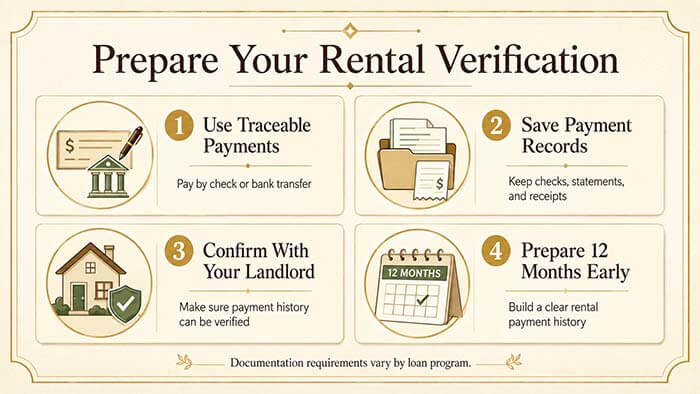
- Start Paying by Check or Bank Transfer:
- If you currently pay rent in cash, switch to checks or bank transfers immediately. This creates a verifiable paper trail.
- Keep Accurate Records:
- Maintain copies of canceled checks, bank statements, or payment receipts.
- Communicate with Your Landlord:
- If renting from a private landlord, ensure they’re willing to confirm your payment history if needed.
- Plan Ahead:
- If you’re considering buying a home, start preparing your rental documentation 12 months in advance.
How Gustan Cho Associates Can Help
At Gustan Cho Associates, we help borrowers with unique financial situations, especially those who struggle with rental verification. Here are the main reasons that set us apart:
- No Overlays: Unlike other lenders, we don’t add extra rules on top of standard guidelines. If the Automated Underwriting System (AUS) doesn’t require VOR, neither do we.
- Flexible Options: We offer exemptions for rent-free living and work with borrowers with limited credit, recent late payments, or high DTI ratios.
- Get Help When You Need It: Our friendly mortgage experts are here to help every day of the week. If you’re wondering when is rental verification required or have any other questions about the process, ask! We’re here to make everything easier for you.
Apply for a Mortgage Today
If you’re wondering, “When is rental verification required?” or if you’re ready to take the next step in your homeownership journey, Gustan Cho Associates is here to help. Our team specializes in working with borrowers who face challenges with credit, rental history, or complex financial situations.
To get started, contact us at 800-900-8569 or email gcho@gustancho.com. We’re available seven days a week, including evenings, weekends, and holidays.
Let us help you turn your dream of homeownership into reality!
Frequently Asked Questions About When is Rental Verification Required:
When is Rental Verification Required for a Mortgage?
Rental verification is typically required when the lender needs proof you’ve paid your housing payment on time—most commonly in manual underwriting, with thin/limited credit, lower scores, recent late payments, or high DTI scenarios. It’s used to confirm you can handle a mortgage payment.
Is Rental Verification Required for FHA Loans?
Not always. Many FHA loans approved through automated underwriting may not require a Verification of Rent (VOR). But if the file is downgraded to manual underwriting, lenders commonly require a 12-month rent history (documented).
Is Verification of Rent Required for VA Loans?
It depends on the lender and the underwriting path. A VOR is not always required, but some VA lenders request it—especially when they want stronger proof of on-time housing payments or when the file needs closer review.
What Documents Count as Proof of Rent for Rental Verification?
Most lenders accept 12 months of canceled checks or bank statements showing rent withdrawals. If you rent from a property management company, a completed VOR form/ledger may be accepted (often with payment dates shown).
Can I Use Zelle, Venmo, PayPal, or Cash App as Rental Verification?
Sometimes. Digital payments can work when the record clearly shows payer, payee, date, and amount, and it ties back to your bank activity (statements help). Lenders vary, so the key is clear, traceable documentation.
What if I Pay Rent in Cash—Can I Still Verify Rent?
Often, cash rent is hard to document. Some lenders may accept a VOR from a professional property management company (with a rent ledger/payment dates). Cash paid to a private landlord is usually much harder to use as acceptable proof.
How Many Months of Rent History do Lenders Want?
Many manual underwriting scenarios require 12 months of on-time rent history. Some lenders may ask for a different period based on program rules and risk factors, but “12 months documented” is a common standard when VOR is required.
What if I Rent From a Family Member—Does That Change Rental Verification?
Yes. For FHA-related scenarios, if you rent from a family member, guidelines may require an executed lease plus 12 months of canceled checks or bank statements (not just a letter).
Does Fannie Mae (Conventional Loans) Require Verification of Rent?
Not always. Conventional underwriting can factor in a positive rent payment history in automated systems, but Fannie Mae notes it is not “validating” rent payments—it’s using provided history to inform risk assessment. Requirements vary by loan file and lender overlays.
How Long Does Rental Verification Take During Underwriting?
If you already have 12 months of statements or canceled checks, it can be quick (often 1–3 days to review). Delays usually happen when a landlord/property manager is slow to return a VOR form or the proof is unclear (cash, missing memo lines, inconsistent deposits).
This blog about “When Is Rental Verification Required By Mortgage Lenders” was updated on January 14th, 2026.
Rebuild your future with FHA or VA loans—even during or after Chapter 13 bankruptcy
Apply Online And Get recommendations From Loan Experts