
Can a foreign national get a U.S. mortgage? Yes. Foreign nationals can qualify for a U.S. mortgage without U.S. citizenship, a green card, a Social Security number, or a U.S. credit score. Depending on the program, foreign national loans may use overseas income, bank statements, verified assets, foreign credit references, or rental property cash flow. Down payment, reserve, identity, property use, and documentation requirements vary by lender. Borrowers living and working in the United States may qualify under different guidelines.
What Is a Foreign National Loan?
A foreign national loan is a mortgage for a non-U.S. citizen whose primary residence and income are generally outside the United States. These programs can help international buyers finance a U.S. home even without a green card, Social Security number, U.S. tax returns, or established U.S. credit.
Instead of relying only on traditional U.S. documents, lenders may review foreign income, international bank statements, liquid assets, foreign credit references, and the proposed down payment. For an investment property, some borrowers may qualify through a DSCR program that focuses on the property’s rental income.
Many foreign national loans are classified as Non-QM or non-conforming mortgages because they do not follow standard Fannie Mae or Freddie Mac guidelines. However, the terms are not interchangeable. “Foreign national” describes the borrower, while “Non-QM” describes the underwriting program. A person living and working in the United States on a visa may be evaluated under separate non-permanent-resident or ITIN guidelines.
Foreign National Versus Non-Permanent Resident Versus ITIN Borrower
These borrower classifications can overlap, but they do not mean the same thing. The correct category depends on where the borrower lives, immigration documentation, tax identification, income source, and the lender’s program rules.
Foreign National
A foreign national generally lives and earns income outside the United States and is not a U.S. citizen or permanent resident. The borrower may not have a Social Security number, ITIN, U.S. tax returns, or U.S. credit history. Foreign national loans may use overseas income, foreign bank statements, verified assets, alternative credit references, or investment-property cash flow.
Non-Permanent Resident
A non-permanent resident typically lives in the United States legally under an eligible visa or other authorized status but does not have a green card. The borrower may have a Social Security number, U.S. employment, and established domestic credit. Available mortgage programs depend on current agency rules, immigration documents, income stability, and lender requirements.
ITIN Borrower
An ITIN borrower does not qualify for a Social Security number but has an Individual Taxpayer Identification Number from the IRS. An ITIN is used for federal tax purposes and does not provide or prove immigration status. Some lenders offer ITIN mortgage programs for borrowers with documented income, tax returns, credit history, and sufficient funds. The lender should identify the correct borrower category before recommending a program. A foreign national living overseas should not automatically be treated the same as an ITIN borrower or a non-permanent resident working in the United States.
Foreign National Loan Requirements at a Glance
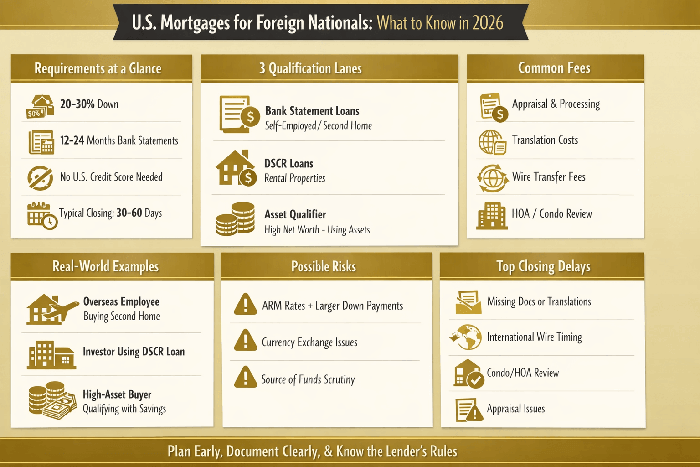
Foreign national mortgage guidelines are set by individual lenders and investors, so there is no single rulebook that applies to every borrower. The following figures are common starting points, not guaranteed terms.
| Requirement | Typical Starting Point |
|---|---|
| Down payment | Often 20% to 30%; more may be required for larger loans or higher-risk properties |
| Cash reserves | Commonly 6 to 12 months of principal, interest, taxes, insurance, and applicable HOA dues |
| Identification | Valid passport and additional identification; visa documentation may be required when applicable |
| U.S. credit | A U.S. credit score may not be required |
| Alternative credit | Foreign credit report, bank reference letter, or other verifiable payment history may be accepted |
| Income or qualification | Foreign employment income, bank statements, verified assets, or DSCR for an eligible investment property |
| Funds to close | Down payment, closing costs, and reserves must be verified and properly sourced |
| Property eligibility | May include single-family homes, townhomes, condos, second homes, and investment properties |
| Closing timeline | Often 30 to 60 days, depending on document verification, translation, appraisal, and title work |
Some programs permit borrowers to qualify without a Social Security number or ITIN, while others require a U.S. tax identification number or bank account. Loan amounts, interest rates, prepayment penalties, eligible countries, property types, and occupancy rules also vary. International buyers should avoid moving large sums of money without keeping a complete paper trail. Lenders may request statements, transfer records, currency conversions, and explanations showing where the funds came from. Documents not written in English may also require an acceptable translation before underwriting.
How Lenders Evaluate Borrowers Without U.S. Credit
Not having a U.S. credit score does not mean a borrower receives a mortgage without a credit review. With foreign national loans, lenders may use other documents to determine how the borrower manages financial obligations and whether sufficient funds are available to repay the loan. Depending on the program, the lender may review:
- A foreign credit report, when one is available
- Reference letters from established banks or financial institutions
- Housing, utility, telecommunications, or international loan payment histories
- Foreign and U.S. bank statements
- Employment, business, or income documents from another country
- Liquid assets available for the down payment, closing costs, and reserves
- The source and history of large deposits or international transfers
Lenders consider the size of the down payment, the funds remaining after closing, the property type, and the home’s use. For an investment property, a DSCR program may focus primarily on whether the expected rental income can support the proposed housing payment. If the borrower already has a U.S. credit file, the lender may review it even when a minimum U.S. credit score is not required. Late payments, collections, public records, or undisclosed debts can still affect the loan decision.
Foreign Income, Bank Statement, DSCR, and Asset-Qualifier Options
Foreign national borrowers do not all qualify the same way. Depending on the property, income source, and available assets, foreign national loans may use one of several documentation methods.
Foreign Income Verification
A salaried borrower working outside the United States may qualify with an employment letter, pay statements, bank records, tax documents, or other evidence of stable foreign income. The lender may verify the employer, determine whether the income is likely to continue, and convert the earnings into U.S. dollars using an acceptable exchange rate.
Bank Statement Loans
Bank statement programs may help business owners and self-employed borrowers whose tax returns do not clearly show their cash flow. The lender generally reviews 12 to 24 months of personal or business bank statements. Business deposits may be reduced by an expense factor before the lender calculates qualifying income.
DSCR Loans for Investment Properties
A debt-service coverage ratio loan is generally limited to non-owner-occupied investment property. Instead of relying primarily on the borrower’s personal income, the lender compares the property’s qualifying rent to the proposed housing payment. The required DSCR, down payment, reserves, and treatment of short-term rental income vary by program.
Asset-Qualifier Loans
An asset-qualifier or asset-depletion program may work for borrowers with substantial liquid assets but limited or complicated monthly income. The lender uses an approved calculation to convert eligible assets into qualifying income. Cash, deposit accounts, and certain investment accounts may be considered, although some assets are discounted or excluded. The best option depends on what the borrower is purchasing and which documents can be verified. Funds used for the down payment and reserves may not always be available for the asset-qualifier calculation, so the lender should review the complete financial picture before selecting a program.
Start Your Foreign National Loan Pre-Approval Today
Apply online 24/7 with Gustan Cho Associates and see how fast you can be pre-approved with our foreign national loan programsCan Work Visa Holders in The U.S. Get Approved For Foreign National Loans?
Can non-permanent investors of the United States, foreign national students, and foreign nationals with work visas qualify and get approved for Foreign National Loans? The answer is YES. Foreign National Loans may require additional paperwork, and approval often depends on the property type, your intended use, and your financial reserves.
Lenders of Foreign National Loans will take the down payment, reserves, and the subject property cash flow, and use alternative non-traditional means in calculating the borrower’s income and debt-to-income ratio.
Eligible borrowers include non-U.S. citizens living abroad, non-permanent residents without a green card, people without a U.S. Social Security number, and international real estate investors. You can still qualify to buy property even if you do not have a U.S. credit report. Foreign National Loans is popular among foreign nationals who are real estate investors. Many foreign nationals have the knowledge, means, experience, and capital to pull the trigger on investing in investment properties. Gustan Cho Associates get many inquiries by foreign nationals inquiring the eligibility requirements and guidelines on Foreign National Loans. Among the properties of choice are single-family homes, condos, and small multifamily buildings.
Non-Permanent Resident Without a Green Card
Borrowers are outside the U.S. on a visa, while others frequently travel back and forth. Depending on the loan program, you may need to provide specific documents. Your identity and paperwork must meet the program’s guidelines. Many foreign investors can qualify by making a larger down payment and showing strong reserves, even if all their income is earned abroad. National mortgage programs vary, but here are some of the most common underwriting categories:
Required Down Payment on Foreign National Loans
Foreign national loans typically require a larger down payment than standard loans. The amount depends on the property, loan size, and your profile. Lenders prefer borrowers with more equity because it lowers risk and makes approval more likely, especially if you have little or no U.S. credit history.
You will likely need to provide:
- Bank Statements (Any country)
- Liquid reserves after closing (additional remaining funds)
- Source of down payment (to show your funds are legitimate and traceable), so lenders can confirm your assets are available and have been in your account for a while.
Credit Requirements for Foreign National Loans
Most foreign national borrowers do not have a regular U.S. credit file. Depending on the loan program, lenders may accept the following:
- U.S. Credit Report, if available
- International Credit Report, if available
Other Credit References such as:
- Letters of reference from a bank
- Payment history for utilities or telecommunications (where accepted) that can be verified, your approval will depend on strong collateral and healthy reserves.
- Now, let’s look at the income documentation you’ll need as a foreign national borrower.
- This may include income verification for foreign employment or business.
- Bank statement income analysis (where applicable).
- High-net-worth borrowers’ assets.
- Rental income (especially for loans for investment properties).
What Are Mortgage Underwriters Looking For on Foreign National Loans
First and foremost, every lender has their own rules, regulations, and policies they have put in place to ensure the mortgage loan process meets local, state, and federal guidelines and law. There are internal as well as third party national public records search verification agencies to cross check information and data received by all during the intake and preparation step of the loan process. Bottom line is each lender streamlines the process to avoid any potential of fraud (Whether it is a mistake or it is intentional). The primary goal is to demonstrate that you can repay the loan by providing clear proof of your income.
Document verification typically includes:
- Valid passport.
- Applicable visa.
- Other secondary identification.
- Proof of foreign country address.
Documents Required on Foreign National Loans
If your documents are not in English, you will need to provide a certified translation. Certain property types, such as condominiums (especially condo hotels), may be restricted or subject to stricter policies under foreign national programs.
Down Payment, Reserves, Loan Amounts, and Terms
 The requirements for foreign national loans depend on the borrower’s financial profile, property use, loan size, and the lender’s current program. A larger down payment and stronger reserves can expand the available options, but they do not guarantee approval.
Down Payment
A down payment of 20% to 30% is a common starting range. The required amount may be higher for luxury homes, condo hotels, non-warrantable condos, short-term rentals, or borrowers with limited financial documentation. Investment properties may also have different requirements from second homes or eligible primary residences.
Cash Reserves
Reserves are funds the borrower must have left after paying the down payment and closing costs. Many programs require enough money to cover 6 to 12 months of principal, interest, property taxes, homeowners’ insurance, and applicable association dues. Larger loans or higher-risk properties may require additional reserves.
Loan Amounts
Minimum and maximum loan amounts vary widely by lender. The amount available may depend on the property value, occupancy, location, loan-to-value ratio, borrower liquidity, and documentation method. High-balance loans commonly require more equity and stronger reserves.
Interest Rates and Loan Terms
Foreign national mortgages may offer fixed or adjustable interest rates with repayment periods of up to 30 years. Some programs also provide interest-only payment options, especially for investment properties. Rates and pricing are based on current market conditions and risk factors, including down payment, property type, loan amount, documentation, and reserves. Borrowers should also ask whether the loan includes a prepayment penalty, rate-adjustment limits, or a balloon payment. These terms can affect the cost of selling or refinancing the property later, so the complete loan offer should be reviewed—not just the initial interest rate.
Eligible Properties and Occupancy Rules
Depending on the lender, foreign national loans may be available for several residential property types, including:
- Single-family homes
- Townhomes
- Condominiums
- Two- to four-unit properties
- Second homes and vacation homes
- Long-term rental properties
- Some short-term rental properties
Specialized programs may also finance non-warrantable condos or condotels. These properties usually require additional project review, a larger down payment, and stronger reserves. Rural homes, mixed-use buildings, properties in poor condition, and homes with unusual features may have fewer financing options. Occupancy is equally important. Many foreign national mortgage programs are designed for second homes and non-owner-occupied investment properties. Some lenders allow an eligible primary residence, but this depends on where the borrower lives, the borrower’s visa or residency circumstances, and the program’s definition of a foreign national. DSCR loans are generally limited to investment properties because approval is based primarily on rental income. These should not be used if the borrower intends to live in the home as their primary residence or vacation property. The borrower must accurately disclose the intended use of the property. Misrepresenting a primary residence as an investment property—or an investment property as a second home—can be considered occupancy fraud. Buyers should confirm both the property type and occupancy classification with the lender before signing a purchase contract.
Documents and Source-of-Funds Requirements
The paperwork required for foreign national loans depends on the qualification method, property use, and lender. A borrower qualifying through foreign employment will provide different income documents from an investor using a DSCR loan. Commonly requested documents include:
- A valid passport and secondary identification
- Visa or residency documents, when applicable
- Proof of the borrower’s foreign address
- Personal or business bank statements
- Proof of funds for the down payment, closing costs, and reserves
- Foreign employment, income, or business records when income is used
- Foreign credit reports or bank reference letters, if required
- A purchase contract and property information
- Business formation and ownership documents, when an eligible entity holds title
The lender must also verify the source of the funds for the transaction. Borrowers may need to provide account statements, wire confirmations, deposit records, currency conversion documents, and evidence of ownership for each account. Large deposits, business transfers, asset sales, cryptocurrency conversions, and gifted funds can require additional explanations and supporting records. International buyers should keep a complete paper trail when moving money between accounts or countries. Funds that cannot be traced to an acceptable source may not be counted toward the transaction. Documents not written in English may require a translation that meets the lender’s standards. Because translation and overseas verification can take time, borrowers should ask which documents must be translated before submitting the loan for underwriting.
Down Payment Requirements on Foreign National Loans
- The amount of down payment depends on the property type
- The down payment required is a percentage of the down payment and the difference between the purchase price and loan amount
- Type and location of the property
- Borrower profile (country of residence, accessibility of documents)
How the Application and Closing Process Works
The process for foreign national loans is similar to other mortgages, but verifying overseas income, assets, identity, and transferred funds can add extra steps.
1. Initial Program Review
The loan officer reviews the borrower’s country of residence, property use, expected purchase price, available funds, income sources, and U.S. credit history, if any. This helps identify whether foreign income, bank statements, assets, or DSCR may be used to qualify.
2. Document Review and Preapproval
The borrower provides identification, bank statements, proof of funds, and any required income or credit documents. After reviewing the file, the lender may issue a preapproval subject to the property, appraisal, underwriting, and other conditions.
3. Property Selection and Loan Application
Once the borrower has an accepted purchase contract, the formal application and disclosures are completed. The lender confirms that the property type and intended occupancy meet the requirements of the selected program.
4. Appraisal, Title, and Underwriting
An appraisal is ordered to establish the property’s value and, for certain investment loans, its market rent. The title company examines ownership and lien records. The underwriter reviews the borrower, property, funds, and supporting documents.
5. Clearing Loan Conditions
Additional conditions may include updated bank statements, translated documents, explanations for large deposits, proof of international transfers, or corrected property information. Responding quickly can prevent avoidable delays.
6. Final Approval and Closing
After all conditions are satisfied, the lender issues final approval and confirms the amount needed to close. International wires should be sent early enough to account for bank cutoff times, intermediary banks, and currency conversion. Many foreign national mortgages close within approximately 30 to 60 days, although complex documentation or property issues can extend the timeline. Remote signing, a power of attorney, or closing outside the United States may be possible, but these arrangements must be approved in advance by the lender and title company.
Underwriting and Conditional Approval
Underwriting reviews your full profile and then may issue conditions. This is a normal part of the process and can include:
- Additional bank pages or explanations of transactions
- Updated proof of funds (if applicable)
- Clarifying letters for large deposits
- Verification of overseas employment or assets
Underwriting The Property: Appraisal and Title Work
- The mortgage underwriter will be underwriting the property.
- Underwriting will go over and review the appraisal checks the value and condition of the property.
- A title search examines the ownership history to ensure the transfer is free from legal issues.
- These steps occur simultaneously with underwriting to ensure a smooth process.
Foreign National and Want to Buy in the U.S.?
Call Gustan Cho Associates at 800-900-8569 and ask about our foreign national loan programs for primary, second homes, and investment propertiesCosts, Taxes, and Cross-Border Considerations
The down payment is only one part of the money needed for foreign national loans. Buyers should also plan for lender charges, appraisal and inspection fees, title or settlement costs, recording fees, homeowners’ insurance, property taxes, and applicable association dues. Additional cross-border expenses may include:
- Currency-conversion charges
- International wire fees
- Document translation or certification
- Foreign credit or bank-verification services
- Legal and tax-advisory fees
- Entity formation expenses when an eligible LLC or corporation holds title
Exchange rates can change between preapproval and closing. A weaker exchange rate may reduce the U.S. dollar value of the borrower’s available funds and affect the down payment or reserve requirement. Buyers should also allow time for international bank cutoffs, intermediary institutions, and verification of transferred funds.
U.S. Tax Considerations
Foreign ownership of U.S. real estate entails tax reporting requirements. Rental income from U.S. properties may be taxed, depending on elections, deductions, and tax treaties. When a foreign owner sells U.S. real estate, the Foreign Investment in Real Property Tax Act (FIRPTA) may mandate withholding from the sale proceeds. This withholding is not the seller’s final tax liability but affects the closing amount received. An ITIN may also be needed when a foreign person has a U.S. tax filing or reporting requirement but is not eligible for a Social Security number. Ownership choices can affect income, estate, gift, and liability issues. A buyer should not assume that using an LLC, corporation, or trust will automatically reduce taxes. Before selecting how to hold title, foreign buyers should consult qualified U.S. and home-country tax professionals and an attorney experienced in cross-border real estate.
GCA Foreign National Approval Example
This scenario illustrates how Gustan Cho Associates may structure a mortgage application for a foreign national. This is not a borrower file, loan commitment, or approval guarantee. A business owner living outside the United States wants to purchase a $500,000 single-family rental property. The buyer does not have a Social Security number, U.S. tax returns, or a U.S. credit score. The proposed foreign national loan is structured with:
- A $350,000 loan amount
- A $150,000 down payment
- Additional funds for closing costs
- Twelve months of reserves remaining after closing
- Qualification based primarily on the property’s rental income
- A valid passport, foreign bank statements, and a bank reference letter
The main underwriting issue is documenting the transfer of funds from the borrower’s foreign personal and business accounts. The borrower provides complete bank statements, business ownership records, transfer receipts, and a written explanation linking each account to its transactions. The appraisal supports the purchase price and provides market-rent information acceptable to the DSCR lender. After the borrower’s identity, assets, source of funds, property eligibility, and reserve requirement are verified, the lender approves the loan subject to its final conditions. This example shows why having enough money is not the only requirement. The lender must also be able to verify the borrower’s identity, trace the funds, confirm the property’s eligibility, and document that all conditions of the selected loan program have been satisfied.
Steps to Take Before Applying
Getting started early can minimize delays and help lenders find the right foreign national loan for borrowers. International buyers should take the following steps before submitting an application:
- Decide how the property will be used. Determine whether the home will be a primary residence, second home, or investment property. Occupancy affects which programs are available.
- Estimate the complete cash requirement. Plan for the down payment, closing costs, required reserves, currency-conversion charges, and international wire fees.
- Identify the best qualification method. Gather information about foreign employment, business income, bank deposits, liquid assets, or expected rental income.
- Collect identification and financial documents. Prepare a valid passport, applicable visa documents, bank statements, proof of address, income records, and available foreign credit references.
- Review translation requirements. Ask the lender which documents must be translated and what type of translation will be accepted.
- Keep funds easy to trace. Avoid unnecessary transfers between personal, business, and investment accounts. Keep records of large deposits, asset sales, gifts, cryptocurrency conversions, and international wire transfers.
- Check property eligibility early. Condos, condotels, short-term rentals, multi-unit homes, and unusual properties may require specialized programs or additional review.
- Compare the complete loan terms. Review the interest rate, fixed or adjustable period, monthly payment, lender fees, prepayment penalty, reserve requirement, and interest-only features when applicable.
- Speak with tax and legal professionals. Get qualified advice before deciding whether to purchase personally or through an LLC, corporation, or trust.
- Complete a documented preapproval. Have the lender review the borrower’s documents and funds before making an offer. A basic conversation or online estimate is not the same as a preapproval based on verified information.
Comparison of Traditional Mortgage vs Foreign National Loans
Foreign national borrowers who own businesses abroad may need to provide additional documentation. We help organize income and business documents to complete your application package. USA
- International mortgage for U.S. property
- ITIN mortgage loans
- foreign national investment property loan
- non-QM foreign national loan
- U.S. mortgage for non-U.S. citizens
- mortgage without U.S. credit
- DSCR loan for foreign nationals
- foreign national refinancing
The Optimal Choice Foreign national loans require a lender who understands non-QM guidelines, alternative documentation, and can solve problems quickly. At Gustan Cho Associates, we are proud to get approvals that other lenders often cannot, especially for borrowers with unique profiles, foreign income, or non-standard documentation. If you told “no” because you do not have U.S. credit, have not filed U.S. tax returns, or your income comes from outside the country, we can likely help you.
Final Thoughts on Foreign National Loans
Buying U.S. real estate without citizenship or an established U.S. credit score is possible, but the right financing depends on more than nationality. Property use, down payment, reserves, income, assets, and the ability to document funds all affect which foreign national loans may be available. The best first step is to conduct a thorough review before making an offer or transferring money. Gustan Cho Associates can evaluate the borrower’s financial profile, explain available qualification methods, and identify documentation issues that could delay underwriting. To discuss financing for a U.S. primary residence, second home, or investment property, call 800-900-8569 or email gcho@gustancho.com. Gustan Cho Associates is a DBA of Coast2Coast Mortgage, LLC, NMLS 376205. All loans are subject to lender guidelines, underwriting approval, and property eligibility.
Frequently Asked Questions About Foreign National Loans
Can a Foreign National Refinance or Take Cash Out of a U.S. Property?
Yes. Some foreign national loan programs permit rate-and-term refinancing or cash-out refinancing. Approval depends on the property’s equity, ownership history, occupancy, documentation, and the lender’s current guidelines.
Can a Foreign National Apply With a U.S. Co-Borrower?
Some lenders allow a U.S. citizen or permanent resident to apply with a foreign national. The lender evaluates each borrower’s income, assets, credit profile, and ownership interest. Adding a U.S. co-borrower does not automatically qualify the loan for conventional financing or eliminate the foreign national down payment requirements.
Are Gift Funds Allowed for a Foreign National Mortgage?
Gift fund rules vary by lender and loan program. When permitted, the lender may require a gift letter, the donor’s bank statements, proof of the transfer, and evidence that repayment is not expected. Gift funds may also be ineligible to satisfy the borrower’s reserve requirement, so confirm the rules before transferring funds.
Can a Foreign National Finance Multiple U.S. Properties?
Yes, a qualified borrower may be able to finance more than one U.S. investment property. Each property and loan is evaluated separately, and the lender may require additional reserves as the borrower’s total count of financed properties increases. Some lenders also limit their total exposure to one borrower.
Will a Foreign National Mortgage Help Build U.S. Credit?
It may help if the mortgage servicer reports the account and payment history to U.S. credit bureaus. However, creditors are not required to report information to every credit bureau. Ask the lender or servicer which bureaus receive payment data before assuming the loan will establish U.S. credit. The Consumer Financial Protection Bureau explains how credit reporting works.
Does Buying U.S. Real Estate Help a Foreign National Obtain a Visa or Green Card?
No. Purchasing a home or rental property does not automatically provide immigration status, a visa, or permanent residency. The federal EB-5 program has separate investment, job-creation, and eligibility requirements; an ordinary real estate purchase does not qualify on its own. Borrowers seeking immigration advice should consult a qualified attorney. Review the official EB-5 requirements from USCIS.
Can a Foreign National Qualify for a Conventional Mortgage?
A person who lives outside the United States generally will not meet standard agency eligibility as a foreign national borrower. Fannie Mae permits eligible lawful permanent and non-permanent U.S. residents to obtain conventional financing, subject to legal presence and identification requirements. A nonresident buyer may instead need a foreign national loan offered through a portfolio or non-QM lender. See Fannie Mae’s current non-U.S. citizen eligibility requirements.
This article about “Foreign National Loans: Buy U.S. Homes with No Credit Score” was updated on August 14th, 2026.
