How do mortgage lenders view charge-offs?
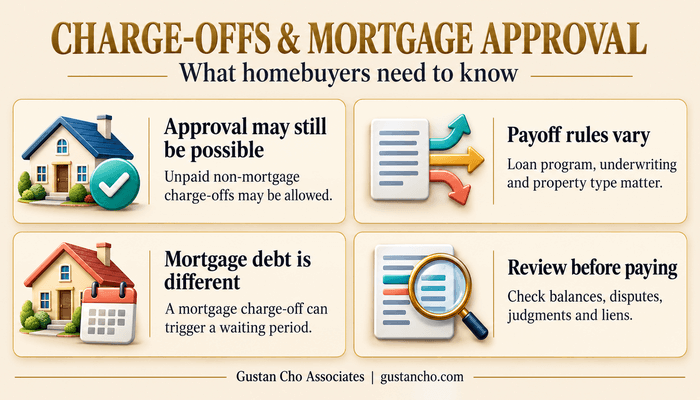
Unpaid charge-offs not related to a mortgage typically won’t prevent you from getting a mortgage, nor will you need to pay them off before closing. How it is handled depends on the type of loan, the underwriting process, the kind of property, and whether you plan to live there. If there is a related judgment or lien, you may need to resolve that separately. A charged-off mortgage is not treated the same as a charged-off credit card or personal loan. It can lead to additional requirements, such as a waiting period. Lenders also look at your overall credit history and might set stricter rules than the basic guidelines.
What Is a Charge-Off?
A charge-off happens when a lender considers an unpaid debt as uncollectible and marks it as a loss in their financial records.
That does not automatically erase the debt. The creditor may still try to collect it, assign it to a collection agency, sell it to another company, or pursue other remedies allowed by law.
For mortgage underwriting, the important question is not simply whether an account says “charged off.” The lender also considers the type of debt, whether any money is still owed, and how the applicable loan program treats the account.
Charge-Offs vs. Collection Accounts
Charge-offs and collection accounts are often discussed together, but they are not the same thing. A charge-off reflects a creditor’s decision to write an account off as a loss. A collection account generally means the debt has been placed with, or sold to, a company that is attempting to collect it. That distinction matters because mortgage guidelines can treat the two differently.
Why the Difference Matters for FHA Loans
FHA does not automatically treat a non-mortgage charge-off the same way it treats a non-medical collection account. For example, FHA’s calculated payment rules for certain unpaid collection balances should not automatically be applied to ordinary charge-off accounts. Borrowers should make sure the lender is using the correct guidelines for the way the account is actually reported.
How Recent Charge-Offs Affect Mortgage Underwriting
A recent charge-off usually receives more attention than an account that became delinquent several years ago. The underwriter may look at what caused the default, whether the borrower has re-established credit, and whether there is a pattern of recent late payments or other serious derogatory credit. A new charge-off shortly before applying can raise more concern because it may indicate that the borrower is still having difficulty meeting financial obligations.
One Charge-Off Is Different From a Pattern
An isolated event may be viewed differently from several recently charged-off accounts. The underwriter reviews the entire credit profile rather than making a decision based on a single tradeline. A strong recent payment history, stable income, and otherwise manageable debt can help provide context, but they do not override a specific agency or lender requirement.
FHA Guidelines for Charge-Off Accounts
FHA does not generally require non-mortgage charge-off accounts to be paid before closing, simply because they appear on the credit report. Charge-off balances are not automatically included as monthly liabilities for FHA debt-to-income calculations. That is different from FHA’s treatment of certain unpaid collection accounts.
Do Not Apply the FHA 5% Collection Rule to Charge-Offs
One common mistake is using 5% of a charge-off balance as a monthly payment. That calculation applies to certain non-medical collection accounts under FHA guidelines, not ordinary charge-off accounts. For example, a borrower with a $10,000 charged-off credit-card balance should not automatically have a $500 monthly payment added to DTI solely because of that charge-off.
FHA Manual Underwriting: Required Charge-Off Documentation
For a manually underwritten FHA loan, the borrower must provide a letter explaining each charge-off and the supporting documentation for each. The explanation and the supporting documentation must be consistent with the other credit information in the file. The underwriter will have to assess whether the charge-offs were due to a failure to meet financial obligations, difficulty managing debt, or other mitigating circumstances. The lender will also have to record its reasons for approving the mortgage in the event of charge-offs. These are specific requirements of the manual underwriting process, rather than optional reviews of the borrower’s payment history. A good explanation will identify the account, explain the reason for the missed payments, and set out the borrower’s current circumstances. The explanation may be supported by a range of documents such as income statements, correspondence with creditors and evidence that the temporary hardship has now ceased. Docs are separate from the payoff and DTI treatment. Asking for an explanation in no way implies that the charge-off balance must be paid or that a monthly payment must be added to DTI.
VA Guidelines for Charge-Off Accounts
VA distinguishes medical charge-offs, non-medical charge-offs, and collection accounts when evaluating a borrower’s credit.
Medical Charge-Offs
Lenders may disregard identifiable medical collections and charge-offs that have not become judgments or liens. VA does not require these accounts to be paid before closing or require an explanation of the medical derogatory credit.
Non-Medical Charge-Offs
The underwriter must address the circumstances behind non-medical charge-offs when evaluating the borrower’s overall credit history. This review considers the negative payment history rather than treating every charge-off as an automatic disqualification. If the lender requires payment, ask for the specific guideline or requirement that supports that condition.
Collection-Account Payments Follow Separate Rules
For unpaid non-medical collection accounts without payment arrangements, VA calculates the monthly payment as 5% of the outstanding balance divided by 12. The amount is included in DTI and residual-income calculations. When the credit report lists a minimum payment, VA directs the lender to recognize that payment. These collection-account instructions should not automatically be applied to every charged-off tradeline. The lender must identify the account’s correct classification before determining its payment treatment.
Fannie Mae Conventional Loan Guidelines for Charge-Offs
Fannie Mae’s payoff requirements differ between loans evaluated through Desktop Underwriter (DU) and manually underwritten loans. The following rules concern collections and non-mortgage charge-offs; mortgage charge-offs have separate eligibility requirements.
Desktop Underwriter: Property Type and Occupancy Matter
Under Selling Guide B3-5.3-09:
- One-unit primary residence: Outstanding collections and non-mortgage charge-offs may remain unpaid, regardless of their balances.
- Two- to four-unit primary residence or second home: Applicable collections and non-mortgage charge-offs must be paid in full by closing when their combined balance exceeds $5,000.
- Investment property: Individual applicable accounts with balances of $250 or more must be paid off. Payoff is also required when applicable account balances collectively exceed $1,000.
Medical collections are excluded from these dollar limits and do not require payoff before or at closing. The lender must also satisfy the applicable DU findings and other eligibility requirements.
Manual Underwriting: Different Payoff Exceptions Apply
Under Selling Guide B3-6-07, non-medical collections and non-mortgage charge-offs may remain unpaid when either of these exceptions applies:
- An individual account’s balance is below $250.
- The combined balance of all applicable accounts is $1,000 or less.
Accounts exceeding the Guide’s limits must be paid before or at closing. These manual-underwriting exceptions must be evaluated separately from DU’s property-specific rules.
Freddie Mac Guidelines for Charge-Offs
For a Freddie Mac loan, the lender must determine whether a non-mortgage charge-off can remain unpaid by reviewing the applicable Guide provisions, the account’s current status, and the loan’s underwriting conditions.
LPA Accept: Credit Assessment and Payoff Are Separate
Under Guide Section 5201.1, an Accept risk class means Loan Product Advisor has assessed the borrower’s credit reputation as acceptable. Freddie Mac generally does not require an explanation of adverse or derogatory credit for these mortgages. That documentation provision does not, by itself, establish that every charge-off is exempt from payoff. The lender must verify the information submitted to LPA and satisfy the final Feedback Certificate, which identifies purchase eligibility and documentation requirements. A related judgment, lien, repayment obligation, or mortgage debt requires review under the provisions governing that obligation. If payment is required, ask the loan officer to identify whether the condition comes from Freddie Mac’s Guide, the loan’s findings, or an additional lender requirement.
Manual Underwriting: Explain Significant Derogatory Credit
For manually underwritten loans, Guide Section 5202.1 requires a separate assessment of the borrower’s credit reputation. The review considers the payment record, the circumstances behind derogatory credit, and whether the borrower demonstrates an acceptable ability and willingness to repay. Significant derogatory information requires a written explanation. The explanation helps the underwriter evaluate the cause of the credit problems and determine whether the overall credit risk is acceptable. The lender must separately establish any required payoff or other resolution.
Non-Mortgage Charge-Offs vs. Mortgage Charge-Offs
A charged-off credit card is very different from a charged-off mortgage.
Non-mortgage charge-offs include debts such as credit cards, personal loans, and certain other consumer obligations. Depending on the loan program, many of these accounts may remain unpaid and still allow the borrower to qualify.
A mortgage charge-off is a much more serious derogatory credit event.
Fannie Mae Mortgage Charge-Off Waiting Period
Fannie Mae typically requires a four-year gap between the documented completion date of the mortgage charge-off and the disbursement date of the new loan. A two-year gap may be allowed in the case of extenuating circumstances that the lender documents and deems sufficient to satisfy Fannie Mae’s applicable requirements. The application and pre-approval dates are not the end of the story. Your loan officer needs to verify the charge-off completion date against the credit report and/or supporting documentation to determine the timing of the new loan disbursement. The completion of the waiting period does not guarantee approval, as the remaining credit and eligibility criteria remain in effect. These are the Fannie Mae requirements for mortgage charge-offs. FHA, VA, and Freddie Mac loans will, of course, be governed by their respective applicable guidance. Ordinary non-mortgage charge-offs are dealt with under the rules set out above.
Do Charge-Offs Affect Debt-to-Income Ratio?
A non-mortgage charge-off does not automatically create a monthly payment that must be included in the borrower’s debt-to-income ratio. The treatment depends on the loan program and how the account is reported. This is especially important when a charge-off still shows a large unpaid balance. The balance alone does not mean the lender should invent a monthly payment and add it to DTI.
Do Not Confuse a Charge-Off With an Active Revolving Account
An open credit card with an outstanding balance is treated differently from a credit card that has already been charged off. For example, Fannie Mae requires an active revolving account payment to be included in monthly obligations. If no payment is shown, the lender may have to calculate one under Fannie Mae guidelines. That rule should not automatically be applied to an account reported as a non-mortgage charge-off. The credit report needs to be reviewed carefully to determine the account’s actual status.
Have Charge-Offs? You May Still Qualify for a Mortgage
Mortgage lenders look at the type of charge-off, balance, age, credit history, loan program, and whether the account is tied to a judgment or lien. Get your credit scenario reviewed before applying.What to Do About Charge-Offs Before Applying for a Mortgage
Before you even consider paying a charge-off, work out how the account is going to impact your proposed mortgage. Follow these steps to determine the requirements, ensure you have sufficient funds to close, and ensure all necessary documentation is ready.
Confirm the Account’s Current Status
Have your loan officer review the account type, balance, payment status, and any associated collection account. Determine whether the debt is in the nature of a mortgage, a repayment agreement, a dispute, or a judgement/lien. If both the original creditor and a collection agency report the debt, flag that link so the lender can determine the correct approach.
Identify the Source of Any Payoff Requirement
Once the loan program and underwriting method are established, ask your loan officer to explain any required payoff. The condition may come from agency guidelines, automated underwriting findings, investor requirements, or a lender overlay. Request the specific requirement before spending money. If it comes from an overlay, ask whether another lender available through your mortgage professional would evaluate the account differently.
Review the Effect on Your Closing Funds
If payment is required, obtain a current written payoff or settlement offer and have the lender confirm whether the proposed resolution meets underwriting requirements. Then recalculate the funds available for your down payment, closing costs, and required reserves. Confirm when payment must occur and what evidence the lender needs afterward.
Paying a Charge-Off: Mortgage, Credit, and Legal Considerations
Paying a charge-off can affect mortgage eligibility, credit reporting, and legal collection rights in different ways. Consider these three questions separately.
Does the Mortgage Require Payment?
Use the program-specific rules above to establish whether payment is necessary. If it is a closing condition, confirm whether the lender accepts the proposed payoff or settlement and what evidence of payment is required. Satisfying that condition meets a mortgage requirement; it does not guarantee a particular improvement in credit score.
What Might Payment Change on the Credit Report?
Payment can update the outstanding balance and show the account as paid or settled. The prior charge-off history can remain, however, so payment does not automatically remove the derogatory entry. Avoid assuming that paying will produce a specific mortgage credit score. Under the Fair Credit Reporting Act’s general rule, the seven-year reporting period begins 180 days after the delinquency that immediately preceded the charge-off. Paying the account does not start a new seven-year reporting period.
Could Payment or Acknowledgment Affect Legal Collection Rights?
The statute of limitations defines the time limit for initiating legal action to collect a debt. It is separate from the credit-reporting period and may depend on state law, the type of debt, and the credit agreement. In some circumstances, a partial payment or acknowledgment of an old debt can restart the legal collection period—even after it has expired. Consult a qualified attorney about that question. A loan officer can explain the mortgage requirements, while an attorney can assess the applicable legal rights and deadlines.
Disputed Charge-Off Accounts During Mortgage Underwriting
A disputed charge-off can impact underwriting, even if the balance does not need to be paid. How it is handled depends on the mortgage program, the account’s classification, and the underwriting results.
Fannie Mae DU: Follow the Disputed-Tradeline Findings
Desktop Underwriter first reviews the loan, including the disputed accounts. If it gives an Approve recommendation that covers those accounts, you do not need to take any extra steps for the disputes. If DU approves the loan after excluding the disputed accounts, the lender needs to verify whether the borrower actually owes the debt and whether the reporting is correct. The loan can proceed based on the provided documents and the investigation results.
FHA: When Disputes Require Manual Underwriting
According to HUD Handbook 4000.1, Section II.A.4.b.iii(B), if an FHA loan is reviewed through the TOTAL Mortgage Scorecard and the total disputed negative balances are $1,000 or more, the loan must be downgraded to Refer for manual underwriting. This includes disputed charge-offs, collections, and accounts with late payments in the last 24 months. The downgrade calculation excludes:
- Disputed medical accounts.
- Accounts disputed because of identity theft, credit card theft, or unauthorized use, supported by a police report or appropriate creditor documentation.
- Non-derogatory disputed accounts, including accounts with no balance, accounts whose late payments are at least 24 months old, and accounts being paid as agreed.
Disputed derogatory accounts belonging to a non-borrowing spouse in a community-property state also do not count toward this downgrade threshold. Sections II.A.4.b.iii(B)–(C) explain these distinctions. An exclusion from the threshold does not eliminate other required underwriting review.
Review the Dispute Before Changing It
Ask your loan officer to identify the loan program, classify the account, verify its balance, and review the reasons for the dispute before recommending a change. For inaccurate reporting, provide evidence supporting the correction, such as payment records or creditor correspondence. Removing every dispute is not a universal mortgage requirement; the next step should follow the applicable guidelines and the documented facts.
Hypothetical Mortgage Underwriting Examples
These illustrations show how charge-off rules apply to different situations. They are not documented client cases or promises of approval.
FHA: $15,000 in Credit-Card Charge-Offs
A borrower has $15,000 in old credit-card charge-offs. The accounts are correctly classified as non-mortgage charge-offs, with no related collections, disputes, judgments, or liens. Applying 5% would produce $15,000 × 5% = $750 per month. However, FHA’s collection-account calculation should not be applied to these ordinary charge-offs. Their balances do not automatically create a $750 monthly DTI obligation. The lender must still verify the borrower’s income, other debts, assets, and eligibility. If the loan requires manual underwriting, the charge-off explanations and supporting documentation must also satisfy FHA requirements.
Fannie Mae DU: The Same $9,000 Balance, Different Properties
A borrower purchasing a one-unit primary residence has $9,000 in unpaid non-mortgage charge-offs. Under Fannie Mae’s DU rules, those balances do not require payoff solely because of their amount. Change the proposed purchase to a second home, keeping the same $9,000 balance. The applicable accounts now exceed Fannie Mae’s $5,000 aggregate threshold and must be paid in full before or at closing. Both transactions still require acceptable DU findings and satisfaction of the remaining loan requirements. For the second home, the lender must also verify sufficient funds for the payoff, closing, and any required reserves.
Charged-Off Second Mortgage: Timing Affects Eligibility
A borrower proposes a new Fannie Mae loan that would disburse three years after the documented completion of a second-mortgage charge-off. That timing does not meet Fannie Mae’s standard four-year waiting period. A two-year exception may be available only when qualifying extenuating circumstances are documented, and the applicable requirements are satisfied. The waiting period ends on the new loan’s disbursement date. The lender must establish the charge-off date, determine whether an exception applies, and confirm that the borrower meets the remaining credit and eligibility requirements.
Common Charge-Off Problems That Delay Mortgage Approval
Many delays occur because the account is not what the borrower or loan officer originally thought it was. A credit report may show a charge-off, collection, judgment, dispute, or combination of accounts connected to the same original debt.
Treating Every Derogatory Account the Same
A collection is not automatically a charge-off. A charge-off is not automatically a judgment. A judgment is not the same as a lien. Those distinctions matter because mortgage guidelines can treat each one differently.
Paying an Account Before the File Is Reviewed
A borrower may spend thousands of dollars on an account that the loan program never required payment for. That can leave less money available for closing or reserves. Review the mortgage guidelines first.
Discovering a Lien During Title Work
An old debt may appear harmless on the credit report, but it becomes more significant if title work reveals a lien on the property. Credit underwriting and title clearance are separate parts of the mortgage process. A debt that does not require payoff under a credit guideline can still create a title issue that has to be resolved.
Documents to Gather When Applying With Charge-Offs
Gather the necessary documents for your accounts. Your loan officer will specify what is required for your mortgage program and underwriting process.
- Current credit report: This report lists your creditors, balances, account status, and any notes about disputes. It shows whether an account is marked as a charge-off, in collections, or another type of obligation.
- Paid-in-full or settlement confirmation: This document proves you made a payment, what the creditor agreed to, and if there is any balance left. If you have them, include the written settlement terms and payment confirmation.
- Existing repayment agreement and payment history: This shows your agreed monthly payment and records of payments you have made. Include the agreement, statements, canceled checks, or other proof of payment.
- Evidence for an inaccurate account dispute: Letters from creditors, account statements, payment records, or identity theft documents can help clarify questions about who owns the account, the balance, or any late payments that were wrongly reported.
- Judgment, lien, satisfaction, or release documents: Establish the recorded legal status of the debt and help the lender and title professional identify any unresolved judgments or property liens.
- Factual explanation and supporting records: When underwriting requires an explanation, identify the account, describe the circumstances behind the default, and provide records supporting those facts. The explanation should agree with the other information in the loan file.
FAQs About How Do Mortgage Lenders View Charge-Offs
Can a New Charge-Off Appear After Pre-Approval?
Yes. If your credit report is updated during processing, a new charge-off might show up. Your lender may need to review your file again or request additional documents. Let your loan officer know right away if anything changes with your accounts before closing.
Can the Same Debt Appear as Both a Charge-Off and a Collection?
Yes. The original creditor might list the charge-off, and a collection agency could report the same debt as a collection. These two entries usually refer to the same debt, not separate ones. Your lender will check who owns the account, the balance, and how it’s reported before deciding how to handle it.
Can a Business Charge-Off Affect My Personal Mortgage Application?
It can when the account is in your name, or you are personally responsible for the debt. Provide records establishing who owes the obligation and its current status. Describing an account as “business debt” does not, by itself, establish how it should be treated in your mortgage file.
Can Charge-Offs Affect Down Payment Assistance Eligibility?
It’s possible. Some assistance programs have their own credit and underwriting rules that go beyond those of your main mortgage. Even if you meet FHA or conventional standards, you might not automatically qualify for assistance. Always check the specific program’s rules before counting on it for your cash-to-close.
Can I Refinance With Unpaid Charge-Offs?
It’s possible. Your lender will review your refinance application based on their program’s rules. Be sure to share whether you want to cash out, how you use the property, and whether any charge-off is tied to a mortgage, repayment plan, judgment, or lien. These details help the lender decide which rules apply.
Final Thoughts on How Mortgage Lenders View Charge-Offs
Before making a payoff decision, identify the unresolved issue in your file: inaccurate reporting, a program-specific payment requirement, a related judgment or lien, or missing documentation. Consider how any required payment would affect the funds available for closing and reserves. A useful review should explain which issue needs to be resolved and what evidence will satisfy the requirement. Have Gustan Cho Associates review your credit report, account records, and proposed purchase or refinance. If another lender has already required payment, include its written condition. This gives the review a concrete starting point for identifying applicable guidelines, documentation needs, and available mortgage options.
This article about “How Do Mortgage Lenders View Charge-Offs When Applying for a Home Loan?” was updated on October 15th, 2026.