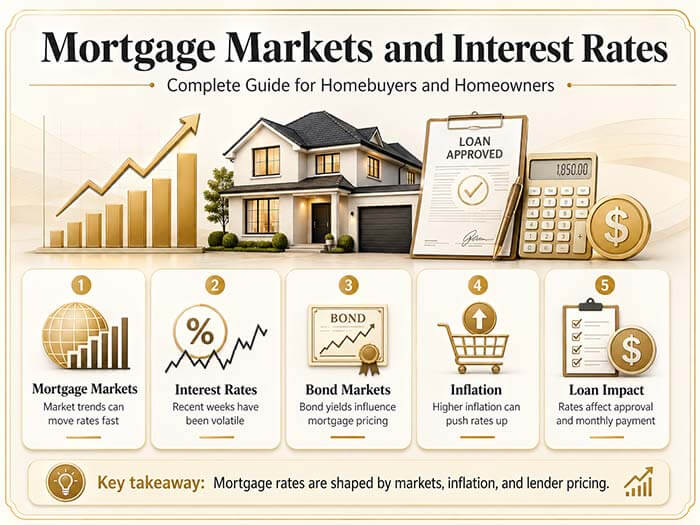
Mortgage Markets and Interest Rates: Complete Guide for Homebuyers and Homeowners
This guide covers the mortgage markets and interest rates. The mortgage markets and interest rates have seen volatile trends in recent weeks. The first and foremost is rising interest rates when analyzing mortgage markets and interest Rates. John Strange, a senior loan officer at Gustan Cho Associates says the following about the mortgage markets:
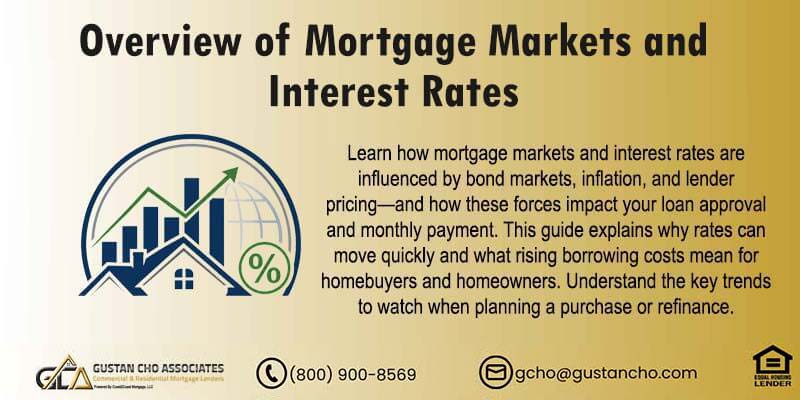
Learn how mortgage markets, interest rates, bond markets, inflation, and lender pricing affect your home loan approval and payment.
Ultimately, in order for an economy to grow in a fractional reserve capitalistic economy, you need some level of inflation. Short term inflation can be dangerous for sudden upticks in the pricing of food, fuel (not included in the core inflationary index), borrowing, these sudden changes can make life very difficult for families on limited residual income. In this article, we will discuss and cover the overview of mortgage markets and interest rates.
Mortgage Markets and Interest Rates: Complete Guide for Homebuyers and Homeowners
Mortgage markets play a big role in buying or refinancing a home. If mortgage rates go up, your monthly payment gets higher, you might not be able to borrow as much, and you could qualify for a smaller home.
Gustan Cho Associates helps borrowers learn about mortgage markets, interest rates, loan options, and lender rules so they can make informed choices before applying for a mortgage.
When rates go down, homes become more affordable, refinancing may be possible, and more people usually start looking to buy. This guide explains how mortgage markets work, what drives mortgage rates, why different borrowers get different rates, and how you can make smart choices without trying to predict the market perfectly.
What Are Mortgage Markets?
Mortgage markets are the financial systems in which home loans are originated, priced, sold, serviced, and invested. Most borrowers think their mortgage rate comes only from the lender they choose. In reality, mortgage rates are influenced by a much larger market. Mortgage lenders price loans based on risk, investor demand, bond market activity, inflation expectations, loan program guidelines, and borrower qualifications. This is why mortgage rates can change from day to day, and sometimes even during the same day.
Why Mortgage Markets Matter To Homebuyers
Mortgage markets matter because they directly affect your monthly payment. A small change in the mortgage interest rate can make a big difference in affordability over the life of a 30-year fixed-rate mortgage. For example, when rates rise, the same loan amount costs more each month. When rates fall, the same loan amount may become more affordable. This is why many buyers closely follow mortgage rate news, especially when they are shopping for a home or deciding whether to refinance.
How Mortgage Markets Affect Interest Rates
Mortgage rates are tied closely to the bond market, especially mortgage-backed securities. When investors demand higher returns, mortgage rates often rise. When investors accept lower yields, mortgage rates may fall. Mortgage rates also respond to inflation, employment reports, expectations of Federal Reserve policy, global uncertainty, and investor confidence. The Federal Reserve does not directly set mortgage rates, but its monetary policy influences short-term interest rates and broader financial conditions, which can, in turn, affect mortgage pricing.
Why Mortgage Rates Change Daily
Mortgage rates change because lenders constantly adjust pricing based on market conditions. A rate quote you receive today may not be available tomorrow unless it is locked. This is why borrowers should understand the difference between getting a mortgage quote and locking a mortgage rate. A quote is only an estimate based on current pricing. A lock protects the borrower from market changes during the lock period, subject to lender terms and conditions.
How Mortgage Interest Rates Are Set
Mortgage interest rates are not random. They are based on market forces, lender risk, investor appetite, and borrower profile. The average mortgage rate you see online is only a national benchmark. Your actual mortgage rate depends on your credit score, loan amount, down payment, debt-to-income ratio, property type, occupancy type, loan program, and whether you pay discount points.
The Bond Market And Mortgage-Backed Securities
Many mortgages are bundled into mortgage-backed securities, commonly called MBS. Investors buy these securities, and their demand helps influence mortgage rates. When investors are nervous about inflation or economic uncertainty, they may demand higher yields. Higher yields can lead to higher mortgage rates. When investors are willing to accept lower yields, mortgage rates may improve.
Inflation, Jobs Reports, And Economic News
Inflation is one of the biggest drivers of mortgage rates. When inflation is high, lenders and investors typically want higher returns to protect the value of their money over time. That can push mortgage rates higher. Strong jobs reports can also move mortgage markets. If the economy looks too strong, investors may worry inflation will stay elevated. If the economy slows too much, rates may move lower if investors expect weaker demand or future Federal Reserve rate cuts.
The Federal Reserve’s Indirect Impact On Mortgage Rates
Many borrowers believe the Federal Reserve directly controls mortgage rates. That is not exactly correct. The Fed sets monetary policy to influence short-term interest rates and overall financial conditions. Mortgage rates are longer-term rates and are more directly influenced by bond investors, inflation expectations, and mortgage-backed securities. This is why mortgage rates can move even when the Fed does not change its benchmark rate.
Mortgage Rates Today And Why Borrowers Should Avoid Chasing Headlines
Mortgage rate headlines can be helpful. However, they can also confuse borrowers. Freddie Mac’s Primary Mortgage Market Survey is one widely followed benchmark.
A published average is not a promise that every borrower will receive that rate. Your actual mortgage rate depends on your file, loan program, property, credit profile, and lender’s pricing.
Freddie Mac reported a 30-year fixed-rate mortgage average of 6.23% for the week shown on its rate page, with 15-year fixed rates at 5.58% as of April 23, 2026. The best approach is not to obsess over one headline rate. The better approach is to compare full loan estimates, understand total costs, and choose a mortgage payment that works with your budget.
Mortgage Rates vs APR: What Borrowers Need To Know
One of the most common mistakes borrowers make is comparing only the interest rate. The mortgage interest rate matters, but it is not the only cost of the loan. APR, or annual percentage rate, gives borrowers a broader view of loan cost because it includes the interest rate plus certain fees and charges. The Consumer Financial Protection Bureau explains that APR reflects the mortgage interest rate plus other costs, including points, fees, and other charges.
What is a Mortgage Interest Rate?
The mortgage interest rate is the rate used to calculate the interest portion of your monthly mortgage payment. A lower interest rate usually means a lower monthly principal and interest payment, assuming the same loan amount and loan term.
What Is APR on a Mortgage?
APR is designed to show the broader cost of borrowing. APR may include the interest rate, discount points, mortgage broker fees, and other finance charges. Because of this, the APR is often higher than the note rate. Borrowers should review both the interest rate and APR when comparing mortgage offers.
Why the Lowest Rate Is Not Always the Best Deal
The lowest mortgage rate may come with higher closing costs or discount points. That does not automatically make it bad, but borrowers need to understand the tradeoff. If you plan to keep the loan for many years, paying points for a lower rate may make sense in some cases. If you may sell or refinance soon, paying a high upfront cost for a slightly lower rate may not be worth it.
What Affects Your Personal Mortgage Rate?
Two borrowers can apply on the same day and receive different mortgage rates. That is because lenders price loans based on risk and loan structure. Your personal mortgage rate is based on your financial profile, the loan program, the property, and lender pricing.
Credit Score And Credit History
Credit score is one of the most important mortgage rate factors. Borrowers with stronger credit profiles often qualify for better pricing. Borrowers with lower credit scores may still qualify for mortgage approval, but the rate may be higher depending on the loan program. Gustan Cho Associates works with borrowers who have strong credit, average credit, prior credit issues, late payments, bankruptcy, foreclosure, collections, and other credit challenges.
Down Payment and Loan-To-Value Ratio
The loan-to-value ratio, often called LTV, compares the loan amount to the property’s value. A larger down payment usually lowers the lender’s risk. A borrower putting 20% down may receive different pricing than a borrower putting 3%, 3.5%, or 5% down. However, the best loan program is not always the one with the largest down payment. FHA, VA, USDA, conventional, and Non-QM loans all have different guidelines and pricing structures.
Debt-to-Income Ratio
Debt-to-income ratio, or DTI, compares monthly debts to gross monthly income. Higher DTI can affect approval strength and, in some cases, pricing. Borrowers with higher DTI ratios may still qualify if they receive automated underwriting approval or have strong compensating factors. However, lender overlays can make a major difference. Some lenders may deny loans that technically meet agency guidelines because they add stricter in-house rules.
Loan Program and Property Type
Different loan programs have different mortgage rates. FHA, VA, USDA, conventional, jumbo, and Non-QM rates are priced differently. Property type also matters. A single-family primary residence is usually priced differently from a second home, investment property, condo, multi-unit property, non-warrantable condo, or mixed-use property.
Discount Points And Closing Costs
Discount points are upfront fees paid to lower the interest rate. One point usually equals 1% of the loan amount. Paying points can lower the monthly payment but increase closing costs. Borrowers should ask how long it takes to recover the cost through monthly savings. This is often called the break-even point.
Long Term Inflation Mortgage Markets and Interest Rates
Long term inflation is necessary and can be reflected in higher long-term borrowing such as 10–30-year bonds. What are bonds?
- They are debt instruments
- Some investment firms use bonds to create capital by securitizing debt
- This is done with a promise to pay the full amount back at a later date with semi-annual interest earned along the way
Bonds are used to creating capital for corporations, for public projects, for government liquidity to pay current obligations, and for riskier ventures like technology, medical research, casinos, etc.
Risk Levels on Bonds
Bonds are all classified based on risk. The riskier the bond is to pay back, the higher the interest rate of return. Risk versus rewards concept. Governments are seen as the safest investments. Especially on the federal side because they have the ability to both raise taxes and print money. Bonds, in general, are more desirable as an investment. This because in case of bankruptcy of a corporation or just a dividend payout, in general, the bond investors will get their money back before stockholders do. What does this mean to the conversation of mortgages?
Start Your Process Towards Buying A Home
Apply Online And Get recommendations From Loan ExpertsBonds and Mortgage Markets
When interest rates rise, investors who own bonds see the underlying value of their investment lose face value. Inflation or a rise in interest rates does exactly that. Rising rates will raise the value of the dollar. Dale Elenteny, a senior loan officer says the following about the mortgage markets:
When their cost of borrowing goes up, their cost of business goes up since they have to charge ore to recoup the interest they pay on loans. The government is the same way.
For instance, when states like Illinois or California or Rhode Island get downgraded as an investment because of repayment risk, that is due to their debts being higher than their income. But will hurt the purchasing power at the same time since the growth of businesses is largely based on their ability to borrow and leverage.
Mortgage Markets Out of Control Due To Inflation
Just like a citizen, they must now pay a higher interest rate to investors when they borrow money to pay for things like pension obligations, which also go up. This causes a rise in taxes, and regulatory costs since those municipalities must increase the cost of business to pay the higher cost of the benefit This is one of the main reasons cities are so expensive. Less space, fewer resources, and too many benefits to citizens raise the cost of living, as they attempt to raise the standard of living. Most businesses and cities that are insolvent don’t have a cash problem; they have a cash flow problem.
Why Mortgage Rates are Different from Lender to Lender
Mortgage rates vary by lender because lenders do not all have the same pricing, investors, overhead, margins, overlays, or risk appetite. This is why shopping for a mortgage is important. One lender may deny a borrower, while another lender may approve the same borrower under the same agency guidelines.
Lender Overlays and Risk Pricing
Lender overlays are extra rules added by individual lenders. These rules go beyond FHA, VA, USDA, Fannie Mae, or Freddie Mac guidelines. For example, FHA guidelines may allow a borrower to qualify with a certain credit score or debt-to-income ratio, but a lender may require a higher score or a lower DTI due to overlays. Gustan Cho Associates is known for helping borrowers who may qualify under agency guidelines but were turned down by lenders with overlays.
Wholesale Mortgage Lenders vs Retail Lenders
Wholesale mortgage channels may offer access to multiple lenders and loan programs. Retail lenders usually offer their own products and pricing. Borrowers who do not fit inside a narrow lending box may benefit from working with a mortgage team that has access to many wholesale lending partners. More options can be important for borrowers with unique credit, income, property, or documentation challenges.
Why Shopping Mortgage Rates Matters
Shopping for mortgage rates does not mean choosing the lowest advertised rate online. Borrowers should compare the full loan structure, including the rate, APR, lender fees, points, mortgage insurance, underwriting flexibility, and closing timeline. A low rate is not helpful if the lender cannot close the loan.
How Mortgage Markets Affect Home Affordability
Mortgage markets affect affordability because interest rates influence monthly payments. When rates rise, buyers may need to lower their purchase price, increase their down payment, pay off debts, or choose a different loan program. When rates fall, buyers may qualify for more home or refinance an existing mortgage into a lower payment.
Monthly Payment Shock
Payment shock occurs when a borrower’s new housing payment is much higher than their current one. Lenders may review payment shock, especially on manually underwritten loans or files with risk layers. A borrower moving from low rent to a much higher mortgage payment should make sure the new payment is comfortable, not just approvable.
Buying Power and Home Prices
Mortgage rates and home prices work together. A lower rate can improve buying power. A higher rate can reduce buying power. However, buyers should not assume home prices will automatically fall when rates rise. Local inventory, job growth, migration patterns, housing supply, and seller motivation all affect home prices.
Refinance Opportunities When Rates Drop
Some buyers purchase a home at today’s rate and refinance later if rates drop. This can be a smart strategy when the payment is affordable today, and the borrower understands that a future refinance is not guaranteed. A refinance depends on credit, income, equity, loan program rules, property value, and market rates at the time of application.
Fixed-Rate Mortgages vs Adjustable-Rate Mortgages
Borrowers can choose between fixed-rate mortgages and adjustable-rate mortgages, depending on their goals and eligibility. A fixed-rate mortgage provides stability because the principal and interest payments remain for the life of the loan. loan. An adjustable-rate mortgage, or ARM, may start with a lower rate, but the rate can change later.
When a Fixed-Rate Mortgage Makes Sense
A fixed-rate mortgage may be a good fit for borrowers who want long-term stability. If you plan to keep the home for many years, a fixed-rate mortgage can make budgeting easier. Most homebuyers choose 30-year fixed-rate mortgages because they offer lower monthly payments than shorter-term loans.
When an ARM May Be Worth Reviewing
An ARM may be worth reviewing if the starting rate is lower and the borrower plans to sell, refinance, or pay off the loan before the adjustable period begins. However, borrowers should understand the risk. If rates are higher when the adjustment period begins, the payment can increase.
Risks of Chasing a Lower Starting Rate
A lower starting rate is not always better. Borrowers should review the margin, index, adjustment caps, first adjustment date, lifetime cap, and worst-case payment. The right mortgage is not always the one with the lowest starting payment. The right mortgage is the one that fits the borrower’s long-term financial plan.
Government and Conventional Loan Rates
Mortgage markets affect every loan type, but each program is priced differently. FHA, VA, USDA, conventional, jumbo, and Non-QM loans all have different risk models and investor guidelines.
FHA Mortgage Rates
FHA loans are popular with first-time homebuyers, borrowers with lower credit scores, and borrowers with higher debt-to-income ratios. FHA mortgage rates can be competitive, but FHA loans also have mortgage insurance. Borrowers should compare the full payment, not just the interest rate.
VA Mortgage Rates
VA loans are available to eligible veterans, active-duty service members, and qualifying surviving spouses. VA loans often offer competitive rates and no monthly mortgage insurance. VA loans also use residual income to help evaluate whether the borrower has enough money left over after major monthly obligations.
USDA Mortgage Rates
USDA loans are designed for eligible rural and suburban areas and may allow qualified borrowers to make no down payment. USDA loans have income limits and property eligibility rules. USDA mortgage rates may be attractive, but borrowers must qualify under USDA guidelines.
Conventional Mortgage Rates
Conventional loans follow the guidelines of Fannie Mae and Freddie Mac. Conventional mortgage rates depend heavily on credit score, loan-to-value ratio, property type, occupancy, and other pricing adjustments. Borrowers with strong credit and lower LTV ratios may benefit from conventional financing. Borrowers with lower credit or higher DTI may need to compare FHA or other options.
Non-QM and Alternative Mortgage Rates
Non-QM loans are alternative mortgage options for borrowers who do not fit traditional agency guidelines. These may include bank statement loans, DSCR loans, asset-based loans, loans following a recent credit event, and other flexible programs.
Non-QM mortgage rates are usually higher than traditional FHA, VA, USDA, or conventional rates because the loan carries different risk and investor requirements. However,
Non-QM loans can be valuable for self-employed borrowers, real estate investors, and borrowers with recent bankruptcy, foreclosure, or unique income documentation.
Should You Wait for Mortgage Rates to Drop?
 Many buyers ask whether they should wait for mortgage rates to fall. The honest answer is that nobody can perfectly predict mortgage markets. Forecasts can help, but forecasts change. Fannie Mae’s Economic and Strategic Research Group publishes housing and mortgage market forecasts, but it also notes that forecasts are based on assumptions and are subject to change.
Why Timing the Market Is Difficult
Trying to time mortgage rates can be risky. If rates fall, buyers may benefit. But if home prices rise, inventory tightens, or competition increases, the lower rate may not help as much as expected. The better question is not, “Can I perfectly time the market?” The better question is, “Can I afford the home and mortgage payment today?”
Buy Now and Refinance Later
Some borrowers buy now and refinance later when rates improve. This can work when the current payment is affordable, and the borrower understands the risks. A refinance is never guaranteed. The borrower must still qualify, the property must support the value, and the market must offer better terms.
Focus on Approval, Payment, and Long-Term Goals
Borrowers should focus on three things before buying:
- Can I qualify for the mortgage?
- Can I afford the monthly payment?
- Does this home fit my long-term financial goals?
- Mortgage markets matter, but the borrower’s personal budget matters more.
How to Compare Mortgage Offers the Right Way
Comparing mortgage offers is more than comparing rates. Borrowers should compare the full loan estimate, monthly payment, APR, closing costs, points, mortgage insurance, escrow payment, and lender experience. A slightly higher rate with lower costs may be better for one borrower. A lower rate with points may be better for another borrower. The best mortgage depends on the borrower’s timeline, cash-to-close, credit profile, and long-term plans.
Compare the Same Loan Type
Do not compare an FHA quote to a conventional quote without understanding the difference in mortgage insurance, down payment, credit requirements, and underwriting rules. Do not compare a fixed-rate mortgage to an ARM without understanding future adjustment risk.
Review The Total Monthly Payment
The total housing payment may include principal, interest, property taxes, homeowners’ insurance, mortgage insurance, HOA dues, and flood insurance if required. A low interest rate does not always mean the lowest total payment.
Mortgage Markets and Interest Rates
In closing, rates have been low in large part due to the inherent belief mortgages in the long term are safer now than they have ever been. This is due to the credit criteria it takes to get one.
Large institutions use that safe haven to earn guaranteed interest on both mortgage bonds, which are called Fannie Mae and Ginnie Mae Bonds, and servicing rights to take in the interest payments from you the citizen.
By December 25, 2024, substantial transformations have been observed in the mortgage market due to recent economic shifts and the implementation of new policies. Below is a breakdown of the existing conditions and future estimations:
Current Mortgage Rates
30-Year Fixed-Rate Mortgages:
- The mortgage rate recently crossed the 6.72% mark, an increase from the previous week’s 6.6%.
- This was the highest increase recorded since late November.
15-Year Fixed-Rate Mortgages:
- The 15-year fixed-rate mortgage market also experienced a surge.
- The average percentage rate hit 5.92%, compared to last week’s 5.84%.
Factors Influencing Current Rates
Federal Reserve Policies:
- The Federal Reserve’s rate cuts, aimed at improving affordability, have led to increasing mortgage rates, which is odd.
- This is due to the surge in yields, which average around 10-year treasury bonds and immensely impact mortgage rates.
Economic Indicators:
- Major budget deficits and high inflation have increased the demand for long-term interest rates.
Housing Market Trends
Existing Home Sales:
- November reported existing home sales at a record high; from March’s 4.15 million sales, a 4.8 % increase was seen.
- Compared to June 2021, it stood at a staggering 6.1% growth yearly.
Home Prices:
- Despite seeing growth in home prices nationally, which crossed $406,100, along with a 4.7% increase from last year, the current pace of sales indicates a market in the midst of recovery.
Forecast for 2026: Investment Market Snapshot
Mortgage Rate Predictions
- Lenders predict a gradual drop in mortgage rates through 2026.
- According to Fannie Mae, the 30-year fixed mortgage will start the year with a 6.5% rate and lower it to 6.2 by the end of the year.
Market Movement:
- Even though rates are dropping and buyer requirements are met, the preparedness house markets for the year are predicted to remain quite restrained, considering the key issues of housing affordability and stock shortages in the property market.
Borrowers
Housing Cost Hurdles:
- Raised interest rates have obstructed many potential buyers struggling with additional high interest rates.
- Mortgage Applications remain unchanged.
Unclear Economic Outlook:
- The possibility of future interest changes is apparent, considering various policy possibilities and market fluctuations.
- Therefore, it is always advised to be on the lookout and consult specialists before making plans.
In conclusion, albeit modestly, the mortgage market will ease its interest rates within 2026. Several economic factors and weaknesses in the market, alongside additional policies, will likely be a sizeable tailwind for the housing market.
Ask About Overlays Before You Apply
Borrowers with credit challenges, high DTI, recent late payments, bankruptcy, foreclosure, self-employment, or unique income should ask about lender overlays before applying. The right lender can make the difference between approval and denial.
Why Gustan Cho Associates Helps Borrowers Navigate Mortgage Markets
Mortgage markets can be confusing because rates, guidelines, investor rules, and lender overlays change constantly. Gustan Cho Associates helps borrowers understand their options and choose the loan program that fits their credit, income, property, and financial goals.
Many borrowers come to Gustan Cho Associates after being denied by another lender. A denial from one lender does not always mean the borrower cannot qualify.
It may mean the lender had overlays or did not offer the right loan program. Gustan Cho Associates works with borrowers seeking FHA, VA, USDA, conventional, jumbo, Non-QM, bank statement, DSCR, and other mortgage options.
The Broken Mortgage Markets
Make no mistake, the economy and large businesses flourish because you the citizen chooses to pay his or her bills on time chooses to keep money in that bank and chooses to show up at work on time. Without you, the system would collapse. Borrowers who need to qualify for a mortgage with a national lender with no overlays, please contact us at Gustan Cho Associates at 800-900-8569 or text us for a faster response. Or email us at gcho@gustancho.com.
Final Thoughts on Mortgage Markets and Interest Rates
Mortgage markets and interest rates are among the many factors that influence home affordability, as well as potential borrower actions such as new purchase mortgage strategies, refinancing strategies, approval, mortgage payment amounts, and purchase mortgage options. Mortgage rate trends are something a borrower should familiarize themselves with; however, they shouldn’t purchase mortgage options based solely on current headlines.
How Mortgage Markets Affect Home Affordability
When evaluating which mortgage option makes the most sense, it is best to consider your entire financial situation. Elements of your financial picture, like your Credit Score, your ratio of Monthly Total Debt to Monthly
Total Income, your Expected Down Payment, your Mortgage Loan Program, the type of property you are purchasing, and any mortgage lender guidelines, will all be applicable.
The frustration of mortgage borrowers will be a constant in mortgage markets. Rates will be like a roller coaster. A borrower who takes care to become as knowledgeable as possible will be better prepared to buy, refinance, and shop around without all of the mortgage-related anxiety.
Mortgage Markets FAQs
Why Do Mortgage Rates Change Daily?
Several factors influence mortgage rates daily. Inflation reports, economic news, desired mortgage-lender settlements, and bond-market demand. These time-sensitive factors also explain why borrowers commonly lock in a rate once they’ve agreed to loan conditions.
Does The Federal Reserve Control Mortgage Rates?
The Federal Reserve, under no circumstances, controls whether the mortgage interest rates are raised or lowered. Mortgage rates, however, are indirectly affected by the Fed altering short-term rates and by ongoing economic conditions. It could be said that mortgage rates are more strongly influenced by the bond market and the trading of mortgage-backed securities.
What Are Mortgage and APR Rates?
The interest rate to compute the monthly payment is the mortgage rate. The APR includes the interest rate and loan costs, such as points and fees. When assessing mortgage offers, borrowers should factor in the mortgage rate and the APR.
Is it Wise to Hold Off?
You should not focus on just one component when making the best decision about mortgage payments, affordable homes, qualifications, and/or available financing. A mortgage may then be appropriate. The likelihood of a drop in mortgage rates is extremely uncertain. What is certain is that rates may be dropped, and refinancing is an available option.
Why Is My Rate Different?
Most of the rates available on the web are mortgage rate averages or rate quotes available. Your rate is then determined by using, among other things, your credit score, loan program, property, loan, and/or down payment amounts, and points. As a result, an individual mortgage borrower may have more of one thing and less of another and his/her/her mortgage rate will differ.
Will Lower Mortgage Rates Affect My Ability to Refinance?
Mortgage rates will drop and may be available. Your mortgage rate is available, but it will also depend on you. A mortgage means more than just a mortgage. It means the end of your mortgage. It means the opening of your mortgage. It means a positive change in your mortgage. The mortgage drop means you are moving on to a new mortgage. It also means a more secure financial position, taking into account the initial savings and the end of your mortgage.
What Would Cause Different Lenders To Offer Different Mortgage Rates?
Different lenders differ in how they price cash flows, their investors, fixed costs, risk tolerance, and overlays. This means one lender may have a lower mortgage lending rate but have higher lending costs. Other lenders may have greater underwriting flexibility. Thus, it is best for a borrower to provide an overall loan offer, not just a mortgage rate.
Do FHA, VA, USDA, and Standard home loans have the same rates?
No, Mortgage Rates for FHA, VA, USDA, and Standard loans are not the same. They have different rules, insurance types, and models of investors and risks. Thus, the best mortgage loans depend on factors such as creditworthiness, income, down payment, location, military status, and the borrower’s long-term goals.
Bottom Line of Shopping for the Best Mortgage Rates?
A borrower should compare the same types of mortgages, the same Amount, the same lock period, and costs (points, rate, and offer). Borrowers need to check the interest & mortgage insurance costs, as well as the monthly payment, to select their best lender.