
Types of Mortgages: 2026 Guide to Choosing the Right Loan
Are you ready to buy a home but not sure which loan is right for you? You’re not alone. Picking the right mortgage can feel confusing—but it doesn’t have to be. In this guide, we’ll walk you through the most common types of mortgages in 2026 and help you determine which fits your life and budget. At Gustan Cho Associates, we help people every day who thought they couldn’t get approved. Whether your credit is perfect or far from it, there’s a mortgage for you. Let’s break down your options.
What Are the Main Types of Mortgages?
There are many types of mortgages, but most homebuyers choose from these six:
| Loan Type | Best For | Down Payment | Min. Credit Score | PMI Required? |
| FHA Loan | First-time buyers, low credit | 3.5% (580 score) | 580 | Yes |
| VA Loan | Veterans and active military | 0% | No minimum | No |
| USDA Loan | Rural areas, low-to-mid income | 0% | 640 recommended | Yes (low cost) |
| Conventional | Good credit, stable income | 3–5%+ | 620 | Yes <20% down |
| Jumbo Loan | High-value homes | 10–20%+ | 700+ recommended | Usually |
| Non-QM Loan | Self-employed, bad credit | 10–20%+ | Flexible | No |
Types of Mortgages: Traditional and Non-Prime Loan Options for Homebuyers
When discussing mortgage types, people refer to the various loan programs available for home purchase. These include conventional, FHA, VA, USDA, jumbo, non-QM, non-prime, bank statement, DSCR, and other specialized mortgage products. You can also group mortgages by how you. Mortgages can also be categorized by payment structure. Some features have fixed interest rates, while others have adjustable rates. Additionally, certain loans are designed for home purchases, while others are intended for refinancing or cash-out purposes.
Types of Mortgages Explained for Homebuyers
The mortgage you choose will impact your down payment, interest rate, monthly payment, closing costs, mortgage insurance, approval likelihood, and total cost over time. For example, a borrower with excellent credit and a strong down payment may prefer a conventional loan.
A borrower with a lower credit score may have a better chance of qualifying for an FHA loan. A veteran may be able to buy with a VA loan and no down payment.
A self-employed borrower who cannot document income with tax returns may need a non-QM bank statement loan. Selecting the wrong loan may result in denial, higher costs, or delays. The right loan can enable you to purchase a home, even if you were previously declined by another lender.
Traditional Mortgages Versus Non-Prime Mortgage Options
Traditional mortgages include conventional loans and government-backed mortgages such as FHA, VA, and USDA loans. These loans follow agency or government program guidelines and are commonly used by homebuyers nationwide. Non-prime and non-QM loans provide alternatives for those who do not meet standard lending criteria. These options assist self-employed borrowers, real estate investors, individuals with recent credit challenges, or those with unconventional income sources. Non-prime does not necessarily indicate poor credit. It often means the borrower’s situation does not align with standard lending guidelines.
Conventional Mortgages
A conventional mortgage is a home loan not backed by the government. These loans are popular among borrowers with stable income, strong credit, and sufficient funds for a down payment and closing costs.sts. Conventional loans may be fixed-rate or adjustable-rate mortgages. Fannie Mae explains that conventional loans can be either fixed-rate or adjustable-rate, while government-guaranteed loans are backed by agencies such as FHA or VA.
Conforming Conventional Loans
A conforming conventional loan follows the guidelines set by Fannie Mae and Freddie Mac. These loans must meet certain requirements related to loan size, credit profile, property type, debt-to-income ratio, and documentation. Conforming loans are popular because they often provide favorable interest rates for borrowers with strong credit. They can be used for primary residences, second homes, or investment properties, depending on eligibility.
Non-Conforming Conventional Loans
A non-conforming loan does not meet standard conforming loan requirements. Jumbo loans are the most common example of non-conforming mortgages. Some non-QM loans are also non-conforming because they do not meet traditional agency requirements.
Non-conforming loans are not inherently negative; they simply follow different underwriting standards. These loans often suit borrowers with higher credit scores, stable income, lower debt-to-income ratios, and larger down payments.
A conventional loan could be a good choice if you want to skip government mortgage insurance, buy an investment property, get a second home, or need flexible property options. However, conventional loans may be more difficult to obtain if you have late payments, high debt, a low credit score, or limited credit history.
FHA Loans
An FHA loan is a mortgage insured by the Federal Housing Administration. These loans are popular among first-time buyers, individuals with limited savings, and those with less-than-perfect credit. FHA loans are government-backed, meaning the lender is insured if the borrower defaults. This insurance helps lenders approve borrowers who may not qualify for conventional financing.
FHA Loans for First-Time Homebuyers and Credit-Challenged Borrowers
First-time buyers often choose FHA loans because they require lower down payments and offer more flexible credit requirements than many conventional loans. However, FHA loans are not only for first-time buyers. Repeat homebuyers can also use FHA financing if they meet eligibility requirements. If you have credit challenges, limited credit history, higher debt, or a lower credit score, you may find it easier to qualify for an FHA loan than a conventional loan. national one.
FHA Loans With Lower Credit Scores
FHA loans are recognized for their flexibility regarding credit scores. Even if you do not qualify for a conventional loan, you may still be eligible for an FHA loan. A common misconception is that all lenders follow the same FHA guidelines. In reality, some lenders impose additional, stricter requirements known as overlays. overlays.
A lender overlay is an extra rule a lender adds on top of the basic FHA requirements. For example, FHA might allow a lower credit score, but a lender could require a higher one;
Gustan Cho Associates can assist in these situations. Many applicants are denied not due to FHA guidelines, but because of additional lender requirements. We works with borrowers who need FHA loans with no lender overlays, including borrowers with lower credit scores, higher debt-to-income ratios, recent credit issues, or manual underwriting needs.
FHA Loans – The Easiest Mortgage to Qualify For
FHA loans work well for first-time homebuyers. You can be eligible with a credit score of at least 580 and only a 3.5% down payment.That makes it easier for folks who don’t have a lot saved up or have had some financial bumps, like collections, late payments, bankruptcy, or foreclosure.
The whole point of this program is to help out borrowers, especially those who might struggle to get a yes from traditional lenders.
At Gustan Cho Associates, we help clients get FHA loans, even if their credit scores are below 620 and they have been denied by other lenders. We want to help more people achieve their dream of owning a home, no matter their financial history.
VA Loans
A VA loan is a mortgage program for eligible veterans, active-duty service members, National Guard members, reservists, and certain surviving spouses. VA loans are backed by the U.S. Department of Veterans Affairs. VA loans are an excellent option because they allow eligible borrowers to purchase a home with no down payment. The VA lists several major VA home loan types, including purchase loans, Native American Direct Loans, Interest Rate Reduction Refinance Loans, and cash-out refinance loans.
VA Loans for Veterans, Active-Duty Service Members, and Eligible Spouses
VA loans help eligible military members buy, refinance, or retain their homes. Key benefits include no down payment, competitive interest rates, and no monthly private mortgage insurance. Typically, the VA does not issue these loans directly. Instead, borrowers work with VA-approved lenders.
VA Purchase Loans, VA IRRRL, and VA Cash-Out Refinance
A VA purchase loan helps eligible borrowers buy a home. A VA Interest Rate Reduction Refinance Loan, also called a VA IRRRL, may help borrowers refinance an existing VA loan into a new VA loan with a lower payment or more stable terms. The VA describes the IRRRL as a refinance option for borrowers with an existing VA-backed home loan who want to reduce monthly payments or stabilize payments. A VA cash-out refinance allows eligible homeowners to replace their current mortgage with a new VA-backed loan and access home equity. The VA explains that this can be used to take cash out of home equity or refinance a non-VA loan into a VA-backed mortgage.
VA Loans With No Lender Overlays
While VA loans are flexible, many lenders impose their own requirements. Some may require a credit score of 620 or 640, even though the VA does not set a universal minimum score.yone.
Many clients approach us after being declined by other lenders due to overlays. You may still qualify for a VA loan, even if another lender has denied your application.
VA loans can be an excellent choice for eligible borrowers with credit challenges, lower credit scores, high debt, or limited funds for a down payment.
VA Loans – 0% Down for Veterans and Military
VA loans are often considered the best mortgage option for service members because of their awesome terms and perks. One of the coolest things about VA loans is that you don’t need a down payment, making it easier for veterans and active duty folks to buy a home. Plus, you can skip the mortgage insurance, which can really help save a chunk of money over time. On top of that, VA loans usually come with super-low interest rates, making them even more affordable.
To get a VA loan, you need to be an active duty service member, veteran, or an eligible surviving spouse, and you’ll need a Certificate of Eligibility (COE).
There’s no strict minimum credit score for these loans, but most lenders tend to look for a score of 580 or higher. At Gustan Cho Associates, we’re all about helping veterans get their loans, even if other lenders have turned them down before. We’re here to support those who’ve served our country in reaching their homeownership dreams.
USDA Loans
A USDA loan is a government-backed mortgage program designed for eligible rural and suburban homebuyers. USDA loans are backed by the U.S. Department of Agriculture through Rural Development. USDA loans are attractive because eligible buyers can purchase a home with no down payment. The USDA Single Family Housing Guaranteed Loan Program helps approved lenders offer 100% financed, no-money-down loans to eligible low- and moderate-income borrowers in qualifying areas.
USDA Loans for Eligible Rural and Suburban Homebuyers
Many assume USDA loans are only for farms or remote areas, but some suburban neighborhoods also qualify, depending on USDA maps and income limits. USDA loans are available to eligible borrowers who meet income, credit, occupancy, and property location requirements.
USDA No-Money-Down Mortgage Options
A major advantage of USDA loans is that eligible buyers can finance the full purchase price, making them suitable for those with stable income but limited savings. However, USDA loans are not available in all areas, and household income limits apply.
USDA Loans – Zero Down Payment for Rural Locations
USDA loans are perfect for homebuyers in small towns or rural areas. You can buy with 0% down, but there’s a household income cap to qualify. Good for:
- Families with moderate income
- Buyers in USDA-approved rural zones
You must meet the area’s income limits and property location rules to qualify. These types of mortgages are great for first-time homebuyers who want a low-cost loan with flexible terms.
Conventional Loans – Best for Good Credit Borrowers
Conventional loans are the most common type of mortgage in the U.S. They are usually backed by Fannie Mae or Freddie Mac. These loans offer good terms, especially for borrowers with strong credit.
Typically, a 620 or above credit score is required. First-time buyers can snag a conventional loan with a 3% down payment. Repeat buyers usually must make a down payment of at least 5%.
If you put down less than 20%, you must get private mortgage insurance (PMI). However, you can remove this insurance later when you have enough equity in your home. Conventional loans are flexible. They allow you to buy second homes and investment properties, which is impossible with FHA, VA, or USDA loans.
Jumbo Loans – For Homes Above $832,750
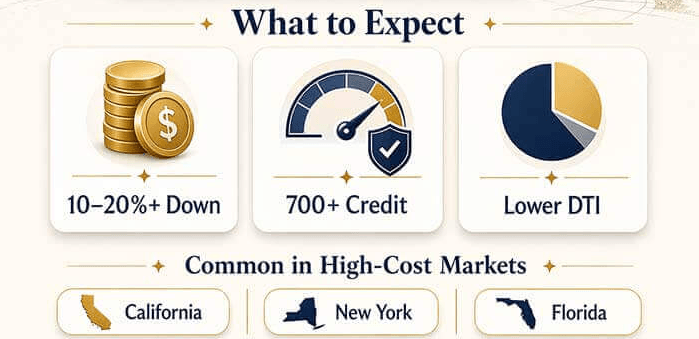
If the home you want costs more than the 2026 loan limit of $832,750 (in most areas), you’ll need a jumbo loan. What to expect:
- Higher down payment (10–20%+)
- Strong credit (usually 700+)
- Lower debt-to-income ratio (DTI)
Jumbo loans are common in high-cost markets like California, New York, and Florida. Because the loan amounts are higher and riskier for lenders, these types of mortgages come with stricter rules. Gustan Cho Associates has traditional and non-prime jumbo loans for our borrowers.
Non-QM Mortgages – Flexible Options for Self-Employed or Credit-Challenged Borrowers
Non-QM loans (non-qualified mortgages) are not backed by Fannie, Freddie, FHA, or VA—but that’s exactly why they’re flexible. Ideal for:
- Self-employed borrowers using bank statements or P&L
- Buyers with recent credit events (bankruptcy, foreclosure)
- High DTI ratios or no tax returns
No tax returns, no problem. You can qualify based on bank deposits, asset depletion, or even a CPA letter for income. These types of mortgages have helped thousands of borrowers get approved at Gustan Cho Associates—even after being denied elsewhere.
Traditional and Non-Prime Jumbo Mortgage Options
We have shared some useful links on traditional versus non-prime jumbo mortgages below:
- FHA and VA High-Balance Jumbo Loans in High-Cost Areas
- High-Cost Conforming Loans in High-Cost Areas
- 90 LTV Jumbo Mortgages
- non-QM Jumbo Mortgages
- Bank Statement Loans for Self-Employed Borrowers
- Self-Employed Borrowers Mortgages
- Jumbo Loans With Low Credit Scores
Why Do Mortgage Types Matter?
Choosing the right loan affects:
- Your interest rate
- How much you pay monthly
- How much you need to save for a down payment
- Whether you’ll need mortgage insurance
Not all lenders offer every type. Some have overlays or extra rules that make qualifying harder. That’s where Gustan Cho Associates stands out—we don’t add unnecessary overlays and offer all major types of mortgages.
Traditional or Non-Prime Loan? Let’s Find the Right Loan for You!
Contact us today to see which loan best fits your needs and start your application.What Are Lender Overlays?
Even if a government program like FHA says you can qualify with a 580 score, many lenders add overlays—like requiring a 620 or higher. This is a big reason why borrowers get denied. Gustan Cho Associates follows agency guidelines only. No overlays. If HUD says 580 is OK, we’ll honor it. It’s why over 75% of our clients came to us after being denied elsewhere.
Smart Tips for Picking the Right Mortgage
Here’s how to pick the best fit for your situation:
- Check your credit score – Know where you stand.
- Look at your income – Can you show tax returns, or do you need bank statement options?
- How much do you have saved? – Your down payment amount helps narrow down choices.
- Are you a veteran or living in a rural area? – You might qualify for $0 down options.
- Talk to a lender about all the programs. – Don’t limit your options.
We Make It Easy – Apply Now and Get Matched
At Gustan Cho Associates, we believe everyone deserves a shot at homeownership. Whether you need a low down payment loan, a mortgage with bad credit, or a creative option as a business owner, we’ll help you find the right loan.
We offer all types of mortgages and specialize in doing loans that other lenders won’t touch. If you’ve been denied, don’t give up. Let us help.
Borrowers who need a five-star national mortgage company licensed in 48 states with no overlays and who are experts on different types of mortgages, please contact us at 800-900-8569, text us for a faster response, or email us at gcho@gustancho.com.
Take the First Step Toward Homeownership
Whether buying your first home or your fifth, understanding the different types of mortgages gives you the power to choose what’s right. Don’t settle for one-size-fits-all lenders. At Gustan Cho Associates, we customize the loan to fit you. Ready to see what you qualify for? Apply now and get expert guidance.
Types of Mortgages: Traditional and Non-Prime Loan Options for Homebuyers
Choosing the right mortgage is a significant decision for any homebuyer. Each loan type has specific requirements for credit scores, down payments, income, property, and approval. Some borrowers qualify for traditional mortgages easily.
Others may require more flexible options if they are self-employed, have lower credit scores, have recent job changes, have a history of bankruptcy or foreclosure, have had late payments, or have had previous loan denials.
Fortunately, there are multiple mortgage options available. First-time buyers may choose FHA loans, veterans can access VA loans, rural buyers may qualify for USDA loans, and high-income buyers seeking expensive homes might require jumbo loans. Self-employed individuals may benefit from bank statement loans, while real estate investors may consider DSCR loans. Gustan Cho Associates offers both traditional and non-prime mortgage options. It is important to select a loan that aligns with your credit, income, down payment, property, and long-term objectives.
Jumbo Mortgages
A jumbo mortgage is a loan for a home that exceeds standard loan limits. Jumbo loans are used to purchase higher-priced properties. Because jumbo loans are larger and do not follow standard guidelines, lenders typically impose stricter approval requirements.
Jumbo Loans for Higher-Priced Homes
Jumbo mortgages are common in high-cost housing markets. They are used to purchase luxury homes, primary residences, second homes, or investment properties that exceed conforming loan limits.
Jumbo Loan Credit, Down Payment, and Reserve Requirements
Lenders offering jumbo loans typically require higher credit scores, larger down payments, lower debt levels, and cash reserves after closing. The exact requirements depend on the lender, loan amount, property type, occupancy, credit profile, and borrower income. If you do not meet standard jumbo loan requirements, you may need a non-QM jumbo loan or another mortgage type.
Non-QM and Non-Prime Mortgage Loans
Non-QM and non-prime loans are designed for borrowers who do not meet standard mortgage criteria. Non-QM stands for non-qualified mortgage and serves those with unique income, credit, or property situations. These loans are especially beneficial for self-employed borrowers, real estate investors, foreign nationals, individuals with recent bankruptcy or foreclosure, and those unable to document income in traditional ways.
Bank Statement Loans for Self-Employed Borrowers
A bank statement loan enables eligible self-employed borrowers to qualify based on bank deposits instead of traditional tax return income. This option benefits business owners, independent contractors, freelancers, consultants, and entrepreneurs whose tax returns may not reflect sufficient income due to business deductions. Bank statement loans are not no-document loans. Lenders still verify income, deposits, business activity, credit, assets, and ability to repay.
DSCR Loans for Real Estate Investors
A DSCR loan is a mortgage for real estate investors, where DSCR stands for debt service coverage ratio. Instead of relying primarily on personal income, DSCR loans assess the investment property’s income potential. If the property’s rental income can support the mortgage payment, the borrower may qualify. DSCR loans are popular among investors purchasing rental homes, short-term rentals, multi-unit buildings, and other income-producing properties.
Asset Depletion Loans
An asset-depletion loan allows you to qualify based on your assets rather than traditional employment income. This option is helpful for retirees, high-net-worth individuals, business owners, or anyone with substantial savings but limited reportable income. Lenders determine qualifying income by reviewing assets such as investment accounts, retirement funds, or cash reserves.
Foreign National Mortgage Loans
A foreign national mortgage is designed for non-U.S. citizens seeking to purchase property in the United States who do not possess the same documentation as residents. International buyers can use these loans to purchase second homes, investment properties, or other real estate in the United States. Requirements depend on the lender and may include bigger down payments, proof of foreign income, bank references, asset documents, and ID.
Mortgage Options After Bankruptcy, Foreclosure, or Late Payments
Non-prime loans can assist individuals who have recently experienced bankruptcy, foreclosure, short sale, deed-in-lieu, charge-offs, collections, or late payments. Traditional loans typically require waiting periods after significant credit issues. Non-QM and non-prime loans may be more flexible but often require larger down payments and may have higher interest rates. If a bank, credit union, or lender has declined your application, a non-prime mortgage may offer an alternative.
Fixed-Rate Versus Adjustable-Rate Mortgages
Mortgage loans can also be categorized by how interest is calculated. The two most common types of mortgages are fixed-rate and adjustable-rate mortgages.
Fixed-Rate Mortgages
A fiA fixed-rate mortgage maintains the same interest rate throughout the loan term, ensuring consistent principal and interest payments. Fixed-rate mortgages are popular because they’re simple and predictable. Many buyers pick them if they plan to stay in the home for a long time or want steady payments. Common fixed-rate terms include 30-year, 20-year, and 15-year fixed-rate mortgages.
Adjustable-Rate Mortgages
An adjustable-rate mortgage (ARM) features an interest rate that may change after an initial fixed-rate period. For example, a 5/6 or 7/6 ARM offers a fixed rate for the initial years, after which the rate adjusts based on market conditions and loan terms. These loans carry greater future payment risk and may be suitable for borrowers planning to sell, refinance, or pay off the mortgage before the adjustment period begins.
Purchase, Refinance, and Cash-Out Mortgage Options
The type of mortgage you need depends on your objective. Some loans are intended for home purchases, while others are designed for refinancing. A purchase mortgage is used to buy a home. It can be a conventional, FHA, VA, USDA, jumbo, non-QM, or non-prime loan. The best loan for purchasing a home depends on your credit score, income, down payment, property type, and intended occupancy.
Rate-and-Term Refinance Loans
A rate-and-term refinance replaces an existing mortgage with a new one, typically to lower the interest rate, extend the loan term, remove mortgage insurance, or convert from an adjustable-rate to a fixed-rate mortgage. A rate-and-term refinance generally does not involve withdrawing significant cash from the property.
Cash-Out Refinance Loans:
A cash-out refinance allows homeowners to replace their current mortgage with a larger one and receive a portion of their home equity in cash..
Cash-out refinance loans may be available through conventional, FHA, VA, jumbo, and non-QM mortgage programs. Homeowners often use cash-out refinances for debt consolidation, home improvements, investments, business needs, or emergency reserves.
Renovation Mortgage Loans
A renovation mortgage enables borrowers to finance the purchase or refinance of a home while including renovation costs in the same loan. Renovation loans are useful when a property requires repairs, upgrades, or improvements.
FHA 203(k) Renovation Loans
An FHA 203(k) loan allows eligible borrowers to finance a home purchase or refinance, including approved renovation costs. This mortgage is beneficial when purchasing a property that requires repairs but still meets FHA renovation guidelines.
Conventional Renovation Loans
Fannie Mae offers renovation mortgage options, such as HomeStyle Renovation, that enable eligible borrowers to finance repairs or improvements as part of a purchase or refinance mortgage. Conventional renovation loans may benefit borrowers seeking to update kitchens, bathrooms, flooring, roofing, or other property features.
Reverse Mortgages
A reverse mortgage is a specialized loan for older homeowners who wish to access home equity without making traditional monthly mortgage payments. The most common reverse mortgage is the Home Equity Conversion Mortgage (HECM). Reverse mortgages are not suitable for everyone and require careful consideration, as interest, fees, and mortgage insurance can reduce home equity over time. Borrowers must continue to meet occupancy, tax, insurance, and property maintenance requirements.
How To Choose the Best Type of Mortgage
The best mortgage is not always the one with the lowest advertised interest rate. Instead, it is the loan that aligns with your credit profile, income, property type, down payment, long-term plans, and approval requirements.
Match the Loan Program to Your Credit, Income, and Property Type
A borrower with excellent credit may benefit from a conventional mortgage. Buyers with lower credit scores may require FHA financing. Eligible veterans may be best served by a VA loan, while buyers in qualifying rural areas may consider a USDA loan. Self-employed borrowers may need a bank statement loan, real estate investors may require a DSCR loan, and those with recent bankruptcy or foreclosure may need a non-prime mortgage The appropriate loan program should align with the borrower’s complete financial profile. a picture.
Why the Lowest Rate Is Not Always the Best Loan
A low interest rate is irrelevant if the borrower cannot close. Some lenders advertise attractive rates but impose strict overlays that prevent qualification. The best mortgage lender is not always the one with the lowest quote. The ideal lender can structure the appropriate loan, ensure accurate approval, close on time, and prevent unexpected issues.
Types of Mortgages for Borrowers Denied by Another Lender
Many borrowers approach Gustan Cho Associates after being denied by another lender. A denial does not necessarily mean the borrower cannot. In some cases, the borrower did not meet a specific lender’s overlay. Another lender may offer a loan program better suited to the borrower’s needs. fits the borrower’s needs.
Common Reasons Borrowers Get Mortgage Denial
Common Reasons Borrowers may be denied include low credit scores, late payments, high debt-to-income ratios, self-employment income, recent bankruptcy, foreclosure, collections, charge-offs, disputed accounts, insufficient reserves, or property-related issues.
Some denials occur late in the mortgage process because the application was not properly structured from the outset.
How Gustan Cho Associates Helps Borrowers Find the Right Mortgage
Gustan Cho Associates specializes in assisting borrowers who do not fit within standard lending criteria. The team works with traditional loans, government-backed loans, non-QM loans, non-prime mortgages, and investor loan programs. This approach provides borrowers with more options and a greater likelihood of finding a mortgage that suits their circumstances.
Conclusion on Mortgage Types
Understanding the various mortgage types helps prospective homebuyers choose the best loan before applying. Options include conventional, FHA, VA, USDA, jumbo, non-QM, and non-prime loans. A borrower’s credit, income, debts, down payment, property type, and preferences determine the most suitable mortgage. Strong credit may qualify for a conventional loan. Veterans often benefit most from VA loans. Self-employed borrowers may prefer bank statement mortgages. Real estate investors may choose DSCR loans. Those with credit challenges may need non-prime loans. Choosing the right mortgage can be challenging. Borrowers should consult a lender experienced with both traditional and non-prime loans to improve their chances of approval.
Mortgage Types: Frequently Asked Questions
What Are The Main Types Of Mortgages?
- There are conventional, FHA, VA, USDA, and jumbo loans. Main mortgage types include conventional, FHA, VA, USDA, jumbo, fixed-rate, adjustable-rate, non-QM, and non-prime loans. Each type has different credit, income, and property requirements. They have flexible guidelines for credit and down payments, and they are required, making this a great mortgage type for homebuyers. Some first-time homebuyers may also be eligible for a conventional, VA, or USDA loan.
What’s The Simplest Mortgage To Qualify For?
- FHA loans are often considered the easiest traditional mortgages to qualify for due to flexible credit and debt-to-income requirements. However, the best option depends on individual circumstances. Some borrowers may find VA, USDA, non-QM, or non-prime loans easier to obtain.
What Distinguishes A Conventional Loan From An FHA Loan?
- An FHA loan means the Federal Housing Administration backs the loan. Because FHA loans are backed by the federal government, they can be more flexible. An FHA loan is backed by the Federal Housing Administration, making it more flexible for borrowers with lower credit scores. Conventional loans are not government-backed and typically have stricter requirements. self-employed borrowers, real estate investors, and foreign nationals.
What Are The Best Mortgages For Self-Employed Borrowers?
- Self-employed borrowers may qualify for conventional, FHA, VA, or USDA loans using their tax returns. If tax returns do not show enough income, a bank statement or non-QM loan may be preferable.
What’s Good For Real Estate Investors?
- Real estate investors may use conventional investment property loans, jumbo loans, DSCR loans, or other non-QM options. DSCR loans are often preferred because they emphasize rental income over personal income.
Is It Possible To Obtain A Mortgage Following A Bankruptcy Or A Foreclosure? Can I Obtain A Mortgage After Bankruptcy Or Foreclosure?
- It is indeed possible to obtain a mortgage after bankruptcy or foreclosure. Traditional loans may require longer waiting periods, while non-QM and non-prime loans may be available sooner. Eligibility depends on the type and timing of the credit event, credit recovery, down payment, and your overall borrower profile. Fixed-rate mortgages have interest rates that stay the same for the entire loan term. Adjustable-rate mortgages start with a fixed rate that adjusts periodically. Fixed-rate loans offer stability, while adjustable-rate loans may start lower but carry the risk of future increases.
Which Mortgage Does Not Require A Down Payment?
- Eligible veterans, service VA loans are available to eligible veterans, service members, and surviving spouses with no down payment required. USDA loans also offer no down payment for buyers in qualifying rural or suburban areas.
What Are The Main Types Of Mortgages?
The most frequent mortgage types include FHA, VA, USDA, Conventional, Jumbo, and non-QM loans. Each type is designed to meet various requirements, such as purchasing your initial home, accommodating low credit, or catering to self-employed individuals.
Which Types Of Mortgages Are Best For First-Time Homebuyers?
FHA loans are a top pick for first-time buyers because they only need 3.5% down and allow lower credit scores. USDA and VA loans are also great if you qualify, mainly because they offer zero down payment.
Can I Still Get A Mortgage If I Have Bad Credit?
Yes! Some types of mortgages, like FHA or Non-QM loans, are made for people with lower credit scores. At Gustan Cho Associates, we help people who have been denied by other lenders.
What’s The Difference Between Conventional And FHA Loans?
FHA loans are easier to get with low credit or small savings. Conventional loans are better for people with good credit and steady income. Both are popular types of mortgages with different rules.
Are There Types of Mortgages With No Down Payment?
Yes! VA loans for veterans and USDA loans for rural homes allow 0% down. These types of mortgages help people buy homes without needing a lot of cash upfront.
Why Do Lenders Have Different Rules For The Same Types Of Mortgages?
Some lenders add extra rules called “overlays.” For example, FHA allows credit scores of 580, but some lenders ask for 620 or more. At Gustan Cho Associates, we don’t add overlays. We follow the official rules.
Can I Get Approved If I’ve Been Turned Down Before?
Absolutely. Many of our clients came to us after being denied elsewhere. Because we offer many types of mortgages and don’t add overlays, we can often help when others can’t.
This Guide About “Types of Mortgages | Traditional and Non-Prime Loan Options” Was Updated on April 28, 2026.
