I make money, but my tax returns don’t show enough income. That is one of the biggest problems borrowers face when applying for self-employed mortgage loans. You may have strong cash flow, steady clients, and enough money to make the payment. But lenders usually do not qualify you based on gross sales or deposits before expenses. They look at documented income after business write-offs. That is where many business owners get stuck. The same deductions that lower your tax bill can make your mortgage income look too low on paper. Self-employed mortgage loans are still possible. The key is knowing how lenders review tax returns, business income, bank statements, credit, debt, and reserves before choosing the right loan program.
Why Self-Employed Borrowers Get Reviewed Differently
Self-employed borrowers get reviewed differently because their income is not always simple or steady on paper. A W-2 employee can usually show pay stubs, W-2 forms, and employer verification. A business owner may need tax returns, business records, profit-and-loss statements, or bank statements to prove income.
The biggest issue is how lenders calculate income. Many self-employed borrowers earn strong cash flow, but business write-offs can lower the income shown on tax returns. That lower taxable income may be the number lenders use to qualify the borrower for self-employed mortgage loans.
Lenders also look at whether the business is stable and likely to continue. They may review how long the borrower has been self-employed, whether income is rising or falling, how much business debt there is, and whether the borrower has sufficient reserves after closing. This does not mean self-employed borrowers are weaker buyers. It means the file needs more documentation. The lender must prove that the income is real, lawful, and sufficient to support the new mortgage payment.
W-2 Borrowers vs. Self-Employed Borrowers
W-2 borrowers and self-employed borrowers can often qualify for the same mortgage programs. The main difference is income documentation. W-2 borrowers usually prove income with pay stubs, W-2 forms, and employment verification. Self-employed borrowers may need tax returns, business returns, profit-and-loss statements, bank statements, or non-QM loan options. The challenge is that self-employed borrowers may earn high income, but tax deductions can lower the income lenders use to qualify them. When tax-return income is too low, bank statement loans or other alternative documentation programs may help.
How Lenders Calculate Self-Employed Income
Lenders usually calculate self-employed income by reviewing tax returns, not just bank deposits or gross sales. They want to know how much income is left after normal business expenses are deducted.
For many borrowers, this is where the problem starts. A business may generate strong revenue, but the lender may use the net income reported on the tax returns. If the borrower writes off many expenses, the qualifying income can appear much lower than the money actually coming into the business.
Most lenders review 1 or 2 years of tax returns, depending on the loan program, automated underwriting findings, and lender policies. If income is steady or increasing, approval is usually easier to obtain. If income drops, the lender may use the lower year or ask for an explanation. Some expenses may be added back when allowed. These can include depreciation, business mileage adjustments, and other non-cash expenses. The exact calculation depends on the loan program and how the business is filed. For self-employed mortgage loans, the goal is not just to prove the borrower’s earned income. The lender must show that the income is stable, documented, and likely to continue after closing.
Two-Year Self-Employment Requirement
Most lenders want to see a two-year history of self-employment before approving a mortgage. The reason is simple. They need enough history to show that the business income is stable and likely to continue. Two years does not always mean the borrower must own the exact same business for two full years. In some cases, prior experience in the same line of work can help. For example, a borrower who worked as a W-2 electrician and then started an electrical business may have a stronger file than someone who started a brand-new business in a field they had never worked in before. Lenders usually review the most recent one or two years of tax returns to calculate income. If the income is steady or going up, the file is easier to support. If the income is falling, the lender may ask why it dropped and may use the lower income amount. Borrowers with less than two years of self-employment may still have options, but the file must be strong. Credit, reserves, debt-to-income ratio, business history, and prior work experience all matter. For self-employed mortgage loans, the goal is to prove the income is not temporary. It can support the new mortgage payment after closing.
Can You Get Approved With One Year of Tax Returns?
Some self-employed borrowers may qualify for a conventional mortgage using only one year of tax returns. This is usually possible only when the automated underwriting system allows it, the borrower has an acceptable business history, and the income appears stable and likely to continue.
The full file still matters. Lenders may review the borrower’s prior work experience, current business income, credit, debt-to-income ratio, assets, and the business’s ability to support the new mortgage payment.
Lender overlays can also make a big difference. Some lenders require two years of tax returns even when agency guidelines or AUS findings may allow one year. This is why self-employed borrowers should work with a lender that understands the difference between actual agency guidelines and lender overlays.
Get the Self-Employed Mortgage Checklist
Know what lenders may need before you apply, including bank statements, business licenses, tax returns, profit-and-loss statements, and asset documentation.Common Documents Needed
Self-employed borrowers usually need more paperwork than W-2 borrowers because lenders must document both personal and business income. The exact documents depend on the loan program, business type, and how the borrower files taxes. Most lenders may ask for personal tax returns, business tax returns, bank statements, a year-to-date profit-and-loss statement, a business license, a CPA letter, or proof that the business is still operating. Some files may also need K-1s, 1099s, corporate returns, or partnership returns. Bank statements may be reviewed to confirm deposits, cash flow, reserves, and large deposits. If the borrower is using business funds for closing, the lender may need to verify that taking those funds will not hurt the business. For self-employed mortgage loans, clean and complete documents can make a major difference. Missing pages, unclear deposits, declining income, or tax returns that do not match the loan application can slow down underwriting or lead to more conditions.
FHA, VA, USDA, and Conventional Self-Employed Mortgage Rules
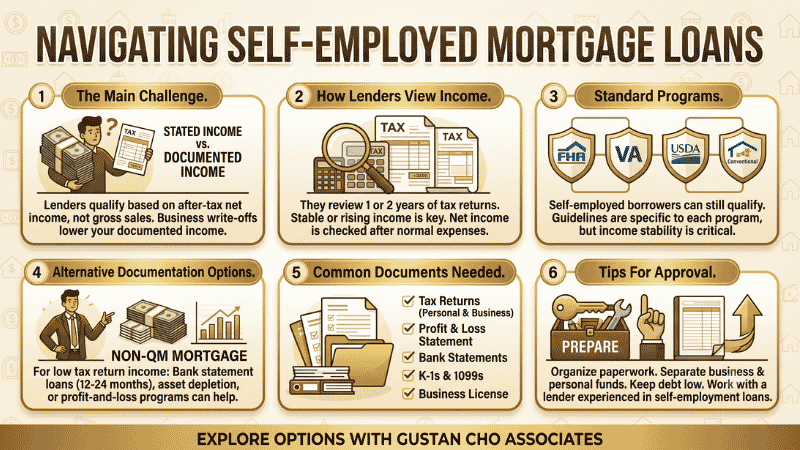
Self-employed borrowers can qualify for FHA, VA, USDA, and conventional loans, but each program has different income evaluation criteria. The key requirement is to show that the income is stable, well-documented, and likely to continue.
FHA Loans
FHA loans are suitable for borrowers with lower credit scores, higher debt-to-income ratios, or smaller down payments. Self-employed individuals must provide tax returns and business records to document income. FHA guidelines follow HUD Handbook 4000.1.
VA Loans
VA loans can be a strong option for eligible veterans, active-duty service members, and surviving spouses. VA does not treat self-employment as a problem by itself, but the lender still has to document stable income and the borrower’s ability to repay. VA underwriting guidance is found in VA Pamphlet 26-7.
USDA Loans
USDA loans may help eligible buyers purchase homes in approved rural areas with low-to-moderate income limits. A self-employed borrower must still clearly document income, and property and household income must meet USDA program rules.
Conventional Loans
Conventional loans follow Fannie Mae or Freddie Mac guidelines. These programs often rely heavily on tax returns, business income analysis, automated underwriting findings, credit, debt-to-income ratio, and reserves. Fannie Mae’s Selling Guide explains that self-employed income must be reviewed for stability and documentation. The loan program matters, but the lender matters too. Some lenders add overlays that make approval harder than agency rules require. For self-employed mortgage loans, one lender may deny the file while another may approve it, even with the same borrower profile.
When Tax Returns Do Not Show Enough Income
Many self-employed borrowers run into trouble because the income on their tax returns is much lower than the money they actually earn. Business owners often take legitimate deductions to reduce their taxable income. While this can lower taxes, it can also reduce the income lenders use to qualify for a mortgage. For example, a business may generate substantial revenue each year, but after expenses, depreciation, and other write-offs, the net income shown on the tax return may not be enough to support the desired loan amount. As a result, a borrower who can comfortably afford the payment may still have difficulty qualifying under traditional mortgage guidelines.
This is one of the most common reasons self-employed mortgage loans get denied. The issue is not always the borrower’s cash flow. It is often the income calculation used by the lender.
When tax returns do not show enough qualifying income, alternative loan programs may help. Depending on the borrower’s situation, options can include bank statement loans, asset depletion loans, profit-and-loss programs, or other non-QM mortgage products. These programs may allow lenders to evaluate income differently than they do for traditional FHA, VA, USDA, or conventional loans. Before assuming you do not qualify, it is important to understand how your income is being calculated. In many cases, the solution is not earning more money. It is finding a loan program that better reflects how your business generates income.
Bank Statement Loans for Self-Employed Borrowers
Bank statement loans can help self-employed borrowers with strong cash flow who do not show sufficient income on their tax returns. Instead of using only tax-return income, the lender reviews deposits shown on personal or business bank statements. Most bank statement loan programs review 12 or 24 months of bank statements. The lender looks for consistent deposits, business-related income, stable account activity, and sufficient funds remaining after expenses. If business bank statements are used, the lender may apply an expense factor because not every deposit is personal income. These loans are often used by business owners, freelancers, independent contractors, real estate investors, and 1099 workers. They can be helpful when legal tax write-offs make traditional qualifying income too low. Bank statement loans are usually non-QM loans. That means they do not follow the same rules as FHA, VA, USDA, or conventional loans. They might need higher credit scores, larger down payments, greater reserves, or higher interest rates than traditional mortgage programs. For self-employed mortgage loans, bank statement options make sense when the borrower has real income but cannot prove enough income through tax returns. The key is clean bank statements, steady deposits, limited overdrafts, and a clear connection between deposits and the borrower’s business.
When a Non-QM Mortgage May Help Self-Employed Borrowers
A non-QM mortgage may help self-employed borrowers who cannot qualify with traditional tax-return income. Many business owners write off expenses, which can lower the income shown on tax returns even when the business has strong cash flow.
Instead of relying only on tax returns, some non-QM loans may allow borrowers to document income through bank statements, assets, rental income, profit-and-loss statements, or other alternative documentation.
Non-QM loans are not the same as FHA, VA, USDA, or conventional loans. They usually have different credit, down payment, reserve, and pricing requirements. For self-employed borrowers, this can be a useful option when they demonstrate the ability to repay but do not meet traditional mortgage guidelines.
Common Reasons Self-Employed Mortgage Loans Get Denied
Self-employed mortgage loans are often denied because the income reported to the lender is lower than the income the borrower believes they actually earn. This usually happens when tax deductions, business expenses, or declining income reduce the qualifying income on paper. Another common issue is incomplete or unclear documentation. Missing tax return pages, unsigned returns, unexplained large deposits, outdated profit-and-loss statements, or bank statements with overdrafts can create problems during underwriting. Declining income can also hurt approval. If the business earned less this year than last year, the lender may question whether the income is stable. A short explanation may not be enough. The file may need updated business records, recent deposits, or proof that the business is still strong. High debt-to-income ratios can also lead to denial. Even when the business has good cash flow, the lender must assess whether the borrower can meet the new mortgage payment alongside existing debts. Some borrowers are denied because they applied with the wrong lender or wrong loan program. A borrower who does not qualify based on tax returns may still qualify with a bank statement loan, a non-QM loan, or another alternative documentation option.
How To Improve Your Approval Chances
Self-employed borrowers can enhance their approval chances by organizing their documents before applying. Clear paperwork helps lenders assess income and simplifies the underwriting process. Start by gathering complete tax returns, all schedules, business returns, K-1s, 1099s, recent bank statements, and a year-to-date profit-and-loss statement if needed. Make sure the documents are complete, signed, and match the income listed on the loan application.
Keep business and personal money as separate as possible. Mixed deposits, unexplained transfers, overdrafts, and large cash deposits can create more questions. Clean bank statements with steady deposits can help support the file, especially for bank statement or non-QM loans.
Watch your debt before applying. Lower credit card balances, avoid new loans, and do not open new accounts before closing. A lower debt-to-income ratio can offset some of the risk that comes with variable self-employed income. Work with a lender who understands self-employed mortgage loans. One lender may only look at tax-return income, while another may review bank statement loans, non-QM options, or other alternative documentation programs. The right loan program can make the difference between a denial and an approval.
Final Thoughts on Self-Employed Mortgage Loans
If you work for yourself, getting a mortgage may involve extra steps, but it’s possible. The key factors for approval are your tax records and the consistency of your business income. Your credit score, savings, and current debt also play important roles. Lenders need to feel confident that you will continue to earn money. Individuals can qualify for various self-employed mortgage loans, such as FHA, VA, USDA, regular, high-value, or non-QM loans, depending on how they document their income. If your tax forms show low earnings, you can provide alternative documentation such as bank statements, assets, business revenue logs, or rental income for property investors. Start by choosing a mortgage lender experienced with self-employment income and the different documentation methods required. Gustan Cho Associates can help freelancers find the right loan options that fit their financial situations.
FAQs on Self-Employed Mortgage Loans
Can I Get Self-Employed Mortgage Loans if I have Just Started My Business?
You may have options, but it is harder when the business is very new. Most lenders want to see a history of stable income. If you recently moved from a W-2 job into the same line of work, that prior experience may help. If the business is brand new and has little income history, a non-QM loan may be worth reviewing.
Do Mortgage Lenders Use Gross Income or Net Income for Self-Employed Borrowers?
Mortgage lenders usually focus on net income after business expenses, not gross sales. This is why some business owners feel they make enough money but still have trouble qualifying. Certain add-backs may help, but the lender must follow the loan program’s income rules.
Can I Qualify for a Mortgage if I Pay Myself Through an LLC or S Corporation?
Yes, but the lender may review both your personal income and the business tax returns. They may look at wages, distributions, K-1 income, retained earnings, and whether the business can continue operating after funds are used for closing.
Do Self-Employed Borrowers Need Perfect Credit to Get Approved?
No, perfect credit is not required. However, stronger credit can help offset risk when income is variable or documentation is complex. Lower debt, clean bank statements, reserves, and stable income can also strengthen the file.
Can I Use Money from My Business Bank Account for My Down Payment?
You may be able to use business funds for the down payment or closing costs. The lender may need to confirm that taking money from the business will not harm cash flow or the business’s ability to continue operating.
Are 1099 Workers Considered Self-Employed for Mortgage Approval?
Many 1099 workers are treated as self-employed because taxes are not withheld the same way as a W-2 employee. Lenders may review tax returns, 1099 forms, bank statements, and business expenses to calculate qualifying income.
Can I Refinance if I am Self-Employed?
Yes, self-employed borrowers can refinance if they meet income, credit, equity, and documentation requirements. The lender will still review whether the business income is stable and enough to support the new mortgage payment.
This article about “Self-Employed Mortgage Loans When Banks Say No” was updated on June 23rd, 2026.