Understanding QM-Qualified Mortgages: What Borrowers Need to Know in 2026
As you navigate the world of home loans, you will likely come across QM-qualified mortgages and non-QM loans. Knowing the difference can shape your eligibility, paperwork, interest rate, and the stability of your payments in the years ahead. At Gustan Cho Associates, we provide both QM and non-QM mortgages, without the extra hoops of government and conventional loans. Our experts work with you to find the mortgage that fits your income, credit, and long-term dreams.
A qualified mortgage (QM) is a loan that follows rules set by the Consumer Financial Protection Bureau (CFPB) to ensure risky loan features are removed and that lenders verify you can pay back the mortgage.
A QM mortgage follows strict rules for checking your finances. Lenders must look at your income, savings, job, debts, and credit to make sure you can pay back the loan. These rules protect lenders and give borrowers a safer, more reliable mortgage. If you’re thinking about buying a home or refinancing, chances are you’ve heard about QM-qualified mortgages. But what exactly does it mean, and why does it matter to you as a borrower?
This blog will briefly summarize everything you need to know about QM-qualified mortgages. By the end, you’ll clearly understand whether a QM loan is right for you and how Gustan Cho Associates can help you get started.
What Are QM-Qualified Mortgages And The Key Characteristics of QM-Qualified Mortgages
While each program has its own rules, all QM-qualified mortgages share some basics. These loans need monthly payments that pay down both the amount you borrowed and the interest, so your home is paid off by the end. They do not allow payments that only cover interest, large final payments, or loans where the amount you owe increases. Fees are limited by loan size, and lenders always check whether you can repay. They also look at your debt compared to your income and how your finances are checked. Most QM loans are what people think of as regular mortgages.
What Is A Non-QM Mortgage?
Non-QM loans are just mortgages that do not meet every QM rule. Lenders still have to verify that you can repay them. These loans are not automatically risky or for people with bad credit—they just do not fit the QM rules because of things like how your income is shown, the kind of property, loan details, or your personal situation. Smaller lenders and investors usually offer non-QM loans and often retain them rather than sell them to big companies.
Because the rules are more flexible, these loans help people who do not meet the usual requirements, such as the self-employed, those who earn commissions, real estate investors, or anyone with recent credit issues.
QM loans come in two main flavors: Safe Harbor and Rebuttable Presumption. Safe Harbor QMs are the gold standard, following the strictest rules for pricing, paperwork, and underwriting. This means lenders are well protected, and borrowers enjoy friendlier terms and conditions.
Safe Harbor And Rebuttable Presumption QMs
Rebuttable Presumption QMs still meet the core qualified mortgage rules, but they might come with slightly higher costs or push closer to the edge of the guidelines. Borrowers have more room to question the lender if something seems off. Both types are built to be far safer than the risky loans that fueled past housing bubbles.
Simply put, a QM-qualified mortgage focuses on your ability to repay the loan. Lenders look closely at your income, debts, and other financial factors to ensure you’re not taking on a loan you can’t afford.
It’s all about making lending safer and more sustainable. QM-qualified mortgages, or “Qualified Mortgages,” are home loans that meet specific rules designed to ensure borrowers can repay their loans. These rules were introduced on January 10, 2014, under the Dodd-Frank Act. The primary goal of QM-qualified mortgages is to protect both borrowers and lenders by preventing risky lending practices.
Why Are QM-Qualified Mortgages Important?
QM-qualified mortgages serve two main purposes:
Protect Borrowers:
- QM-qualified mortgages are designed to help protect borrowers like you by closely examining your ability to repay the loan.
- This means they aim to ensure you don’t end up in a situation where you might face foreclosure or financial stress.
- By focusing on these factors, QM-qualified mortgages can help create a safer borrowing experience, making it easier to manage your payments without worrying about losing your home.
Protect Lenders:
- QM-qualified mortgages are a type of loan that helps protect lenders from legal issues as long as they stick to the rules set out by the Qualified Mortgage guidelines.
- Lenders who play by these rules don’t have to worry as much about being sued. For borrowers, this can lead to more secure loan options and better protections overall when borrowing money.
At Gustan Cho Associates, we’re here to guide you through the QM loan process and ensure you understand how it works. Our goal is to make homeownership achievable and affordable for everyone.
Why Are Non-QM Loans Offered In Our Current Mortgage Markets?
Today, more Americans have non-traditional income, complicated tax returns, or work histories that do not fit the standard mold. A self-employed person might show less income on paper because of business write-offs, even if they have plenty to afford a mortgage. Real estate investors might not pass the usual DTI test, but their rental income or cash flow tells a different story.
Non-QM mortgage programs look beyond just W-2s, using alternative paperwork to see if you can repay. This opens real doors for business owners and self-employed people. For many, non-QM loans are the key to buying a home or growing an investment portfolio.
Key Features of QM-Qualified Mortgages
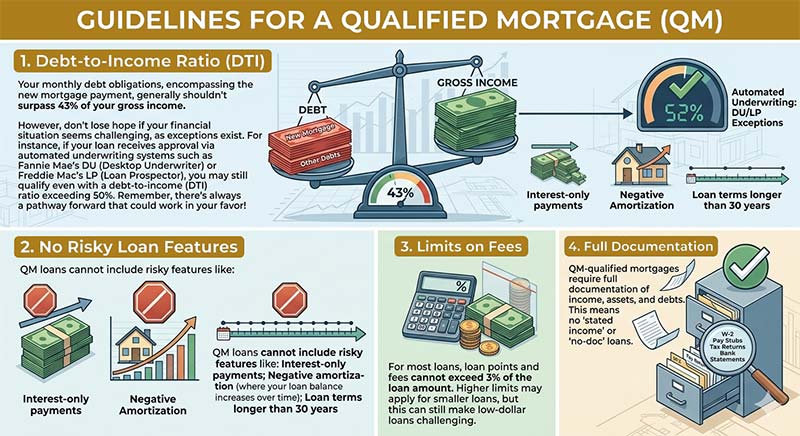
To qualify as a QM-qualified mortgage, a loan must meet the following requirements:
1. Debt-to-Income Ratio (DTI)
Your monthly debt obligations, encompassing the new mortgage payment, generally shouldn’t surpass 43% of your gross income. However, don’t lose hope if your financial situation seems challenging, as exceptions exist.
For instance, if your loan receives approval via automated underwriting systems such as Fannie Mae’s DU (Desktop Underwriter) or Freddie Mac’s LP (Loan Prospector), you may still qualify even with a debt-to-income (DTI) ratio exceeding 50%. Remember, there’s always a pathway forward that could work in your favor!
2. No Risky Loan Features
QM loans cannot include risky features like:
- Interest-only payments
- Negative amortization (where your loan balance increases over time)
- Loan terms longer than 30 years
3. Limits on Fees
For most loans, loan points and fees cannot exceed 3% of the loan amount. Higher limits may apply for smaller loans, but this can still make low-dollar loans challenging.
4. Full Documentation
QM-qualified mortgages require full documentation of income, assets, and debts. This means no “stated income” or “no-doc” loans.
What Are Safe Harbor QM Loans?
A “Safe Harbor” QM loan offers lenders the highest level of legal protection. These loans meet all QM guidelines and demonstrate that the borrower’s repayment ability has been thoroughly verified. Safe Harbor loans are typically associated with lower risk and are easier for lenders to approve.
Many loans insured by organizations such as Fannie Mae, Freddie Mac, FHA, VA, or USDA can be considered Safe Harbor Qualified Mortgages. This means you can feel confident knowing that these loans meet specific regulatory standards, providing security in your financial decisions.
Ready To Get A Qm-Qualified Mortgages
Apply Online And Get recommendations From Loan Experts
Non-QM Mortgage Programs
Non-QM programs come with a toolkit of special loan options. Take bank statement loans, for example: self-employed borrowers can demonstrate their income with a year or two of bank statements rather than tax returns. For business owners, freelancers, and gig workers, this paints a truer picture of their real cash flow.
Real estate investor DSCR (Debt Service Coverage Ratio) loans are a big part of the market. These loans consider the property’s rental income to determine whether it can cover the mortgage and costs, rather than focusing on your personal debt and income. There are also asset-depletion loans, interest-only non-QM loans, loans for condos that do not meet standard rules, and loans for people with bankruptcy, foreclosure, or short sales in their past.
Features Of A Non-QM Loan
What makes non-QM loans stand out is their flexibility, but this also means their terms can differ significantly from those of regular loans. Non-QM lenders are more willing to accept higher debt-to-income ratios, lower credit scores, recent late payments, and alternative income sources. They also consider larger loans and special cases, such as when someone lives in the home but is not on the loan.
Down Payment, Interest Rate, and Risk
Because non-QM loans entail greater risk and require more tailored underwriting, they often come with higher interest rates and larger down payments than QM loans. Depending on the program, you might see rates and down payments climb into the double digits. For many qualified borrowers, though, the opportunity to buy a home or investment property makes these extra costs worthwhile.
QM-Qualified Mortgages and Non-QM Loans Key Differences
The main difference between QM-qualified mortgages and non-QM loans is the lender’s compliance with the CFPB’s QM template and your demonstration of ability to repay. QM loans require adherence to rules, specific documentation, and Automated Underwriting Systems.
Non-QM loans rely on Manual Underwriting and Borrower or Property Specific Guidelines
QM-qualified mortgages usually mean lower rates, fewer fees, and steady payments—especially if you choose a fixed-rate loan. Non-QM loans, on the other hand, offer flexible qualification options but may come with adjustable rates, interest-only periods, or shorter fixed-rate terms. When deciding, weigh how easy it is to qualify, how steady your payments will be, and what you want from the property.
Guidelines for Underwriting and Documentation
QM Loans usually have a more automated, rigid underwriting approach because they must follow the guidelines of an agency or Government-Sponsored Enterprise (GSE), such as Desktop Underwriter or Loan Product Advisor. You are typically eligible by providing proof of income through W-2s, pay stubs, tax returns, and a lender’s credit report. The lender then calculates your DTI and uses a set measure to approve or deny the loan.
Standards of Underwriting Guidelines and Documentation
Non-QM underwriters do not just trust automated systems—they dig into bank statements, business records, rent rolls, leases, and asset statements. They might use special rules such as minimum DSCR, alternative income calculations, or custom credit grading. This hands-on approach often fits self-employed people and real estate investors much better.
Debt-To-Income, Credit, And Loan Jargon
QM-qualified mortgages tend to play it safe with stricter DTI limits, especially for government and conforming loans. DTI, or Debt-to-Income, is just your total monthly debts (including the new mortgage) divided by your gross income. These loans also stick to set credit score rules and pricing tiers, so missing the mark can be a dealbreaker. Non-QM loans, though, are more forgiving—they might accept lower credit scores, recent credit hiccups, or offer interest-only periods and shorter fixed-rate terms, which can be a win for short-term investors.
Interest Rates, Down Payments, and Risk
Thanks to their standardized, lower-risk rules, QM loans usually come with better interest rates and smaller down payments—especially if you are a first-time buyer or purchasing your main home. Many QM loans are backed by the government, like FHA, VA, or USDA, and can be flexible with credit and down payment requirements.
Mortgage Rates On Non-QM Loans
Non-QM mortgages usually have higher interest rates and bigger down payments because they are seen as riskier and more complicated. Some borrowers and investors think these risks are worth it if they mean they can buy a property or secure a certain kind of income. People who plan to live in the home should understand the risks, such as how payments might change or rates might go up, and consider options to switch to a QM loan later so they are not stuck with these terms.
Who Is A Good Candidate For A QM-Qualified Mortgage?
QM loans are a great fit for W-2 employees with steady jobs, straightforward tax returns, and a credit history that is either clean or on the mend. If your income, debts, and assets fall within government or agency guidelines, you are in line for the best rates and terms.
If you are aiming for long-term homeownership with steady payments, lower costs, and solid consumer protections, a QM-qualified mortgage could be your best bet. Many first-time buyers and move-up homeowners find that the right QM loan helps them buy—and keep—their dream home.
Pros And Cons Of QM Loans
Choosing a QM loan offers several benefits, such as careful checks to ensure you can repay, clear steps, and the removal of risky features that caused problems in the past. Borrowers get lower interest rates, fewer fees, and better long-term costs. However, major credit problems can make it hard to qualify for a QM loan. In those cases, a non-QM loan can be a short-term fix until you qualify for a QM loan.
Getting Approved For a Non-QM Mortgage
If you can afford a mortgage but do not fit the QM mold, a non-QM loan might be right for you. This covers self-employed business owners, 1099 contractors, gig workers, commission earners, and seasonal employees. It also helps those who have bounced back from bankruptcy, foreclosure, or other credit setbacks but are still waiting out the required timelines.
If you have the means to pay a mortgage but do not check every QM box, a non-QM loan could be a great fit. This includes self-employed folks, 1099 contractors, gig workers, commission earners, and seasonal employees.
It also covers people who have recovered from tough credit events but are still in the waiting period. If your taxable income looks low, bank statement loans and other non-QM options let lenders look at your deposits and business trends for a truer picture of your ability to repay.
With a bank statement non-QM mortgage, you might qualify using 12 or 24 months of deposits from different accounts. This can help you buy a home or refinance at a level that aligns with your actual cash flow, especially if your tax returns show lower income.
Updates to QM Guidelines in 2026
The mortgage industry has evolved significantly since QM-qualified mortgages were introduced. Here are the latest updates:
Revised DTI Limits:
- While the 43% DTI cap remains a standard benchmark, automated underwriting systems allow more flexibility, especially for borrowers with strong credit profiles.
Adjusted Loan Fee Thresholds:
- Loan points and fee thresholds are now adjusted annually for inflation, providing more clarity for smaller loan amounts.
Inclusive Credit Scoring Models:
- New credit scoring models, such as FICO 10 and VantageScore 4.0, are being adopted, making it easier for borrowers with limited credit history to qualify.
At Gustan Cho Associates, we stay updated on these changes to provide the best options tailored to your unique financial situation.
QM-Qualified Mortgages vs. Non-QM Loans
So, how do QM-qualified mortgages compare to non-QM loans? Let’s take a closer look:
QM-Qualified Mortgages:
- Focus on the borrower’s ability to repay
- Offer lower interest rates
- Require full documentation
- Provide legal protections for lenders
Non-QM Loans:
- Designed for borrowers who don’t meet QM guidelines
- Include options like bank statement loans, asset-based loans, and interest-only loans
- Offer more flexibility in income verification
- Typically, they have higher interest rates
Non-QM loans are an excellent alternative for self-employed borrowers, real estate investors, or those with recent credit events like bankruptcy or foreclosure. Gustan Cho Associates specializes in QM and non-QM loans, ensuring you can access the right loan.
Who Benefits from QM-Qualified Mortgages?
QM-qualified mortgages are ideal for:
- First-time homebuyers with stable income and good credit
- Borrowers seeking competitive interest rates
- Homeowners looking to refinance with a traditional loan structure
If you’re unsure whether a QM loan is right for you, our experienced loan officers at Gustan Cho Associates can guide you through the decision-making process.
How to Qualify for a QM Loan
Qualifying for a QM loan involves these key steps:
Check Your Credit Score:
- Many QM loans typically ask for a 620 minimum credit score or above.
- Remember, a higher score can significantly enhance your approval chances and secure more favorable rates.
- Keep striving for that goal!
Calculate Your DTI:
- Make sure your monthly debts (including the mortgage) are within the acceptable range.
Gather Documentation:
- Collect proof of your income, assets, and debts.
- This should include items like pay stubs, tax returns, and bank statements.
- By organizing these documents ahead of time, you set yourself up for a smoother process.
- Remember, having everything ready can significantly reduce stress.
Work with a Trusted Lender:
- Working with a trusted lender can truly transform your experience.
- At Gustan Cho Associates, we streamline the process, helping you access the best loan options available.
- Rest assured, we’re here to support you every step of the way!
Why Choose Gustan Cho Associates?
At Gustan Cho Associates, we specialize in helping borrowers navigate the complexities of QM-qualified mortgages and non-QM loans. Here’s what sets us apart:
Expertise:
- Our knowledgeable team standing your financial aspirations and supporting you throughout the journey.
Take the Next Step Today
- Gustan Cho Associates continuously monitors the newest mortgage guidelines and market trends.
- By staying informed, we ensure you will receive the most accurate information and support as you navigate your financial options.
Flexibility:
- We offer a variety of loan options so you can discover the one that meets your needs.
Personalized Service:
- We genuinely invest effort into under
Borrowers With Fresh Credit Events
Life happens—medical bills, divorce, business troubles, or job loss can all hurt your credit. Even after you bounce back, QM loans often require you to wait years after bankruptcy, foreclosure, or short sales. Non-QM lenders may skip these long waits if you can show you are ready and able to repay.
For these borrowers, non-QM loans offer a bridge back to traditional financing. You can buy a home or investment property, build up a track record of on-time payments, and later refinance into a QM mortgage once you have met the waiting periods.
Investors in Real Estate And Portfolio Borrowers
Real estate investors often turn to non-QM DSCR loans, asset-based lending, and other programs made just for them. These loans consider rental income from the property itself, not your personal income or DTI. The flexibility of these loans. This flexibility is a game-changer in hot real estate markets, letting investors buy and fix up properties so they can later qualify for traditional loans.
Non-QM investor loans are key for building rental portfolios, buying non-warrantable condos, or snapping up fix-and-flip properties that need work before they meet standard lending rules. The ability to Repay Rule.
Both QM and non-QM lenders have to make sure you can repay your loan, but they go about it differently. QM loans follow standard paperwork requirements, while non-QM loans use their own rules and alternative documents. Either way, good lenders dig deep into your finances. QM mortgages—especially Safe Harbor loans—come with extra consumer protections to help you avoid unaffordable terms. If you are considering a non-QM loan, it is smart to work with an experienced mortgage pro who can guide you, explain the risks, and help you understand how your payments might change.
Lenders Explaining Your Ability To Repay
In QM loans, lenders usually assess your repayment ability by W-2, pay stub, tax return, employer verification, and regular credit report. Most lenders operating agency- and government-backed systems follow the same guidelines because of automated underwriting systems.
Non-QM lenders check business tax returns, bank statements, profit-and-loss reports, proof of rent, savings, and other less common paperwork. This process is more detailed and needs experts who understand self-employment, investing, and different ways people earn money.
Risks Involved With Non-QM Loans And How To Reduce Them
Getting a non-QM mortgage often means paying higher interest rates, putting down more money, and accepting less flexible terms than with a standard fixed-rate QM loan. These loans might also come with prepayment penalties or adjustable rates, so it is important to review the details carefully.
To manage these risks, work with a mortgage broker who knows both QM and non-QM loans and can lay out all the pros and cons. It is also wise to have an exit plan, like refinancing into a QM loan once you meet the income, credit, and waiting period requirements.
QM-Qualified Mortgages Versus Non-QM Loans With Gustan Cho Associates
Gustan Cho Associates is a nationwide mortgage broker with a wide menu of QM and non-QM loans through our wholesale partners. We do not add extra requirements to government or conventional loans, so we can often approve QM borrowers that others turn away. Our broad non-QM lineup also helps clients with tricky income or recent credit bumps.
We are here to make your mortgage journey smoother. After taking a close look at your finances, we use both QM and non-QM strategies to find the loan that aligns with your goals, risk tolerance, and timeline.
Regardless of whether you are purchasing your first home, refinancing, or looking into non-QM options, Gustan Cho Associates is ready to support you. Contact us today at 800-900-8569 or alex@gustancho.com to connect with a dedicated loan officer who can guide you in turning your homeownership aspirations into reality. We are available 7 days a week, on weekends, and even on holidays.
Ready To Buy Your Dream Home By Qualify for QM Loan
Apply Online And Get recommendations From Loan Experts
Reason To Partner With A Specialist Non-QM Mortgage Broker
Non-QM lending is a unique niche with rules that can vary widely from one lender to another. Small details in how your loan is put together can mean the difference between getting approved or denied—or between landing a great rate and an average one. By working with an experienced broker like Gustan Cho Associates, you get access to dozens of investors and non-QM programs, all through one team.
Since we also fund traditional QM and offer traditional QM loans, we can give you honest advice about whether you really need a non-QM mortgage or if a well-structured QM loan could get you the same results for less.
Our goal is to make sure you do not end up in a pricier loan unless it is truly necessary. Deciding between a QM and non-QM loan starts with a close look at your income, credit, assets, and goals. QM loans usually come with better terms, but if you do not fit the strict rules or need to wait out a timeline, a non-QM loan can be a smart bridge while you build up your financial profile.
A knowledgeable loan officer can help you. A skilled loan officer can walk you through your choices.
Non-QM Mortgage Programs and Types
At Gustan Cho Associates, we consider both routes, review your scenario with several investors, and lay out clear, meaningful option so you can make the best decision.
Whether you are a W-2 worker, self-employed, a seasoned real estate investor, or someone bouncing back from a credit event, there is probably a mortgage option that fits you. The first step is learning the difference between QM and non-QM loans.
Ready to get started? Apply online with Gustan Cho Associates. Our mortgage advisors will walk you through the paperwork, credit checks, and program choices to help you land the right QM or non-QM mortgage for your purchase or refinance.
Ready to get started? Apply Now and take the first step toward securing your QM-qualified mortgage today! Your journey to homeownership starts here!
QM-Qualified Mortgages vs. Non-QM Loans FAQs
What is A QM-Qualified Mortgage?
- A QM-qualified mortgage is a home loan that is compliant with certain criteria established by the Consumer Financial Protection Bureau (CFPB) to ensure that lenders have verified one’s ability to repay the loan.
- QM-Qualified Mortgages do not include certain risky loan features such as negative amortization or balloon payments.
- QM-qualified mortgages are home loans that follow specific rules to make sure borrowers can repay them.
- They focus on your ability to pay back the loan by checking your income, debts, and financial stability.
Is A Non-QM Loan Classed As Subprime?
- No, a non-QM loan is not classed as subprime.
- It might be a non-QM loan because it does not meet all QM classifications, perhaps due to different income documentation, property types, or recent credit activity.
- However, the lender must also evaluate your ability to repay.
Is The Interest On A Non-QM Loan Higher?
- Normally, non-QM loans involve greater risk.
- Therefore have higher interest rates and down payment requirements than QM mortgages, due to their more customized underwriting.
Can Non-QM Loans Be Refinanced To QM Mortgages?
- Many borrowers use non-QM loans as a short-term solution.
- Borrowers later refinance into a QM mortgage once they meet the necessary requirements, including credit requirements, the prescribed waiting periods are terminated, or they have other credit issues and can afford the payment.
Who Is A Non-QM Mortgage Suitable For?
- A Non-QM mortgage is ideal for self-employed borrowers, independent contractors, real estate investors, and those who have experienced bankruptcy or other significant credit events.
Why Are QM-Qualified Mortgages Important?
- They protect borrowers by ensuring loans are affordable and protect lenders from legal risks as long as they follow the rules.
- This makes lending safer for everyone.
What Is The Maximum Debt-to-Income (DTI) Ratio For QM-Qualified Mortgages?
- Generally, your DTI should not exceed 43%.
- However, if other factors are strong, automated systems like Fannie Mae’s DU or Freddie Mac’s LP may allow higher DTIs, sometimes above 50%.
Can I Qualify for a QM Loan If I A Am Self-Employed?
- Absolutely, you can qualify for a QM loan as a self-employed individual!
- However, gathering comprehensive documentation, including your tax returns and bank statements, is essential to validate your income.
- Remember, QM loans require solid evidence of financial stability, so make sure you have everything organized to enhance your chances. You’ve got this!
Are QM-Qualified Mortgages Available for First-Time Homebuyers?
- Absolutely! QM loans are great for first-time buyers with stable incomes and good credit.
- They offer competitive rates and help make homeownership more accessible.
How Do QM Loans Differ From Non-QM Loans?
- QM loans adhere to stringent regulations, providing borrowers with lower interest rates, and require comprehensive documentation.
- In contrast, non-QM loans present greater flexibility, making them suitable for individuals who may not meet conventional criteria.
- However, it’s important to note that these loans may have higher interest rates.
- This flexibility can open up opportunities for borrowers who face unique financial situations.
Do QM-Qualified Mortgages Have Prepayment Penalties?
- The good news is that most QM loans are designed without prepayment penalties.
- This means you can pay off your loan early without worrying about additional fees, giving you more flexibility in your financial journey.
What Kind Of Documentation Do I Need For A QM Loan?
- You’ll need proof of income, assets, and debts, such as pay stubs, tax returns, and bank statements.
- Full documentation is required to qualify.
Are There Exceptions To The 3% Loan Fee Cap For QM Loans?
- Yes, higher fee limits may apply for smaller loan amounts.
- However, smaller loans can still be challenging due to the cost of compliance.
Why Should I Work With Gustan Cho Associates For A QM Loan?
- Gustan Cho Associates offers expertise, flexible loan options, and personalized service.
- We’re dedicated to guiding you through the process and finding the best mortgage for your needs.
Talking to a lender or broker who has both loan options is the most informative. At Gustan Cho Associates, we analyze your income and employment as well as your credit and goals to provide advice on whether QM-qualified mortgages or non-QM loans make the most sense.
This blog about “What Are QM-Qualified Mortgages Versus Non-QM Loans” was updated on March 16th, 2026.