NON-QM Jumbo Loans: Flexible Mortgage Options for Bad Credit and Alternative Income Documentation
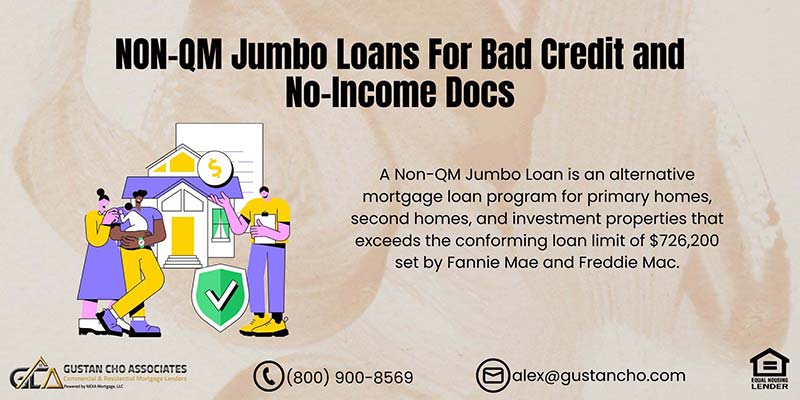
NON-QM jumbo loans are alternative mortgage loan programs for owner-occupant primary homes, second homes, and investment properties. Most non-QM loans do not have maximum loan limits. Any non-QM or alternative lending products with a loan balance higher than the 2026 conforming loan limit of $832,750 is called or often referred to as non-QM jumbo loans.
Non-QM mortgage rates on non-QM jumbo loans are slightly higher than conforming loans and are determined by the borrower’s credit scores, down payment, credit issues, and other risk factors of the borrower.
One important observation regarding your accuracy: under the existing mortgage rules and regulations, most lenders must make a good-faith determination of the borrower’s ability to repay the loan. As stated in the CFPB instructions, lenders must determine the borrower’s income, assets, employment, credit history, and monthly expenses. Also stated in the rules, lenders cannot close loans based on stated income. Therefore, ‘no income doc loans’ is best described as ‘alternative income documentation’ or ‘limited traditional income documentation’ to avoid the appearance of no-verification loans. Gustan Cho Associates offer many non-QM jumbo loan programs.
Understanding Non-QM Jumbo Loans
Non-QM jumbo loans feature flexible underwriting guidelines. Lenders assess risk based on a range of financial factors and may approve loans accordingly.
Flexible Income Documentation
Income may be documented using personal or business bank statements, profit and loss statements, CPA statements, asset-based qualifications, or rental income. Lenders may accept non-standard income verification to accommodate the borrower’s financial situation.
Non-QM 12-Month Bank Statement Jumbo Loans
Bank statement qualification is a common non-QM method. Rather than relying on net income from tax returns, lenders review deposit histories over 12 or 24 months. This approach is well-suited for self-employed individuals, consultants, or small business owners.
Cash Flow and Non-Salaried Asset Depletion
Under a non-QM, asset-based qualification is available for Non-QM loans, offering this option to high-net-worth individuals. Lenders assess liquidated assets as monthly income streams for underwriting. This option is suitable for retirees, those with substantial brokerage accounts, or individuals with significant liquid assets instead of regular salaried income. In many cases, individuals with poor credit can still qualify for non-QM jumbo loans if their overall financial profile is strong.
How Credit Score Impacts The Approval Process
Credit scores clearly still have an impact. Credit scores still impact pricing, loan-to-value ratios, reserve requirements, and available program options. However, in non-QM lending, credit scores are only one part of the evaluation.
Lenders may also consider the recency of adverse credit events, efforts to rebuild credit, and post-event housing payment history. There are special non-QM jumbo loans one day out of bankruptcy and foreclosure.
Applicants with strong compensating factors, such as a larger down payment, substantial reserves, a strong history of bank deposits, low overall financing, or consistent positive business cash flow, are more likely to be approved. makes non-QM jumbo loans particularly suitable for borrowers with complex financial profiles. Lenders assess the entire applicant’s financial situation rather than relying solely on credit scores.
Non-QM Jumbo Mortgage Options

Gustan Cho Associates has a national reputation for its no-lender overlay on government and conventional loan business models. We are known by many as a one-stop mortgage shop due to having countless non-QM loan options for homebuyers and real estate investors of owner-occupant homes, second homes, and investment properties. The following are the non-QM mortgage loan programs we have available with no maximum loan limits:
- 12-month bank statement loans with no income tax returns required and limited documentation for self-employed borrowers
- No-doc mortgages for primary homes
- Non-QM loans one day out of bankruptcy and foreclosure
- Rental income mortgages with no personal income verification
- Asset-based mortgages
- Foreign National Loans (ITIN)
- Interest-Only Home Loans
- Mortgage loans with recent credit events
- Non-QM jumbo loans one day after bankruptcy or foreclosure
Explore Non-QM jumbo loans for self-employed borrowers and investors with complex income scenarios. Learn how flexible jumbo financing operates, qualification criteria, benefits, and key requirements.
Non-QM Jumbo Loans: Alternative Financing Solutions for Complicated Borrowers
Non-QM jumbo loans serve borrowers who need financing above conforming loan limits but do not meet traditional mortgage underwriting criteria. In 2026, the conforming loan limit for one-unit properties in most regions is $832,750. Loans exceeding this amount are classified as jumbo loans.
Non-QM jumbo loans are especially beneficial for self-employed individuals, business owners, real estate investors, retirees with significant assets, and homebuyers with complex income.
Non-QM jumbo loans also help borrowers with prior credit challenges who need lenders willing to look beyond automated agency guidelines. Non-QM jumbo loans offer greater flexibility in evaluating income, assets, credit history, and repayment capacity. However, documentation and validation of repayment ability are still required, so these loans are not the same as the “stated income” loans from before the financial crisis.
Flexible, Complex Borrower Mortgage Solutions: Non-QM Jumbo Loans
Non-QM jumbo loans offer financing options for borrowers seeking to purchase higher-value properties or refinance existing loans with substantial balances. Non-QM jumbo loans are particularly useful when a borrower’s financial profile is complex or incomplete, as they may allow for alternative documentation beyond standard tax returns, W-2s, or debt-to-income ratios.
A non-QM loan is not inherently unsafe or irresponsible. Instead, it uses alternative underwriting criteria to assess borrower risk. Non-QM jumbo loans are designed for borrowers with legitimate income and assets that cannot be documented through conventional methods.
Non-QM jumbo loans are mortgages that exceed conforming loan limits and are not categorized as Qualified Mortgages because they do not meet the QM standards. A Qualified Mortgage is a type of loan characterized by specific features that aid in making repayment more sustainable and predictable. The CFPB describes mortgages that fall outside the Qualified Mortgage definition as Non-Qualified Mortgages, and these are used when loans have particular attributes that disqualify them from being considered a Qualified Mortgage.
Bad Credit? You Can Still Qualify for a NON-QM Jumbo Loan!
Contact us today to learn how we can help you secure a jumbo loan despite your credit challenges.What Classifies As a Jumbo Loan?
Many homebuyers are exploring jumbo mortgages versus conforming loans in today’s bullish housing markets. One frequently asked question from homebuyers is what classifies as a jumbo loan. Dale Elenteny, a senior associate at Gustan Cho Associates, said the following about the difference between non-QM and qualified mortgages and what classifies as a jumbo mortgage:
A Jumbo loan is often referred to as a non-conforming loan. Conventional loans are called conforming loans. This is because they need to conform to FANNIE MAE or FREDDIE MAC mortgage lending guidelines.
Home prices have been skyrocketing for the past five years. The Federal Finance Housing Agency (FHFA) and HUD have been increasing the maximum conforming and FHA loan limits for the past five years. The maximum conforming loan limit set by the Federal Housing Financing Agency (FHFA) for 2026 is $832,750.
The Difference Between Traditional And Non-QM Jumbo Loans
Traditional mortgage programs require pay stubs, W-2s, tax returns, and strict underwriting calculations. In contrast, Non-QM jumbo loans allow alternative documentation, such as bank statements, asset balances, cash flow analyses, profit and loss statements, or rental income, to assess a borrower’s ability to repay and sustain the mortgage.
Non-QM jumbo loans are a viable option for those seeking higher loan amounts and more flexible underwriting than traditional mortgages.
The CFPB states that lenders are generally required to document and verify income, employment, assets, liabilities, debts, and credit history to assess the ability to repay. This means that today’s non-QM loans are better characterized as alternative-documentation mortgages rather than true no-doc lending.
When a Jumbo Mortgage Becomes a Non-QM Loan
A jumbo mortgage qualifies as non-QM when it exceeds conforming loan limits and includes nontraditional underwriting features. These can be alternative documentation, interest-only, expanded credit flexibilities, recent housing-event exceptions, or specific lenders’ qualifications outside the norm of agency guidelines.
As a result, Non-QM jumbo loans appeal to high-income, high-asset, or high-cash-flow borrowers who do not meet standard underwriting requirements.
Most non-QM jumbo borrowers have more complex situations than typical mortgage customers. These may include self-employment, recent credit events, qualification based on bank statements, or high loan-to-value ratios for unique properties. Such cases require more than simple rate comparisons.
Target Borrower of Non-QM Jumbo Loans
A range of lenders have varying requirements for Non-QM jumbo loans. For example, some may offer better terms for bank statement qualifications, while others have more lenient credit or reserve requirements.
High-risk mortgage borrowers with nontraditional income or imperfect credit require tailored strategies. Choosing the right loan structure is crucial for both qualification and long-term affordability.
These differences can significantly impact loan outcomes. Not every borrower needs a non-QM product, but for the right borrower, these programs can offer significant benefits. Non-QM jumbo loans are mortgages above conforming loan limits that use more flexible underwriting than traditional Qualified Mortgage programs. They are often used for complex borrower profiles or those with alternative income documentation.
Self-Employed Borrowers
Self-employed borrowers may appear less qualified due to business deductions, but they often generate significant revenue, maintain strong deposits, and hold substantial financial reserves.
Self-employed borrowers can take advantage of Non-QM Jumbo Loans because lenders can qualify them using alternative documentation, such as bank statements or business cash flow, rather than relying solely on tax returns.
However, fluctuating business revenue and reinvestment can negatively affect these financial patterns, thereby overlooking their strategic value. Non-QM jumbo lenders, however, may recognize revenue spikes and reinvestment as business strengths, offering more favorable consideration to business owners with variable income.
Real Estate Investors
Non-QM Jumbo Loans are valuable for real estate investors purchasing high-value properties. Investors can qualify based on rental income or property cash flow, rather than personal income tax returns.
Borrowers With Previous Credit Issues
Non-QM jumbo loans may be available to borrowers with previous late payments, bankruptcy, foreclosure, short sale, or deed-in-lieu, depending on lender criteria and the overall application strength. Non-QM lenders typically assess the borrower’s entire financial profile rather than focusing solely on isolated credit events.
VA High-Balance Jumbo Loans Versus Non-QM Jumbo Loans

Self-employed borrowers, business owners, real estate investors, and retirees with significant assets are ideal candidates. These loans also suit those with prior credit issues who need more flexible underwriting.
Non-QM Loans for self-employed borrowers do not require any income tax returns. Twelve months of bank statement deposits are averaged and used as borrowers’ monthly income on non-QM jumbo loans. VA loans with loan amounts higher than the 2026 conforming loan limits of $832,750 are called High-balance VA jumbo loans.
Debt-To-Income Ratio Requirements On Non-QM Jumbo Loans
The maximum debt-to-income ratio allowed on non-QM jumbo loans is 50% loan-to-value with compensating factors. There is no private mortgage insurance premium required on non-QM jumbo loans. A 10% to 30% down payment is required. The amount of down payment depends on borrowers’ credit scores, the type of property, and the length of time they had a prior bankruptcy or housing event.
Traditional Jumbo Mortgages
Not all mortgage companies offer Jumbo loans. Lenders that do offer Jumbo loans often have tougher mortgage guidelines than lenders offering government and conventional loans. Jumbo lenders require the following:
- higher down payments
- higher credit scores
- reserves
- lower debt-to-income ratios than conventional mortgage lenders
Mortgage Rates on Jumbo Loans
Jumbo mortgage rates are normally 0.50% to 1.5% higher than standard conforming mortgage rates. Most mortgage companies require a minimum of a 20% to 25% down payment on traditional jumbo loans. Gustan Cho Associates offers 90% LTV traditional jumbo loan programs, meaning the borrower only needs a 10% down payment. The debt to income ratio on our 10% down payment jumbo loan program is 50% DTI.
Minimum Credit Score Requirements on Jumbo Loans
The minimum credit score requirement on our traditional 90% LTV jumbo loan program is 720 FICO. Other lenders will require a 700 plus credit score on traditional jumbo loans. Non-QM and alternative mortgage lenders require credit scores down to a 550 FICO. Larger down payments are required on high-balance non-QM loans. There is no mortgage insurance required with non-QM jumbo loans.
How Can I Get The Best Rates On Non-QM Mortgages
As mentioned earlier, Jumbo mortgage rates are higher than conforming mortgage rates. Why are Jumbo loan mortgage rates higher? The main reason why mortgage rates on Jumbo loans are higher is that the federal government does not back Jumbo loans. Fannie Mae and Freddie Mac buy conventional loans on the secondary market. Government loans are insured and backed by FHA, VA, and USDA—private investors back jumbo loans. Jumbo mortgages are riskier than other loan programs. That is why Jumbo mortgage lenders have higher mortgage rates and require tougher lending guidelines than other mortgage loan programs.
California Real Estate: High-Cost Areas, Jumbo Conforming Loan Limits
California has one of the highest real estate prices in the nation, and the average loan size in California is $1,087,000, whereas, in other parts of the country, the average loan size is $525,000. Despite the mass exodus of Californians to other lower-taxed states with affordable housing, California has a housing shortage. This is due to the heavy environmental regulations by California’s Democrats and the land shortage near major cities like Los Angeles, San Francisco, Sacramento, San Diego, and Orange County.
Looking for a Jumbo Loan with Bad Credit? NON-QM Loans Can Help You Get Approved!
Reach out today to explore how NON-QM jumbo loans can help you qualify and secure the home of your dreams.High-Balance Jumbo Loans
During the real estate and mortgage collapse, the federal government took over Fannie Mae and Freddie Mac in late 2008. This takeover happened as the housing market throughout the country was tanking like never before in history. The federal government intervened. 2009 the United States Congress created and passed the American Recovery and Reinvestment Act of 2009. This law boosted the normal conforming mortgage limit from the standard $832,750 to higher loan limits in many parts of the country. This increase in loan limits was a designated high-cost area, especially in areas throughout California. 2026 high-cost FHA and Conventional loan limits are capped at $1,249,125 for single-family homes.
Buying Homes In High-Cost Areas With NON-QM Jumbo Loans
Before the passage of this new mortgage lending increase law, many homeowners in California could not purchase homes in many high-cost areas of California, such as the following areas.
- San Francisco
- San Diego
- Orange County
- Los Angeles
- Irvine
- Sacramento
- San Francisco
Now homebuyers in high-cost areas could borrow conforming conventional loans up to $832,750 without needing to qualify for Jumbo loans.
Advantages of Non-QM Jumbo Loans
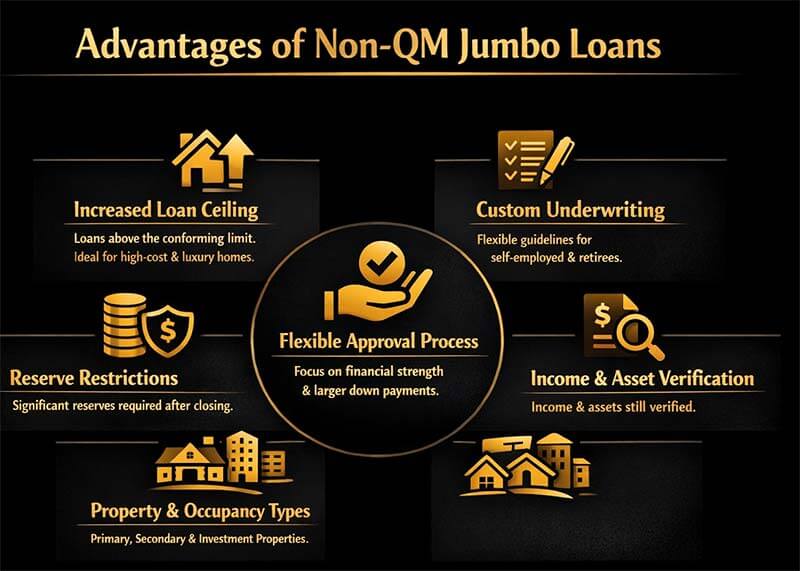
Customizable documentation is just one reason Non-QM Jumbo Loans are attractive.
Increased Loan Ceiling
Being jumbo by classification, these loans allow borrowers to purchase homes above the conforming loan limit. This is especially important for buyers in high-cost markets and borrowers seeking luxury homes. For 2026, the baseline conforming limit is $832,750 in most regions, with even higher limits in certain high-cost markets.
Custom Underwriting
Less strict, more variable underwriting better reflects the realities faced by self-employed individuals, retirees, and those with significant investments. This flexibility can be decisive in loan approval.
Non-QM Jumbo Loans evaluate the borrower’s overall financial strength rather than forcing them into conventional criteria. Mortgqge underwriters considers the borrower’s ability to pay the new Non-QM jumbo loans.
Each lender has unique conditions and requirements, but certain factors are universally important. A larger down payment improves the file by reducing risk and, consequently, lowering the loan-to-value ratio. In jumbo lending, the borrower’s equity is allotted significant consideration in the final approval decision.
Reserve Restrictions
Jumbo lenders typically require significant reserves after closing, especially for borrowers who use alternative documentation or have prior credit issues. Large reserves demonstrate liquidity and the ability to repay.
Income and Asset Verification
Non-QM jumbo loans, while flexible, still require some income and asset documentation. The CFPB mandates that lenders document and verify a borrower’s financials to assess the borrower’s ability to repay. While the documentation may differ from that of a typical conventional loan, some form of underwriting still takes place.
Property and Occupancy Types
Guidelines for primary, secondary, and investment properties vary. For unique or luxury properties, such as rural homes or non-warrantable condos, specialized lender expertise may be required.
Qualifying For a Jumbo Loan Program
Jumbo loan eligibility requirements vary from lender to lender. In general, there are several factors to qualify for Jumbo Mortgages. Jumbo Loans are considered riskier loans. Jumbo mortgage rates are credit-driven and loan-to-value-driven. To qualify for a Jumbo Loan with the best mortgage rates, a home buyer needs the following:
- a credit score of 700 plus
- down payment of 25%
- debt to income ratio below 40% DTI
This does not mean borrowers who cannot meet the above requirements will not qualify for a Jumbo loan. But their terms and rates can be worse.
Non-QM Jumbo Loans Pros and Cons
Like any mortgage product, Non-QM jumbo loans involve trade-offs. A primary advantage of Non-QM jumbo loans is flexibility. These products allow borrowers with unique financial situations or prior credit events to access mortgage financing outside standard underwriting constraints.
Possible Trade-Offs
Non-QM loan options often have higher rates, stricter reserve and down payment requirements, and varied lender guidelines. Shopping for loans is especially important due to this variety. Experienced mortgage teams are more likely to secure optimal terms by leveraging their knowledge of different lender programs.
Down Payment on Traditional Jumbo Loans
Generally, the larger a homebuyer’s down payment, the less risk a mortgage lender has. Jumbo mortgage loans normally require a 20% to 25% down payment. However, if the home buyer puts that extra 5% down payment, the Jumbo mortgage rates will be lower since the Jumbo mortgage lender has less risk. Same with credit scores. To qualify for a Jumbo mortgage loan, the bare minimum credit score required is normally 700 credit score. However, a 700 credit score is considered a super low credit score for Jumbo mortgages.
Loan Level Pricing Adjustments On Jumbo Mortgages
There are price adjustments for every 20 points on Jumbo mortgage rates. A person with a 700 credit score will pay a higher Jumbo mortgage rate than a person with a credit score of 740 or higher. Most Jumbo mortgage lenders will cap the maximum debt-to-income ratios at 40% DTI for Jumbo mortgage loan applicants. Gustan Cho Associates has a traditional jumbo mortgage program that will cap the debt-to-income ratio on jumbo loans at 50% loan-to-value.
Traditional 10% Down Payment Jumbo Loans: 90% LTV Jumbo Mortgages With No PMI Required
Gustan Cho Associates now offers traditional and NON-QM Jumbo Loans with a 10% down payment and no required private mortgage insurance. No income tax returns are required on NON-QM Loans for self-employed borrowers. The minimum credit scores required are 700 to qualify for non-QM jumbo loans, with a 10% down payment.
Gustan Cho Associates also has a national reputation for being a one-stop mortgage shop with dozens of non-QM and alternative mortgage programs on owner-occupant homes, second-home financing, and investment properties.
The team at Gustan Cho Associates is available seven days a week, on evenings, weekends, and holidays. To qualify, please get in touch with Gustan Cho Associates at 800-900-8569 or text us for a faster response. Or email us at alex@gustancho.com. Gustan Cho Associates has a national reputation for not having lender overlays on government and conventional loans.
Non-QM Jumbo Loans for Bad Credit? We’ve Got the Solutions You Need!
Contact us now to discuss your options for a NON-QM jumbo loan and get pre-approved today!What Loan Limit Constitutes Jumbo Loans?
Mortgage loans that exceed Fannie Mae and Freddie Mac’s conforming mortgage lending limits of $832,750 are known as non-conforming mortgage loans or Jumbo Home Loans. Gustan Cho Associates now offers NON-QM Jumbo Home Loans for self-employed borrowers. No income tax returns are required on the 12-month bank statement Non-QM Jumbo Loan Program for self-employed borrowers.
12-Month Bank Statement Loans
12 months of bank statements are averaged to derive monthly income. Only deposits are averaged. Withdrawals do not matter. A 10% to 20% down payment is required. The lower the credit score, the higher the down payment requirements. Down Payment depends on borrowers’ credit scores. The minimum credit score required on non-QM jumbo loans is 550, with a 40% down payment. No private mortgage insurance is required. Up to 50% debt-to-income ratio with compensating factors. There is no loan limit. The larger the loan size is, the larger the down payment requirement. Verification of mortgage or verification of rent is required on non-QM bank statement loans for self-employed borrowers.
Jumbo Non-QM Loans One Day Out of Bankruptcy and Foreclosure
The great news with NON-QM Jumbo Home Loans is there is no waiting period after a housing event or bankruptcy. Traditional Jumbo Mortgages require a 7-year waiting period after a housing event or bankruptcy. This article will cover and discuss Jumbo Home Loans Lending Guidelines On Non-QM Mortgages. Non-QM Jumbo Loans have much lenient loan guidelines versus traditional jumbo mortgages.
Comeback Of NON-QM Mortgages After 2008 Real Estate Meltdown
After the 2008 housing market meltdown, Jumbo lenders took a major hit with thousands of foreclosures. Many Jumbo mortgage lenders offered stated income/no-doc Jumbo home loans. This was offered if the home buyer had at least a 20% down payment. It was fairly easy to get a Jumbo mortgage. Unfortunately, the historically high foreclosure rates affected the higher-end homes. Many of those homes plummeted by more than 20% of their values during the real estate market collapse. The real estate crisis left many Jumbo lenders losing millions, if not billions, of dollars. After the housing collapse, Jumbo lenders eliminated the stated income/no doc mortgage lending program.
Non-QM Jumbo Mortgage Lenders
All Jumbo lenders set extremely high credit and income standards. 25% down payment and 740 scores, and no greater than 40% debt to income ratios were the norms to qualify for a Jumbo mortgage post the real estate meltdown. Most Jumbo lenders also required borrowers to have at least one year of reserves. Many self-employed homebuyers of high-end homes were disqualified because they took substantial write-offs on their income tax returns. Self-employed folks are allowed to take substantial write-offs on their income tax returns.
Unreimbursed Business Expenses
Taking advantage of many unreimbursed business expenses is one of the rewards and benefits of being a self-employed wage earner. However, unreimbursed business expenses often disqualify self-employed wage earners from qualifying for a home mortgage. Lenders use adjusted gross income when calculating qualified income for self-employed wage earners. A bankruptcy, foreclosure, deed-in-lieu of foreclosure, or short sale was not permitted to qualify for a Jumbo mortgage. However, Gustan Cho Associates offers one-day out-of-bankruptcy or foreclosure non-QM mortgage loan programs.
Risk For Lenders With Jumbo Home Loans
Jumbo Home Loans are viewed as riskier in the eyes of any mortgage lender. Higher-end homes are tougher to sell. It also takes longer to sell in the marketplace in general. It is also tougher to qualify for jumbo home loans than a conventional mortgage or government loans such as FHA, VA, or USDA.
There are cases where high-end homes are listed in the marketplace for over a year without a single showing. Higher-end homes are normally custom homes that are custom-built to suit the homeowner’s needs.
A home buyer qualified to purchase a high-end home will be pickier about the home he or she chooses than a home buyer with only a certain budget for a home purchase. A high-end home buyer normally has the means to build his or her own home. High-end home buyers build their homes to their liking and tastes. If a jumbo lender forecloses on a high-end luxury home, the home can sit for a long time. Due to these reasons, jumbo loans are considered riskier loans. Higher risk means higher interest rates.
High Risk Means Higher Rates And Tougher Lending Guidelines
Since Jumbo Home Loans are considered high-risk, most lenders require borrowers to meet the following standards:
- Higher credit scores
- Lower debt-to-income ratios
- Lower loan to values
- Reserves
- Most Jumbo lenders have a 740 score credit requirement
- Maximum 40% debt-to-income ratio cap
- 80% loan to value
- One year of housing payment reserves which consist of principal, interest, taxes, and insurance
A large percentage of Jumbo lenders even have a 75% loan-to-value requirement.
Special NON-QM Jumbo Home Loans
We now have eased mortgage lending requirements to qualify for Jumbo mortgages. Gustan Cho Associates not only has a national five-reputation as a mortgage company licensed in multiple states with no lender overlays on government and conventional loans, but we offer dozens of different non-QM loan programs. Gustan Cho Associates now offers NON-QM Jumbo Home Loans for self-employed borrowers: No income tax returns are required. We go off 12 months’ bank statement deposits—up to 50% debt-to-income ratios.
Need a Jumbo Loan with Bad Credit? NON-QM Jumbo Loans Can Help!
Reach out today to learn more about how NON-QM jumbo loans work and get started with your application.Non-QM Jumbo Mortgages For Owner-Occupant Homes, Second Homes, Investment Properties
Gustan Cho Associates offers non-QM loans on primary owner-occupant homes, second homes, and investment properties. Gustan Cho Associates has many non-QM investment property loan programs for real estate investors. Our fix-and-flip loan program for real estate investors is one of our most popular. Gustan Cho Associates offers asset-depletion, P and L statement-only investment loan programs, and countless other alternative finance home mortgage programs. Over 30% of our borrowers are folks in need of Non-QM loans and alternative financing mortgage programs.
Non-QM Jumbo Mortgage Guidelines
Gustan Cho Associates has dozens of Non-QM wholesale lending partners. There are no set mortgage guidelines on Non-QM loans. Our Non-QM wholesale lending investors often can make exceptions to their mortgage guidelines. The deal needs to make sense.
Suppose a non-QM borrower does not meet the specific lender’s wholesale guidelines but has other compensating factors. In that case, the wholesale investor will take the borrower’s case scenario on a case-by-case basis.
We now offer Jumbo loans for high-end homebuyers with a minimum 620 credit score. However, the lower the credit scores, the higher the down payment requirements. We also have a special 10% down payment Jumbo loan program for borrowers with at least 720 credit scores. No mortgage insurance is required with all non-QM loans. No Tax Returns are Required.
90% LTV Jumbo Mortgage Loans
The 90% loan-to-value Jumbo mortgage loan program has tougher lending guidelines since the Jumbo mortgage investor has a higher risk. To qualify for the 10% down payment NON-QM Jumbo Loans, the mortgage loan applicant needs at least a 700 credit score. Maximum of 50% debt-to-income ratio with compensating factors. No late payment history in the past 12 months on non-QM loan programs. Verification Of Rent or Verification Of Mortgage Required. No Private Mortgage Insurance is Required. There is no mandatory waiting period after housing events or bankruptcy.
Qualifying For Non-QM Jumbo Home Loans
High-End Home Buyers who need to qualify for NON-QM Jumbo Home Loans for self-employed borrowers can contact us at Gustan Cho Associates at 800-900-8569 or text us for a faster response. Or email us at gcho@gustancho.com. Over 30% of our business is helping our mortgage borrowers with Non-QM loans. Gustan Cho Associates is affiliated with over two dozen non-QM wholesale lending partners/investors. If there is a non-QM loan program in the market, Gustan Cho Associates has it. Our team of licensed and support personnel at Gustan Cho Associates are available seven days a week, on evenings, weekends, and holidays.
FAQs: NON-QM Jumbo Loans For Bad Credit and No-Income Docs
What Are Non-QM Jumbo Loans?
A Non-QM Jumbo Loan is an alternative mortgage loan program for primary homes, second homes, and investment properties that exceeds the conforming loan limit of $832,750 set by Fannie Mae and Freddie Mac. These loans do not have maximum loan limits and offer more flexible underwriting criteria than traditional loans.
How Do Non-QM Jumbo Loan Rates Compare To Rates On Conforming Loans?
Jumbo Loan non-QM rates are higher than conforming loan rates. The specific rate is influenced by different factors, such as the borrower’s credit score, down payment, credit history, and other risk factors.
What Types Of non-QM Jumbo Loans Does Gustan Cho Associates Offer?
Gustan Cho Associates offers various Non-QM Jumbo Loan programs, including options for self-employed borrowers, no-doc mortgages, and loans for individuals with recent credit events.
What Classifies A Loan As A Jumbo Loan?
A Jumbo Loan, a non-conforming loan, refers to a mortgage surpassing the conforming loan limits established by Fannie Mae and Freddie Mac. For 2023, the limit is $832,750.
What Are The Debt-To-Income (DTI) Ratio Requirements For Non-QM Jumbo Loans?
The maximum DTI ratio for Non-QM Jumbo Loans is 50%, with compensating factors. There is no requirement for private mortgage insurance (PMI), and down payments range from 10% to 30%, depending on credit scores, property type, and the borrower’s financial history.
What Are The Credit Score Requirements For Traditional Jumbo Loans?
The minimum credit score for traditional 90% LTV Jumbo Loans is 720. Some lenders might need a minimum credit score of 700 for traditional Jumbo Loans.
How Can I Get The Best Rates On Non-QM Jumbo Mortgages?
To secure the best rates on Non-QM Jumbo Mortgages, borrowers should aim for a high credit score (700+), a significant down payment (25% or more), and a low debt-to-income ratio (below 40%).
What Down Payment Is Required For Non-QM Jumbo Loans?
The initial payment for non-QM jumbo Loans can differ but usually falls within the 10% to 30% range, depending on the borrower’s credit score and other financial considerations.
Can I Qualify For A Non-QM Jumbo Loan With A Recent Bankruptcy Or Foreclosure?
Gustan Cho Associates offers Non-QM Jumbo Loans with no waiting period required after a bankruptcy or foreclosure.
What Makes Non-QM Jumbo Loans Riskier For Lenders?
Non-QM Jumbo Loans are considered riskier because they are not backed by the federal government and involve higher loan amounts. These loans are often for high-end properties, which can be more difficult to sell and take longer to sell in the market.
Are There Non-QM Jumbo Loans For Self-Employed Borrowers?
Gustan Cho Associates offers Non-QM Jumbo Loans for self-employed borrowers, including 12-month bank statement loans that do not require income tax returns.
Are Non-QM Jumbo Loans The Same As Stated-Income Loans?
No. Current Non-QM jumbo loans do not correlate to the previously stated-income products. The CFPB states that generally, lenders must document and verify income, assets, debts, employment, and credit history, and assess the borrower’s ability to repay.
Can I Qualify For Non-QM Jumbo Loans With Bad Credit?
Yes. Depending on the lender and the application, bad credit may not be disqualifying if the borrower has strong compensating factors, such as reserves, a larger down payment, or stable alternative income.
Are Tax Returns Required On Non-QM Jumbo Loans?
Not necessarily. Some lenders may accept qualifications based on bank statements, asset depletion, profit-and-loss documentation, or rental income documentation instead of tax returns.
Can I Get Approved For Non-QM Jumbo Loans Above The Standard Loan Limit.
Yes. In other words, a Non-QM jumbo loan is a jumbo mortgage that also features non-QM, or more flexible, underwriting. Typically, in the United States, the baseline conforming limit for a single unit in 2026 is 832,750.
Are Non-QM Jumbo Loans Beneficial To Self-Employed Individuals?
Certainly. Non-QM jumbo loans are a viable option for self-employed individuals, as they may accept alternative documentation such as bank statements instead of tax returns.
How Can I Apply For A Non-QM Jumbo Loan With Gustan Cho Associates?
To apply, contact Gustan Cho Associates at 800-900-8569, text for a faster response, or email alex@gustancho.com. The team is available seven days a week, including evenings, weekends, and holidays.