Buying a home in Alaska with bad credit can feel stressful, especially if you have been denied by another lender or told your credit score is too low. The good news is that bad credit does not always mean you cannot qualify for a mortgage. Some loan programs allow lower credit scores, recent credit issues, higher debt-to-income ratios, or limited credit history if the rest of the file is strong.
Alaska homebuyers may have options through FHA, VA, USDA, conventional, or non-QM loans. The right program depends on your credit score, income, down payment, debts, property location, and whether the loan receives automated underwriting approval.
Some borrowers may qualify with a low credit score, while others may need compensating factors such as stable income, rental history, reserves, or a larger down payment. Buying a home in Alaska can also come with unique challenges. Property location, heating systems, weather conditions, rural access, appraisal timing, well and septic systems, and higher living costs can all affect the mortgage process. This is why getting fully pre-approved before shopping for a home is important. In this guide, we will explain how buying a home in Alaska with bad credit works, which mortgage programs may help, what lenders review, and what steps borrowers can take to improve their chances of approval.
Best Bad Credit Mortgage Programs in Alaska
FHA Loans With 500 FICO in Alaska
FHA loans are the best mortgage loans for homebuyers with bad credit, low credit scores, and high debt to income ratio. We will cover other mortgage loans for bad credit borrowers. FHA loans allow for a low down payment with lenient lending guidelines at competitive rates.
Understanding FHA loans and other loan programs are important for homebuyers and homeowners thinking of buying or refinancing a home in Alaska.
There are several types of loan programs. Many homebuyers do not know the various differences in the types of loan programs they can choose from. We will cover FHA, VA, and non-QM loans for bad credit in Alaska in this blog.
FHA Loans in Alaska for Bad Credit
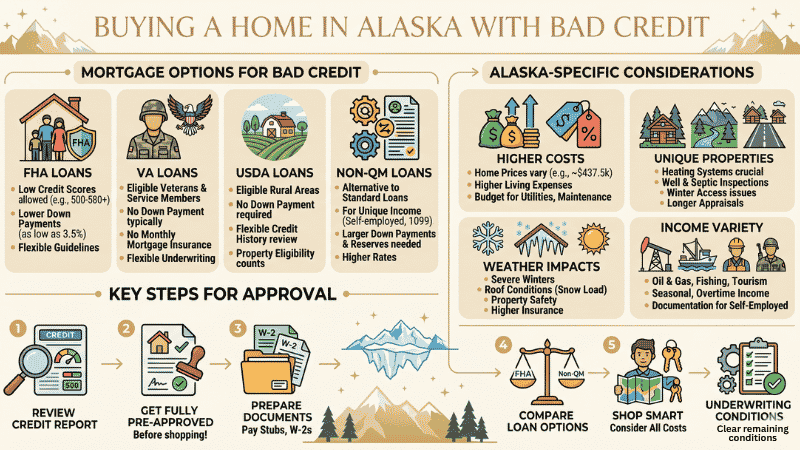
- Minimum Score: You can apply at 500 only if you put 10% down. 580 means 3.5% down.
- An FHA loan—guaranteed by the Federal Housing Administration—opens the door for most low-score borrowers.
- Lenders can take a second look at your debt-to-income ratio, and some offer manual underwriting for tougher situations.
VA Loans in Alaska for Veterans With Low Scores
- The VA has no score limit, but lenders usually set the floor at 500 to 550.
- A 0% down payment helps, but no mortgage insurance saves you even more.
- In a state with a large military population, 0% can stretch your budget when homes are scarce.
USDA Loans in Alaska’s Rural Areas
- USDA financing is available for homes in rural or semi-rural areas, meaning much of rural Alaska qualifies.
- 100% financing is available, leaving you with no down payment and quickly climbing your way to owning a home.
- Some lenders add extra rules, but many will go as low as 580 FICO when overlays are light.
Conventional Loans for Borrowers Getting Back on Track
- Most lenders target 620 for conventional loans, yet a few in Alaska will review alternative credit histories instead.
- Better credit and bigger down payments boost your odds of approval.
Non-QM and Alternative Mortgage Options in Alaska
- Bank statement loans: Self-employed applicants can document income using 12 to 24 months of deposits.
- DSCR investor loans: These programs focus on projected rental income, not the borrower’s credit score.
- No-doc or limited-doc programs: Designed for buyers whose finances don’t fit a standard 2-year job history.
- Seek these options through specialized mortgage brokers covering the entire state.
Is Buying a Home in Alaska Expensive for Bad Credit Borrowers?
Buying a home in Alaska can be more expensive than buying in many other states, especially when you factor in more than the purchase price. Home prices can vary widely by area. Anchorage, Juneau, Fairbanks, Wasilla, Kodiak, and rural communities can all have very different price ranges, property types, utilities, and access issues. For borrowers with bad credit, the cost of buying a home may also depend on the loan program. FHA loans allow lower credit scores with a lower down payment, while VA loans may help eligible veterans and active-duty service members buy with no down payment. USDA loans may help qualified buyers in eligible rural areas. Non-QM loans could be a suitable choice for borrowers who don’t meet conventional lending criteria, but they often require a larger down payment, stronger reserves, or higher rates. Alaska buyers should also budget for costs that may be higher than expected. Heating bills, homeowners’ insurance, property taxes, flood or hazard concerns, well and septic inspections, and winter maintenance can all affect the true monthly cost of owning a home. In remote areas, appraisals, inspections, repairs, and contractor availability may also take longer or cost more. This is why bad-credit borrowers should get fully pre-approved before shopping for homes in Alaska. A strong pre-approval helps confirm the loan program, credit requirements, down payment, estimated payment, closing costs, and whether the property type and location are likely to meet lender guidelines.
What Makes Buying a Home in Alaska Different?
Buying a home in Alaska can be different from buying in many other states because property location, weather, utilities, and access can affect the mortgage process. A home in Anchorage or Fairbanks may be easier to finance than a remote property where appraisers, inspectors, contractors, or utilities are harder to access. Rural properties in Alaska may raise additional questions during underwriting. Lenders may review road access, property condition, heating systems, water source, septic systems, and whether the home is safe and livable year-round. If the property has a private well or septic system, the lender may require inspections or repairs before closing.
Heating systems are also important in Alaska. Because winters can be severe, the home must have a reliable, acceptable heating source. Older roofs, insulation problems, frozen pipes, foundation issues, and winter maintenance concerns can also affect inspections, appraisals, and repair conditions.
Alaska buyers should also plan for higher utility, fuel, homeowners’ insurance, and maintenance costs. These costs can affect the borrower’s monthly budget, even if they are not included in every mortgage payment. Military buyers may have strong options through VA loans, especially in areas with a large military presence. USDA loans may also help qualified buyers purchase homes in eligible rural areas. However, property eligibility, income limits, appraisal requirements, and lender guidelines still apply. Because local housing supply can vary by city, town, and remote community, Alaska buyers should get fully pre-approved before shopping. A strong pre-approval helps confirm the loan program, the estimated payment, property requirements, and whether the home’s location may require additional mortgage conditions.
Where Most Alaska Homebuyers Search for Homes
Many individuals looking into buying a home in Alaska start their search in cities like Anchorage, Fairbanks, Juneau, Wasilla, and the surrounding areas. These locations typically offer a greater selection of homes, stronger job markets, and better access to essential services, such as lenders, appraisers, inspectors, and contractors. Anchorage may appeal to buyers who want more employment options and a larger housing market, while Fairbanks and Juneau can offer different price ranges, property types, and local lending considerations. Wasilla may attract buyers looking for more space or more affordable options outside Anchorage. Rural Alaska can also offer opportunities, especially for buyers interested in USDA-eligible areas or properties with more land. However, rural homes may come with additional mortgage requirements, including road access, utilities, heating systems, wells, septic systems, appraisal availability, and property condition. This is why buyers with bad credit should get pre-approved before choosing a location, so they know which areas, property types, and loan programs are realistic for their situation.
How Alaska Employment and Income Affect Mortgage Approval
Your income and job history are major parts of mortgage approval, especially when buying a home in Alaska with bad credit. Lenders want to see that your income is stable, documented, and likely to continue. A low credit score does not automatically prevent approval, but weak or hard-to-document income can make the file more difficult to approve. Many Alaska borrowers work in industries such as oil and gas, fishing, construction, tourism, transportation, government, healthcare, and the military. Some of these jobs may include overtime, seasonal income, bonus income, per diem pay, or periods of reduced hours. Lenders may be able to use this income if it has a history and can be properly documented.
Military borrowers may qualify using base pay, housing allowance, subsistence allowance, and other eligible income. VA loans can be a strong option for eligible veterans, active-duty service members, and surviving spouses. However, lenders still review income stability, residual income, debts, and credit history.
Self-employed borrowers, fishing industry workers, contractors, and business owners may need extra documentation. This can include tax returns, profit-and-loss statements, bank statements, 1099 forms, business licenses, or letters explaining seasonal income patterns. If tax returns do not show sufficient qualifying income, some borrowers may need to consider non-QM options, such as bank statement loans or 1099 income programs. Before shopping for a home, Alaska buyers should gather recent pay stubs, W-2s, tax returns, bank statements, proof of rental history, and explanations for any employment gaps or credit issues. The stronger the income documentation, the better the chance of finding the right loan program for a bad-credit mortgage approval.
Buy a Home in Alaska With Low Credit
Low FICO scores do not always stop mortgage approval. Alaska buyers may have FHA, VA, USDA, conventional, or non-QM loan options depending on the full file.Why Alaska Weather Matters When Buying a Home
When buying a home in Alaska, it’s important to consider how the weather affects not just everyday living but also various aspects of homeownership, including mortgage agreements, appraisals, home inspections, insurance, and long-term ownership costs. Given the severity of winters, lenders and appraisers tend to focus on ensuring the property is safe, livable, and adequately protected against extreme weather. A reliable heating system is one of the most important property features in Alaska. The home should have an acceptable heat source that can keep the property livable year-round. Buyers should also review insulation, windows, pipes, and energy efficiency because poor insulation or outdated systems can lead to higher monthly utility bills. Roof condition is another major concern. Snow load, ice buildup, leaks, and older roofing materials can create repair issues during the appraisal or inspection. If the roof is near the end of its life, the lender may require repairs before closing, depending on the loan program and property condition. Access to the property also matters. Some homes may have long driveways, private roads, seasonal access, or remote locations that are harder to reach during winter. Lenders may review whether the home has safe, year-round access. Buyers should also check for flood zones, drainage problems, foundation issues, septic concerns, well systems, and winter maintenance needs. These items can affect homeowners’ insurance, repair costs, appraisal conditions, and whether the property meets FHA, VA, USDA, conventional, or non-QM loan guidelines.
Finding the Best Lenders for Alaska Borrowers with Challenged Credit
Choose Lenders with No Overlays
Some banks add stricter credit score rules than what FHA, VA, or USDA require. Find the lender that sticks to the original program guidelines with no overlays.
Use a Mortgage Broker Instead of a Big Bank
Brokers canvass a large list of lenders and can negotiate for your situation. Size tends to work against you at a big bank, where low scores are often an auto-decline.
Shop Loans by Rate and Pop the Fees on the Table
Even when credit is shaky, comparing offers can save you a few thousand bucks. Collect Loan Estimates from at least three lenders and review the numbers side by side.
What Is The Best Mortgage To Buy House In Alaska With Bad Credit?
There are hundreds of non-QM and non-prime mortgage loan programs. There is every type of non-QM loan program in Alaska for every type of borrower.
Non-QM loans require a 20% or higher down payment. VA, FHA, and Conventional loans have mortgage programs for bad credit.
FHA and VA loans allow homebuyers with credit scores down to 500 FICO to be eligible for mortgage loans. FHA loans are the most popular loan program in Alaska. This is because close to 40% of all home mortgages in the nation are FHA loans.
Median Home Prices When Buying a Home in Alaska
Median home prices in Alaska should be reviewed before you start shopping because the purchase price affects more than the sales contract. It can impact your loan amount, down payment, monthly payment, debt-to-income ratio, cash reserves, closing costs, and which mortgage programs may be available. As of 2026, Alaska home prices vary widely by city, borough, property type, and location. Realtor.com reports Alaska’s median home sale price at about $437,500, but buyers should verify current figures before buying, as local markets can change quickly.
For borrowers with bad credit, the home price can affect approval in several ways. A higher purchase price usually means a larger loan amount, higher payment, and a higher debt-to-income ratio. This can make approval harder if the borrower has limited income, recent late payments, collections, or a lower credit score.
Loan limits also matter. In 2026, Fannie Mae lists the one-unit conventional loan limit for Alaska at $1,249,125, which is higher than the baseline limit for most states because Alaska is treated as a special high-cost area. FHA loan limits also vary by county, and buyers should check the current HUD FHA mortgage limit lookup before making an offer. VA buyers may have varying levels of flexibility depending on entitlement, loan amount, and lender guidelines. Eligible veterans and active-duty service members may be able to use VA financing with no down payment, but the lender still reviews credit history, residual income, debts, and property condition. If the purchase price is too high for FHA, VA, USDA, or conventional approval, some borrowers may need to consider non-QM options. Non-QM loans can help borrowers who do not fit traditional agency guidelines, but they may require a larger down payment, stronger reserves, and higher rates. Before choosing a home, Alaska buyers should get fully pre-approved and confirm the estimated payment, down payment, closing costs, loan limits, property requirements, and whether the home price fits their income and credit profile.
Cost of Living in Alaska
The public need to realize the cost of living in Alaska is substantially higher in Alaska versus other states in the United States. Alaska has a higher cost of living. However, Alaska has jobs that are paying a huge premium. Most jobs and career positions have higher wages and salaries than comparable companies throughout the nation. Cost of living The average cost of living in Alaska is $48,700 per year, which is pretty high compared to other states in the U.S.
Is It Better to Rent or Buy in Alaska With Bad Credit?
Buying a home in Alaska with bad credit may make sense if you have a stable income, enough money for your down payment and closing costs, and a plan to stay in the home long term. Even with a lower credit score, some borrowers may qualify through FHA, VA, USDA, conventional, or non-QM loan options, depending on the full mortgage file. However, buying is not always the best move right away. If your credit score is very low, your debts are too high, your income is unstable, or you do not have enough savings, renting for a little longer may give you time to improve your credit and strengthen your approval chances. Paying down debt, saving more money, and building a clean rental history can help you qualify for better loan terms later. Rent-versus-buy decisions in Alaska also depend on location, home price, mortgage rate, property taxes, homeowners’ insurance, heating costs, maintenance, and how long you plan to live in the home. A house may look affordable based on the sale price, but the full monthly cost can be higher once utilities, repairs, and winter maintenance are factored in. Before deciding whether to rent or buy, Alaska borrowers should compare the estimated mortgage payment against their current rent and monthly budget. A full pre-approval can confirm whether buying now is realistic or whether it is better to spend a few months improving credit, saving funds, and preparing for a stronger mortgage approval.
Buying a Home in Alaska With Bad Credit
Yes, absolutely! The last thing anybody wants is for a bad credit history to stand in the way of them attaining their lifelong dream of buying their dream house, especially first-time buyers. So, here is the thing, there are a number of mortgage options available for aspiring homeowners in Alaska that don’t require a not-so-perfect credit score. In the following sections of this guide of buying a home in Alaska, we will cover the various mortgage loan options borrowers have buying a home in Alaska with bad credit.
Current Alaska Housing Market Considerations for Homebuyers
Alaska homebuyers should look at the housing market by local area, not just by statewide averages. Anchorage, Fairbanks, Juneau, Wasilla, Kodiak, and rural communities can have very different home prices, inventory levels, property types, and mortgage challenges. Realtor.com currently reports Alaska’s median home sale price at about $437,500, with about 4,600 active listings, but buyers should verify local market data before making an offer. Inventory can be limited in many Alaska markets, especially in areas where job centers, military bases, schools, hospitals, and transportation routes create stronger buyer demand. A low supply of homes can make it harder for buyers to find a property that fits their budget, loan program, and credit profile. This is really important for people with bad credit since they often have limited loan choices and can’t be flexible with their payments. Local price differences also matter. A home in Anchorage or Juneau may have a different price point than a home in Fairbanks, Wasilla, or a rural community. Remote properties may offer more land or lower competition, but they can also create extra issues with appraisals, inspections, utilities, road access, wells, septic systems, heating systems, and repair requirements. Appraisal timing can also be a challenge in parts of Alaska. In remote areas, there may be fewer available appraisers or longer travel times, which can delay loan approval and closing. If the property needs repairs, finding contractors or completing work before closing may also take longer. Military markets can be another important factor. Areas near military installations may have strong VA loan activity, steady buyer demand, and housing needs tied to relocation schedules. VA buyers should still get pre-approved early because residual income, credit history, property condition, and lender overlays can affect approval. Because housing conditions in Alaska can vary by city, season, and property type, buyers should get fully pre-approved before shopping. A strong pre-approval helps confirm the loan program, payment range, down payment, closing costs, loan limits, and property requirements before making an offer.
Step-by-Step Guide to Buying a Home in Alaska With Bad Credit
Buying a home in Alaska with bad credit starts with knowing where you stand before you shop for a property. The first step is to review your credit report and mortgage credit scores. Mortgage lenders use specific credit scoring models, so the score you see from a free credit app may not be the same score used for loan approval. Check for recent late payments, collections, charge-offs, disputes, high credit card balances, or errors that could affect underwriting. The next step is to get pre-approved before looking at homes. This is especially important for bad-credit borrowers because not every loan program or lender will allow the same credit profile. A full pre-approval can help confirm your estimated payment, down payment, closing costs, debt-to-income ratio, and whether your file may need automated approval or manual underwriting. After that, compare your loan options. FHA loans may help borrowers with lower credit scores and smaller down payments. VA loans may be a strong option for eligible veterans, active-duty service members, and surviving spouses. USDA loans may help qualified buyers in eligible rural areas. Conventional loans work better for borrowers with stronger credit and re-established payment history. Non-QM loans may help borrowers with unique income, recent credit events, or documentation issues that do not fit agency guidelines. Borrowers should also prepare their documents early. This may include pay stubs, W-2s, tax returns, bank statements, retirement or asset statements, rent history, gift funds, letters of explanation, bankruptcy papers, divorce decrees, child support documents, or proof that collections and judgments have been resolved when required. The stronger the documentation, the easier it is for the lender to understand the full file. Once you are pre-approved, shop within your approved payment range rather than focusing only on the purchase price. In Alaska, heating costs, homeowners’ insurance, property taxes, maintenance, utilities, and winter expenses can affect affordability. A home that fits the loan amount may still be too expensive if the monthly carrying costs are high. Before closing, order the inspections that matter for Alaska properties. Depending on the home, this may include a general home inspection, roof review, heating system inspection, well and septic inspection, foundation review, flood zone check, or other property-specific inspections. Remote homes may also require extra attention to road access, utilities, and year-round livability. The final step is clearing underwriting conditions before closing. Conditions may include updated bank statements, proof of funds, letters of explanation, appraisal repairs, verification of employment, insurance documents, or credit documentation. Bad-credit borrowers should avoid opening new accounts, making large, undocumented deposits, missing payments, or changing jobs during the mortgage process. Keeping the file stable can help protect the approval through closing.
Mortgage Guidelines on Recent Late Payments in Alaska
One or two late payments may not always be a deal killer. One of the key points borrowers need to realize is that not all lenders have the same lending guidelines on FHA loans.
Just because you get denied for an FHA loan by one lender does not mean you cannot qualify for an FHA loan with another lender. This, again, is due to the lender overlays each individual lender can impose.
Just having a higher credit score does not automatically mean that you qualify for an FHA loan. Non-QM loans are a great mortgage option for homebuyers in Alaska who cannot get an approve/eligible per the automated underwriting system due to having late payments in the past 12 months.
Maximum FHA Loan Limit in Alaska
The housing market is booming in the U.S. The housing market has been booming before the coronavirus pandemic hit the nation. Housing prices were skyrocketing year after year.
Both HUD and the Federal Housing Finance Agency (FHFA) have been increasing FHA and Conventional loan limits year after year for the past four years.
Once the COVID-19 pandemic hit the nation, many experts and analysts expected there was going to be another housing crisis worse than the 2008 financial crisis and housing meltdown. However, the housing market kept on booming despite the coronavirus pandemic. Even with 50 million Americans out of work, the housing market remains stronger than ever.
Mortgage Rates for Bad Credit Mortgages in Alaska
Mortgage rates hit a historic high last week. 30-year fixed-rate mortgages are now at 5.96%. There is more demand for housing than inventory. Homebuilders are setting record revenues.
HUD, the parent of FHA, increased its 2026 FHA loan limit to $541,287 in low-cost areas and $1,249,125 in high-cost counties as of Jan. 1st, 2026.
The FHFA increased 2026 conforming loan limits to $832,750 due to skyrocketing home prices in standard areas and $1249,125 in high-cost counties. The VA removed the maximum loan limits on VA loans effective January 1st, 2020. There are no maximum loan limit on VA loans.
Final Thoughts on Buying a Home in Alaska With Bad Credit
Buying a home in Alaska with bad credit is possible, but the right loan program matters. FHA, VA, USDA, conventional, and non-QM loans all have different rules for credit scores, down payment, debt-to-income ratio, income documentation, property condition, and lender overlays.
The best step is to get fully pre-approved before shopping for a home. This helps you understand your budget, estimated payment, closing costs, and which loan programs may fit your credit profile. It also helps you avoid looking at homes that may not meet the property requirements for your loan.
Alaska buyers should also think beyond the sales price. Heating costs, homeowners’ insurance, property taxes, utility expenses, winter maintenance, remote access, wells, septic systems, and appraisal timing can all affect the mortgage process and the true cost of homeownership. If you have bad credit, recent late payments, collections, bankruptcy, foreclosure, high debt-to-income ratios, or unique income, do not assume you are out of options. A lender that understands FHA, VA, USDA, conventional, and non-QM guidelines can review your full file and help you determine the most realistic path to approval.
FAQs About Buying a Home in Alaska With Bad Credit
Can I Buy A House In Alaska If I Have Collections On My Credit Report?
Yes, it may be possible to buy a home in Alaska with collections, but the lender will review the type of collection, balance, age, payment history, and loan program. Medical collections may be treated differently from non-medical collections. Some collections may not need to be paid before closing, while others may need to be resolved depending on the loan program, automated underwriting findings, and lender overlays.
Do I Need To Pay Off All Debt Before Applying For A Mortgage In Alaska?
No, you do not always need to pay off all debt before applying. Lenders mainly review your monthly debt payments, income, credit history, and debt-to-income ratio. Paying off certain debts may help with approval, but paying off the wrong account can reduce cash reserves or create documentation issues. It is best to speak with a mortgage lender before paying off large balances during the loan process.
Will A Past Bankruptcy Stop Me From Buying A Home In Alaska?
A past bankruptcy does not always stop you from buying a home. The waiting period depends on the loan program, the type of bankruptcy, the discharge date, the payment history after bankruptcy, and whether the loan receives automated or manual underwriting approval. FHA, VA, USDA, conventional, and non-QM loans all have different rules, so borrowers should not assume they are automatically denied.
Can I Use Down Payment Assistance In Alaska With Bad Credit?
Some Alaska buyers may qualify for down payment assistance, but approval depends on the program, credit score, income limits, property location, loan type, and available funds. Down payment assistance programs may also have their own overlays. Borrowers with bad credit should get pre-approved first to confirm whether assistance can be combined with their mortgage program.
What Should I Avoid Before Closing On A Home In Alaska?
Before closing, avoid opening new credit accounts, missing payments, changing jobs, making large, undocumented deposits, co-signing for someone else, or increasing credit card balances. These changes can affect your credit score, debt-to-income ratio, cash reserves, and final loan approval. This is especially important for bad-credit borrowers because the file may already have less room for changes.
Is It Harder To Buy A Remote Home In Alaska With Bad Credit?
It can be harder, depending on the property. Remote Alaska homes may create extra issues with appraisals, inspections, road access, utilities, heating systems, wells, septic systems, insurance, and repair requirements. Bad credit does not automatically stop approval, but the property must still meet the lender’s and the loan program’s requirements. USDA explains that rural housing loans also depend on applicant eligibility and property eligibility, not just credit profile.
This article about “Buying a Home in Alaska With Low FICO Scores and Poor Credit” was updated on May 28th, 2026.