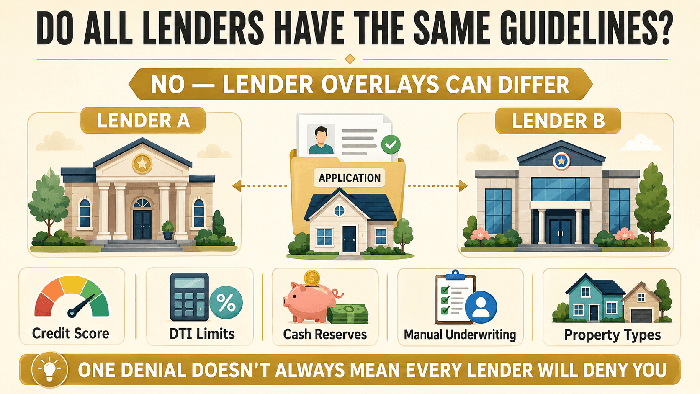
Do all mortgage lenders have the same guidelines? No, mortgage lenders do not all have the same guidelines. FHA, VA, USDA, Fannie Mae, and Freddie Mac establish program requirements, but lenders may add stricter rules called lender overlays. One lender might require a higher credit score, lower debt-to-income ratio, more reserves, or no manual underwriting. Rates, fees, and available programs also vary. A denial from one lender does not automatically mean every lender will deny the loan, but meeting basic agency requirements does not guarantee approval.
Agency Mortgage Guidelines Versus Lender Overlays
Do all lenders have the same guidelines? No. Mortgage programs have baseline requirements, but individual lenders may enforce stricter standards. Agency mortgage guidelines are the core rules established for a loan program. HUD sets requirements for FHA loans, the VA establishes VA loan standards, and the USDA governs USDA loans. Fannie Mae and Freddie Mac publish requirements for conventional mortgages that they may purchase. Lenders must follow the applicable agency or investor requirements. However, meeting those minimum standards does not guarantee approval. The lender must still confirm that the borrower, property, and loan meet all underwriting requirements. Lender overlays are additional rules a lender applies beyond the program’s minimum guidelines. For example, a lender may require:
- A higher credit score
- A lower debt-to-income ratio
- More cash reserves
- Fewer recent late payments
- Automated underwriting approval
- Restrictions on manual underwriting or certain property types
Overlays may reflect the lender’s risk tolerance, investor requirements, or available loan products. Therefore, a borrower declined by one lender may qualify elsewhere if the issue was an overlay rather than a violation of the underlying agency guidelines. Approval still depends on the complete application, documentation, and underwriting review.
Why Mortgage Lender Guidelines Can Differ
Do all lenders have the same guidelines? No. Although lenders must follow the rules of the applicable loan program, several factors can affect the standards each company uses.
Risk Tolerance
Every lender decides how much credit and operational risk it is willing to accept. A lender may require a higher credit score, lower debt-to-income ratio, or additional cash reserves to reduce the risk of default or loan repurchase.
Investor Requirements
Many lenders sell closed loans to investors. Those investors may impose requirements beyond FHA, VA, USDA, Fannie Mae, or Freddie Mac guidelines. These added rules can become lender overlays that cover credit, income, assets, property types, or recent payment history. Fannie Mae defines overlays as lender guidelines that exceed the requirements of the investor purchasing the loan.
Product Availability
Not every company offers the same mortgage programs. Some lenders may not provide manual underwriting, renovation loans, manufactured-home financing, non-QM loans, or programs for borrowers with recent credit events. A denial may mean the lender lacks a suitable product, not that the borrower is ineligible everywhere.
Underwriting Methods
Lenders may rely on automated underwriting systems, manual underwriting, or a combination of both. Automated systems evaluate risk and program eligibility, while manual underwriting requires a person to review the complete file. Documentation requirements and the treatment of risk factors may differ within the applicable program rules.
Company Policies
A lender’s staffing, compliance procedures, fraud controls, geographic coverage, and business model may also shape its guidelines. Some companies restrict certain loan amounts, property types, income sources, or borrower profiles. These differences explain why one lender may decline a loan that another is willing to review. Borrowers should ask whether the issue involves an agency rule, an investor requirement, or a lender overlay. A second review may uncover another option, but approval always depends on the complete application, supporting documents, property, and underwriting decision.
Common Mortgage Lender Overlays
Do all lenders have the same guidelines? No. Lenders may add stricter requirements—known as lender overlays—to the minimum rules established by an agency, investor, or loan program.
Credit Scores
A loan program may allow a lower credit score, while an individual lender may require a higher score. Credit-score overlays are especially common for borrowers with limited credit histories or recent major credit events.
Debt-to-Income Ratios
Automated underwriting may approve a higher debt-to-income ratio based on the borrower’s complete financial profile. However, a lender may cap the DTI at a lower percentage to reduce risk.
Manual Underwriting
Some mortgage programs allow manual underwriting when an automated system does not issue an approval. A lender may decline manually underwritten loans or impose tighter requirements for payment history, reserves, and compensating factors.
Cash Reserves
Lenders may require borrowers to have enough funds to cover several months of mortgage payments after closing, even if agency guidelines don’t mandate reserves. Reserve requirements may increase for investment properties, properties with multiple financings, or higher-risk files.
Recent Late Payments
A lender may restrict borrowers with recent late payments, even when the underlying program does not impose an automatic waiting period. Mortgage late payments are generally reviewed more seriously than isolated late payments on revolving accounts.
Collections and Charge-Offs
The treatment of collections and charge-offs depends on the loan program, account type, balance, and underwriting findings. A lender overlay may require certain accounts to be paid, resolved, or included in the DTI calculation, even when agency guidelines allow more flexibility.
Gift Funds
Many programs permit eligible gift funds for a down payment or closing costs. However, lenders may add rules governing acceptable donors, transfer methods, bank statements, and proof that the funds do not need to be repaid.
Employment and Income Documentation
Lenders may apply stricter standards to overtime, bonuses, commission income, self-employment income, or recent job changes. One lender might require a longer earnings history or more documentation before considering variable income stable and likely to continue.
Property Types
Some lenders restrict manufactured homes, condominiums, mixed-use properties, non-warrantable condos, unique homes, or properties requiring repairs. The borrower may qualify financially, but still needs a lender that offers financing for that specific property type. An overlay does not make the underlying agency guideline invalid. It means the lender has chosen to apply a more restrictive standard. Borrowers who are denied should ask whether the decision resulted from an agency rule, an automated underwriting finding, or a lender overlay. Another lender may have different requirements, but approval is never guaranteed and always depends on the completeness of the loan file.
denied by One Lender? Get a Second Opinion
A mortgage denial does not always mean you cannot qualify. It may mean that lender had stricter overlays than FHA, VA, USDA, conventional, or Non-QM guidelines require.How Requirements Differ by Mortgage Program
Do all lenders have the same guidelines? No. Each mortgage program has its own baseline rules, and lenders may add stricter credit, DTI, reserve, or underwriting requirements.
FHA Loans
FHA loans are insured by the Federal Housing Administration and generally offer more flexibility for lower credit scores, smaller down payments, and prior credit issues. Approval still depends on income, debts, assets, property eligibility, and whether underwriting is automated or manual. Individual lenders may impose requirements beyond HUD’s minimum standards.
VA Loans
VA loans are available to eligible veterans, active-duty service members, and certain surviving spouses. VA underwriting emphasizes satisfactory credit, stable income, and sufficient residual income after major monthly expenses. The VA does not establish a universal minimum credit score, but lenders may set their own score requirements and overlays.
USDA Loans
USDA-guaranteed loans may offer no-down-payment financing for eligible borrowers purchasing qualifying primary residences in approved rural areas. Household income limits, property location, repayment ability, and credit history are important. Lenders may apply stricter credit-score or DTI standards than USDA requires.
Conventional Loans
Conventional loans are commonly underwritten for sale to Fannie Mae or Freddie Mac. Requirements depend on the loan product, occupancy, property type, down payment, and automated underwriting findings. Both agencies also publish rules for eligible manually underwritten loans. A lender may add overlays involving credit scores, DTI, reserves, or recent credit events.
Non-QM Loans
Non-qualified mortgage loans do not follow the FHA, VA, USDA, Fannie Mae, or Freddie Mac handbooks. Instead, requirements are established by the lender and investor. Depending on the product, income may be evaluated using bank statements, 1099 earnings, asset depletion, a profit-and-loss statement, or rental-property cash flow. Non-QM does not mean unregulated or automatically easier to obtain. Lenders must reasonably assess, in good faith, whether the borrower can repay the loan in residential mortgage transactions. Credit scores, down payments, reserves, rates, and documentation standards can vary widely. These program differences explain why a borrower may qualify for one type of mortgage but not another. They also explain why two lenders offering the same program can reach different decisions. Meeting a program’s baseline requirements does not guarantee approval.
Example of Two Lenders Reaching Different Decisions
The following example is hypothetical and does not represent a guaranteed loan approval. An eligible veteran applies for a VA loan with:
- A 605 credit score
- Stable W-2 income
- A 46% debt-to-income ratio
- Enough residual income for the household and region
- No recent late housing payments
- An acceptable automated underwriting result
The borrower appears to meet the applicable VA program requirements. However, Lender A requires a minimum credit score of 620 under its internal overlay. Because the borrower has a 605 credit score, Lender A declines the application without further review. Lender B offers VA loans without the same 620 credit-score overlay. It reviews the borrower’s income, credit history, debts, residual income, assets, and property documentation. After full underwriting, Lender B may approve the loan if the entire file satisfies VA and investor requirements. This example shows why the answer to “Do all lenders have the same guidelines?” is no. A denial due to a lender’s overlay does not necessarily mean the borrower is ineligible for the loan program. However, another lender’s willingness to review the file does not guarantee approval.
Questions to Ask After a Mortgage Denial
A mortgage denial does not always mean the borrower is ineligible with every lender. Ask the loan officer or underwriter for the specific reason behind the decision and review the adverse-action notice carefully. The following questions can help identify the problem.
Was It an Agency Eligibility Issue?
Ask whether the application failed a rule established by FHA, VA, USDA, Fannie Mae, or Freddie Mac. Examples include an unmet waiting period, an occupancy restriction, a loan limit, or a program-specific requirement.
Did the Automated Underwriting System Deny the Loan?
Find out whether the automated underwriting system, or AUS, issued an Approve/Eligible, Refer, Caution or ineligible result. Ask which parts of the application may have affected the findings and whether manual underwriting is permitted.
Was the Denial Caused by a Lender Overlay?
Ask whether the lender applied a stricter credit score, DTI, reserve, or payment-history requirement than the loan program requires. This is important because the answer to “Do all lenders have the same guidelines?” is no. Another lender may not impose the same overlay.
Is Any Documentation Missing?
Confirm whether the lender still needs pay stubs, tax returns, bank statements, employment verification, gift documentation, or letters of explanation. Missing or inconsistent documents can prevent an underwriter from verifying eligibility.
Were Income or Assets Calculated Correctly?
Ask the lender to explain how qualifying income, monthly debts, available funds, and cash reserves were calculated. Overtime, bonuses, commissions, self-employment income, deposits and gift funds may require additional documentation before they can be counted.
Is the Property Ineligible?
The borrower may qualify financially while the property does not. Ask whether the issue involves the appraisal, condition, occupancy, zoning, condo approval, manufactured-home requirements, insurance availability, or another property restriction. Borrowers should request a clear explanation rather than immediately submitting applications to several lenders. If the denial resulted from incorrect information, missing documents, or a lender overlay, a qualified mortgage professional may review the file and explain possible next steps. A second review does not guarantee approval.
How to Compare Lenders and Loan Estimates
 Do all lenders have the same guidelines, rates, and fees? No. Compare written Loan Estimates for the same loan type, amount, term, and down payment. Request them within a short period because mortgage rates can change daily. The CFPB explains that lenders use the same standardized Loan Estimate form, making it easier to compare projected loan terms, payments, and closing costs. Review these items carefully:
Interest Rate and APR
The interest rate affects the principal and interest payment. The yearly percentage rate, commonly known as APR, merges the interest rate with points and various loan fees. APR can provide a broader cost comparison, but borrowers should not use it alone—especially when comparing different loan types.
Points and Lender Credits
Discount points are upfront charges generally paid to obtain a lower interest rate. Lender credits reduce closing costs but may be accompanied by a higher rate. Ask each lender to show comparable options with and without points or credits.
Origination Charges
Review Section A on page 2 for underwriting, processing, application, and other lender-controlled origination charges. Also, compare applicable services in Section B. Taxes, insurance, and certain third-party costs may be similar regardless of the lender.
Cash to Close
Cash to close is the estimated amount the borrower must bring to closing after accounting for the down payment, closing costs, deposits, seller credits, lender credits, and other adjustments. A lower cash-to-close figure does not necessarily mean a less expensive loan; determine what caused the difference.
Rate-Lock Terms
Check the top of page 1 to see whether the rate is locked and when the lock expires. Ask about the lock period, cost, extension fees, and what could cause the pricing to change. Compare locked offers with locked offers whenever possible. The lowest advertised rate is not always the best deal. Compare the total cost, monthly payment, cash required, and the lender’s ability to meet the closing date. The CFPB provides additional guidance on reviewing and comparing Loan Estimates.
Final Thoughts on Different Mortgage Lender Guidelines
Do all lenders have the same guidelines? No. Mortgage lenders must follow the rules of the applicable loan program, but they may add overlays for credit scores, debt-to-income ratios, reserves, manual underwriting, income documentation, and property types. A denial from one lender does not automatically mean every lender will reach the same decision. However, different guidelines do not guarantee approval elsewhere. The borrower, property, documentation, and complete financial profile must still meet all agency, investor, and underwriting requirements. If your mortgage was denied or your options seem limited, consider requesting a second review from a mortgage professional who is familiar with various loan programs and lender overlays. A careful review may clarify whether the issue involves a program rule, missing documentation, or a lender-specific requirement—and help you understand the next practical step without pressure to apply.
Frequently Asked Questions:
Why Do Two Lenders Show Different Credit Scores?
Credit scores may vary based on the credit bureau, scoring model, and date the report was pulled. Most mortgage lenders review scores from Equifax, Experian, and TransUnion.
Does Shopping for a Mortgage Hurt Your Credit?
Multiple mortgage inquiries made within a focused shopping period are generally treated as one inquiry. The CFPB says borrowers can have several lenders check their credit within a 45-day window without added impact.
Can You Switch Mortgage Lenders After Preapproval?
Yes. A preapproval does not commit you to that lender. However, switching may require new disclosures, underwriting, and possibly another appraisal, which could affect the closing date.
Does Mortgage Preapproval Guarantee Final Approval?
No. A preapproval is based on initial information and assumptions. Final approval depends on verified income, credit, assets, debts, property details, and underwriting.
Can a Mortgage Rate Change After Preapproval?
Yes. A quoted rate may change until it is locked. Even a locked rate can change if important application details change or the lock expires before closing.
Can a Lender Deny a Loan After Conditional Approval?
Yes. Conditional approval means the loan still has outstanding requirements. The lender may deny the application if the borrower does not meet those conditions or if verification reveals new problems with credit, income, assets, or the property.
Can You Negotiate Mortgage Rates and Lender Fees?
Yes. Borrowers may ask a lender to improve the rate, reduce origination charges, or match a competing offer. Lenders are not required to agree, and third-party charges may be harder to negotiate.
This article about “Do All Lenders Have The Same Guidelines? Avoid Denial” was updated on July 30th, 2026.