VA loans residual income requirements and guidelines state that borrowers can qualify for VA loans with a high debt-to-income ratio as long as they have a high VA residual income. The U.S. Veterans Administration, commonly called the VA, is the federal agency governing VA loans. Dale Elenteny, a senior loan officer who has helped hundreds of veterans with credit scores down to 500 FICO qualify and get approved for VA loans, explains the role of the Veterans Administration:
The Veterans Administration is not a lender. The responsibility is not to originate, process, underwrite, and fund VA loans. Private lenders designated and approved by the VA originate, process, underwrite, and fund VA loans.
Lenders can offer 100% financing with no mortgage insurance on VA loans at competitive rates due to the government guarantee against loss or foreclosure. VA loans have no maximum debt-to-income ratio cap on VA loans. We go off the automated underwriting system (AUS) findings. It is possible for borrowers with over a 60% debt-to-income ratio to get an approve/eligible per the automated underwriting system as long as they have sufficient residual income.
What Is VA Loans Residual Income?

VA Loans Residual Income Guidelines: How to Qualify for VA Loans
VA loans residual income test is very important because it determines borrowers’ residual income after paying all their minimum monthly bills, including the proposed mortgage payment.
What Is VA Loan Residual Income?
What is the VA loans residual income? VA loans residual income is the discretionary monthly income the borrower has left over after paying all the monthly mortgage payments and all other household bills.
What Does Residual Income Mean on a VA Loan?
- Food
- Clothing
- Transportation
- Medical expenses
- Household supplies
- Personal expenses
- Unexpected costs
Residual Income versus Debt-to-Income Ratio
How VA Loan DTI Is Calculated
The Debt-to-Income Ratio Generally Compares the Proposed Housing Payment and Recurring Monthly Obligations with Gross Qualifying Income:
- Total monthly housing and debt payments ÷ gross monthly income = DTI
- The VA uses 41% as its standard DTI benchmark.
- However, 41% is not an automatic maximum for every VA loan.
- A higher ratio may be acceptable when the complete file supports approval.
How VA Residual Income Is Calculated
Residual Income Starts with Actual Take-Home Income and Other Eligible Net Income:
- Net take-home income and eligible net income
- monthly debts and obligations − estimated monthly shelter expenses = residual income
VA loans have lenient mortgage guidelines. There is no maximum debt-to-income ratio on VA loans. Gustan Cho Associates have approved and closed VA loans with over 60% debt-to-income ratio. As long as you have strong residual income on VA loans, you can get an approve/eligible per the automated underwriting system on VA loans. VA Home Loans is the best loan program for owner-occupant home buyers.
Step 1: Determine Monthly Gross Earnings
The Lender Begins with Stable and Verifiable Qualifying Income, Which May Include:
- Employment income
- Military base pay
- Eligible military allowances
- VA disability compensation
- Pension or retirement income
- Social Security income
- Documented part-time or overtime income
- Eligible commission income
- Self-employment income
- Other stable and reliable income
- Only income that can be proven and is likely to continue may be used.
- Variable and self-employed income may require additional documentation and proof.
Step 2: Subtract Payroll Deductions
- Federal income tax
- State income tax
- Social Security or retirement deductions
- Other required payroll deductions
Step 3: Add Eligible Net Income
Step 4: Subtract Monthly Debts and Obligations
The Lender Subtracts Applicable Monthly Obligations, Including:
- Auto loan payments
- Credit card minimum payments
- Student loan payments
- Personal loans
- Alimony
- Child support
- Installment debts
- Other significant recurring obligations
- Certain job-related expenses
- Dependent-care or childcare expenses
- Significant commuting costs when applicable
- A debt with fewer than 10 payments left is not automatically ignored.
- The underwriter must decide if the payment will significantly affect the household during the first months of the mortgage.
Step 5: Subtract Estimated Monthly Shelter Expenses
VA Shelter Expenses Can Include:
- Mortgage principal and interest
- Property taxes
- Homeowners insurance
- Flood insurance is required.
- Special assessments
- Homeowners association dues
- Condominium dues
- Estimated maintenance and utilities
- Other property-related assessments
Step 6: Compare the Result with the VA Guideline
- The loan amount
- The number of household members
- The property’s geographic region
VA Residual Income Guidelines for Loans of $79,999 or Less
For Loan Amounts of $79,999 or Less, the Monthly Guidelines are:
- One-person household: Northeast $390; Midwest $382; South $382; West $425.
- Two-person household: Northeast $654; Midwest $641; South $641; West $713.
- Three-person household: Northeast $788; Midwest $772; South $772; West $859.
- Four-person household: Northeast $888; Midwest $868; South $868; West $967.
- Five-person household: Northeast $921; Midwest $902; South $902; West $1,004.
- For households with more than five members, add $75 per additional member, up to seven members.
VA Residual Income Guidelines for Loans of $80,000 or More
Most Current VA Home Purchases Fall Within the Following Category.
- One-person household: Northeast $450; Midwest $441; South $441; West $491.
- Two-person household: Northeast $755; Midwest $738; South $738; West $823.
- Three-person household: Northeast $909; Midwest $889; South $889; West $990.
- Four-person household: Northeast $1,025; Midwest $1,003; South $1,003; West $1,117.
- Five-person household: Northeast $1,062; Midwest $1,039; South $1,039; West $1,158.
- For households with more than five members, add $80 per additional member, up to seven members.
Which VA Residual Income Region Applies?
Northeast Region
- Connecticut
- Maine
- Massachusetts
- New Hampshire
- New Jersey
- New York
- Pennsylvania
- Rhode Island
- Vermont.
Midwest Region
- Illinois
- Indiana
- Iowa
- Kansas
- Michigan
- Minnesota
- Missouri
- Nebraska
- North Dakota
- Ohio
- South Dakota
- Wisconsin.
South Region
- Alabama
- Arkansas
- Delaware
- District of Columbia
- Florida
- Georgia
- Kentucky
- Louisiana
- Maryland
- Mississippi
- North Carolina
- Oklahoma
- Puerto Rico
- South Carolina
- Tennessee
- Texas
- Virginia
- West Virginia.
West Region
- Alaska
- Arizona
- California
- Colorado
- Hawaii
- Idaho
- Montana
- Nevada
- New Mexico
- Oregon
- Utah
- Washington
- Wyoming
Who Counts Toward VA Household Size?
Household Size is Not Always Just the People Signing the Mortgage.
VA Guidelines Generally Require the Lender to Count Everyone Who Depends on the Borrower for Support, Including:
- The Veteran
- A spouse
- Children
- Children from a spouse’s prior relationship
- Other household members who depend financially on the borrower.
The VA 41% DTI and 20% Residual Income Rule
Federal Regulations Provide the Following Framework:
- When DTI is 41% or less but residual income is below the guideline, the loan may still be approved with appropriate supervisory justification.
- When DTI is above 41%, the loan may be approved with documented justification and relevant compensating factors.
- When DTI is above 41% and residual income exceeds the applicable guideline by at least 20%, a second-level review and written justification are not required under the federal rule.
- A higher DTI caused solely by documented tax-free income is treated differently and should be explained in the loan file.
Is 20% Extra Residual Income Always Required?
Acceptable Compensating Factors for a VA Loan
Examples Listed in Federal Regulations Include:
- Excellent long-term credit
- Conservative use of consumer credit
- Minimal consumer debt
- Long-term employment
- Significant liquid assets
- A down payment or existing equity
- Little or no increase in housing expense
- Military benefits
- Satisfactory homeownership experience
- High residual income
- Low DTI
- Continuing tax credits
- Potential tax benefits from homeownership
Hypothetical VA Residual Income Example with High DTI
Assume the Household Has:
- Actual monthly take-home and eligible net income: $7,200
- Proposed mortgage and other shelter expenses: $2,700
- Monthly debts: $900
- Documented childcare expenses: $500
The Estimated Residual Income is:
- The household exceeds both the normal $1,003 guideline and the approximately $1,204 level, representing 20% above the guideline.
- This scenario is provided for educational purposes only.
- The underwriter must still assess credit history, income stability, assets, property expenses, automated underwriting findings, and lender-specific requirements prior to approval.
Example of Acceptable DTI but Insufficient Residual Income
Assume:
- Actual monthly net income: $5,200
- Shelter expenses: $2,300
- Recurring debts: $584
- Childcare and job-related costs: $1,300
Estimated Residual Income:
- The household would be approximately $101 below the $1,117 guideline, even though its DTI could be within the 41% benchmark.
- This situation does not automatically result in denial. Federal regulations permit supervisory justification in specific cases, provided the lender thoroughly documents the compensating factors supporting approval.
Military Base Adjustment to Residual Income
- The residual-income guideline may be reduced by at least 5% for an active-duty servicemember or military retiree when there is clear evidence that the borrower or spouse will continue receiving financial benefits from access to facilities on a nearby military base.
- This adjustment is not automatic.
- The lender must determine that the household is likely to continue benefiting from the available military facilities.
Can Nontaxable Income Help With VA Loan Approval?
Verified Nontaxable Income May Help a Borrower Qualify, Including Certain:
- Military allowances
- VA disability payments
- Child support
- Workers’ compensation
- Disability retirement income
- Public assistance income
What Does the VA Provide for Veterans?
VA Loan Approval Starts With Residual Income—Do You Qualify?
Check Your VA Residual Income Now! Apply Now And Get recommendations From Loan ExpertsOne frequently asked question at Gustan Cho Associates is, what does the VA provide for veterans? The U.S. Department is a giant federal agency. The Veterans Administration’s main role and priority is to provide a wide variety of benefits to every veteran of the U.S. Armed Services. Tim Cho, an active duty veteran and staff sergeant of the U.S. Army, advises the role of the Veterans Administration as follows:
The VA provides benefits to veterans such as disability benefits which include monetar, pension, VA hospital and medical benefits, the Veteran Readiness program, employment, burial, and administering VA home loans.
One of the main roles of the VA is to create and launch VA agency mortgage guidelines for VA loans. Veterans Affairs is in charge of administering the VA loan guarantee program on VA loans.
Residual Income Can Change During Underwriting
The Calculation Can Change When the Lender Receives Final Information About:
- Property taxes
- Homeowners insurance
- Flood insurance
- HOA or condominium dues
- Special assessments
- The property’s maintenance and utility estimate
- Student loan payments
- Child support or alimony
- Childcare expenses
- Previously undisclosed debts
- Changes in employment or income
- Updated credit reports
How to Improve VA Loan Residual Income
Reduce the Proposed Mortgage Payment
- A lower purchase price, a larger down payment, a lower interest rate, or a lower-cost property can reduce the proposed housing expense.
- When evaluating discount points or a larger down payment, it is important to compare the upfront costs with the potential monthly savings prior to making a decision.
Pay Down Monthly Debts
- Paying off or reducing a debt can improve both DTI and residual income.
- Focus on debts with the highest required monthly payments rather than assuming the debt with the largest balance always has the greatest qualifying impact.
- Credit accounts should not be closed or funds transferred without first consulting the loan officer.
Verify All Eligible Income
Provide Complete Documentation for the Eligible:
- Military income
- VA disability income
- Retirement income
- Overtime
- Bonuses
- Commission income
- Part-time income
- Child support
- Rental income
- Self-employment income
Correct Credit Report Errors
- An incorrect monthly payment can reduce qualifying capacity.
- Review auto loans, student loans, credit cards, co-signed debts, and accounts that have already been paid off.
- The lender must document material debts and resolve discrepancies between the application and the credit report.
Compare Properties Carefully
Two Homes with the Same Sales Price May Produce Different Residual-Income Results Because of Differences in:
- Property taxes
- Insurance
- Flood zones
- HOA dues
- Condominium assessments
- Property size
- A property with a lower purchase price does not always result in lower monthly payments. Compare all expenses to determine the most affordable option.
Common VA Residual Income Mistakes
Using Gross Income Instead of Net Income
- Gross income is central to DTI. Residual income is the balance remaining after payroll deductions, qualifying obligations, and housing expenses.
Counting Only the Borrowers on the Loan
- VA household size can include dependents and other people supported by the Veteran, even when they are not on the note or title.
Assuming 41% Is a Hard DTI Limit
- The VA identifies 41% as its standard benchmark, but federal rules allow approval above that level with appropriate analysis.
Assuming the 20% Cushion Is Always Mandatory
- Exceeding the residual-income guideline by 20% can eliminate the additional review requirement on a file with a DTI above 41%. It is not written as an absolute requirement for approval of every higher-DTI loan.
Ignoring Childcare or Job Expenses
- Documented dependent care, significant commuting costs, and other known job-related expenses may affect the residual-income calculation.
Underestimating Taxes, Insurance, or HOA Dues
- A file that barely meets the guidelines can fall short if the final property expenses exceed the initial estimates.
Do All VA Lenders Calculate Residual Income the Same Way?
A borrower denied by one lender may benefit from having the file reviewed by a mortgage professional experienced with higher DTI, manual underwriting, limited credit history, or unusual income.
Documents Needed for a VA Residual Income Review
Prepare the Following Documents as Early as Possible:
- Recent pay stubs
- W-2 forms
- Military Leave and Earnings Statement
- VA disability award letter, when applicable
- Retirement or Social Security award letters
- Federal tax returns when required
- Year-to-date profit-and-loss statement for self-employed borrowers
- Bank statements
- Student loan statements
- Child support or alimony documentation
- Childcare expense documentation
- HOA or condominium information
- Homeowners insurance quote
- Property tax estimate
- Statements for debts that may be paid off before closing
What Role Does the Veteran Administration Play in a VA Loan?
Another frequently asked question is, what role does the Veterans Administration play in a VA loan? In general, the role of the VA is to provide benefits to active duty, retired veterans, and spouses of eligible deceased veterans in various fields.
VA is not a lender. The Veterans Administration is a federal mortgage insurance to private lenders and financial institutions who originate, process, close, and service VA home loans.
One of the most important roles of the VA is the administration of financing housing to eligible veterans and surviving spouses of eligible deceased veterans. The main role of the VA with VA loans is to guarantee lenders who originate, process, underwrite, close, and service VA home loans. In this blog, we will discuss VA loans and the VA residual income guidelines.
How Does the Veteran Administration Insure Private Lenders on VA Loans?
The Veterans Administration acts as a large mortgage insurer for private lenders. The VA insures and partially guarantees lenders against losses sustained by homeowners who default and foreclose on the VA loans. Lenders can offer 100% financing, with lenient lending requirements, at competitive rates on VA loans, advises Sonny Walton, a dually realtor and loan officer at Gustan Cho Associates:
As long as the lender has followed VA agency lending guidelines on VA loans, the VA will step in and partially guarantee the loss sustained by the lender on the VA loan.
However, not all borrowers can qualify for VA Loans. VA Mortgages are for eligible active-duty, retired, or surviving spouses. To qualify for VA Loans, borrowers need a valid Certificate of Eligibility from the VA. Our loan officers can help with the paperwork to obtain the COE. VA Loans are for primary owner-occupant one to four-unit homes only. VA does not allow for second homes and investment property financing.
What is Special About VA Loans versus Other Mortgage Options?
VA agency guidelines are more lenient than any other government or conventional loans. Not all members who served in the U.S. Military can qualify for VA loans. Only eligible active or retired United States Armed Services members who have earned a certificate of eligibility (COE) qualify for VA loans. VA loans are the only home mortgage program that does not have a minimum credit score requirement. VA does not have a maximum debt-to-income ratio cap as long as the borrower has an approve/eligible per automated underwriting system (AUS).
VA Loan Requirements for 500 Credit Score Homebuyers
The key to getting an approve/eligible per automated underwriting system on VA loans with credit scores down to 500 FICO is to have been timely on all monthly payments in the past 12 months. 24 months of timely payments are required on manual underwrites. Over 80% of our borrowers at Gustan Cho Associates. are borrowers who could not get approved or got a last-minute mortgage loan denial from other lenders.
When researching mortgage lenders, make sure the lender has no lender overlays on VA loans, advises Ethel Matthews, a dually licensed realtor and loan officer at Gustan Cho Associates:
Overlays are additional mortgage lending requirements implemented by individual lenders above and beyond the VA. This is why most lenders require minimum DTI requirements, such as 41% to 50%. The trick in getting an approve/eligible per automated underwriting system with a high debt-to-income ratio is to have a high residual income. Borrowers with strong residual income can get an approve/eligible per AUS with a debt-to-income ratio over 60% DTI.
VA Loan Eligibility Requirements to Qualify for Pre-Approval
This section will discuss and cover the many benefits of VA loans versus other home mortgage programs. The main benefits of VA loans are 100% financing which means no down payment on a home purchase. There are no closing costs with seller concessions or lender credit. VA loans have lower mortgage rates than conventional loans—no annual mortgage insurance premium. Dale Elenteny explains the many benefits of VA loans as follows:
There are no minimum credit score requirements, no maximum debt-to-income ratio requirements, and no maximum loan limit cap on VA loans. Upfront VA funding fee can be rolled into the VA loan balance.
As of January 2020, there are no more maximum loan limit caps on VA loans. The maximum loan limit that was set every year on VA loans was the same as the conforming loan limit. Borrowers can qualify for VA Loans 2 years after bankruptcy, foreclosure, deed-in-lieu of foreclosure, or short sale. Borrowers passing the VA residual income test can exceed DTI by over 60%. In this blog, we will discuss the importance of the VA residual income test for borrowers with high debt-to-income ratios.
Buying With a VA Loan? Know Your Residual Income Requirement
Start Your VA Loan Application With Confidence!How Can I Qualify for VA Loans with High Debt-to-Income Ratios
VA loans do not have a maximum debt-to-income ratio cap as long as the borrower can get an approve/eligible per automated underwriting system (AUS). As long as the borrower has sufficient residual income, the automated underwriting system will render an approve/eligible per AUS. There are no maximum debt-to-income ratio caps on VA loans, says Mike Gracz of Gustan Cho Associates, Inc.
The Department of Veterans Affairs (VA) has no maximum debt-to-income ratio requirements. Most lenders have additional mortgage guidelines on VA loans called lender overlays.
We have approved and closed countless borrowers with credit scores in the 500s and debt-to-income ratios higher than 60%. However, an approved/eligible per automated underwriting system is required, and borrowers must meet the VA residual income test.
What Does VA Loans Residual Income Mean?
Many folks get VA residual income confused with debt-to-income ratios. VA residual income is consumers’ leftover money after paying all the monthly minimum payments, including the proposed housing payments. Residual income on the VA loans test needs to be met by borrowers. Many people ask, what is residual income? John Strange, a top-producing loan officer at Gustan Cho Associates, explains VA loans residual income as follows:
Residual income helps lenders determine how much money veterans have each month after paying all their bills, including living expenses, all monthly debts, the new mortgage, and any other veteran expenses.
The minimum residual income depends on the number of family members. For borrowers, VA loans have debt-to-income restrictions that are pretty straightforward, but they also require a veteran to pass the residual income formula. If you are applying for a VA loan with another lender, I challenge you to ask your loan officer how residual income is calculated. Unfortunately, many loan officers in the industry cannot explain how residual income works concerning a VA loan.
How Do You Calculate Residual Income on VA Loans?
Another frequently asked question on VA loans is how to calculate VA residual income. Residual income on a VA loan is very simple. Residual income is left over after all the borrower’s expenses have been paid. VA residual income is calculated by deducting all monthly debt payments that make up your debt-to-income ratio. Alex Carlucci of Gustan Cho Associates is one of our top loan experts on VA loans.
VA Residual Income Chart By Region For Loan Amounts of $79,999 and Below
Here is the Residual Income Chart: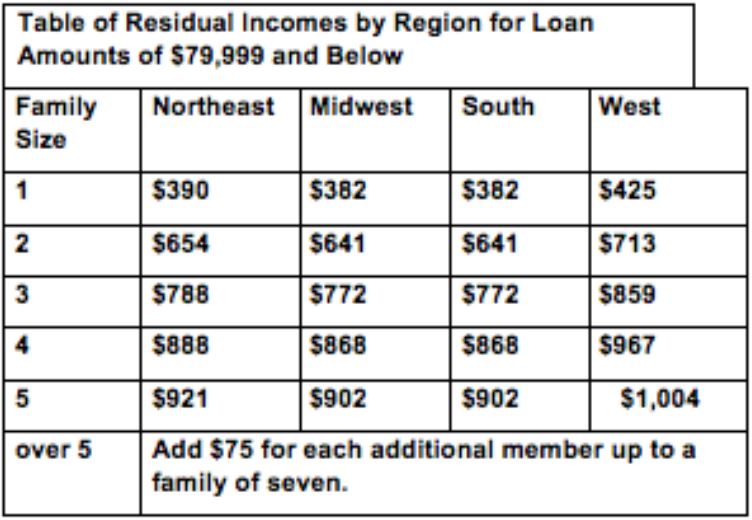
VA Loans Residual Income Table By Broken Down By Region
For borrowers with a higher than $80,000 household income, the following chart explains the VA Residual Income Requirements:
Do All Lenders Have Different Requirements for VA Loans?
Over 80% of our borrowers at Gustan Cho Associates are folks who either got a last-minute mortgage denial or could not qualify for a VA loan due to the lender’s lender overlays. As long as borrowers get an approve/eligible per the automated underwriting system (AUS), we are ready to approve and close the loan. We do not just close your VA Loans; rest assured that we will close them on time.
What Happens If VA Residual Income or DTI Does Not Meet VA Loan Requirements?
Unexperienced mortgage loan originators may issue you a pre-qualification letter based on your debt to income. With a pre-approval letter, a homebuyer goes out shopping for a house. Once the homebuyer gets an executed purchase contract, the mortgage process starts. There are many instances where once starting the mortgage process, the mortgage processor or underwriter flags the borrower is not passing residual income test.
Failing the residual income test can instantly kill your VA loan, and you may lose your earnest money and out-of-pocket expenses such as appraisal and inspection.
This is why coming to the experts at Gustan Cho Associates is important. The team at Gustan Cho Associates will walk you through the process. Call us at Gustan Cho Associates at 800-900-8569 or text us for a faster response. Gustan Cho Mortgage Group offers the TBD underwrite. Part of that is verifying borrowers’ residual income. By now, I’m sure you are asking what residual income is.
The Role of DTI to Residual Income for VA Loans
In layman’s terms, residual income is the amount of money left over after paying all your required monthly capital costs. This is also known as disposable income. Residual income is an important component of obtaining a loan. It is very similar to a back and debt-to-income ratio but is calculated differently based on the size of your family and the region you live in. Certain items, such as the size of the home, can come into effect in this calculation. This calculation is used in conjunction with other credit risk indicators, such as the following:
- loan-to-value
- reserve accounts
- credit score
- the overall credit profile of borrowers
- debt to income requirements
Passing VA Loans Residual Income Guidelines Requirements
Residual income calculations are something veteran borrowers must pass to obtain VA loans. VA loans do allow for higher debt-to-income ratios compared to conventional financing. But with debt-to-income ratios above 41%, the veteran must pass the residual income requirements by around 20%. Sonny Walton, a dually licensed realtor and loan officer at Gustan Cho Associates, explains VA loans residual income:
The VA residual income analysis helps determine the borrower’s ability to pay all of their debts, have general living expenses where they do not have to struggle financially and be able to pay their mortgage payment.
As you can see, residual income requirements are the highest in the Western region. So for this example, we will use a VA loan in California with a family size of 5 and a debt-to-income ratio of 55%. Since the debt to income is above 41%, you must aim for 20% above the requirement. Veteran borrowers will need to have $1390 in residual income. If the borrower had a lower debt-to-income ratio for the same scenario, they would need $1158 in residual income.
What is Included in Residual Income on VA Loans?
Let’s go over one more example from the Midwest region for a veteran buying a home in Illinois with a family size of 2 and a debt-to-income ratio of 47%. The Veteran is buying a home for $200,000. It has a total mortgage payment of $1700, including taxes and insurance. Dale Elenteny, NMLS 904444 of Gustan Cho Associates explains VA loans residual income guidelines:
Residual income is a very important factor for lenders on VA loans. Residual income helps lenders decide whether or not the borrower has enough money and reserves for the ability to repay their new VA home loan.
The veteran must have a residual income of 20% above the requirement of $889 due to the debt-to-income ratio. In this case, that amount is $1067. Remember, the family size is two, husband and wife. Residual income, unlike debt-to-income ratios, is calculated by net income. Once again debt to income ratios are calculated from gross income, and residual income is based on take-home pay.
Case Scenario on Passing the Residual Income Test on VA Loans
Veterans’ Take-Home Pay = $4500 a month
Veterans Debts:
- Mortgage = $1700 (includes principal, interest, taxes, and insurance)
- Car payment = $300
- Credit Cards = $50
- Personal Loan =$50
DTI = 46.7% Residual income = $2190
- (the maintenance expense was calculated off a home of 2000 square feet in this example)
- In this scenario, the veteran does pass the residual income requirement
Maintenance expenses are based on the size of the home and added to the residual income calculations. As stated above, ask the loan officer if they can explain this. Chances are they are not aware of how residual income affects each VA loan.
VA Loan Denied Over DTI? Residual Income Could Save Your Approval
Strong residual income can override a high debt-to-income ratio. See If You Qualify for VA Loan Approval Based on Residual Income!VA Loans for Bad Credit and Low Credit Scores
The U.S. Department of Veteran Affairs does not have a minimum credit score requirement or maximum debt-to-income ratio caps. Why do most VA lenders require a 620 or 640 credit score? John Strange explains Gustan Cho Associates’s no lender overlays policy on VA loans as follows:
Lenders can have different VA loan requirements on VA loans. It is not because of VA guidelines but because most VA lenders have mortgage overlays on VA loans. Gustan Cho Associates has zero overlays on VA loans.
Gustan Cho Associates has a national reputation for helping veteran home buyers with higher debt-to-income ratios and credit scores under 600 secure VA Home Loans. Many of our Gustan Cho Associates borrowers are veteran home buyers in a Chapter 13 Bankruptcy Repayment Plan or recently had their Chapter 13 Bankruptcy discharged. There is no waiting period to qualify for VA Home Loans after Chapter 13 Bankruptcy discharge. Gustan Cho Associates Mortgage Group are experts in VA and FHA Manual Underwriting.
Best Lenders for Bad Credit with No Overlays on VA Loans
Borrowers don’t want to find themselves in a panic situation right before closing is supposed to happen. Another lender has denied 80% of our clients or has not gotten the correct information from their loan officers. That’s why contacting the experts at Gustan Cho Associates for your VA mortgage needs is important. Each family has a different story, requiring an extraordinary residual income. As you can see, this is another aspect that clouds the qualifications for a VA loan. Contact us at Gustan Cho Associates to get your TBD pre-approval started!
Final Thoughts on VA Loan Residual Income Guidelines
Applicants denied due to high DTI or insufficient residual income are encouraged to request a comprehensive review of the calculations.
Frequently Asked Questions (FAQs)
What are the VA Loan’s Residual Income guidelines?
Residual income guidelines for VA loans in 2024 vary based on family size, region, and loan amount. Generally, borrowers must demonstrate sufficient residual income after accounting for monthly expenses to meet VA requirements.
Why Does the VA Consider Residual Income?
The VA considers residual income to ensure borrowers can afford mortgage payments and other living expenses. It helps assess the borrower’s ability to maintain financial stability after obtaining a VA loan.
How is Residual Income Calculated on VA Loans?
Residual income is calculated by subtracting the borrower’s monthly expenses (including the new mortgage payment, taxes, insurance, and other debts) from their gross monthly income. The remaining amount is considered residual income.
What are the Minimum Residual Income Requirements on VA Loans?
The VA does not specify a minimum residual income requirement. Instead, lenders evaluate residual income based on VA guidelines, which may vary depending on location and family size.
How Do VA Residual Income Requirements Vary by Family Size?
VA residual income requirements increase with larger family sizes. Larger families typically have higher living expenses, so the VA adjusts the residual income thresholds accordingly.
Do VA Residual Income Requirements Vary by Location?
Yes, VA residual income requirements may vary by location due to differences in the cost of living. Areas with higher living costs may have higher residual income requirements than those with lower living costs.
Can Assets be Considered as Part of Residual income on VA Loans?
Yes, assets such as savings and investments may be considered part of residual income if they generate regular income. However, specific guidelines may vary among lenders.
What Happens if a Borrower Does Not Meet the Residual Income Requirements?
Suppose a borrower does not meet the residual income requirements. If so, they could still be eligible for a VA loan by showcasing compensating factors, like a strong credit score or significant assets.
Are There Exceptions to VA Residual Income Guidelines?
In some cases, lenders may make exceptions to VA residual income guidelines based on the overall strength of the borrower’s application and other compensating factors.