Yes, qualified borrowers may get a home loan with job offer letter before starting work or receiving their first paycheck. Approval depends on the mortgage program, verified employment terms, the start date of income, and sufficient funds to meet the applicable closing and reserve requirements.
How a Home Loan With a Job Offer Letter Works
A job offer letter documents future employment income within an eligible FHA, VA, or conventional mortgage program. It is not a separate loan product. The lender uses the eligible income to calculate your debt-to-income ratio—the share of your gross monthly income needed for housing and other monthly debt payments. You must also meet the loan’s credit, down payment, and property requirements.
What Must Be Included in a Job Offer Letter?
Your employment offer should identify:
- Your name and the employer’s name.
- Position or job title.
- Scheduled employment start date.
- Base salary or hourly rate, with other compensation listed separately.
- Guaranteed minimum weekly hours, when applicable.
- Conditions that must be completed before employment begins.
- Your acceptance and any required signatures.
Provide the complete offer, including attachments and amendments. If a required detail is missing, ask the employer for a written clarification.
Supporting Documents for a Home Loan With a Job Offer Letter
Beyond the offer itself, the lender may request:
- Bank or investment statements documenting available funds.
- Records verifying current income used to cover the gap before new income begins.
- Employer confirmation that required employment conditions have been satisfied.
- Education, training, or licensing records relevant to the new position.
- Prior employment or income records needed to establish your work history.
- A new-job paystub when required by the selected loan option.
Your loan officer should identify which records apply to your file so you can gather them early.
Can You Close Before Receiving Your First Paycheck?
Yes, under certain mortgage programs. The borrower may be able to close before receiving a paycheck when future employment income is permitted, and the file meets the applicable requirements. The lender will pay close attention to:
- Employment start date
- Closing or Note Date
- Type of income
- Available reserves
- Terms of the employment offer
- Whether a paystub will be available before loan delivery
The rules are not the same for every program. Some allow employment to begin after closing. Others require the new job to start within a specific number of days.
Start-Date Changes Can Affect Approval
If the employer delays the start date, the lender should be notified immediately. A change of only a few weeks can affect whether the future income still meets the program’s timing requirements.
Fannie Mae Job Offer Letter Guidelines
Fannie Mae does not allow employment by a family member or anyone with an interest in the transaction for either option.
Option 1: Paystub Before Loan Delivery
The lender must review a signed job offer that lists the employer, job title, pay, and start date. The lender also needs to obtain a pay stub and verify employment before sending the loan to Fannie Mae.
Option 2: No Paystub Before Loan Delivery
This option requires:
- The buying of a single-unit primary residence.
- Only fixed-base qualifying income.
- A start date between 30 days before and 90 days after the Note Date.
- An offer that has been fully executed, with the employment-related conditions settled before the closing date.
Additional Financial Resources for Option 2
Beyond reserves required by Desktop Underwriter (DU) or the transaction, document either:
- Six months of principal, interest, taxes, insurance, and applicable association dues (PITIA); or
- The resources that cover the monthly liabilities included in the DTI, including PITIA, from the Note Date to the start of employment, plus one extra month.
Partial months can be counted as full months. The second calculation can include the reserves together with the documented current net income from you or a co-borrower during the gap, even if that income is not used to qualify or stops when the new job starts.
Freddie Mac Future Employment Income Guidelines
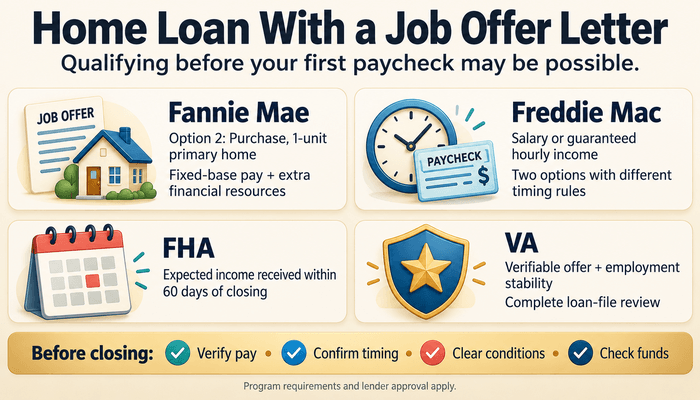 Freddie Mac permits eligible future income from new primary employment or an approved income increase with your current primary employer.
Guaranteed Hourly Income Can Qualify
Future earnings must be non-fluctuating. For a new hourly job, the employer must guarantee a minimum number of hours per week. For an hourly pay increase with your current employer, documentation must show that current and future hours do not fluctuate. Freddie Mac expanded these hourly-income provisions in May 2026.
Option 1: Income Starts Within 90 Days
This option is for buying or refinancing a one-unit primary home without taking cash out. Your income must begin no later than 90 days after the Note Date. In addition to closing costs and standard reserves, you need extra funds to cover your housing costs and other monthly bills for the time before your income begins, plus one more month. If a month is only partly covered, it still counts as a full month. Any verified income you expect to receive during this period can lower the amount you need.
Option 2: Income Begins Before Loan Delivery
Employment or income increase must begin before delivery to Freddie Mac. The 90-day limit does not apply. A paystub or permitted verification of employment must support the qualifying income. Eligible transactions include purchases, no-cash-out refinances, and cash-out refinances. Eligible properties include one- to four-unit primary residences, second homes, and one- to four-unit investment properties. Option 2 has no special additional-funds requirement for future income. Closing funds and any ordinary reserve requirements still apply.
Employer Restrictions Apply to Both Options
Neither option permits employment by a family member or interested party to the transaction. See the Freddie Mac Guide, Section 5303.2, for the complete requirements.
FHA Job Offer Letter and Expected-Income Guidelines
Income Must Be Received Within 60 Days
HUD’s expected-income provision requires income that will be received within 60 days of mortgage closing. The lender must obtain written employer confirmation of the income amount and that it is guaranteed to begin within that period. Confirm both the employment start date and the first pay date. A job starting within the 60-day window does not, by itself, establish when you will receive the income.
Funds Must Cover the Gap Until Income Arrives
The lender must verify enough current income or cash reserves to cover your mortgage payment and other monthly obligations from closing until you begin receiving the expected income. The calculation, therefore, needs to account for the wait between starting work and receiving pay.
Expected Income From a Family-Owned Business Is Excluded
FHA’s expected-income provision excludes future income from a family-owned business. An offer letter from that business does not make the income eligible under this provision. See HUD Handbook 4000.1 for the complete requirements.
Recent Graduate or Relocating for a New Job? You May Have Options
Education, training, career field, relocation, and future employment can all matter when underwriting a mortgage before you begin work.VA Home Loan With a Job Offer Letter
VA recognizes a valid, verifiable employment offer that begins on or after the anticipated closing date, even when a pay stub from the new job is unavailable. The lender must determine whether the future income is sufficiently stable and reliable to use for qualification.
Employment History and Career Advancement Matter
The lender reviews your previous employment, education, training, and qualifications for the new position. A job change that advances your career within the same or a related field may receive favorable consideration. Frequent changes, unexplained moves, or a transition to an unrelated occupation may warrant closer review. When the lender accepts income from short-term employment, it must document the reasons for doing so on VA Form 26-6393, Loan Analysis.
The Underwriter Reviews the Complete Loan File
The employment offer is considered alongside your credit history, debts, assets, and ability to cover housing and family living expenses, including VA’s residual-income analysis. Acceptance of future employment income, therefore, depends on the documented circumstances of your application.
Practical Examples of Qualifying With a Job Offer Letter
The following examples are hypothetical.
Example 1: Calculating Additional Funds Before Employment Starts
Assume a borrower meets Freddie Mac Option 1 requirements and has:
- Monthly housing expenses: $2,800
- Other monthly debt payments: $600
- Two months between the Note Date and employment start
- No verified income available to reduce the calculation
The lender adds one month to the waiting period: ($2,800 + $600) × 3 months = $10,200 The borrower needs $10,200 in additional funds beyond the money required for closing and ordinary reserves. This illustrates why having enough for the down payment does not necessarily satisfy the future-income requirements.
Example 2: An Hourly Rate With and Without Guaranteed Hours
One offer pays $30 per hour with at least 36 hours guaranteed each week. Those terms support a base-income calculation of: $30 × 36 hours × 52 weeks ÷ 12 = $4,680 per month Another offer pays $30 per hour but says hours depend on scheduling. The lender cannot assume the same $4,680 in monthly income as in that offer. Under Freddie Mac’s future-income provisions, hourly earnings from a new employer require guaranteed minimum weekly hours. The rate alone does not establish the qualifying amount.
Example 3: A Professional Offer With Unresolved Conditions
The nurse is offered a position on the condition that she obtains a state license and undergoes a background check. With a Fannie Mae Option 2 loan, the lender must ensure, before closing, that both conditions have been met: a license showing that one of the conditions has been fulfilled. Employer verification is still required for the background check. An HR letter stating that all employment conditions have been cleared can serve as evidence of the resolution.
Home Loan With Job Offer Letter for Recent Graduates
Recent graduates may still qualify even if they do not have two full years of traditional employment. The lender may review the borrower’s education and new employment to establish a reasonable history leading up to the current career. Documents may include:
- College transcripts
- Diploma or degree
- Trade-school records
- Professional license
- Employment offer
- Employment contract
- Start date and compensation
The fact that a borrower recently graduated does not automatically make the income acceptable. The job, compensation, and supporting documents must still meet the requirements of the selected mortgage program.
Professional Careers With Licensing Requirements
Doctors, nurses, attorneys, teachers, engineers, and other professionals may receive employment offers before completing a licensing, credentialing, or graduation requirement. The lender needs to determine whether the offer is still conditional and whether the remaining condition must be satisfied before closing.
What Happens if the Job Offer Has Conditions?
A conditional employment offer does not automatically prevent mortgage approval. The important question is whether the applicable loan program requires those conditions to be cleared before closing or before the future income can be used. Common employment conditions include:
- Background check
- Drug screening
- Professional licensing
- Graduation
- Security clearance
- Credentialing
- Employer-required examination
For Fannie Mae’s applicable future-employment option, the lender must confirm before closing that employment conditions have been satisfied when the offer contains contingencies. Freddie Mac also makes an important distinction: a normal probationary, training, or orientation period that begins after employment starts is not automatically considered a contingency of the employment offer.
Do Not Assume a Probationary Period Disqualifies the Loan
Many employers place new hires on a 60- or 90-day probationary period. That alone does not necessarily mean the employment is temporary or unacceptable. The lender should review the actual employment terms rather than treating the word “probationary” as an automatic basis for denying the income.
Common Job Offer Letter Problems and Practical Fixes
- Guaranteed hours are missing: Ask the employer to document any guaranteed minimum hours. The clarification must reflect the actual employment arrangement.
- The start date is delayed: Obtain an updated offer and have the lender recalculate timing eligibility and required funds before confirming the closing date.
- Advertised compensation includes bonuses or commissions: Ask the lender which portion can be used to qualify before budgeting around the total.
- Available funds fall short: Have the lender check whether documented current income can count toward the gap requirement under the selected option.
- Changes to pay, position, or employer: Notify the loan officer immediately and submit the revised terms for review.
- If the employer cannot be reached: Provide an authorized HR or payroll contact who can verify the employment terms.
Employment Changes to Report Before Closing
Notify your loan officer promptly if the employer changes your:
- Start date or first pay date.
- Salary, hourly rate, or guaranteed hours.
- Position or employment status.
- Conditions of employment.
Also, report a change of employer or withdrawal of the offer. The lender may need updated employer verification, a revised income or financial-resource calculation, and another underwriting review. Provide written confirmation of the change as soon as it becomes available.
Final Thoughts on Getting a Home Loan With Job Offer Letter
Ask your loan officer to look over your full job offer before you pick a closing date. Get a clear list of any job requirements and the amount of money you need to keep after closing. Then, check with your employer about when your job and pay will officially start.
FAQs About Home Loans With Job Offer Letters
Can I Qualify with a Remote Job Offer?
Yes, as long as your job offer meets the program’s requirements. The lender might check with your employer to confirm you’re authorized to work remotely from your new home.
Can a Signing Bonus Help Me Qualify?
A one-time bonus usually isn’t counted as regular income. After you receive and verify it, you can use it for closing costs, your down payment, or reserves. Be sure to mention if you have to pay any of it back.
Can I Use Two Job Offers?
If you have two future job offers, you usually can’t combine them automatically. The rules for having more than one job apply. If there are two co-borrowers, each person can use a qualifying offer if both meet the program’s requirements.
Can I Use an Offer from a Family-Owned Business?
Fannie Mae and Freddie Mac’s offer options exclude employment by family members or interested parties. FHA’s expected-income provision excludes family-owned businesses. Income already being earned follows separate rules.
Can I Use a Job Offer for a Refinance?
Fannie Mae Option 1 permits refinancing with a supporting pay stub before delivery; Option 2 is purchase-only. Freddie Mac Option 1 permits no-cash-out refinances of one-unit primary homes. Option 2 also permits eligible cash-out refinances when income begins and is documented before delivery.
What if my Employer Withdraws the Offer Before Closing?
Tell your loan officer immediately. The lender must reassess approval using other eligible income or a replacement offer. Closing may be delayed, or the loan may not proceed.
This article about “Home Loan With Job Offer Letter: Mortgage Guidelines Before You Start Work” was updated on October 7th, 2026.