How Credit Repair Works During The Mortgage Process To Get Approved
This guide covers how credit repair works during the mortgage process. A substantial percentage of my borrowers are folks who had previous credit issues, prior bankruptcies, foreclosures, a deed in lieu, or short sales and have overcome the financial issues and are now ready to purchase a home. HUD, the parent of FHA, does not allow credit disputes on derogatory credit tradelines and non-medical collection accounts, says John Strange, of Gustan Cho Associates:
HUD, the parent of FHA loans, does not permit borrowers to have credit disputes on non-medical derogatory credit tradelines and collections on FHA loans.
You can have credit disputes on VA, USDA, non-QM, jumbo, and conventional loans. However, Many assumed they did not qualify for a mortgage loan because of bad credit. The way how credit repair works during the mortgage process is that the two do not go hand in hand. We will be discussing how credit repair works. We will discuss how credit repair may be unnecessary and more damaging than good later in this BLOG. This article will discuss and cover how credit disputes affect the mortgage process.
How Credit Repair Works During The Mortgage Process To Get Approved
Buying a home is a major financial step. Many people only realize how much their credit matters when they apply for a mortgage and find that issues like past collections, late payments, high credit card balances, or errors on credit report can affect approval. Credit repair during the mortgage process is different from general credit repair. Lenders look at more than just your credit score.
Lenders review your full credit history, recent late payments, disputes, debt balances, credit use, collections, charge-offs, judgments, public records, and how your credit profile affects automated underwriting.
At Gustan Cho Associates, we help many borrowers who were turned down by other lenders due to credit issues, lender overlays, disputes, or recent negative marks. Being denied a mortgage does not always mean you cannot qualify. Often, you just need the right strategy, proper documentation, and a lender who understands the guidelines without adding extra rules.
What Does Credit Repair Mean During The Mortgage Process?
Credit repair during the mortgage process means reviewing your credit report before or during loan approval to identify inaccurate, outdated, duplicate, or unverifiable information that may be hurting your mortgage qualification. Consumers can get a copy of their credit report at no cost through Annual Credit Report.
Federal law allows consumers to dispute inaccurate information on their credit reports, and there is no fee to file a dispute directly with the credit reporting agency or the company that reported the information.
Credit repair may include disputing inaccurate credit report information, paying down revolving credit card balances, resolving certain debts when required, removing incorrect late payments, updating paid accounts, correcting duplicate collections, and fixing accounts that do not belong to the borrower.
Credit Repair Is Not A Magic Fix
Credit repair cannot legally remove accurate and timely negative information from a credit report. If a late payment, collection, charge-off, bankruptcy, foreclosure, or repossession is accurate, it may remain on the credit report for the allowed reporting period.
Credit repair during the mortgage process is not about hiding bad credit. It means finding mistakes, correcting incorrect information, improving your score when possible, and getting your credit ready for lender review.
Borrowers should be careful with companies that promise to remove all negative credit, guarantee a specific score increase, or ask borrowers to dispute accurate information. The CFPB warns that no one can remove accurate and current negative information from a credit report.
Credit Repair Should Be Mortgage-Focused
Most credit repair companies just try to raise your credit score. Mortgage-focused credit repair is different because the main goal is to get your mortgage approved.
A Borrower May Have A Higher Credit Score But Still Have Mortgage Approval Problems Because Of:
- Recent late payments
- Open credit disputes
- Unresolved judgments
- Federal tax debt
- High debt-to-income ratio
- Collections affecting automated underwriting
- Accounts reporting incorrectly
- Credit scores that do not match program requirements
- Lender overlays stricter than agency guidelines
This is why credit repair during the mortgage process should always take into account the specific mortgage program you are applying for.
Ready To Become Homeowner

These folks have the down payment and closing costs and can comfortably afford their new housing payments on their new home purchase. However, many did not pay attention to their credit and still have many derogatory items reported on their credit report. Their first reaction is to learn how credit repair works and go to a credit repair program before consulting with a loan officer to get pre-approved. Many homebuyers do not understand that they may not need credit repair. They do not realize that they already qualify for a mortgage loan.
Get a Free Credit and Mortgage Review Together
Don’t guess what will help or hurt your loan. We’ll pull your credit, review your file, and give you a step-by-step plan to repair credit while moving toward closing
How Credit Repair Works?
Most who go through credit repair go through disputing derogatory items for errors in the hopes of the credit bureaus removing them from their credit report. Consumers who want to delete old derogatory items on their credit report via credit repair go by disputing those credit tradelines to credit bureaus.
Victims of erroneous credit reporting need to state a reason, such as “credit card does not belong to me,” and a reason for either the creditor or credit bureaus to investigate the correctness/validity of the derogatory credit item. The credit reporting agency then contacts the creditor, who has 30 days to prove the derogatory item is valid.
If they provide the validity of the credit dispute, the derogatory credit item that was being disputed stays on the consumer credit report. Suppose the creditor does not respond to the consumer credit dispute to the credit bureaus within 30 days. In that case, the credit reporting agencies must delete or correct the disputed item under federal law. Each of the three credit bureaus is independent of one another, so consumers need to dispute all three credit reporting agencies.
How Credit Repair Works With Credit Disputes
Again, credit repair works by disputing derogatory or incorrect credit items to each of the three independent credit reporting agencies. Once consumers have mailed their credit dispute to the three bureaus, each credit bureau will mail correspondences. It is best to send all correspondences to credit bureaus via certified USPS.
Inaccuracies On Credit Reports During Mortgage Process
Consumers can do credit disputes with each of the three credit reporting agencies. Each credit reporting agency is independent of the other so every consumer will have three different credit scores. Credit Disputes during the mortgage process are not recommended unless it is necessary.
Learn how credit repair works during the mortgage process, what to fix before applying, how disputes affect approval, and how lenders review credit.
For borrowers who see any inaccuracies on their credit report and need to qualify for a mortgage, the loan officer should be made aware of the situation and have the loan officer and the lender handle the credit dispute. With rapid rescores, lenders can correct inaccuracies on credit reports during the mortgage process. Rapid Rescore only takes three to five business days. Here are the three credit bureaus:
Why Credit Repair Matters Before Applying For A Mortgage
Credit repair is essential because your credit score influences mortgage qualification, interest rates, required down payments, and eligibility for specific loan programs.
Mortgage lenders assess credit differently from credit card, auto, or personal loan lenders. You may qualify for a car loan with credit issues, but still face challenges obtaining a mortgage due to more rigorous underwriting standards.
Mortgage Lenders Review More Than The Credit Score
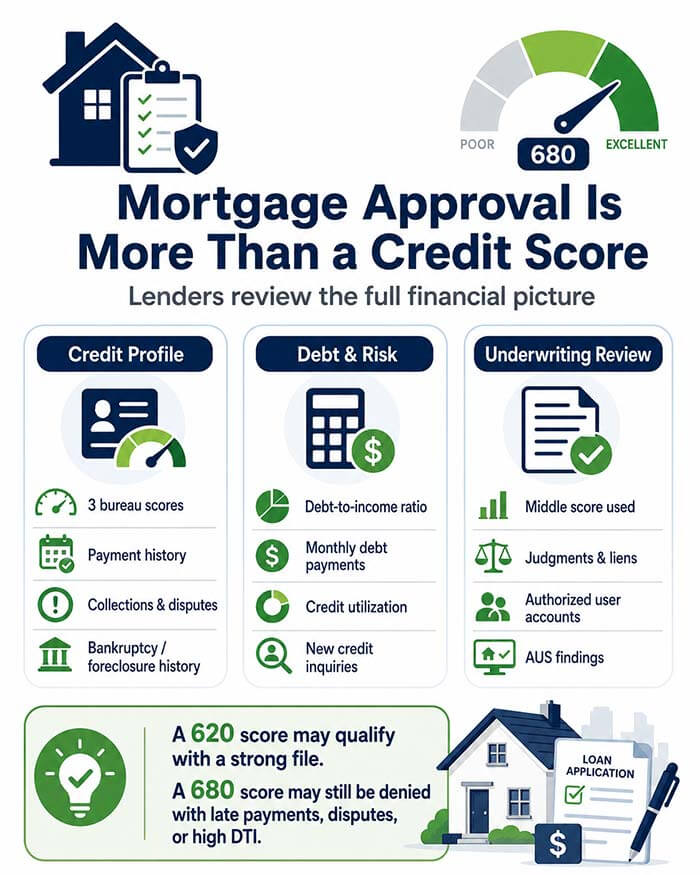
Many applicants believe only the credit score matters; however, mortgage lenders consider multiple factors beyond the score.
Mortgage Lenders Review:
- Credit scores from all three bureaus
- Middle credit score used for qualifying
- Payment history
- Recent late payments
- Collections and charge-offs
- Credit disputes
- Judgments and liens
- Bankruptcy, foreclosure, deed-in-lieu, or short sale history
- Credit utilization
- Monthly debt payments
- Authorized user accounts
- Recent new credit inquiries
- Debt-to-income ratio
- Automated underwriting findings
An applicant with a 620 credit score may be approved if other aspects of the application are strong. Conversely, a 680 score does not guarantee approval if there are recent late payments, unresolved disputes, or a high debt-to-income ratio.
Credit Issues Can Trigger Lender Overlays
A lender overlay is an internal mortgage company rule that is stricter than FHA, VA, USDA, Fannie Mae, or Freddie Mac guidelines.
For example, FHA may allow a borrower with a 580 credit score to qualify with a 3.5% down payment if the borrower receives eligible automated underwriting findings. However, some lenders may require a credit score of 620 or higher due to their own overlays.
This is why borrowers should ask whether a denial was caused by agency guidelines or the lender’s internal overlays.
How Credit Repair Works During The Mortgage Process Step By Step
Credit repair during the mortgage process requires an organized and strategic approach. Unplanned disputes or abrupt changes to credit accounts may create additional complications if not managed properly.
Step 1: Review The Full Mortgage Credit Report
The first step is reviewing the borrower’s full mortgage credit report. A mortgage credit report may show information differently from a free consumer credit monitoring app.
Borrowers Should Review:
- Personal information
- Name variations
- Addresses
- Social Security number errors
- Open accounts
- Closed accounts
- Collections
- Charge-offs
- Late payments
- Public records
- Credit inquiries
- Disputed accounts
- Authorized user accounts
- Credit limits and balances
The goal is to identify which information is correct, which is wrong, what could impact your score, and what might affect your mortgage approval.
Step 2: Identify Credit Report Errors
Credit report errors can include accounts that do not belong to the borrower, incorrect late payments, duplicate collections, wrong balances, incorrect account status, paid accounts still reporting as unpaid, and debts that should no longer be reporting.
The FTC recommends disputing errors with each credit bureau that shows the mistake, explaining what is wrong, including supporting documents, and keeping records of everything submitted.
Step 3: Determine Which Credit Issues Affect Mortgage Approval
Not every credit issue needs to be fixed before mortgage approval. Some negative items may lower the score, but may not require payment. Other items may need to be resolved because of underwriting requirements.
For example, an old medical collection may not stop FHA approval in some cases. However, an unpaid judgment, a federal tax lien, or a recent mortgage late payment may create a larger underwriting issue. A mortgage professional can assist in identifying which credit issues are most significant for your specific loan program.
Step 4: Avoid Disputing Accurate Accounts During The Mortgage Process
This is one of the most important parts of mortgage credit repair. Credit disputes can complicate mortgage underwriting. If an account is in dispute, the automated underwriting system may ignore the account or treat the credit profile differently. Some disputed accounts may need to be removed from dispute status before they are closed. You should avoid disputing every negative account during the mortgage process. Challenging accurate information may delay approval, create credit rescore complications, or negatively affect your application.
Step 5: Pay Down Credit Card Balances Strategically
One of the fastest ways to improve a credit score may be to reduce revolving credit utilization. Credit utilization means how much of your credit limit is being used. For example, if a borrower has a $1,000 credit card limit and a $900 balance, the utilization is high. Paying that balance down may improve the score. If you are applying for a mortgage, prioritize managing your credit card balances. The proportion of credit utilized can significantly influence your credit score.
Step 6: Use Rapid Rescore Only When Appropriate
A rapid rescore is not credit repair. It is a lender-assisted update to a credit report after documented changes have already been made.
For example, if a borrower pays down a credit card balance, the lender may request a rapid rescore after receiving proof of payment. This may help update the mortgage credit report faster than waiting for the creditor’s normal reporting cycle.
Rapid rescore may help when a borrower needs a few more points to qualify, receive better pricing, or meet a loan program requirement.
Step 7: Re-Run Automated Underwriting
After credit improvements are made, the lender may re-run automated underwriting. Automated underwriting systems include Desktop Underwriter, Loan Product Advisor, and other program-specific systems. These systems review the borrower’s credit, income, assets, debts, down payment, property type, and overall risk profile. An increased credit score does not guarantee approval; the entire application must still satisfy the lender’s requirements.
What Credit Issues Should Be Fixed Before A Mortgage?
Some credit issues are more important than others during the mortgage process.
Inaccurate Late Payments
- Late payments can hurt credit scores and raise underwriting concerns, especially if they are recent.
- If a late payment is incorrect, the borrower should dispute it with supporting documentation.
- Examples may include bank statements, creditor letters, payment confirmations, or account history showing the payment was made on time.
High Credit Card Balances
- High credit card balances can lower credit scores and increase monthly debt payments.
- Paying down revolving debt can improve both credit scores and debt-to-income ratios.
- Borrowers should avoid closing credit cards after paying them down, as doing so can reduce available credit and potentially increase utilization.
Duplicate Collections
- Sometimes the same collection account appears multiple times.
- Duplicate collections can hurt the borrower’s credit profile and create confusion during underwriting.
- If a duplicate account is inaccurate, the borrower should dispute the duplicate reporting with documentation.
Paid Accounts Reporting As Unpaid
- A paid collection, settlement, or charged-off account should report accurately. If an account was paid or settled but still appears incorrect, the borrower should gather proof and request a correction.
Accounts That Do Not Belong To The Borrower
- Accounts caused by identity theft, mixed files, or reporting errors should be addressed immediately.
- Borrowers may need to file disputes and provide identity theft documentation when applicable.
Open Credit Disputes
- Open credit disputes can be a major issue for mortgage borrowers.
- Some disputes may need to be removed before closing, depending on the loan program, account type, balance, and automated underwriting findings.
Credit Disputes During The Mortgage Process
Credit disputes are among the most misunderstood aspects of mortgage approval. A credit dispute tells the credit bureau that the consumer disagrees with information on the report. Disputes can be helpful when the information is truly inaccurate. However, disputes can also create underwriting problems if they are open during the mortgage process.
When Credit Disputes Can Help
Credit Disputes May Help When:
- The account does not belong to the borrower
- The late payment is inaccurate
- The balance is wrong
- The account should show paid or settled
- The collection is duplicated
- The account was included in the bankruptcy, but the reports were incorrect
- The creditor is reporting outdated information
When Credit Disputes Can Hurt Mortgage Approval
Credit Disputes May Hurt Mortgage Approval When:
- The borrower disputes the accuracy of the negative accounts
- The dispute suppresses credit score calculations
- The automated underwriting system requires dispute removal
- The lender requires the account to be removed from dispute status
- The borrower cannot document the dispute reason
- The dispute causes delays before closing
Do not start disputing lots of accounts right before applying for a mortgage. Always talk to a mortgage professional first.
Can Credit Repair Raise Your Mortgage Credit Score?
Credit repair may raise a mortgage credit score if inaccurate negative information is corrected, high revolving balances are reduced, duplicate accounts are removed, or reporting errors are fixed.
However, credit repair does not guarantee an increase in your score.
Why Credit Scores May Improve
Credit scores may improve when:
- Credit card balances are paid down
- Incorrect late payments are removed
- Duplicate collections are corrected
- Paid accounts update properly
- Incorrect balances are fixed
- Authorized user accounts report favorably
- Old, inaccurate, negative accounts are deleted
Why Credit Scores May Not Improve
Credit Scores May Not Improve If:
- The negative information is accurate
- The borrower has had recent late payments
- Credit utilization remains high
- The borrower opens a new debt
- The credit profile is thin
- Old positive accounts are closed
The borrower has recent collections or charge-offs. Credit repair is most effective when combined with sound credit habits, such as making timely payments, maintaining low credit card balances, and planning ahead for your mortgage application. However, FHA approval still depends on credit history, automated underwriting findings, income, debts, assets, and lender overlays.
FHA Loans May Allow Lower Credit Scores
FHA guidelines are often more flexible than conventional loan guidelines, but not every lender follows FHA minimum standards. Some lenders add overlays requiring higher credit scores, lower DTI ratios, or stricter credit history.
FHA Manual Underwriting And Credit Repair
If a borrower does not receive automated approval, FHA manual underwriting may be possible. Manual underwriting requires a deeper review of payment history, compensating factors, rental history, residual income, reserves, and explanations for credit issues. Credit repair can help prepare your application, but you must still demonstrate the ability and willingness to repay the loans.
VA loans do not have a VA-required minimum credit score, but many lenders impose their own minimum credit score overlays.
VA Loans And Lender Overlays
A veteran may be denied by one lender due to credit score overlays but approved by another VA lender that follows VA guidelines more closely.
Credit repair during the VA mortgage process should focus on recent payment history, residual income, debt-to-income ratio, collections, charge-offs, and whether the file can receive automated approval or manual underwriting.
VA Manual Underwriting
VA manual underwriting may be available for borrowers with credit challenges. However, recent late payments, poor rental history, unresolved debts, and lack of compensating factors can make approval difficult.
Credit Repair And Conventional Loans
Conventional loans backed by Fannie Mae or Freddie Mac often require stronger credit than FHA or VA loans.
Credit Scores Can Affect:
- Loan approval
- Mortgage insurance pricing
- Interest rate pricing
- Debt-to-income tolerance
- Automated underwriting results
- Down payment options
Conventional Loans Are More Credit-Sensitive
- A small increase in credit score can sometimes make a big difference in conventional loan pricing.
- For borrowers close to a qualifying score threshold, paying down credit cards, correcting errors, or updating inaccurate balances may improve approval options.
Credit Repair And USDA Loans
USDA loans are designed for eligible rural and suburban homebuyers who meet income and property eligibility requirements.
USDA loans can be flexible, but credit history still matters.
USDA Credit Review
USDA lenders review payment history, credit scores, debts, collections, and automated underwriting findings. Borrowers with credit issues may need explanations, documentation, or manual underwriting review. Credit repair may assist if errors, unresolved disputes, or high credit card balances are hindering your mortgage approval.
What Credit Repair Companies Can and Cannot Do
- Credit repair companies can help review credit reports, prepare disputes, organize documentation, and communicate with credit bureaus.
- However, they cannot legally guarantee the removal of accurate negative credit.
- The Credit Repair Organizations Act bars credit repair companies from demanding advance payment before services are performed, requires written contracts, prohibits misleading claims, and gives consumers certain cancellation rights.
Red Flags Of A Credit Repair Scam
Borrowers should be careful if a credit repair company:
- Guarantees a specific score increase
- Promises to remove accurate negative accounts
- Tells you to dispute everything, even accurate accounts
- Asks for large upfront fees
- Tells you to create a new identity
- Refuses to explain your rights
- Does not provide a written contract
- Pressures you to act immediately
The CFPB warns that scam warning signs include pressure to pay upfront fees and promises to remove negative information from a credit report.
What Borrowers Can Do Themselves
Borrowers can dispute inaccurate credit report information themselves. They can gather supporting documents, contact credit bureaus and furnishers, maintain dispute records, and follow up until the issue is resolved.
The FTC recommends explaining in writing what is wrong, including supporting documents, and keeping records of everything sent.
Completion Of Credit Dispute
You cannot have credit disputes on derogatory and non-medical collection accounts on FHA loans. Other loan programs depends on the findings of the Automated Underwriting System findings. Consumers will get a revised copy of their credit report from each of the three credit bureaus once the credit reporting agencies have completed their credit dispute investigations. Consumers some deletions of negative credit items they have disputed.
Some will fall off, while others will stay on. Each credit bureau will send revised, updated credit reports that state disputed derogatory credit items, and next to it, it will state whether it Remains, is Deleted, or is Updated.
Most consumers’ goal with credit repair and credit disputes is to get derogatory and incorrect items removed from their credit reports to improve their credit and increase their credit scores. Most go through credit repair so they can qualify for a mortgage. Statistics state that most people get about 20% of disputes removed the first time around. Many consumers dispute the first time by disputing every derogatory item on their credit report and just “NOT MINE ” as a reason for their dispute. Credit reports should be checked periodically for errors.
Not Sure What to Dispute or Pay Off? Let Us Help
Random credit disputes can delay or kill a mortgage. We’ll help you create a credit repair game plan that works with, not against, your loan
FHA Loans For Bad Credit And Lower Credit Scores
FHA Loans are the most popular loan program today for the following type of mortgage borrowers:
- First Time Home Buyers
- High debt-to-income ratios
- Borrowers with bad credit
- Borrowers with late payments after bankruptcy and foreclosure
- Borrowers with judgments and tax liens
- Borrowers with lower credit scores
- Borrowers with no credit or limited credit
- Borrowers with no credit tradelines
- Borrowers with recent bankruptcies or housing events
- Borrowers in need of multiple co-borrowers
Qualifying For FHA Loans With Bad Credit
Homebuyers do not necessarily need credit repair in most instances if they consider qualifying for an FHA mortgage. Here are the basic qualification requirements for FHA loans with bad credit. The minimum credit score requirement for FHA Loans is 500 FICO.
The minimum down payment requirement for FHA Loans is 3.5% for buyers with at least 580 credit scores. Homebuyers with credit scores between 500 and 579 can qualify for FHA Loans with low credit scores but need a 10% down payment.
HUD is the parent of FHA and sets Guidelines on FHA Loans. FHA Guidelines on collections and charge-offs do not require old collections and charge-offs to be paid off by borrowers to qualify for FHA Loans.
Common Credit Repair Mistakes During The Mortgage Process
Credit repair can benefit borrowers; however, an ineffective strategy may delay or jeopardize mortgage approval.
Mistake 1: Disputing Every Negative Account
Mass disputes can create underwriting problems. Borrowers should only dispute inaccurate, incomplete, outdated, or unverifiable information.
Mistake 2: Paying Collections Without A Mortgage Strategy
Paying an old collection may or may not help the credit score. In some cases, it may update the account and temporarily affect the score. Borrowers should speak with a mortgage professional before paying off old collections during the loan process.
Mistake 3: Closing Credit Cards
Closing credit cards can reduce available credit and increase utilization. This can lower credit scores.
Mistake 4: Opening New Credit
New credit inquiries and new debt can hurt mortgage approval. Borrowers should avoid opening new credit cards, auto loans, furniture accounts, or personal loans before closing.
Mistake 5: Ignoring Credit Disputes
Open disputes can delay closing. Borrowers should identify disputes early and ask the lender whether they must be removed.
Mistake 6: Waiting Until The Last Minute
Credit repair works best before the mortgage application. Waiting until underwriting can cause delays, rushed decisions, and approval problems.
Best Credit Repair Strategy Before Applying For A Mortgage
The optimal approach is to review your credit early, identify errors, avoid unnecessary disputes, reduce credit card balances, maintain thorough records, and collaborate with a lender knowledgeable about credit and mortgage regulations.
Start 60 To 120 Days Before Applying
Borrowers should ideally review their credit at least 2 to 4 months before applying for a mortgage. This gives time to fix errors, pay down debt, update reporting, and prepare documentation.
Focus On Credit Items That Affect Approval
Perfect credit is not required; the primary objective is to secure mortgage approval
Focus On:
- Mortgage credit scores
- Recent late payments
- Credit card utilization
- Collections and charge-offs
- Open disputes
- Judgments and liens
- Bankruptcy or foreclosure waiting periods
- Debt-to-income ratio
- Automated underwriting findings
Keep Making All Payments On Time
Recent late payments can be very damaging during the mortgage process. Borrowers should make every payment on time, including rent, credit card payments, auto loans, student loans, and installment payments.
Avoid Major Financial Changes.
Prior to closing on your mortgage, avoid changing employment, incurring additional debt, making undocumented large deposits, opening new credit accounts, co-signing loans, or transferring funds without proper documentation.
How Credit Repair Works on Judgments and Tax-Liens
Borrowers can qualify for FHA Loans with tax lien and judgments. But need a written payment agreement by the judgment creditor or IRS and proof of three months’ payments. Proof of three months of timely payments can be provided by providing three months of canceled checks or three months of bank statements.
Documents Needed For Credit Repair During The Mortgage Process
Borrowers should keep records of all credit repair activity.
Important Documents To Gather
- Credit reports from all three bureaus
- Mortgage credit report from the lender
- Proof of paid collections or settlements
- Creditor letters
- Bank statements showing payments
- Court documents for judgments or liens
- Bankruptcy discharge papers, if applicable
- Foreclosure or short sale documents, if applicable
- Identity theft reports, if applicable
- Dispute letters and responses
- Proof of corrected account reporting
- Credit card balance payoff confirmations.
- Comprehensive documentation enables lenders, underwriters, and credit bureaus to understand changes and their rationale during the mortgage process
- Gustan Cho Associates helps borrowers review credit challenges from a mortgage approval perspective.
- Many borrowers come to us after being denied by another lender because of credit scores, overlays, disputes, collections, charge-offs, late payments, or automated underwriting issues.
- The goal is to find out whether you really do not qualify or whether the problem is extra lender rules, how the loan was set up, unresolved credit disputes, or missing paperwork.
Mortgage Approval Is About The Full File
A Mortgage Approval Is Not Based On A Single Credit Score.
Lenders Review The Full Borrower Profile, Including:
- Credit
- Income
- Employment
- Assets
- Debt-to-income ratio
- Down payment
- Reserves
- Property type
- Loan program
- Automated underwriting findings
- Manual underwriting options
- Lender overlays
If one lender denies you, you might still qualify with another lender who follows the main guidelines and does not add extra rules.
How Credit Disputes Can Backfire During Mortgage Process
Credit Repair during the mortgage process can hurt the chances of qualifying for a mortgage. There are strict mortgage rules and regulations about how credit repair works and credit disputes during the mortgage process. Credit Disputes are not allowed on the following during the mortgage process. Mortgage applicants cannot have credit disputes on non-medical collection items if the outstanding balance exceeds $1,000.
Credit repair is not about removing accurate bad credit. It is about correcting inaccurate information, improving credit scores where possible, reducing risk, documenting the file, and preparing the borrower for mortgage underwriting.
If you were denied for a mortgage because of credit scores, late payments, collections, charge-offs, credit disputes, or lender overlays, Gustan Cho Associates can review your credit, income, assets, automated underwriting findings, and mortgage options to determine whether you may still qualify.
Final Thoughts On How Credit Repair Works During The Mortgage Process
How credit repair works during the mortgage process depends on your credit report, the loan program, your credit score, debt-to-income ratio, automated underwriting results, and any extra lender rules.
Exercise caution with credit repair companies that guarantee results or advise disputing accurate information. The most effective strategy is to maintain honesty, keep thorough records, and focus on achieving mortgage approval.
If the outstanding non-medical collection account balance is under $1,000, then credit disputes on non-medical collections are exempt. Non-medical collection accounts with zero balances are exempt from credit disputes. Credit disputes on charge-off accounts are not allowed. Credit disputes on medical collections are exempt. Homebuyers with bad credit can contact us at 800-900-8569 or text us for a faster response. Or email us at gcho@gustancho.com if they need to get pre-approved. The team at Gustan Cho Associates is available seven days a week, evenings, weekends, and holidays.
FAQs About How Credit Repair Works During The Mortgage Process
Can Credit Repair Help Me Qualify for a Mortgage?
- Yes, credit repair may help if inaccurate, outdated, duplicate, or incorrect information is hurting your credit score or mortgage approval.
- However, credit repair cannot legally remove accurate negative information.
- Mortgage approval also depends on income, debts, assets, the loan program, and underwriting findings.
Should I Repair My Credit Before Applying for a Mortgage?
Do Mortgage Lenders Allow Credit Disputes?
- Some credit disputes may be allowed, but others can create underwriting problems.
- Many lenders require certain disputed accounts to be removed from dispute status before closing.
- Borrowers should not start random disputes during the mortgage process without guidance.
Can Paying Off Collections Improve My Mortgage Approval?
- Paying off collections may help in some cases, but it does not always increase credit scores.
- Some loan programs may not require certain collections to be paid.
- Borrowers should speak with a mortgage professional before paying off old collections during the loan process.
How Fast Can Credit Repair Raise My Credit Score?
- There is no guaranteed timeline. Some score improvements may occur after the credit card balances are updated or errors are corrected.
- Other issues may take longer.
- A rapid rescore may help update certain verified changes faster during the mortgage process.
Can A Credit Repair Company Remove Late Payments?
- A credit repair company can help dispute inaccurate late payments.
- However, no company can legally remove accurate and timely late payments simply because the borrower wants them removed.
What Is The Fastest Way To Improve Credit Before A Mortgage?
- One of the fastest ways may be paying down revolving credit card balances if utilization is high.
- Correcting inaccurate information and updating paid balances may also help.
- The right strategy depends on the borrower’s credit report.
Will Opening A New Credit Card Help My Mortgage Credit Score?
- Opening new credit before a mortgage can be risky.
- It may create a new inquiry, lower the average account age, and add new debt.
- Borrowers should avoid opening new accounts before closing unless their lender advises them to do so.
Can I Get Approved For A Mortgage with Bad Credit?
- Yes, some borrowers can qualify with bad credit, depending on the loan program, credit score, income, debt-to-income ratio, down payment, payment history, and underwriting findings.
- FHA and VA loans may offer more flexibility than conventional loans.
What Should I Do if I Was Denied Because of My Credit?
- Ask the lender whether the denial was caused by agency guidelines, automated underwriting findings, or lender overlays.
- Then have your credit, income, debts, and loan options reviewed by a mortgage lender experienced with credit-challenged borrowers.
Clean Up Your Credit Without Stopping Your Home Loan
You can work on credit repair during the mortgage process—if it’s done the right way