
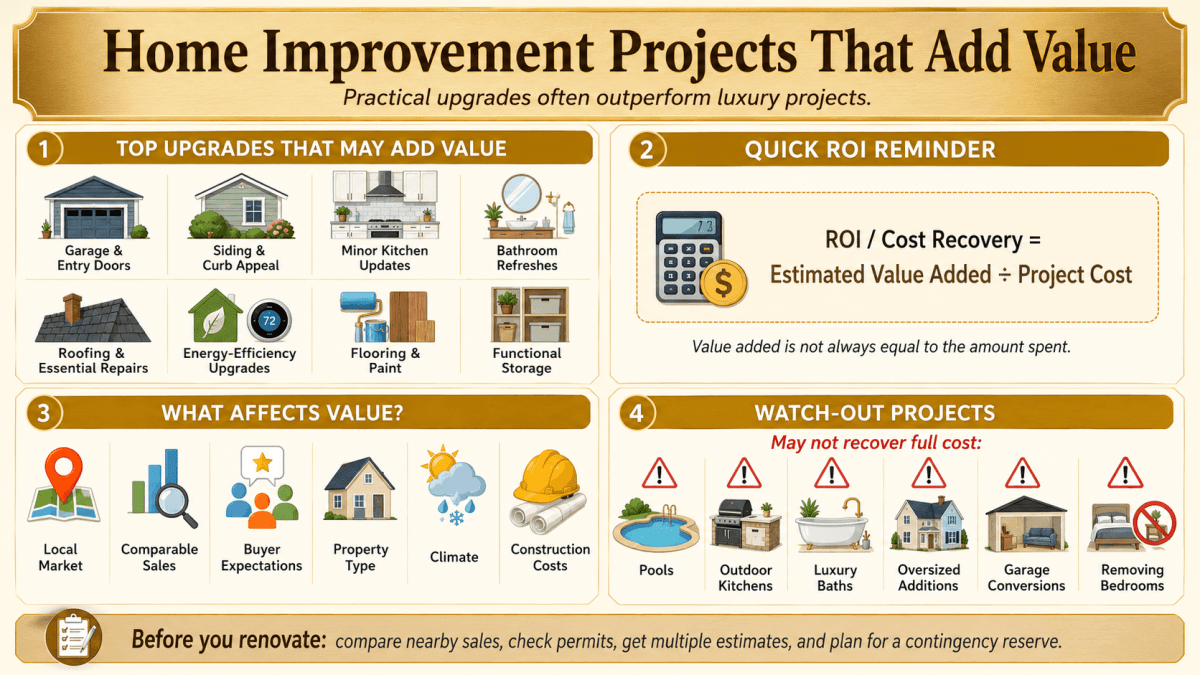
Home improvement projects that add value are usually practical, functional, and appealing to a wide range of buyers. Updates such as fresh paint, improved curb appeal, necessary repairs, modern flooring, and modest kitchen or bathroom upgrades may provide a better return than highly customized luxury features.
However, no renovation guarantees a profit or a dollar-for-dollar increase in home value. The amount a home improvement contributes depends on the local housing market, nearby comparable sales, the condition of the property, the quality of the work, and what buyers in the area are willing to pay. Before starting a major project, homeowners should compare the expected cost with the likely resale benefit and consider how long they plan to remain in the home.
Which Home Improvement Projects Add the Most Value?
Home improvement projects that add value are often practical upgrades that enhance appearance, functionality, energy efficiency, or the property’s overall condition. Modest projects may yield a better return than expensive luxury renovations because they appeal to a broader range of buyers.
National remodeling studies can help homeowners compare projects, but their findings should only be used as general benchmarks. For example, the 2025 Cost vs. Value Report compared 28 remodeling projects across 119 U.S. markets. It is estimated that garage door replacement and steel entry door replacement recovered more than their average project costs nationally.
However, the 2025 Remodeling Impact Report from the National Association of REALTORS® and the National Association of the Remodeling Industry estimated a 100% cost recovery for a new steel front door. The difference shows why no national percentage should be treated as a guaranteed return for an individual home.
Garage Door and Entry Door Replacement
A worn garage door or damaged front door can make the entire home appear poorly maintained. Replacing these features may improve security, insulation, function, and curb appeal without requiring a major renovation.
The 2025 Cost vs. Value Report ranked garage door replacement and steel entry door replacement among its strongest-performing projects nationally. The report estimated a 268% cost recovery for the garage door project it studied and 216% for its steel entry door project. These results are based on specific project descriptions, costs, materials, and national modeling. A homeowner’s return can vary significantly based on the property and local market conditions.
Homeowners do not always need to replace the entire door. Repairs, new hardware, fresh paint, improved lighting, or updated house numbers may make the entrance more inviting at a lower cost.
Exterior Siding and Curb Appeal
Buyers often form an opinion about a home before walking through the front door. Damaged siding, peeling paint, overgrown landscaping, clogged gutters, and cracked walkways can make buyers wonder whether the property has larger maintenance problems.
Exterior home improvements may include:
- Replacing damaged siding
- Painting faded exterior surfaces
- Cleaning or repairing gutters
- Trimming landscaping
- Pressure-washing walkways
- Repairing steps and railings
- Updating exterior lighting
The 2025 Cost vs. Value Report estimated national cost recovery of 114% for the fiber-cement siding project it studied and 97% for vinyl siding replacement. Manufactured stone veneer also ranked highly. These figures are national estimates and should not be used as a promise that every exterior project will increase a home’s value by the same amount.
Minor Kitchen Remodeling
A kitchen does not always need to be completely rebuilt to attract buyers. A minor kitchen remodel may focus on the most visible and frequently used features while keeping the existing layout.
Possible updates include:
- Painting or refacing cabinets
- Replacing worn countertops
- Updating cabinet hardware
- Installing a new sink or faucet
- Replacing outdated light fixtures
- Repairing damaged flooring
- Updating older appliances when needed
The 2025 Cost vs. Value Report estimated that its midrange minor kitchen project recovered 113% of its national average cost. In comparison, the same report estimated only 51% cost recovery for a midrange major kitchen remodel and 36% for an upscale major remodel. This does not mean every minor kitchen project will make a profit. Controlling the scope and cost may produce a better return than rebuilding the entire room with luxury finishes.
Bathroom Updates
A clean and functional bathroom may matter more to buyers than expensive tile, custom cabinetry, or luxury fixtures. Homeowners preparing to sell may benefit from fixing leaks, replacing damaged surfaces, improving lighting, refreshing grout, and updating worn fixtures.
The 2025 Cost vs. Value Report estimated an 80% national cost recovery for the midrange bathroom remodel it studied. Its upscale bathroom remodel recovered an estimated 42%. The National Association of REALTORS® report produced different estimates, placing the cost recovery for bathroom renovation at 50%. These differences reflect different project assumptions and research methods.
The best bathroom project is often the one that corrects obvious defects and brings the room closer to the condition of similar homes in the area.
Roofing and Essential Repairs
A new roof, working plumbing, safe electrical systems, proper drainage, and a sound foundation may not feel as exciting as a new kitchen. However, unresolved defects can cause buyers to lower their offers, request repairs, or leave the transaction.
The 2025 Cost vs. Value Report estimated that an asphalt-shingle roof replacement recovered approximately 68% of its national average cost. The NAR remodeling study also found that roofing was among the projects real estate professionals commonly recommended before a home was listed for sale.
Essential repairs may not always produce a dollar-for-dollar return. Their value may come from protecting the home, reducing buyer objections, and preventing problems during an inspection, appraisal, or loan approval.
Energy-Efficiency Home Improvements
Energy-efficiency projects may improve comfort and reduce monthly utility use. Common projects include replacing failing windows, sealing air leaks, improving insulation, updating heating and cooling equipment, and installing efficient lighting or appliances.
The 2025 Cost vs. Value Report estimated national cost recovery of 76% for its vinyl-window replacement project and 72% for its HVAC electrification project. Solar installation produced a much lower national cost-recovery estimate in that report, showing that expensive energy projects do not provide the same return in every market.
Before beginning a major energy upgrade, homeowners should consider the local climate, current utility costs, available incentives, equipment life, and whether buyers in the area are likely to pay more for the home improvement.
Flooring and Interior Paint
Fresh paint and well-maintained flooring can make a home look cleaner, brighter, and ready for occupancy. Neutral paint may also make it easier for buyers to picture their own furniture and decorations in the home.
The NAR remodeling report found that painting the entire home and painting individual rooms were the two projects real estate professionals most frequently recommended to sellers. New roofing, kitchen upgrades, and bathroom renovations followed.
Homeowners may not need to replace every floor. Cleaning carpet, refinishing usable hardwood, replacing damaged sections, or creating more consistent flooring between adjoining rooms may be enough.
Functional Storage
Storage home improvements can make a smaller home feel more organized and usable. Projects may include closet systems, pantry shelving, laundry-room cabinets, built-in storage, or better use of space under stairs and inside entryways.
The 2025 NAR Remodeling Impact Report estimated an 83% cost recovery for closet renovation, placing it behind only a new steel front door among the projects included in its cost-recovery ranking.
Storage improvements should remain practical and flexible. Highly customized built-ins may not appeal to buyers who plan to use the room differently.
National reports can identify broad trends, but homeowners should not choose a project based only on a national return percentage. Local comparable sales, neighborhood price limits, contractor costs, permits, workmanship, and buyer demand will determine how much value a home improvement actually contributes.
How Home Improvement ROI Is Calculated
Home improvement return on investment is commonly measured by comparing the estimated value added to the cost of the project.
ROI or cost recovery = estimated value added ÷ project cost
The result is usually expressed as a percentage. For example, suppose a homeowner spends $20,000 on a kitchen update and the home improvement is estimated to add $15,000 to the home’s resale value:
$15,000 ÷ $20,000 = 75% cost recovery
In this example, the homeowner may recover about 75% of the project cost through increased property value. The remaining 25% is not necessarily wasted because the homeowner may also benefit from improved function, comfort, appearance, or energy efficiency while living in the home.
It is important to understand that value added is not the same as the amount spent. Spending $50,000 on a renovation does not automatically increase a home’s value by $50,000. Buyers and appraisers consider how the home improvement compares with similar homes in the local market.
A project’s estimated value may depend on:
- The home’s location and condition
- The quality of materials and workmanship
- Whether permits were obtained
- The usefulness of the improvement
- Local buyer demand
- Comparable home sales
- Whether the project matches neighborhood standards
- The condition of the improvement when the home is sold
Homeowners should also distinguish between cost recovery and profit. A project with 100% cost recovery may add an amount equal to its cost, but it may not produce a true profit after accounting for financing charges, maintenance, permit fees, selling expenses, and other related costs.
National remodeling reports can provide a general starting point, but they cannot predict the exact return for an individual property. A local real estate professional, appraiser, or experienced contractor may provide more relevant guidance based on nearby homes and current market conditions.
Why Local Market Conditions Matter
The value of a home improvement depends heavily on the local real estate market. A renovation that appeals to buyers in one area may add little value in another. National remodeling reports can show broad trends, but local prices, buyer preferences, construction costs, and comparable sales usually provide a more realistic picture of what an improvement may contribute.
Neighborhood Price Range
Every neighborhood has a general price range based on recent sales, property size, location, and condition. Expensive home improvements may not produce a strong return when they push a home well above the price of nearby properties.
For example, installing a luxury kitchen in a moderately priced neighborhood may improve the home’s appearance and functionality, but buyers may be unwilling to pay enough to cover the full cost of the renovation. Homeowners should compare their planned improvements with the features found in the highest-selling similar homes nearby.
Property Type
The type of property also affects which home improvements are likely to add value. Buyers may have different expectations for:
- Single-family homes
- Condominiums
- Townhomes
- Manufactured homes
- Rural properties
- Multifamily properties
- Vacation homes
A large yard, additional garage space, or finished basement may be highly desirable in a suburban single-family market. The same home improvement may be unavailable, restricted, or less important to buyers purchasing a condominium.
Condominium and homeowners association rules may also limit exterior changes, additions, window replacement, and other improvements.
Climate
Local weather conditions influence which upgrades buyers value most. In colder regions, buyers may pay greater attention to insulation, efficient heating systems, windows, roofing, and weather protection. In warmer climates, air conditioning, shade, ventilation, storm protection, and energy-efficient roofing may be more important.
Features such as pools, fireplaces, screened porches, and heated driveways may also have varying appeal depending on the climate and how often buyers can use them.
Buyer Expectations
Homebuyers often compare a property with other homes available in the same price range. Certain features may be considered optional in one market but expected in another.
Buyers in some areas may expect:
- Updated kitchens and bathrooms
- Central air conditioning
- Energy-efficient windows
- A garage
- Home-office space
- Outdoor living areas
- Finished basements
- Modern electrical and plumbing systems
A home improvement may add value when it brings a home up to local standards. However, adding features that are uncommon or unnecessary in the market may not produce the same return.
Local Construction Costs
The cost of labor, materials, permits, inspections, and contractor services can vary significantly by location. A project that costs $25,000 in one region could cost substantially more in another.
Higher construction costs do not automatically result in a greater increase in property value. Homeowners should obtain several detailed estimates from licensed contractors and compare the total project cost with the likely market benefit.
The budget should also account for permit fees, design services, demolition, cleanup, financing charges, and unexpected repairs.
Comparable Sales
Comparable sales refer to recently sold properties that are alike in location, size, age, condition, and design. Real estate professionals and appraisers use these sales to evaluate how the market responds to specific features.
Before beginning an expensive project, homeowners can compare similar homes with and without the proposed home improvement. For example, they may review whether homes with updated kitchens, extra bathrooms, finished basements, or garages consistently sell for more.
The price difference between comparable homes may provide a useful estimate of contributory value. However, the difference may also reflect lot size, condition, location, or other features, so it should not be treated as a guaranteed return.
Urban Versus Suburban Demand
Urban and suburban buyers may prioritize different features. In dense urban markets, buyers may place greater value on efficient layouts, storage, soundproofing, updated systems, security, and access to outdoor space. Off-street parking may also carry significant value where parking is limited.
Suburban buyers may place more importance on:
- Larger kitchens
- Additional bedrooms
- Home offices
- Garages
- Finished basements
- Family rooms
- Decks and patios
- Yard improvements
Demand can also vary within the same metropolitan area. A renovation should be based on the needs of likely buyers for that specific property rather than general assumptions about the entire city or region.
Homeowners should study nearby sales, consult knowledgeable local professionals, and consider the property’s price range before beginning a major renovation. The most valuable home improvement is usually one that corrects a weakness, meets local buyer expectations, and remains appropriate for the neighborhood.
Does Finishing a Basement Add Value?
Finishing a basement may add usable space and make a home more attractive to buyers, but it does not guarantee a dollar-for-dollar return. The amount of value added depends on the quality of the work, local building requirements, the basement’s condition, and whether buyers in the area consider finished lower-level space desirable.
Ceiling Height and Overall Usability
A basement with adequate ceiling height usually feels more comfortable. It may be easier to use as a family room, office, gym, or guest area. Low ceilings, exposed pipes, support beams, or limited natural light can reduce the space’s appeal.
Local building codes may also establish minimum ceiling-height requirements for finished rooms. Before beginning the project, homeowners should confirm that the space can legally be converted for its intended use.
Safe Egress
Bedrooms and other sleeping areas generally need a safe means of emergency escape. This may require an appropriately sized egress window, window well, or exterior door, depending on local rules.
A room should not be advertised or treated as a legal bedroom merely because it contains a bed or closet. Failure to meet egress requirements may affect safety, permits, appraisal treatment, and how the property can be marketed.
Moisture and Water Problems
Homeowners should correct moisture problems before installing drywall, flooring, insulation, or finished surfaces. Signs of concern may include:
- Water stains
- Mold or mildew
- Musty odors
- Foundation cracks
- Poor drainage
- Sump-pump problems
- Condensation
- Previous flooding
Covering an unresolved water problem can lead to expensive damage and may create health, insurance, or resale concerns. Waterproofing, drainage improvements, foundation repairs, or dehumidification may be necessary before the basement is finished.
Heating, Cooling, and Ventilation
A finished basement should have adequate heating, cooling, and ventilation for the local climate. Portable heaters or temporary equipment may not provide the same comfort, safety, or market appeal as a properly designed system.
Homeowners should determine whether the existing heating and cooling system can handle the additional space. Electrical capacity, insulation, air circulation, and humidity control should also be considered.
Adding a Bathroom
A basement bathroom may improve convenience and make the lower level more functional. However, adding one can significantly increase the project cost, especially when plumbing lines, sewage-ejection systems, ventilation, or concrete removal are required.
The bathroom should be properly permitted and installed. The cost may not be fully recovered if similar homes in the neighborhood lack finished basements or additional lower-level bathrooms.
Permits and Inspections
Most basement conversions require permits for some combination of framing, electrical work, plumbing, heating, insulation, and structural changes. Local officials may also inspect the work at different stages.
Unpermitted home improvements can create problems when the homeowner sells or refinances the property. An appraiser may question whether the space is legal, and buyers may request documentation or corrective work. Insurance coverage may also become more complicated after a loss involving unpermitted construction.
Above-Grade Versus Below-Grade Valuation
Finished basement space is generally not valued in the same way as an above-grade living area. Appraisers usually report above-grade rooms and square footage separately from rooms located entirely or partly below ground level.
A well-finished basement may still contribute meaningful value, but homeowners should not assume that adding 1,000 square feet below grade will increase the property’s value by the same amount as adding 1,000 square feet above grade.
Appraisers typically consider the quality, condition, utility, and market reaction to the basement. They may compare the property to other nearby homes with similarly finished lower levels.
Local Buyer Demand
Finished basements are more desirable in some markets than others. Buyers in colder climates or in areas with many homes with basements may expect a finished lower level. In markets where basements are uncommon, buyers may place less value on the improvement.
The proposed use also matters. Flexible space that can serve as a family room, office, exercise area, or guest space may appeal to more buyers than a highly personalized theater, bar, or hobby room.
Before starting the project, homeowners should review comparable sales and speak with a knowledgeable local real estate professional. Finishing a basement may improve comfort and marketability, but the project should be based on legal requirements, local demand, and a realistic estimate of contributory value.
Ready to Upgrade Your Home the Smart Way?
Share your project list, estimated budget, and goal—resale, comfort, repairs, or refinancing. We’ll help you build a smart improvement and financing plan.
Does Converting an Attic Add Value?
Converting an attic may add usable space and improve a home’s appeal, but the project can be more complicated than it appears. An attic should not be treated as a legal living space simply because it has flooring, walls, or furniture. Its value depends on whether the structure can safely support the conversion, whether the work meets local building requirements, and whether buyers in the area want the additional space.
Structural Capacity
Attic floor framing may have been designed only to support insulation, storage, and the ceiling below. It may not be strong enough to carry the weight of occupants, furniture, walls, plumbing, and finished flooring.
A qualified contractor, architect, or structural engineer may need to inspect the framing before work begins. Reinforcing floor joists, changing roof supports, or correcting structural defects can significantly increase the project’s cost.
Homeowners should not remove trusses, braces, or support members to create more space without professional guidance. These components may be essential to the stability of the roof and the rest of the home.
Safe and Practical Stairs
A legal attic conversion usually requires a permanent and safe staircase. Pull-down ladders or narrow access stairs generally do not provide the same safety, convenience, or buyer appeal as a properly designed stairway.
Installing stairs may also reduce usable space on the floor below. Homeowners should consider:
- Stair width
- Headroom
- Handrails
- Landing space
- Rise and run
- Access during an emergency
- The effect on the existing floor plan
A poorly placed staircase can make both the attic and the lower level less functional.
Fire Safety
Fire safety is an important part of any attic conversion. Depending on local requirements, the project may need smoke alarms, fire-resistant materials, protected stairways, safe electrical wiring, and separation from other areas of the home.
The attic should also have a safe way for occupants to escape during a fire or other emergency. Homeowners should confirm local fire and building requirements before designing the space.
Ceiling Height
Sloped roofs can limit how much of an attic is truly usable. A room may have enough floor area but still feel cramped if most of the ceiling is too low.
Local codes may require a certain amount of the room to meet minimum ceiling-height standards. Dormers or roof modifications may create more headroom, but they can increase costs and require structural engineering, permits, and exterior design approval.
Usable floor area is often more important than the attic’s total floor dimensions.
Insulation and Moisture Control
Attics are exposed to significant temperature fluctuations and can become extremely hot in summer or cold in winter. Proper insulation, ventilation, air sealing, and moisture control are necessary to make the space comfortable and protect the roof.
Poorly designed insulation or ventilation may lead to:
- Condensation
- Mold
- Ice dams
- Roof damage
- High energy bills
- Uneven indoor temperatures
- Poor air quality
The renovation plan should account for roof ventilation, vapor control, existing leaks, and the location of insulation.
Heating, Cooling, and Ventilation
An attic conversion needs a reliable way to maintain a comfortable temperature. The home’s existing heating and cooling system may not have enough capacity to serve the additional space.
Possible solutions include extending the existing system, installing a separate zone, or using an appropriately sized ductless system. The best option depends on the home, climate, insulation, and local requirements.
Ventilation is also important, especially if the attic includes a bathroom, sleeping area, or enclosed rooms.
Emergency Egress
A finished attic used as a bedroom or sleeping area may need an approved emergency escape and rescue opening. A standard window may not be large enough or positioned correctly to meet local requirements.
Egress may involve:
- A properly sized window
- A roof window
- An exterior door
- Safe access for emergency responders
- A clear path to the outside
Homeowners should not advertise an attic as a bedroom unless it meets the applicable requirements for sleeping areas.
Permits and Inspections
Attic conversions commonly involve structural, electrical, insulation, heating, plumbing, and fire-safety work. Permits and inspections may be required before walls or finished surfaces are installed over the work.
Unpermitted attic space may create problems during a sale, appraisal, insurance claim, or refinance. Buyers may ask for permit records, and an appraiser may exclude the area from the home’s recognized living space.
Obtaining permits does not guarantee that the project will recover its cost, but it helps establish that the work was reviewed for compliance with local standards.
Can the Attic Be Counted as a Living Area?
An attic may be treated as a living area only if it meets applicable standards for access, ceiling height, heating, safety, finish quality, and legal use. Appraisers and local authorities may evaluate the space differently depending on the property and local rules.
A finished attic that does not meet these standards may still provide useful storage, office, or hobby space. However, it may not be included in the home’s official living-area measurement or marketed as a legal bedroom.
Before beginning the project, homeowners should confirm what is required for the space to be recognized as a habitable living area.
An attic conversion may add value by creating safe, comfortable, and legally usable space that appeals to local buyers. However, major structural changes, stair construction, insulation, HVAC, permits, and fire-safety work can make the project expensive. Homeowners should compare the full cost with nearby comparable sales before assuming the renovation will produce a strong return.
Improvements That May Not Recover Their Full Cost
Some renovations can improve comfort, appearance, or enjoyment without returning their full cost when the home is sold. Even when they are considered home improvement projects that add value, the amount buyers are willing to pay may be lower than the amount the homeowner spent.
This does not mean these projects are always poor decisions. Their value depends on the property, neighborhood, climate, buyer demand, construction quality, and how long the homeowner plans to use the improvement.
Swimming Pools
A swimming pool may appeal to buyers in warm climates or communities where pools are common. It can also provide years of personal enjoyment for the homeowner.
However, a pool may not recover its full installation cost because some buyers are concerned about:
- Maintenance expenses
- Insurance costs
- Water and energy use
- Safety risks
- Repairs and replacement equipment
- Loss of usable yard space
In some markets, a pool may improve marketability. In others, it may reduce the number of interested buyers. Homeowners should review nearby sales of similar homes with and without pools before beginning the project.
Outdoor Kitchens
Outdoor kitchens can make patios and backyards more functional, especially in areas with mild weather and strong demand for outdoor living.
The return may be limited when the project includes expensive appliances, custom masonry, plumbing, electrical work, or features that can only be used during part of the year. Exposure to weather can also increase maintenance and replacement costs.
A simpler grilling area, durable patio, lighting, or covered seating space may appeal to more buyers at a lower cost.
Luxury Bathroom Remodels
A clean and functional bathroom can make a home more attractive. However, an upscale remodel with imported tile, custom cabinetry, premium fixtures, heated floors, or extensive layout changes may cost more than buyers are willing to pay.
Luxury finishes are often based on personal taste. Buyers may not place the same value on those selections, especially when comparable homes in the neighborhood have more modest bathrooms.
Correcting leaks, improving lighting, replacing worn fixtures, and updating damaged surfaces offer a broader appeal than a complete high-end renovation.
Highly Personalized Rooms
Specialty rooms may provide significant value to the current homeowner but appeal to a limited group of buyers. Examples include:
- Home theaters
- Recording studios
- Wine cellars
- Indoor putting rooms
- Craft rooms
- Large home gyms
- Themed children’s rooms
- Custom game rooms
These spaces add value when they can be easily converted back into a bedroom, office, family room, or other flexible space. Permanent changes that limit future use may reduce buyer interest.
Oversized Additions
An addition can create needed living space, but building a home that is substantially larger than nearby properties may lead to over-improvement.
Buyers generally compare a property with similar homes in the same area. If the addition pushes the home beyond the neighborhood’s typical price range, the market may not support the full cost of construction.
Large additions can also increase:
- Property taxes
- Heating and cooling expenses
- Insurance costs
- Roof and exterior maintenance
- Landscaping expenses
Before expanding the home, owners should examine the size and sale prices of nearby comparable properties.
Extensive Specialty Landscaping
Basic landscaping can improve curb appeal, but elaborate outdoor features may not recover their cost. Specialty projects may include ornamental ponds, fountains, complex gardens, rare plants, large retaining walls, or extensive irrigation systems.
Some buyers may view these features as attractive. Others may see them as expensive or time-consuming to maintain.
Landscaping that is healthy, tidy, easy to maintain, and appropriate for the climate usually appeals to a broader group of buyers than a highly customized design.
Garage Conversions
Converting a garage into a bedroom, office, or family room may create additional usable space. However, it can also remove valuable parking and storage.
The effect on value depends on local buyer expectations. A garage conversion may be more acceptable in an area where garages are uncommon or parking is readily available. It may hurt marketability in suburban neighborhoods where buyers expect enclosed parking.
Homeowners should also consider permits, insulation, heating, floor height, ventilation, and whether the converted space can legally be treated as a living area.
Removing Bedrooms
Removing a bedroom to create a larger suite, bathroom, closet, or open living area may improve the layout for the current homeowner. However, reducing the number of bedrooms can place the property in a different buyer and appraisal category.
For example, converting a three-bedroom home to a two-bedroom home may reduce its appeal to families and make it harder to compare it with nearby three-bedroom sales.
The effect may be less significant when the removed bedroom is very small, poorly located, or easily restored. Homeowners should review local buyer demand before permanently reducing the number of legal bedrooms.
These home improvements may still be worthwhile when they support the homeowner’s lifestyle and long-term plans. The key is to separate personal enjoyment from expected financial return. A renovation can make a home more comfortable without necessarily increasing its resale value by an equal amount.
How Appraisers Evaluate Home Improvements
Appraisers generally do not increase a home’s value by the exact amount the owner spent on renovations. Instead, they look for market-supported contributory value, which is the amount buyers in the local market appear willing to pay for a particular home improvement.
For example, spending $40,000 on a renovation does not automatically increase the appraised value by $40,000. The project may add less value, add no measurable value, or occasionally contribute more than its cost when demand is especially strong. The result depends on how the improved home compares with similar properties that recently sold.
Appraisers may consider:
- The quality and condition of the work
- Whether permits were obtained
- The usefulness of the improvement
- The home’s location and price range
- Local buyer expectations
- Comparable sales with similar features
- Whether the renovation is typical for the neighborhood
- Whether the improvement is above grade or below grade
- The age and remaining useful life of the improvement
An appraiser may compare a renovated home with similar homes that have and have not received the same home improvement. The difference in sale prices may help indicate how much value the local market assigns to the project. However, the appraiser must also account for differences in size, condition, lot, location, design, and other features.
GCA Lending Example: Finished Basement Added Limited Value
In one anonymized Gustan Cho Associates lending case, the homeowners had invested in finishing a basement. They expected the renovation to produce a substantial increase in the appraised value.
The basement improved the home’s appearance and created additional usable space. However, the appraiser assigned only a limited contributory value to the renovation. The finished basement was below grade and could not be valued in the same way as above-grade living space.
Comparable homes in the area also did not show a sufficient price difference to support the increase the homeowners expected.
The renovation may still have improved the owners’ comfort and the home’s appeal to certain buyers. However, the appraisal was based on market evidence rather than the amount the homeowners had spent.
This example illustrates why homeowners should not assume that renovation costs will be fully reflected in an appraisal. Before beginning a major project, it may help to review comparable sales and ask a local real estate professional how buyers in the area typically respond to the proposed home improvement.
How to Avoid Over-Improving Your Home
Over-improving happens when a homeowner spends more on renovations than the local market is likely to support. Even well-designed home improvement projects that add value may provide a limited financial return when they make the property substantially more expensive, larger, or more luxurious than similar homes nearby.
Before beginning a major renovation, homeowners can follow this process to reduce the risk of overspending.
Review Nearby Comparable Sales
Start by reviewing recently sold homes that are similar in location, size, age, condition, and property type. Pay attention to which renovations appear in the highest-selling homes and whether buyers paid noticeably more for those features.
Comparable sales may help answer questions such as:
- Do finished basements receive higher sale prices?
- Are updated kitchens common in the area?
- Do buyers pay more for an additional bathroom?
- Are pools considered desirable?
- Does extra living space produce a meaningful price difference?
A single sale may not provide enough evidence. Review several comparable properties to identify broader market patterns.
Look at the Upper Price Range of Similar Homes
Determine the highest prices buyers have recently paid for homes similar to yours. This can help identify the approximate price ceiling for the neighborhood or property type.
For example, a homeowner may spend $100,000 on a large addition, but the project may not produce a full return if similar homes rarely sell above a certain price. Buyers may prefer to purchase a larger home in another neighborhood rather than pay substantially more for an overimproved property.
The neighborhood’s upper price range is not an absolute limit, but it is an important warning sign when planning an expensive renovation.
Consult a Local Real Estate Professional
An experienced local real estate professional may provide insight into current buyer expectations and the features that influence offers in the area.
Ask which home improvements buyers commonly request, which projects help homes sell, and which upgrades rarely recover their full cost. A local professional may also help identify comparable sales that are more relevant than broad national remodeling data.
The advice should be specific to the home’s neighborhood, price range, and likely buyer group.
Obtain Several Contractor Estimates
Obtain detailed written estimates from multiple qualified contractors before selecting a project. Estimates should describe the scope of work, materials, labor, permits, cleanup, payment schedule, and expected completion timeline.
Comparing estimates can help homeowners identify:
- Unusually high or low bids
- Missing work
- Material differences
- Permit expenses
- Potential change orders
- Items that were not included in the original budget
The lowest estimate is not always the best choice. Poor workmanship can reduce the value of the home improvement and lead to costly repairs.
Verify Permit Requirements
Check with the local building department for necessary permits and inspections. Projects involving structural changes, electrical systems, plumbing, heating, additions, bedrooms, bathrooms, and finished basements commonly require approval.
Unpermitted work may create problems during a sale, appraisal, refinance, or insurance claim. It may also prevent the improved area from being recognized as legal living space.
Permit costs and possible design or engineering requirements should be included in the original budget.
Estimate the Likely Value Added
Compare the project’s total expected cost with the amount it may realistically contribute to the property’s market value.
The estimate should be based on:
- Comparable sales
- Local buyer demand
- The home’s current condition
- The quality and usefulness of the improvement
- Neighborhood price limits
- Expected maintenance costs
Do not assume that the renovation will add value equal to the amount spent. The likely contributory value may be only part of the project cost.
Leave a Contingency Reserve
Renovation projects frequently uncover hidden problems such as damaged wiring, plumbing leaks, mold, structural defects, or outdated materials.
A contingency reserve provides room in the budget for unexpected costs. The appropriate amount depends on the project, but older homes and renovations involving demolition may require a larger reserve.
Homeowners should avoid spending their full available budget on the original contractor estimate. Running out of money before the work is completed can leave the property unfinished and reduce its marketability.
Consider How Long You Will Use the Improvement
Financial return is not the only reason to renovate. A project may be worthwhile if it improves comfort, safety, accessibility, or function for many years.
Homeowners planning to sell soon may want to focus on repairs and broadly appealing improvements. Those planning to remain in the home longer may place greater importance on personal enjoyment and daily use.
The key is to separate lifestyle value from expected resale value. A renovation can be a good personal decision even when it is unlikely to recover its full cost. Understanding that difference can help homeowners choose a project that fits both their financial goals and long-term plans.
Permits, Insurance, and Property Taxes
Permits, insurance coverage, and property taxes should be considered before beginning a major renovation. Even home improvement projects that add value can create unexpected problems when the work does not meet local requirements or the homeowner fails to update the appropriate records.
Requirements vary by city, county, and state. Homeowners should contact their local building department, insurance provider, and property tax assessor before relying on general information about a proposed project.
Determine Which Permits Are Required
Permits may be required for projects involving:
- Structural changes
- Room additions
- Finished basements or attics
- Electrical wiring
- Plumbing
- Heating and cooling systems
- Roofing
- Decks and porches
- Swimming pools
- Garage conversions
- Changes to bedrooms or bathrooms
The exact requirements depend on the location and scope of work. A cosmetic project, such as painting, may not require approval, while moving walls or adding plumbing usually receives greater review.
Homeowners should verify permit requirements directly with the local building department rather than relying only on a contractor. The permit should be obtained before work begins, and required inspections should be completed before walls or finished surfaces conceal the work.
How Unpermitted Work Can Affect Legal Use
A renovated area may look finished without qualifying as legal living space. A basement bedroom, attic conversion, garage apartment, or room addition may need to satisfy requirements for access, ceiling height, egress, heating, electrical safety, and structural support.
Without the necessary approvals, the homeowner may not be able to legally advertise the area as a bedroom, dwelling unit, or recognized living space. Local authorities may also require inspections, corrections, fines, or removal before approving previously unpermitted work.
Homeowners who already have unpermitted improvements can learn more in the GCA guide to buying a house with unpermitted work.
How Permits Can Affect an Appraisal
A permit does not guarantee that an improvement will add value. However, missing permits may cause the appraiser to investigate the quality, safety, legality, and market acceptance of the work.
Fannie Mae requires an appraiser who identifies an addition without a required permit to comment on the quality and appearance of the work and explain its effect, if any, on the property’s market value. Therefore, unpermitted work is not automatically assigned the same value as properly completed and documented construction.
An appraiser may also separate legal above-grade living areas from basements, attics, converted garages, or additions that do not meet applicable standards. The homeowner should not assume that every finished square foot will be included in the home’s recognized living area.
How Unpermitted Work Can Affect Mortgage Approval
Unpermitted work does not automatically make every property ineligible for mortgage financing. However, it can create questions about safety, property condition, legal use, marketability, and appraisal support.
Depending on the loan program and the nature of the work, the lender may request:
- Permit records
- Final inspection documents
- Contractor invoices
- An engineer’s report
- Further appraisal comments
- Repairs or corrections
- Confirmation that the property complies with local requirements
Serious electrical, structural, plumbing, health, or safety concerns may need to be corrected before closing. The outcome depends on the property, local laws, appraisal findings, and loan program.
Review Homeowners Insurance Before Renovating
Major improvements may change the cost to rebuild the home or introduce risks that were not present when the insurance policy was issued. Examples include an addition, a finished basement, a swimming pool, a detached structure, expensive appliances, or a major kitchen renovation.
Homeowners should contact their insurance agent before significant work begins. The insurer can explain whether the policy limits should be increased, whether construction-period coverage is needed, and whether the contractor should provide proof of liability insurance and workers’ compensation coverage.
The National Association of Insurance Commissioners recommends reviewing insurance coverage after changes to life and property and notifying the insurer of significant additions, such as pools, hot tubs, furniture, or electronics, obtained during a renovation.
Unpermitted work may complicate an insurance application or claim, particularly when the work contributed to the damage. The extent of coverage is determined by the policy language, the cause of loss, applicable law, and what was disclosed to the insurer. Homeowners should ask their carrier for a written explanation rather than assuming that all renovated areas are automatically covered.
Improvements May Affect Property Taxes
A renovation may increase a home’s market value and, in some jurisdictions, its assessed value. Additions, finished living areas, pools, major remodeling, and other new construction may be reported to the local assessor through the permitting process.
The effect is not the same everywhere. Some locations reassess only the newly constructed portion, while others follow different assessment schedules, exemptions, or valuation rules. Normal maintenance may also be treated differently from an addition or substantial renovation. California, for example, generally treats qualifying new construction as assessable but notes that the result depends on the work performed.
Before approving a renovation budget, homeowners should ask the local assessor:
- Whether the project may trigger reassessment
- Which part of the property could be reassessed
- When a higher assessment would take effect
- Whether any home improvement exemptions are available
- How to appeal an incorrect assessment
A project may still be worthwhile even when it raises property taxes. However, the possible increase should be included when estimating the renovation’s long-term cost.
Keep Complete Project Records
Homeowners should retain copies of:
- Permits
- Approved plans
- Inspection reports
- Contractor agreements
- Paid invoices
- Material receipts
- Warranties
- Engineering reports
- Before-and-after photographs
- Insurance correspondence
These records may help during a future sale, refinance, appraisal, insurance claim, or tax review. They also make it easier to show that the work was completed professionally and in accordance with applicable requirements.
Permits and inspections do not guarantee that a renovation will recover its full cost. They can, however, reduce uncertainty and help protect the improvement’s safety, legality, insurability, financing eligibility, and marketability.
Ways to Finance Home Improvements
The best way to finance a renovation depends on the project cost, available equity, current mortgage, credit profile, and the urgency of the work. Homeowners should compare interest rates, closing costs, monthly payments, contractor requirements, and the total amount repaid before selecting an option.
Cash
Paying cash avoids interest charges, loan payments, and financing-related closing costs. However, homeowners should avoid using all their available savings. They should keep an emergency reserve for unexpected repairs and living expenses.
Home Equity Loan or HELOC
A home equity loan generally provides a lump sum with scheduled payments. A home equity line of credit, or HELOC, allows the homeowner to borrow from an approved credit line as project expenses arise.
Both options use the property as collateral. Qualification and available financing depend partly on the homeowner’s equity, income, debts, credit profile, and lender requirements.
Cash-Out Refinance
A cash-out refinance replaces the current mortgage with a larger loan and provides the homeowner with part of the difference in cash. The funds may be used for eligible home improvements or other purposes.
Homeowners should compare the new interest rate and closing costs with the terms of their existing mortgage. Refinancing the entire mortgage may not be cost-effective when the current loan has a substantially lower rate.
FHA Title I Property Improvement Loan
HUD’s FHA Title I program insures loans made by approved private lenders for eligible property improvements. Home improvements must significantly enhance the property’s livability or utility. Title I may be considered when the homeowner wants to finance repairs without combining the project with a home purchase or mortgage refinance.
FHA 203(k) Rehabilitation Loan
An FHA 203(k) loan combines the purchase or refinance of a home with financing for eligible rehabilitation. Part of the loan pays the seller or existing mortgage, while funds for the renovation are held in an escrow account and disbursed as the project progresses. HUD offers a Limited 203(k) for smaller, nonstructural projects and a Standard 203(k) for major rehabilitation and structural work.
Fannie Mae HomeStyle Renovation
Fannie Mae HomeStyle Renovation is a conventional mortgage that allows qualified borrowers to include eligible renovation costs in a home purchase or refinance loan. Funds may be used for repairs, remodeling, renovations, and certain energy improvements, subject to program and lender requirements.
Freddie Mac CHOICERenovation
Freddie Mac CHOICERenovation also combines mortgage financing with funds for eligible renovations. The loan proceeds pay directly for the improvements, which can eliminate the need for separate short-term construction financing.
Personal Loan
A personal loan may be an option for a smaller project when the homeowner does not want to use the property as collateral. Personal loans may have higher interest rates or shorter repayment periods than mortgage-based financing, so borrowers should compare the monthly payment and total borrowing cost carefully.
Not every lender offers every renovation program, and individual lenders may impose additional qualification requirements. Readers can learn more through GCA’s complete guides to renovation mortgage loans, FHA Title I loans, FHA 203(k) financing, Fannie Mae HomeStyle Renovation, Freddie Mac CHOICERenovation, and cash-out refinancing.
Final Thoughts About Home Improvement Projects That Add Value:
The best home improvement projects that add value are not the same for every property. A project that makes sense for one homeowner may be too expensive, too personalized, or unnecessary for another.
Before renovating, homeowners should first consider the home’s current condition and address safety concerns, maintenance issues, and outdated systems. The local market also matters because buyers may value certain features differently depending on the neighborhood, climate, property type, and price range.
The project should fit the homeowner’s budget without using all available savings or creating an unaffordable monthly payment. Owners should also consider how long they expect to remain in the home. Someone planning to sell soon may focus on practical updates with broad appeal to buyers, while a long-term owner may place greater importance on comfort, accessibility, and personal enjoyment.
Resale plans should remain part of the decision, but financial return is only one measure of value. A renovation may improve daily life even when it does not fully recover its cost. Likewise, an expensive project may add market value without generating a profit after accounting for construction costs, financing charges, maintenance, and selling expenses.
No particular improvement guarantees a higher sale price or a positive return. Homeowners can make a more informed decision by reviewing comparable sales, researching local buyer demand, obtaining several contractor estimates, confirming permit requirements, and comparing the likely value added with the project’s total cost.
FAQs About Home Improvements That Add Value
Are Home Improvements Tax-Deductible?
Most improvements to a personal residence cannot be deducted from federal taxable income in the year they are completed. However, qualifying capital improvements may be added to the home’s adjusted cost basis, which could lower the taxable profit when the property is sold. Tax treatment may be different for rental properties, business-use areas, and certain medically necessary improvements. Homeowners should keep contracts, receipts, permits, and payment records and consult a qualified tax professional about their specific situation.
What is the Difference Between a Home Repair and a Capital Improvement?
A repair generally keeps a home in ordinary working condition. Examples may include fixing a leak, replacing a broken windowpane, repairing a gutter, or patching damaged plaster. A capital improvement materially adds value, extends the property’s useful life, or adapts it to a new use. Examples may include adding a bedroom, replacing the roof, installing new plumbing, or finishing an unfinished basement. Repairs completed as part of a larger remodeling project may sometimes be treated as part of the improvement for tax-basis purposes.
Does Adding a Bedroom Increase Home Value?
Adding a legal and functional bedroom may increase buyer interest and property value, especially when the home has fewer bedrooms than similar properties nearby. However, the added value depends on the room’s size, layout, access, ceiling height, heating, egress, permits, and local buyer demand. A room that does not satisfy applicable bedroom requirements may not receive the same appraisal or marketing treatment as a legal bedroom. Building an expensive addition may also fail to recover its full cost when comparable homes do not support the higher value.
Does an Accessory Dwelling Unit Add Value to a Home?
An accessory dwelling unit, or ADU, may add value by providing independent living space, room for extended family, or potential rental income. The actual contribution depends on zoning, permits, condition, privacy, utility connections, local rental demand, and comparable properties with similar units. An ADU should not be assumed to increase value by an amount equal to its construction cost. The appraiser must evaluate how the local market responds to the additional unit. Federal housing data has shown stronger median appraised-value growth for California properties with ADUs during the period studied, but that result should not be applied as a national guarantee.
Can Do-it-Yourself Renovations Reduce a Home’s Value?
A well-executed do-it-yourself project may improve a home without creating problems. However, visible defects, unsafe wiring, poor plumbing, uneven finishes, structural issues, or missing permits may reduce buyer confidence and raise concerns with appraisers, inspectors, insurers, or mortgage lenders. Homeowners should use licensed professionals for any project involving structural work, electrical systems, plumbing, heating, roofing, or other regulated work. Appraisers evaluate the condition, quality, marketability, and market acceptance of improvements rather than giving value simply because money and labor were invested.
Do Smart-Home Upgrades Increase Resale Value?
Smart thermostats, security systems, lighting controls, doorbells, and leak detectors may make a home more convenient and attractive to some buyers. However, removable devices and rapidly outdated technology may receive little or no separate appraisal adjustment. Permanent systems that improve energy use, safety, or the home’s operation may have a stronger effect when comparable sales show that local buyers pay more for them. Appraisers still need market evidence to support any measurable contribution to value.
Is it Better to Renovate Before Selling or Sell the Home as-is?
The better option depends on the property’s condition, local competition, renovation cost, available time, and the seller’s financial goals. Small repairs, cleaning, painting, lighting, and curb-appeal home improvements may help buyers see the home more positively without requiring a major investment. Selling as-is may be more practical when the property needs extensive work, the seller must move quickly, or the expected increase in sale proceeds would not cover the renovation cost. A local real estate professional can compare the likely as-is price with the estimated price after repairs before the homeowner commits to a project.
- Related> Which home improvements pay off?
- Related> Renovations that give you return on your investments.
This article about “Home Improvement Projects That Add Value to a Home” was updated on July 20th, 2026.
Selling Soon? Improve What Buyers Notice First
Before you spend money, focus on repairs and upgrades that improve first impressions, reduce buyer objections, and help your listing stand out.