This guide covers things that determines your mortgage rates on home loans. Mortgage rates are the interest rates that you pay for your mortgage loan. Many factors determine what mortgage rates will be offered to you. John Strange, a senior loan officer at Gustan Cho Associates, explains how no two borrowers will get the same rate. Here is what John Strange says about pricing on mortgage rates:
Credit, down payment, loan type, discount points, property use, market trends, and rate locks are among the factors that determine your mortgage rate.
The borrower’s income is primarily important in assessing the borrower’s ability to repay the mortgage. Salaried, hourly, and commissioned employees, self-employed individuals, retired individuals, and disabled persons can all qualify as long as their income meets the stipulations. Lenders mainly base pricing on mortgage rates on risk factors. The biggest factor that affects rates is the borrower’s credit scores. In the following paragraphs, we will cover things that determine your mortgage rates.
Does DTI Control Your Mortgage Rate?
Your debt-to-income (DTI) ratio is the sum of your monthly debt obligations divided by your gross monthly income. DTI is generally an underwriting and qualifying metric. In most cases, a higher DTI will reduce the amount a borrower can qualify for or require stronger compensating factors. It may also affect loan pricing and the lender’s risk model for certain loan programs (e.g., non-QM, jumbo, portfolio, manually underwritten loans). Debt-to-Income Ratio does not impact your mortgage rates.
You should not expect that you will get a better rate just because you have a lower DTI, and keep in mind that paying off debt may ultimately help you qualify for less expensive loans, help you free up cash, or improve your utilization of credit.
That said, it is incorrect to say that every incremental increase in DTI will directly lead to a higher mortgage cost. It depends on the loan program, the specific lender, automated underwriting, the amount of reserves left after the loan is completed, credit scores, LTV (loan-to-value), the level of documentation, and the overall application.
The Lower Your Credit Scores the Higher Your Rates
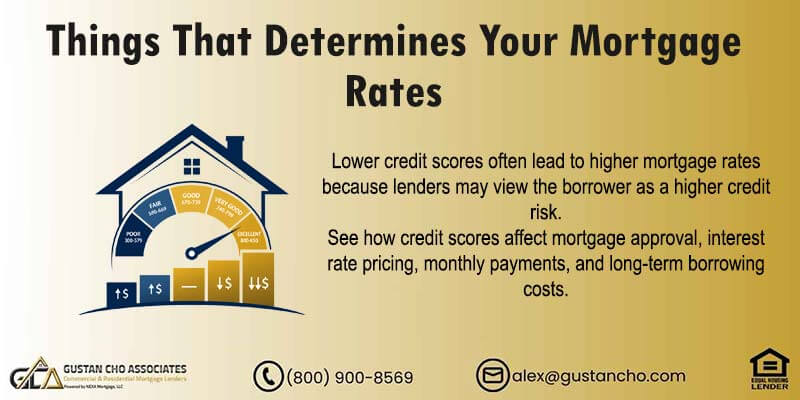
The lower the credit score, the higher the rate. Rates are evaluated by the lender to determine their risk level based on several factors, especially credit scores. Based on the risk factor, the lender will price the rates.
Many borrowers tend to shop mortgage rates from one lender to another. Mortgage rates might not be beneficial if you have less-than-perfect credit.
Or have other factors such as high debt-to-income ratios, self-employed income, open collections, prior bankruptcy, foreclosure, short sale, or prior deed-in-lieu of foreclosure. In the following paragraphs, we will cover things that determines your mortgage rates.
What Are the Things That Determines Your Mortgage Rates

- 760 credit scores – no rate adjustment
- 740 credit scores – 0.25 point rate adjustment
- 720 credit scores – 0.50 point rate adjustment
- 700 credit scores – 1.0 point rate adjustment
- 680 credit scores – 1.75% point rate adjustment
- 660 credit scores – 2.5% point rate adjustment
- 640 credit scores – 3.75% point rate adjustment
- 620 credit scores – 4.5% point rate adjustment
Credit Scores Are Things That Determines Your Mortgage Rates
The bottom line is that the lower your credit scores are, the higher your mortgage rates will be. Credit scores are one of the most looked-at factors when a lender offers you a mortgage rate for your loan approval. A borrower with higher credit scores will get a better mortgage rate for his mortgage loan. Credit Scores Are Things That Determines your mortgage rates on home loans.
What Factors Influence Your Mortgage Rate?
Four primary factors influence mortgage rates: the overall mortgage market, individual financial circumstances, property characteristics, and the selected mortgage type. The market establishes a general price range, while the specific rate offered depends on borrower choices and financial profile.
Two borrowers purchasing homes on the same day may receive different mortgage offers. Lenders may provide varying quotes for identical loans due to differences in pricing structures, costs, and profit requirements.
According to the Consumer Financial Protection Bureau, several variables affect mortgage rates, including credit score, location of the home being financed, home price, loan size, down payment size, loan term, loan type, and whether the loan has a fixed or adjustable rate.
What Factors Influence the Cost of Your Mortgage?
There are two broad categories of factors that influence the cost of a mortgage. The first group includes factors you can’t control, such as market conditions. These are inflation, the bond market, mortgage demand, economic growth, and central bank policies. The second group covers personal and loan-specific factors, like your credit score, loan amount, whether you’re buying a home to live in or as an investment, your down payment, the loan program, and the loan’s cost. Market factors set the starting cost for your loan. Lenders then adjust this cost based on your loan details and application.
Market Factors and the Cost of a Mortgage
Inflation and the Health of the Economy
Inflation is a key factor in mortgage costs. Lenders want to be compensated for the risk that inflation brings. If lenders expect inflation to keep rising, the cost of long-term mortgage bonds also rises. When the economy grows quickly, borrowing usually costs more because more people want credit. If the economy slows or is in a recession, inflation tends to drop, and lenders often choose safer long-term bonds, which can lower interest rates. Economic factors influence the whole mortgage market, but they don’t guarantee that everyone will get the same rate.
Treasury Yields and Mortgage-Backed Securities
Most mortgage loans are sold in the secondary mortgage market and bundled into mortgage-backed securities (MBS). Investors evaluate the potential benefits and risks of MBS against Treasury bonds and other investment options.
Long-term Treasury yields often move in the same direction as mortgage rates, but the link isn’t exact. Factors such as servicing costs, market ups and downs, and prepayment risk also affect the gap between
Treasury yields and mortgage rates. Freddie Mac releases a weekly survey showing average interest rates and points for completed mortgages. These averages give a sense of the overall market, but they aren’t guaranteed offers for any individual borrower.
Does the Federal Reserve Set Mortgage Rates?
The Federal Reserve does not set the interest rate for any one mortgage. The Federal Open Market Committee’s target for the federal funds rate is the most important element in the FOMC’s formulation and implementation of monetary policy.
Changes in monetary policy will affect the general conditions of financial markets, bond yields, the inflation premium, and the cost of money.
Federal Reserve decisions do affect mortgage rates, but a change in the federal funds rate doesn’t always mean 30-year mortgage rates will change the same way. Sometimes, investors expect a rate hike, and long-term mortgage rates might even go down instead.
Quoted a High Mortgage Rate? Get a Second Opinion
Mortgage pricing varies by lender. We’ll review your quote, Loan Estimate, and scenario to see if there may be a better option.12 Borrower and Loan Factors That Determine Your Mortgage Rate
1. Credit Score and Credit History
Credit scoring may be the most significant factor influencing mortgage pricing. Pricing for borrowers with a favorable credit history may be more advantageous, as lenders may view borrowers as a lower risk of default. In addition to credit scoring, lenders may consider
- credit card and mortgage payment history
- payment history, including late payments
- charge-offs and collections
- bank account activity, including bankruptcies and foreclosures
- number and age of credit accounts
- recent requests for credit
Keep in mind that factors such as the loan program, down payment, property, occupancy, loan amount, points, and current market conditions can all affect your rate, even with a strong credit score. Under Fannie Mae’s current loan-level pricing system, credit scoring is one parameter influencing conventional loan pricing. Pricing may also vary based on the loan-to-value ratio and other loan details, so borrowers should not rely solely on a credit score matrix.
2. Down Payment and Loan-to-Value Ratio
The loan-to-value ratio is the mortgage amount divided by the property’s value. A borrower purchasing a $400,000 home and taking out a $360,000 mortgage has a loan-to-value ratio of 90%. A loan-to-value ratio will be higher with a smaller down payment. A borrower with a lower LTV may benefit from pricing, as the lender faces lower risk, since the borrower is more likely to repay the mortgage if they are not in negative equity.
Private Mortgage Insurance vs Down Payment
With a smaller down payment, the borrower may avoid or lower private mortgage insurance. A borrower with a 20% down payment may not be guaranteed the best interest rate. In fact, some lending programs may even offer a higher rate with a lower down payment. When evaluating loan options, it is important to consider all associated costs and trade-offs, rather than focusing solely on the down payment. In some cases, higher upfront payments may result in lower total costs, whereas a smaller down payment could increase overall expenses.
3. Type of Mortgage Program
The different loan programs, such as conventional, FHA, VA, USDA, jumbo, and non-QM, have varying risk and, as such, will have different mortgage costs.
Conventional Loans
Conventional conforming loans are those that can be sold to Fannie Mae and Freddie Mac. As such, they have specific pricing requirements based on borrower characteristics such as credit score and LTV, as well as loan characteristics such as occupancy and property type.
FHA Loans
FHA Loans are private loans underwritten by lenders approved by the Federal Housing Administration (FHA). FHA loans may allow borrowers with lower credit scores to access lower interest rates. However, borrowers need to consider the upfront mortgage insurance premium (MIP) and the annual premium. Even though FHA loans can have lower interest rates, the total cost might be higher once you include mortgage insurance and closing costs.
VA Loans
Veterans and active-duty service members may access VA-guaranteed loans. VA loans may have lower costs due to the absence of monthly mortgage insurance. However, a VA funding fee may be charged unless the borrower has a VA funding fee exemption.
USDA Loans
USDA loans may offer favorable financing for eligible borrowers purchasing eligible properties. USDA loans are subject to borrower income limits, property location, guarantee fees, and lender overlays.
Jumbo and Non-QM Loans
Jumbo loans exceed the conforming loan limits. Non-QM loans are loans that allow less standard forms of income verification, such as personal or business bank statements, 1099 income, profit-and-loss statements, or rental income.
Jumbo and Non-QM loan rates can be higher or lower than conforming loans. The price depends a lot on the lender, investor, loan type, down payment, borrower, collateral, and market conditions.
For most areas of the U.S., the 2026 baseline conforming loan limit for a one-unit property is $832,750; higher limits would apply in high-cost areas.
4. Mortgage Term
This is the period during which a borrower has to repay the loan. The most common mortgage terms are 10, 15, 20, and 30 years. Short-term mortgages usually have lower interest rates for the same loan amount, but monthly payments are higher because the loan is repaid faster.
Lenders may charge a higher interest rate on a 30-year mortgage than on a 15-year mortgage, as the monthly payment for the longer-term mortgage is lower.
Borrowers should consider their individual circumstances and financial obligations to determine the best mortgage term. While monthly payments are higher on shorter-term mortgages, the CFPB says you could save money on interest over time because these loans often have lower rates.
5. Fixed Rate vs. Adjustable Rate Mortgage
With a fixed-rate mortgage, the interest rate remains the same for the entire term of the mortgage. Therefore, monthly principal and interest payments will remain the same, although the total monthly payment may vary due to changes in insurance and taxes. With an adjustable-rate mortgage, the interest rate is fixed for an initial period. After that, the interest rate will change periodically and will be determined by a specific index and a margin. The initial interest rate of this type of loan is typically lower than that of a fixed-rate mortgage, but it will increase after the initial period.
Those Considering an ARM Should Keep in Mind the Following:
- The duration of the initial fixed period
- The adjustment index
- The lender’s margin
- Initial and periodic adjustment caps
- The lifetime rate cap
- The maximum payment
- The expected duration of ownership
- It is important to note that payments may increase after the initial low-rate period concludes.
6. Loan Amount and Conforming Loan Limits
The loan amount can affect pricing. Some lenders might consider small mortgage balances less profitable because certain expenses are incurred during loan origination regardless of loan size.
On the other hand, very large mortgage balances may be considered “jumbo” and would come with separate credit, reserve, appraisal, and down payment requirements.
Loans at the high end of conforming limits and jumbo loans can have very different rates. The same goes for high-balance conforming loans compared to standard ones. It should also be kept in mind that large “jumbo” loans may have very high credit requirements that exceed those of a Conforming loan or a high-balance Conforming loan.
7. Primary Residence, Second Home, or Investment Property
Property usage also influences mortgage rates. Loans for primary residences are generally considered less risky by lenders compared to those for investment properties.
An Investment-Property Borrower Should Analyze the Entire Financing Structure, Including:
- Interest rate
- Discount points
- Down payment
- Reserve requirements
- Prepayment penalties
- Rental income documentation
- Debt-service coverage requirements
- Fannie Mae’s pricing matrix specifies loan purpose, occupancy, product type, and number of units as loan characteristics that affect conventional pricing.
8. Property Type and Number of Units
Pricing may differ if the property is a detached single-family primary residence, a two- to four-unit property, a condominium, a manufactured home, a condotel, a cooperative, or a non-warrantable condominium.
Some property types are harder to sell or carry additional legal, structural, or insurance risks. These factors can mean fewer lenders compete for your loan, which can affect your rate and down payment.
Condo appraisals, along with a review, may also affect the loan structure. If the property appraises lower than expected, the only way to decrease the LTV is to either decrease the loan amount or increase the borrower’s equity by bringing in additional cash to closing.
9. Property Location
Property location can affect the mortgage rate. Factors such as local competition, state regulations, fees, and loan processing times all contribute to rate variations. The CFPB has also listed property location as a consideration, as it can affect the mortgage rate options available to borrowers.
10. Discount Points and Lender Credits
Every quoted mortgage rate comes with a cost. Lenders usually offer different rate options, each with its own cost. Discount points are a way to pay certain fees in exchange for a lower interest rate on a loan. Each point costs 1% of the loan amount, and the cost does not guarantee a specific reduction. The rate difference will depend on the cost and how the lender prices other loans.
On the other hand, lender credits result from accepting a higher interest rate in exchange for a credit toward certain closing costs.
According to the CFPB, points and lender credits allow borrowers to pay costs in different ways. Points, which are an option on the Loan Estimate, must be tied to an interest rate reduction. On the other hand, a lender credit would be offered in conjunction with a higher interest rate because the credit would not be offered otherwise.
Before Paying Points Find Out How Long it Will Take for Break Even Point
Before paying for points, calculate how long it will take to break even. Break-even period = cost of points ÷ value of points. Paying discount points is generally advantageous only if the loan is retained beyond the break-even period. Repaying the loan earlier may negate the anticipated benefits.
11. Rate-Lock Period
A lender can change the mortgage quote until a rate is locked. Standard rate-lock periods are for 15, 30, 45, and 60 days. Longer rate locks can cost more because lenders take on extra risk that market rates might rise. This is common with new builds or delayed closings and may need a special lock.
Most Commonly, Rate Locks on Loans are Honored Through Closing, Provided:
- The lock is not expired on the closing date.
- The loan application does not contain any discrepancies.
- The loan program does not change.
- The property and appraisal are sufficient.
- The borrower continues to qualify.
- The Loan Estimate will indicate whether the rate is locked and specify the lock expiration date.
- Each lender maintains distinct rules and fees regarding rate locks.
12. The Lender’s Pricing and Business Model
Mortgage lenders are not uniform. Even for the same applicant and loan program, lenders may offer different rates.
Disparities May Come from Differences In:
- Relationships with investors
- The value of servicing
- Cost of staff and operations
- Volume of loans
- Required profit margins
- Lender credits
- Coverage areas
- Pricing offered
- Lending model (bank, broker, credit union, correspondent, direct, etc.)
Depending on the loan type, competition may vary. Conventional loans may be offered at better rates from one lender, while another may have better rates on FHA, VA, jumbo, bank statement, or investment property loans. As such, the best way to determine the most competitive rates is to collect multiple Loan Estimates. Relying on advertised or online rates is inferior.
Can Income and Employment Type Influence Mortgage Rates?
How income is documented may affect pricing in alternative-income or non-QM programs. For instance, loans documented through bank statements or a Profit and Loss statement may have different pricing structures than a fully documented loan. Being self-employed will not automatically mean that you will be charged a higher rate when applying for a conventional, FHA, VA, or USDA loan, provided that you meet the normal documentation requirements.
Rental history typically does not have a specific, consistent effect on mortgage rates. It is primarily used to document the history of making housing payments and to assess whether the borrower fulfills the underwriting criteria.
It should not be asserted in this article that a borrower will always be assigned a higher rate in the absence of rental history. This will rely on the mortgage product, the lender, the underwriting process, and the completed application. Rental history will not be a universal pricing characteristic under the CFPB’s consumer rate framework or in Fannie Mae’s current LLPA matrix. If you pay rent, keep a clear record of your payments.
Why Is There a Difference Between Rate Quoted and Advertised Rates?
Typically, Advertised Mortgage Rates are Built on a Sample Transaction from Which the Advertisement Assumes a Certain:
- Credit score
- Loan amount
- Property type
- Loan term
- Occupancy
- Debt profile
- Rate lock
- Location, among others
- Traditionally, closing costs increase because advertised rates are quoted assuming points.
- The CFPB rate-exploration tool uses defined assumptions of the elements mentioned above.
- The rate and total loan cost are significantly impacted by those assumptions.
- When receiving a rate quote, you should ask whether the rate is locked, how many points there are, for how long, and whether the quote reflects your credit, loan amount, property, occupancy, and down payment.
- After a Loan Estimate, the rates and costs may also change.
A Revised Offer May Be Issued if Any of the Following Occur:
- Changes in credit score
- The appraised value is not as high as expected
- There is a change in the down payment
- There is a change in the loan amount
- The borrower changes programs
- There is a change in the type of property or the type of occupancy
- There is a change in the borrower’s documented income
- The interest rate lock expires
- The closing date changes
- There is a requested change in the rate and points from the borrower
- The CFPB says a revised Loan Estimate may be issued if documented income or credit score changes, the appraisal or the down payment changes, the type of loan changes, or the rate lock status changes.
- Do not open or close credit accounts, make large purchases, or increase credit card balances, change jobs, or move documented income before consulting with your loan officer.
How to Get a Lower Mortgage Rate
- Check your credit before applying
- It may help to check your credit early to pay down any balances or correct any mistakes you made.
- Be aware that the credit score some lenders may give may be different from the credit score you see when using credit monitoring services.
- Do not open disputes on accounts simply to boost your score if you do not have any other inaccuracies.
- Open disputes on your accounts may increase processing time during loan underwriting.
Have Loan Estimates from Multiple Lenders
- Have bids from multiple lenders on the same type of loan with the same down payment, occupancy, and interest rate lock for the same length of time.
- It is unfair to compare mortgage quotes from different days (like Monday to Friday) since mortgage rates can change daily.
- The CFPB recommends that potential borrowers compare multiple offers made on the same day to obtain a more accurate comparison.
- Mortgages can be more expensive even if they advertise the lowest interest rates.
- The reverse is also true.
- Flexible rates can also change the everyday cost of the mortgage.
When Choosing Among Mortgage Offers, Make Sure to Account for the Following Factors:
- Interest Rate
- APR (Annual Percentage Rate)
- Discount Points
- Lender Credits
- Origination Charges
- Monthly Principal and Interest
- Mortgage Insurance
- Cash You’ll Need at Closing
- Cost of Borrowing over Five Years
- Rate Lock Expiration
- Break-Even Period
- When considering the costs associated with different mortgage offers, the break-even period is important and should be calculated.
Mortgage Offers Can Show Different Costs Associated with Discount Points
Offer Three Different Costs, Including:
- No discount points
- Discount points (thus, a lower interest rate)
- Lender credits (thus, a higher interest rate)
- Calculate how the offer costs will break even, and compare offers.
- Avoid expenses that could lower your credit score or overall credit profile.
- Maintaining financial stability increases your likelihood of mortgage approval.
Mortgage Rate Versus APR
The Annual Percentage Rate (APR) provides a more comprehensive breakdown of a loan’s cost. Interest costs and other fees associated with the loan make up the APR, so it is typically higher than the interest cost alone.
The interest rate can be found on page one of the Loan Estimate, in the Loan Terms section. APR can be found on page three in the Comparisons section.
While APR is a helpful tool for assessing the cost of different loans with the same interest rate, it should not be used in isolation. If the loan is not held for the full term, the borrower forfeits the cost of the points and the other fees. A small difference in interest rates can make a large difference in a mortgage’s monthly payment.
Consider a Borrower Who Has a 30-Year Fixed Mortgage for $350,000.
- The monthly principal and interest payment will be approximately $2,212 with a 30-year fixed mortgage at an illustrative interest rate of 6.50%.
- The monthly principal and interest payment will be approximately $2,270 with a 30-year fixed mortgage at an illustrative interest rate of 6.75%.
- The difference in payment is $58, which amounts to $20,828 over 30 years.
- It is important to compare different rate options.
- However, sometimes the cost associated with lowering the interest rate with points is not worth it.
How To Correctly Compare Mortgage Offers
Instead of relying on verbal quotes or online ads, ask for official loan estimates.
When Comparing Mortgage Offers, Ensure All Offers are Made on the Same Day and Compare the Same:
- Loan program
- Loan amount
- Down payment
- Property type
- Occupancy
- Loan term
- Rate-lock period
- Discount-point structure
Check page 1 of the Loan Estimate for the interest rate, the monthly payment for principal and interest, the projected payment, and the rate-lock status. Check page 2 for the origination charge, points, lender credits, and closing costs. Check page 3 for the APR and the 5-year cost. Interest rates are only one part of the overall mortgage. The offer you should accept is the one that provides the best overall balance of payments, costs, loan structure, and long-term considerations.
What Is Rental Verification
Rental verification is one of the most important factors in the mortgage approval process. However, the only way to use rental verification is by providing proof of canceled checks for the past 12 months of rental payments. If you have paid your landlord cash, it does not count. It needs to be a bank check or other forms of proof like copies of cashier’s checks, money orders, or bank wires. Cash paid receipt from your landlord or a letter from your lender does not count as rental verification. If the property you are renting is managed by a licensed professional management company, a letter from the property management company can be used as rental verification. Depending on the lender, there may be a pricing adjustment on rental verification.
How Low Payment Shock is a Compensating Factor
Those without rental verification might be paying higher mortgage rates than those with rental verification. Also, the debt-to-income ratio for borrowers with no rental verification can be lowered by more than 5% than those with rental verification.
Another factor lenders consider with those without rental verification: they are concerned about the borrower’s payment shock. This is where they go from zero rent to a new mortgage payment.
Many lenders will require rental verification to approve the borrower for manual underwriting on VA and FHA loans. If you are a renter and are planning on purchasing a new home in the future, make sure you pay your monthly rent by check and be able to provide 12 consecutive months of canceled checks. Low payment shock is a compensating factor.
High Loan-to-Value and Jumbo Loans
Things that determines your mortgage rates are credit scores and several other factors—jumbo loans in one of the things that determines your mortgage rates. Mortgage rates for Jumbo and Portfolio loans, such as condotel mortgage loans, will normally be higher than regular conventional mortgage rates. The things that determines your mortgage rates are the higher your loan-to-value is, the higher your mortgage rates will be. There is a big mortgage rate gap between an 80% loan-to-value mortgage loan and a 50% loan-to-value mortgage loan.
The Final Thoughts on Interest Rates
There are quite a few factors that influence the rates you are offered for a mortgage, such as the credit score, down payment, and loan-to-value ratio, the loan program, mortgage terms, fixed vs. adjustable rate, the property, and the Loan Amount.
You can control your credit profile, the balance of your revolving credit, the amount of your down payment, and the selection of your loan program, among others.
You can’t control inflation, Treasury yields, demand for mortgage-backed securities, and the bond market. Never take a mortgage just because of a rate you have seen advertised. Instead, get a written Loan Estimate and compare the rate, APR, points, lender credits, mortgage insurance, monthly payment, cash at closing, and the five-year cost.
Speak With a Mortgage Professional About Your Available Rates
Gustan Cho Associates helps borrowers nationwide, including those with low credit scores or high DTI ratios, those with bankruptcies or foreclosures, self-employed individuals, and other complex cases.
Someone may be unable to get a loan from one lender but can likely still get one from another in the same general loan program due to differing requirements and overlays.
For a more personalized assessment of your loan options, please call or text us at 800-900-8569 to reach a licensed loan officer. Mortgages have many variables that can change, including interest rates, costs, programs, and borrower eligibility. Not all borrowers will be eligible for a mortgage. To give a borrower an estimate of rates, a lender will need to assess the borrower’s application, credit, the property, the loan, and occupancy, as well as transfer program details and lock duration.
Frequently Asked Questions About What Determines Mortgage Rates
What Credit Score is Needed to Receive the Best Mortgage Rate?
No credit score guarantees a borrower the best mortgage rate. The borrower’s credit score will affect the lender’s loan pricing, but there are many other factors. These include the loan amount, type, and terms; property details and occupancy; and the borrower’s credit score and market conditions. For an accurate quote, borrowers should seek personalized loan pricing rather than relying on score-based pricing charts.
Does a Mortgage Preapproval Lock the Interest Rate?
No, a mortgage preapproval will not lock a borrower’s interest rate. The lender must agree to the rate lock’s terms and conditions for the rate to be considered locked. The lender will have to specify the interest rate, the number of points or lender credits, their expiration, and any other conditions. A borrower can verify a rate lock in the lender’s Loan Estimate.
Do Mortgage Rates Change on the Weekend?
Most changes in mortgage pricing happen during weekday trading hours. A lender may keep Friday’s pricing valid throughout the weekend, suspend pricing locks, or change pricing based on market conditions or company policy. Borrowers should assume any quote made during the weekend is only a temporary offer.
Can a Lender Change My Rate After I Lock It?
A rate lock should prevent a lender from changing the rate unless there are changes to the loan application; it should also prevent the lender from changing the rate if there are no changes to the loan details. There are a number of factors that could allow the lender to adjust pricing, including changes to the credit score, the loan amount, the appraisal, or the type of property.
Can I Negotiate My Interest Rate?
A borrower may ask a lender to lower the rate, reduce Lender fees, match a competing Loan Estimate, or provide a more favorable rate-cost tradeoff. A lender is free to refuse the request; however, competing written offers may induce a borrower to weigh the offers more carefully.
Will Paying Off Debt Lower My Mortgage Rate?
Paying off certain types of debt may help improve your credit score and pricing, but it may also help lower your DTI and improve your ability to qualify for a loan. However, paying off debt does not guarantee a lower rate and may not be worth the cost of closing the mortgage. Borrowers should always consult their loan officer before using funds for debt to avoid losing their mortgage.
Is the 15-Year Mortgage Rate Less Than the 30-Year Mortgage Rate?
A 15-year fixed mortgage tends to have a lower interest rate than a 30-year fixed mortgage of the same type, and the 15-year monthly payment will be higher because the mortgage is paid off in 15 years. Though fixed mortgage rates tend to follow that logic, be aware that pricing varies across lenders and markets. Therefore, borrowers should get written mortgage rate offers for both the 15-year and 30-year terms and compare those.
Should I Pay Discount Points or Accept a Higher Rate?
It depends on the cost paid (the discount points), the savings, the cost of the mortgage, and the length of time the borrower expects to hold the mortgage. If the cost (the discount points) paid is less than the mortgage savings, the discount points should be paid, and a higher mortgage rate should be accepted, if the borrower is expected to hold the mortgage for a lengthy term with a lower break-even time and a cash priority.
Related> What Happens If Scores Drop During Mortgage Process