Getting the lowest mortgage rate is not just about calling lenders and asking for today’s rate. The best mortgage pricing usually goes to borrowers with stronger credit, lower debt, stable income, and the right loan setup. If you want a lower rate, the smartest move is to improve the parts of your profile lenders use to price risk. In this guide, you will learn how to get the lowest mortgage rates, save money over time, and avoid common mistakes when comparing lenders.
How to Get the Lowest Mortgage Rates
Landing the lowest mortgage rate can save you a small fortune. Because rates rise and fall with the economy, knowing how to tune up your finances and talk to lenders matters. This simple guide walks you through tried-and-true tips to grab the best rate, whether buying your first house or refinancing the one you already own. From boosting your credit score to comparing multiple lenders, you’ll find easy steps that cut your rate and save you money.
Why Mortgage Rates Matter
The interest rate on your mortgage shapes your monthly bill and the overall cost of borrowing money to buy a house. A half-point change in that rate can add or save thousands over a thirty-year loan. Picture this: a $300,000 mortgage at 7% will cost far more in interest than the same loan at 6.5%. That smaller rate slice could mean more than $30,000 in your pocket by the finish line. On top of that, a lower rate stretches your budget, making a bigger house seem doable today instead of later. As we look toward 2026, Fed moves, inflation, and housing patterns will likely push rates up and down again, so shoppers who lock in early often win.
Key Factors That Affect Mortgage Rates
Several factors affect the mortgage rate you are offered. The biggest ones are your credit score, how much you put down, how much debt you carry relative to your income, the type of loan you choose, and whether the home will be your primary residence, a second home, or an investment property.
In simple terms, lenders usually offer better rates to borrowers who look less risky on paper. You may also hear mortgage terms like loan-to-value ratio, which compares your loan amount to the home’s value, and debt-to-income ratio, which compares your monthly debts to your monthly income.
These numbers help lenders assess the loan’s risk. Some loans also come with pricing adjustments based on credit score, down payment, property type, or cash-out features. The main point to remember, especially when considering how to get the lowest mortgage rates, is that having stronger financials and a lower-risk loan structure typically results in better mortgage pricing.
Proven Strategies to Get the Lowest Mortgage Rates
If you’re ready to buy a home, these simple steps will help you snag the lowest mortgage rates, whether it’s your first purchase or you already own a house.
How to Get the Lowest Mortgage Rates: Boost Your Credit Score
Your credit score is a leading factor lenders look at when setting your mortgage rate. People with a score around 740 or above usually see the best deals. A higher score tells banks you are less risky, so they may cut or drop those extra fees called LLPAs.
To lift Your Score:
- Pay down pricey debts like credit cards so your credit utilization number looks healthy.
- Always pay bills on time.
- That record is the biggest part of your score.
- Order a free credit report at AnnualCreditReport.com and fix any errors you find.
- Wait to open new credit cards or shut old ones until after you get the loan, since those moves can damage your score.
- Set your sights on at least 740.
- Nudging your score from 680 to 700 can trim LLPAs and mil-rate costs.
Increase Your Down Payment
- The bigger your down payment, the lower your loan-to-value (LTV) ratio.
- LTV is just the loan amount divided by what the home is worth.
- A smaller LTV tells lenders you have more equity up front, which makes them feel safer and can earn you a lower interest rate.
- For instance, a 20 percent down payment on a $400,000 house reduces the LTV from 95 percent to 80 percent.
- That change may let you skip costly private mortgage insurance and cut extra loan-level pricing adjustments.
If you want a bigger down payment:
- Set up a separate savings account and add to it each month, even if the amount feels small.
- Look into state or local programs that give first-time buyers grants or second mortgages for the down payment.
- Ask family members if they can gift you money; many lenders accept this as long as it is well documented.
A 20 percent down payment is the gold standard, but putting down even 10 percent can still improve the rate you get.
How to Get the Best Mortgage Rates – Several Questions and Answers
A lender sets mortgage rates for the mortgage on a housing loan. This mortgage now attracts charges that will impact the entire mortgage cost. Some of the determinants are:
Market Demand
- The supply and demand of mortgages in the housing market.
- Personal Finances include a borrower’s score, debt-to-income ratio, and financial history.
- Knowing these factors allows one to stay ahead of the curve regarding rate changes and terms.
How Does Credit Score Affect My Mortgage Rate?
One of the most important factors that affect your mortgage rate is your credit score. Each lender rates it very differently before providing margin money. Here is how it works.
Excellent Rating (750+) – The lowest rates in the market are available.
- Good Rating (700 – 749) – Rates are slightly higher than competitive rates.
- Fair Rating (650 – 699) – Substantially higher rates and tougher conditions.
- Poor Rating (<650) – The most expensive rates with limited options.
Tip: To raise your score, pay off debts, avoid late payments, and dispute inaccuracies in your credit report.
What Are Fixed And Variable Mortgage Rates? Which Is Better?
Two types of mortgage rates are the main focus:
Fixed-Rate Mortgages
- A fixed interest rate throughout the life of the loan.
- Great for someone looking to own a property for a longer time.
Variable-Rate Mortgages (ARMs)
- These start with lower initial rates but increase based on market conditions.
- They are most suited for short-term buyers or those expecting their income to increase.
The decision will differ depending on how long you want to live in the home and your financial objectives.
What Can I Do to Secure a Lower Mortgage Rate?
Learn what you can do to get better rates on mortgages: Compare Rates
- Check offers from lenders, online sites, banks, and credit unions.
- Check your credit score
- Decrease your expenses and keep a balanced credit utilization ratio.
Make a Bigger Down Payment
This reduces the risk so that you will receive a loan at a better rate.
- Select a shorter loan period.You will find better interest rates on 15-year loans than on 30-year ones.
- Watch the market trends: It’s important to trust the lenders when locking in rates; they want their rates to be competitive, so they will lower them when market trends are bad.
Are There Any Programs For the Government That Offer Lower Mortgage Rates?
Indeed, there are government programs that aid in acquiring a low rate:
- FHA loans: Designed for novice homebuyers and those with less credit.
- VA Loans: Done for active military members and veterans with no PMI and affordable rates.
- USDA Loans: Created for specific suburban or rural areas, with lower rates and better terms.
Always investigate what benefits the program offers and the eligibility you need to meet the requirements.
How Do Mortgage Rates Relate To Market Trends?
In essence, the state of the economy is the fundamental driver of the fluctuation of rates. For instance, below:
- Increase In Inflation: This leads to lenders increasing mortgage rates to accommodate reduced spending ability.
- Economic Slumps: Economic slumps typically lead to decreased rates as the central banks try to revive the economy.
- Housing Interest: An increase in buyer activity may increase rates, albeit temporarily.
Stay up to date and follow market reports so that you can ask an expert when to take a loan.
Is There A Good Period When One Can Fix A Mortgage Rate?
Being able to anticipate when to apply the rate lock is very advantageous.
- Lock When Necessary: This helps if you suspect rates will rise shortly.
- Keep An Eye On The Market: Significant changes in employment reports and inflation data may indicate future rate fluctuations.
- Restrict Rate Locking Changes: Locking your rate at a point too close to the closing period might shield the borrower from rate hikes.
Most lenders accept rate locks within 30 to 60 days, enabling the borrower to have leeway when purchasing a home.
How to Get the Lowest Mortgage Rates: Lower Your Debt-to-Income Ratio
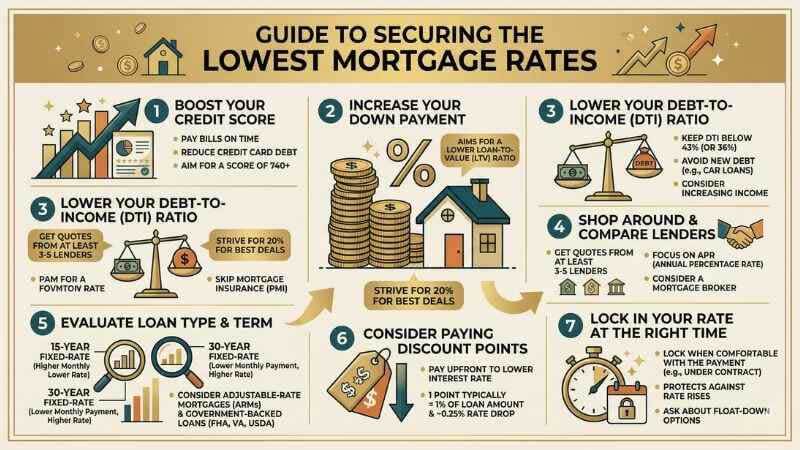
Your debt-to-income (DTI) ratio looks at all your monthly bills compared to your monthly pay. Lenders usually want your DTI below 43 percent; if it sits around 36 percent or lower, they may offer you sweeter terms. To trim your DTI:
- Focus first on high-interest debt, such as credit cards or personal loans.
- Paying these off cuts the balance and the interest you lose each month.
- Hold off on new obligations like car loans or new store cards once you start house shopping, since every added payment raises the DTI you report to lenders.
- Boost your monthly pay with a side job, or ask for that overdue raise, and watch your debt-to-income (DTI) ratio improve.
- A cleaner DTI signals to lenders that you handle money well, so they trim the risk-based fees they would have charged.
Is It Possible To Change Mortgage Rate With Lenders?
Of course! Here are ways to achieve this:
- Be Informed: Have quotations from different lenders ready to use when needed.
- Make Your Case: Strongly emphasize your credit score, income, and down payment.
- Ask to Match: When one lender offers better conditions, ask the rest to match or improve the terms offered.
Borrowers have a lot of leeway in negotiation, so go ahead and do it. Broadening one’s negotiation scope greatly can yield big savings.
What Mistakes Ought One Avoid While Sourcing Mortgage Rates?
- Failure to Compare: You may pay more if you do not check with various lenders.
- Closing Costs: A very low interest rate could lead you to mask other costs, hurting you instead.
- Ignoring Credit Scores: Not taking stock of your credit status can land you in trouble.
- Rate Lock: Delaying locking it may leave you vulnerable to rising rates.
Tip: During the mortgage process, remain informed and active to avoid unnecessary headaches.
Lowest Mortgage Rates Start With Smart Planning
Learn how small moves—like paying down debt or changing loan terms—can lead to big savings.Shop Around and Compare Lenders
- Mortgage rates can vary widely from one lender to the next, even for people whose credit scores and incomes appear almost identical.
- Thanks to websites and helpful brokers, tracking those differences will take only a few clicks.
To Hunt Down the Best Deal:
- Ask three to five lenders, banks, credit unions, and online lenders for fresh rate quotes.
- Check the annual percentage rate (APR), which bundles interest and upfront fees.
- Partner with a mortgage broker who is handy with many lenders and skilled at negotiating.
- Inquire about lender credits.
- Some companies waive fees or trim rates to win your business.
- All that legwork can shave 0.25 percent to 0.5 percent off your rate, a change that can save you thousands over the life of the loan.
Weigh Your Loan Type and Term
Consider the type of loan and its term carefully when thinking about how to get the lowest mortgage rates. Fixed-rate mortgages offer consistent payments throughout the loan’s duration. In contrast, adjustable-rate mortgages (ARMs) may have lower initial rates that can increase over time. Generally, 15-year loans offer better rates than 30-year options, though monthly payments will be higher.
To Find the Choice That Fits You Best:
- Choose a fixed-rate loan if you want sure payments, especially when today’s rates could rise higher.
- Look at an ARM only if you plan to sell or refinance in a few years, and be ready for a possible rate jump.
- Ask about government-backed loans such as FHA, VA, or USDA.
- These can offer better deals to higher-risk borrowers.
- VA loans, for instance, often have lower rates and skip PMI for eligible veterans, while FHA loans are aimed at buyers with modest credit scores.
Consider Paying for Discount Points
- If you want to immediately bring your mortgage rate down, paying for discount points is one option.
- Each point usually costs 1% of your total loan amount and knocks about 0.25% off the interest rate.
- On a $300,000 mortgage, stumping up $3,000 could save you hundreds over the life of the loan.
- That payoff works best when you plan to stay in the house for many years.
- Before you decide, run the math to see how long those savings take to cover the fee and ensure the deal clicks for you.
Lock in Your Rate at the Right Time
- Mortgage rates bounce around daily because of big-picture inflation and Federal Reserve policy.
- A rate lock holds your chosen number for a limited period, often 30 to 60 days, while the lender finishes underwriting.
- Watch market trends through sites like Freddie Mac’s weekly survey or everyday financial news to make the most of that hold.
- Talk to your loan officer about grabbing the lock on a brief dip, especially during wild swings.
- You might also ask for a float-down option, which lets you snag a lower rate if it drops again before closing.
- Good timing here can save thousands over the life of the loan.
Dodge Risk-Based Adjustments (LLPAs)
- Loan-Level Price Adjustments, or LLPAs, can quietly add to your rate when lenders see red flags.
- A low credit score, a high loan-to-value (LTV) or debt-to-income (DTI) ratio, financing an investment property, or pulling cash out can all trigger a surcharge.
To head off these hits:
- As mentioned, lift your credit score and save a bigger down payment.
- Buy a house you plan to live in, not a vacation or rental spot.
- Skip cash-out refinances.
- They usually get pricier adjustments.
- Ask your lender about potential LLPA waivers, especially the ones set for first-time buyers.
- Knowing and fixing LLPA triggers can greatly impact your final rate.
Extra Tips for First-Time Homebuyers
Brand-new buyers often juggle a tighter budget, yet they still have chances to land lower rates. Look into state and local programs that offer below-market interest rates or help with the down payment. FHA loans, for instance, are kinder to folks with modest credit or smaller savings. You might also team up with a HUD-approved housing counselor to map out the journey and spot ways to save on your rate.
The Role of Economic Conditions
Mortgage rates will still ride the ups and downs of inflation, Federal Reserve moves, and the mood of the housing market. The Federal Housing Finance Agency (FHFA) closely monitors conforming loans so Fannie Mae and Freddie Mac don’t jitter and cause wider chaos. Because of that oversight, knowing how the economy behaves can signal when it’s smart to push the apply button or lock in your rate.
Picture This:
If inflation finally eases, rates might settle or even slip, offering a cheaper borrowing cost.
Common Mistakes to Avoid
To score the lowest mortgage rate possible, dodge these common blunders:
- Skipping a look at your credit report lets hidden errors sneak up on you.
- Getting quotes from just one lender shuts the door on better deals.
- Racking up a new car loan or credit card debt raises your debt-to-income ratio.
- Overlooking closing costs wipes out the savings you thought you earned with a lower rate.
- Letting your rate float instead of locking opens you to sudden market swings.
Take Action to Lock In the Lowest Rates
Getting ready now pays off if you want the cheapest mortgage rate. Start by boosting your credit score, saving a bigger down payment, and trimming your debt-to-income ratio. Then, shop different lenders, ask about all loan types, and think about buying discount points if you plan to stay in the home for a long time. Keep an eye on financial news to know when rates dip and lock yours in before they bounce back. Following these steps can cut your monthly payment and make owning a house feel doable. For up-to-date numbers and tips, visit Fannie Mae, Freddie Mac, or the Consumer Financial Protection Bureau. Ready to move? Check your credit and reach out to three lenders this week.
How to Get the Lowest Mortgage Rates: Variable Factors Affect Rates
Mortgage rates aren’t uniform for everyone. The rate available to one borrower may differ from that of another, depending on factors such as credit score, down payment, loan type, property use, and the lock period. This is why understanding how to get the lowest mortgage rates requires a quote tailored to your specific financial profile and loan objectives.
For example, a borrower buying a primary home with strong credit and a larger down payment may qualify for better pricing than someone with lower credit, less money down, or a cash-out refinance.
The key takeaway is that the lowest mortgage rate is usually tied to both your borrower profile and the loan structure. When comparing lenders, do not focus only on the advertised rate. Ask whether the quote includes points, lender fees, and the same lock period. Two lenders may show different numbers at first glance, but the full cost of the loan is what matters most.
How to Get the Lowest Mortgage Rates: Shopping Rates with Different Lenders
Further, consumers must know that mortgage companies price their loans based on the same indices. That means one lender can’t have a 30-year rate at 2.50% and everyone else is at 3.50%. For a conventional loan underwritten to Fannie Mae guidelines, the specific index is a mortgage bond traded by investors daily. If there is a sizable variance at one lender compared to others, there’s something not quite right. Even hybrid loans from different mortgage companies share the same index.
Case Scenario Example on How to Get the Lowest Mortgage Rates Home Loans
For instance, a borrower with a 660-credit score, elevated credit card balances, and a minimal down payment could be offered a higher mortgage rate compared to a borrower with a 720 score, reduced monthly debt, and a larger down payment. Understanding how to get the lowest mortgage rates involves strategies such as paying down balances, steering clear of new debt, and enhancing credit before applying. By doing so, the first borrower could secure better pricing and lower monthly payments.
Bankruptcy and Housing Events Do Not Impact the Ability How to Get the Lowest Mortgage Rates for Home Loans
Also, John had to file for bankruptcy 5 years ago, which remains on his credit report. John has also read in the newspaper that home values in his area have remained stagnant. Due to his credit issues and perceived stagnant home values, John didn’t think refinancing was an option, so he had not entertained it earlier. A few Google searches on “refinancing after a bankruptcy” have brightened his hopes, and he is desperate for a solution to his problems. John is a proud man who has worked hard and doesn’t like to complain about his problems, much less share them with a stranger.
Someone rarely reaches out to refinance to get a lower interest rate and pay off a few bills. Someone usually reaches out to refinance because they have a pain point that needs to be addressed.
At the surface, this is a normal American man with a wife, some kids, a job, and a mortgage. John says he is interested in paying off some credit card debt and maybe lowering his monthly payments, a common reason to refinance. Beneath the surface, what is the real reason why John has reached out to you? What are John and his wife discussing in private? What is their “pillow talk”? John has a talented and hard-working child who may be unable to attend his dream high school. John’s wife is so stressed out about it that John is worried about her health as well as the overall status of his marriage. Now these are real problems. Pain is a strong motivator to act.
Final Thoughts on How to Get the Lowest Mortgage Rates
To understand how to get the lowest mortgage rates, it’s essential for borrowers to prepare before applying. Enhancing your credit score, reducing monthly debt, increasing your down payment savings, comparing various lenders, and selecting the appropriate loan structure can significantly impact your mortgage rate and overall borrowing costs. It’s really important to look at the whole loan situation instead of just zeroing in on the interest rate. This way, you can find the option that best fits your budget and goals. If you’re planning to buy a home or refinance, begin by assessing your credit, debt, and down payment strategy before requesting quotes. A bit of preparation upfront can enhance your pricing and empower you to make a more confident mortgage decision.
Frequently Asked Questions About How to Get the Lowest Mortgage Rates:
How to Get the Lowest Mortgage Rates?
The biggest things that help are a stronger credit score, lower monthly debt, a larger down payment, and shopping with multiple lenders. Your loan type, occupancy, and whether you pay points can also affect your rate.
Does Shopping for Mortgage Rates Hurt Your Credit?
Usually, not in a major way if you do it correctly. Credit scoring models often treat multiple mortgage inquiries made within a short shopping window as a single inquiry, which is why borrowers are commonly advised to compare lenders within about 14 to 45 days.
Should I Compare the Interest Rate or the APR?
When you’re comparing loans, really focus on the APR. The interest rate tells you how much borrowing will cost, but the APR covers that plus any points, fees, and other charges. Just because a loan has a lower rate doesn’t mean it’s the better deal overall.
Do Discount Points Help Lower Mortgage Rates?
Yes, discount points can lower your mortgage rate, but they cost money upfront. One point usually equals 1% of the loan amount, so whether points make sense depends on how long you expect to keep the loan.
When Should I Lock My Mortgage Rate?
You usually lock your rate once you have a property under contract and are comfortable with the payment. A rate lock protects you if rates rise before closing, and many locks last about 30 to 60 days, though terms vary by lender.
How Many Mortgage Lenders Should I Compare?
A good rule is to compare at least three lenders. Reviewing multiple Loan Estimates can help you spot differences in rates, points, lender fees, and total loan cost instead of focusing on one headline number.
This Guide About “How to Get the Lowest Mortgage Rates on Home Loans” was updated on June 29, 2026.