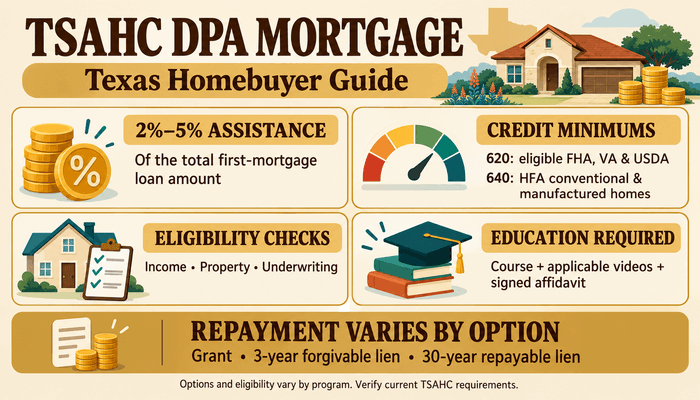
A TSAHC DPA mortgage can help eligible Texas homebuyers pay their down payment and allowable closing costs. Assistance ranges from 2% to 5% of the total first-mortgage loan amount, depending on the selected option. Approval depends on credit, income, property eligibility, and underwriting requirements. Whether the assistance must be repaid depends on its structure and program conditions.
What Is the TSAHC DPA Mortgage Program?
The Texas State Affordable Housing Corporation, or TSAHC, administers the assistance programs. A participating lender handles your mortgage application, reviews the first mortgage and assistance together, and reserves the selected option.
At closing, the lender funds the approved assistance, which is applied to eligible purchase costs through the closing transaction.
How Much Down Payment Assistance Does TSAHC Offer?
TSAHC currently offers assistance equal to:
- 2% of the total loan amount
- 3% of the total loan amount
- 4% of the total loan amount
- 5% of the total loan amount
The amount is based on the first-mortgage loan amount, not the purchase price.
For example, if the first mortgage is $300,000 and the borrower selects 4% assistance, the DPA amount would be $12,000.
Cash-to-close illustration: If your eligible purchase costs are $18,000 before any help, and you get $12,000 in down payment assistance, you would still need to cover the remaining $6,000 with your own funds or credits allowed by your mortgage program.
The amount you need to bring to closing depends on the costs of your transaction, any deposits you’ve already paid, available credits, and any required contribution from you. Getting 4% assistance does not always cover every expense when buying a home.
The Assistance Level Can Affect Mortgage Pricing
Interest rates and loan terms can vary with the assistance option selected. Ask your lender to compare available options for the same purchase scenario, including:
- Cash needed: How much you must provide after assistance, deposits, and permitted credits.
- Monthly payment: The full housing payment at the offered interest rate.
- Fees: The upfront charges associated with each option.
- Repayment obligations: What assistance could become repayable if you sell or refinance.
TSAHC Down Payment Assistance Options
A TSAHC DPA mortgage may include a grant, a three-year forgivable second lien, or a 30-year repayable second lien. Available options depend on the first-mortgage program and whether the transaction uses Bond or Non-Bond financing.
DPA Grant
The grant is available with eligible government loans, not TSAHC’s HFA conventional loans. It does not create a second mortgage lien.
Refinancing or paying off the first mortgage within the first six months after closing can trigger grant repayment. Review the grant terms before planning a refinance.
Three-Year Forgivable Second Lien
This assistance has 0% interest and no monthly payments. It is forgiven in full on the third anniversary of the note when program conditions are met.
The full balance becomes repayable before forgiveness if the borrower sells, transfers, refinances, pays off the first mortgage, stops occupying the home as a primary residence, or triggers another default.
30-Year Repayable Second Lien
This option is available with eligible FHA, VA, and USDA loans through Bond DPA. Assistance may be 4% or 5% of the total loan amount when available.
The second lien has 0% interest and no monthly payments, but it is not forgiven. The balance becomes due at maturity or earlier following a sale, transfer, refinance, first-mortgage payoff, loss of primary-residence occupancy, or another repayment event.
TSAHC Non-Bond DPA Versus Bond DPA
TSAHC offers both Non-Bond and Bond program structures.
The difference matters because the programs can have different eligibility, first-time-homebuyer, purchase-price, and Mortgage Credit Certificate requirements.
Non-Bond DPA
Non-Bond DPA is commonly used when the borrower wants down payment assistance without combining the transaction with a bond-funded mortgage structure.
For a Non-Bond DPA without an MCC, first-time homebuyer status is generally not required.
TSAHC also does not impose a separate purchase-price limit on stand-alone Non-Bond DPA without an MCC, although the underlying mortgage program still has its own loan and property requirements.
Bond DPA
Bond DPA uses mortgage revenue bond funding and includes additional program rules.
First-time-homebuyer requirements generally apply, subject to eligible exceptions, such as those for qualified veterans or certain targeted-area transactions.
Bond transactions can also be subject to TSAHC purchase-price limits and potential federal recapture-tax rules.
Bond DPA and MCC Transactions
Bond DPA and MCC eligibility use a broader family-income calculation than the mortgage qualification does.
For married borrowers, both spouses’ gross income must be counted, including a non-purchasing spouse who is not on title. The lender also reviews income from people listed on the deed of trust and applies TSAHC’s occupancy rules.
Program income may include overtime, bonuses, part-time earnings, and net rental income, even when those amounts are not used to qualify for the first mortgage.
Disclose all relevant income before the lender selects the program. Include your spouse’s income and identify who will live in the home or hold an ownership interest so the lender can determine whose income counts.
Homes for Texas Heroes Home Loan Program
The Homes for Texas Heroes Home Loan Program is designed for eligible Texas professionals and veterans.
Qualified borrowers may be able to use TSAHC down payment assistance with an eligible FHA, VA, USDA, or conventional mortgage.
Who Qualifies as a Texas Hero?
Homes for Texas Heroes includes eligible full-time workers in these categories:
- Public K–12 educators: Classroom teachers, teacher aides, school librarians, school counselors, and school nurses.
- Nursing and allied-health faculty members.
- Firefighters and emergency medical services personnel.
- Peace officers, public security officers, and county jailers.
- Corrections officers and juvenile corrections officers: Including qualifying TDCJ and Texas Juvenile Justice Department employees.
Qualifying veterans and active-duty military applicants may also be eligible under TSAHC’s military and residency requirements.
A job title alone does not establish eligibility. Review TSAHC’s occupation and military definitions, and have the lender document the applicable employment or military qualifications.
First-Time Homebuyer Status Is Not Always Required
For Home Sweet Texas, the requirement depends on the selected assistance structure; see “Do You Have to Be a First-Time Homebuyer for TSAHC DPA?” for the applicable rules.
TSAHC Credit Score Requirements
TSAHC’s minimum representative credit scores are:
- FHA, VA, and USDA: 620 for eligible transactions.
- HFA conventional loans: 640.
- Eligible manufactured-home transactions: 640.
Government loans with representative credit scores from 620 through 639 are subject to a 0.25% origination charge.
Meeting the minimum score does not ensure approval. The borrower must also fulfill the underwriting requirements of the chosen mortgage program.
Buying Your First Home in Texas? Start With a DPA Plan
We’ll help you understand TSAHC eligibility, homebuyer education, income requirements, credit guidelines, cash-to-close, and how assistance works with your mortgage.TSAHC Debt-to-Income and Manual Underwriting Rules
For loans that receive an acceptable automated underwriting recommendation, the allowable debt-to-income ratio depends on the first-mortgage program, the AUS findings, and applicable TSAHC requirements.
FHA Manual Underwriting
Eligible FHA loans may be manually underwritten with:
- A minimum representative credit score of 640.
- A maximum DTI of 45%.
- Compliance with FHA manual-underwriting requirements.
The 45% limit is TSAHC’s ceiling. FHA’s qualifying ratios and compensating-factor requirements may result in a lower allowable DTI.
Manual underwriting is not permitted for FHA manufactured-home transactions through TSAHC.
VA, USDA, and HFA Conventional Loans
Manual underwriting is not permitted for standard TSAHC VA, USDA, or HFA conventional transactions.
A specific exception applies to USDA’s existing manufactured-home pilot program, which requires manual underwriting and is permitted under TSAHC guidelines.
TSAHC Income Limits
Income limits vary by program and property location. The lender must apply the income calculation required for the selected transaction.
Non-Bond DPA Without an MCC
TSAHC generally compares the income used to qualify the borrower for mortgage repayment with the applicable program limit. A non-purchasing spouse’s income is excluded from this TSAHC calculation.
The first-mortgage program may have separate income requirements that still apply.
Bond DPA and MCC Transactions
These transactions use broader family-income rules, including applicable non-purchasing-spouse income and income sources that may not be used for mortgage qualification. The lender must determine whose income is included under TSAHC’s program rules.
Verify Current Limits
Have the lender verify the applicable TSAHC income limit when the loan is reserved. Avoid relying on an older income chart or assuming that the same calculation applies to every assistance option.
Does TSAHC Have a Purchase Price Limit?
It depends on the program.
Stand-alone Non-Bond DPA without a Mortgage Credit Certificate generally does not have a separate TSAHC purchase-price limit.
The property and loan must still meet the limits and eligibility requirements of the underlying FHA, VA, USDA, Fannie Mae, or Freddie Mac program.
Bond DPA and MCC Transactions
Bond DPA and MCC eligibility use a broader family-income calculation than the mortgage qualification does.
For married borrowers, both spouses’ gross income must be counted, including a non-purchasing spouse who is not on title. The lender also reviews income from people listed on the deed of trust and applies TSAHC’s occupancy rules.
Program income may include overtime, bonuses, part-time earnings, and net rental income, even when those amounts are not used to qualify for the first mortgage.
Disclose all relevant income before the lender selects the program. Include your spouse’s income and identify who will live in the home or hold an ownership interest so the lender can determine whose income counts.
Do You Have to Be a First-Time Homebuyer for TSAHC DPA?
Non-Bond DPA Without an MCC
First-time-homebuyer status is not required. Borrowers who previously owned—or currently own—a home may qualify if the property being purchased becomes their principal residence and they meet the other program requirements.
If the current home was purchased using TSAHC down payment assistance, the borrower must sell that home to use TSAHC DPA for a new principal residence.
Bond DPA and MCC Transactions
Bond DPA and Mortgage Credit Certificate transactions generally require first-time-homebuyer status. This means the borrower has not owned an interest in a principal residence during the three years preceding execution of the mortgage.
Qualified veterans and buyers purchasing in eligible targeted areas may qualify for exceptions.
Which Mortgage Loans Can Be Used With TSAHC DPA?
A TSAHC DPA mortgage must use an eligible 30-year fixed-rate first mortgage.
Current TSAHC loan options include:
- FHA
- VA
- USDA-RHS
- Fannie Mae HFA Preferred
- Freddie Mac HFA Advantage
FHA limited 203(k) loans may also be eligible under current program requirements.
Temporary Interest Rate Buydowns on Non-Bond Loans
TSAHC permits 2-1, 1-1, and 1-0 temporary buydowns on eligible Non-Bond mortgages, subject to the selected mortgage program’s requirements.
Buydown funds may come from an eligible builder, seller, lender, or other interested third party permitted under agency guidelines. Borrower-funded buydowns are not permitted.
TSAHC Bond loans do not permit temporary or permanent interest-rate buydowns.
What Homes Are Eligible for TSAHC Down Payment Assistance?
The property must become the borrower’s principal residence and meet TSAHC’s requirements and the selected mortgage program’s guidelines.
Depending on the loan and assistance program, eligible properties can include:
- Detached single-family homes
- Approved condominiums
- Townhomes and units in eligible planned developments
- Existing two- to four-unit properties with at least five years of residential use, provided the borrower occupies one unit and the property meets the selected mortgage program’s requirements.
- Eligible manufactured homes
Manufactured Homes
TSAHC permits eligible manufactured homes to be financed through FHA, USDA, and Non-Bond HFA conventional financing. VA financing is not an eligible TSAHC manufactured-home option.
- FHA and USDA: The manufactured home must be double-wide or larger.
- Non-Bond HFA conventional: Eligible single-wide and multi-section manufactured homes may qualify under the applicable Fannie Mae or Freddie Mac requirements.
The home must have been built in 1994 or later, meet applicable HUD and mortgage-program standards, and be permanently affixed to land and classified as real property under Texas law.
TSAHC Homebuyer Education Requirement
At least one borrower must complete an approved homebuyer education course, online or in person, before closing.
Additional educational videos are required when applicable:
- Mortgage Credit Certificate video: For borrowers receiving an MCC.
- Three-year Deferred Forgivable Second Lien video: For borrowers using that assistance option.
The borrower must also complete and sign the TSAHC Home Buyer Education Affidavit before closing. The lender must include the completed affidavit in the pre-closing checklist.
Complete the course, relevant videos, and affidavit early to avoid delays due to missing education requirements.
TSAHC Mortgage Credit Certificate
A Mortgage Credit Certificate, commonly called an MCC, is different from down payment assistance.
It provides an eligible homeowner with a federal income-tax credit based on a portion of the mortgage interest paid on the home.
TSAHC’s current MCC provides a tax credit equal to 15% of qualifying mortgage interest paid during the tax year.
MCC Is Not Cash for the Down Payment
An MCC does not provide money toward the down payment or closing costs.
Instead, it may reduce the homeowner’s federal income tax liability while the borrower continues to meet the program requirements and occupy the property as a primary residence.
A TSAHC Mortgage Credit Certificate is available only when paired with an eligible Non-Bond DPA or No-DPA loan. It cannot be combined with Bond DPA.
First-Time Homebuyer Rules for an MCC
An MCC generally requires first-time-homebuyer status; see “Do You Have to Be a First-Time Homebuyer for TSAHC DPA?” for the definition and available exceptions.
Potential Federal Recapture Tax
Certain borrowers who receive an MCC or use qualifying bond assistance may be subject to federal mortgage subsidy recapture rules if the home is sold within nine years.
Recapture tax is not automatically owed simply because the borrower sells the home. Whether it applies depends on factors such as the borrower’s income, gain from the sale, and when the property is sold.
Borrowers using an MCC should review the recapture-tax disclosure provided with the program documents.
How to Apply for TSAHC Down Payment Assistance
Borrowers do not apply directly to TSAHC for the first mortgage.
The process starts with a participating lender that offers TSAHC programs.
A typical application includes:
- Mortgage preapproval
- Review of TSAHC income and credit requirements
- Selection of the first-mortgage program
- Selection of the DPA amount and structure
- Verification of property eligibility
- Completion of required homebuyer education
- TSAHC loan reservation
- Underwriting and closing
The lender should confirm TSAHC eligibility before the borrower relies on the assistance for a purchase contract.
TSAHC Funds Are Reserved Through the Lender
Once the borrower has an eligible loan and property, the participating lender completes the applicable TSAHC reservation process.
Program availability, interest rates, and assistance options can change, so the terms should be confirmed when the loan is reserved.
Registering the Loan and Locking the Rate
The lender can register your loan before locking the interest rate. If the rate floats, pricing and assistance availability may change before the lock.
Common TSAHC DPA Problems That Delay Closing
Address these issues early to avoid last-minute eligibility or documentation problems:
- If the borrower’s income is close to the limit, ask the lender to confirm which income sources count toward the limit before choosing the DPA structure or adding an MCC.
- If you are not sure the property is eligible, ensure it meets TSAHC and mortgage program rules before making an offer contingent on receiving assistance.
- Complete the approved homebuyer course, watch any required videos, and sign the education affidavit as soon as possible.
- If anything changes during underwriting—like income, credit, loan type, property, or purchase price—let the lender know right away. The lender will need to check if you still qualify for assistance and review any rate-lock requirements.
- For Texas Heroes loans, ask the lender to confirm employment or military eligibility and gather all needed documents during preapproval.
Plan Your Texas Home Purchase
Contact Gustan Cho Associates to discuss your homebuying plans. Share your target location, price range, and preferred closing timeline, and ask which documents to provide for an initial mortgage review.
FAQs About TSAHC Down Payment Assistance
Can Gift Funds be Used with the TSAHC Down Payment Assistance?
Yes, when the gift source and documentation meet the selected first-mortgage program’s requirements. Have the lender verify eligibility before relying on the funds.
Can TSAHC DPA be Combined with Another Assistance Program?
Additional assistance may be allowed. The lender must check TSAHC and first-mortgage rules, including restrictions on funding sources and additional liens.
Can the TSAHC Down Payment Assistance be Used to Pay Off Debt?
No. DPA cannot pay consumer debts or reduce the first mortgage’s principal.
Can a Borrower Receive Unused TSAHC Assistance as Cash at Closing?
Unused DPA cannot be taken as extra cash. Eligible earnest money or costs paid outside closing may be reimbursed after required borrower contributions are satisfied.
Can TSAHC DPA be Used for a Refinance?
Generally, no. A limited exception may apply to qualifying temporary construction financing that meets TSAHC’s new mortgage requirements.
Can You Change Homes After a TSAHC Loan has Been Reserved?
Before locking, the lender can update the property address. After locking, switching homes requires canceling the lock, registering, and locking a replacement loan at current pricing. Confirm relock timing with your lender.
Before locking, the lender can update the property address. After locking, switching homes requires canceling the lock, registering, and locking a replacement loan at current pricing. Confirm relock timing with your lender.
This article about “TSAHC DPA Mortgage: Texas Requirements and Assistance Options” was updated on October 7th, 2026.