Small business owners often need quick access to capital for payroll, inventory, marketing, equipment, expansion, or short-term cash flow needs. The challenge is that many traditional business loans require collateral, long approval times, tax returns, financial statements, or strong credit. For business owners who do not want to pledge real estate, equipment, or other assets, a 100% unsecured business loan may be an option.
Unsecured business loans are business financing that does not require specific collateral to secure the loan. Instead, lenders may review the business owner’s credit, monthly bank deposits, revenue history, time in business, cash flow, and overall ability to repay.
However, the absence of collateral does not always mean there are no lender conditions. Some lenders may still require a personal guarantee, review business bank activity, verify repayment ability, or place other requirements on the approval. These loans are great for business owners who need cash fast and prefer not to put their personal or business assets at risk. However, unsecured business loans can also come with higher costs, shorter repayment terms, and stricter approval requirements, as the lender is taking on greater risk. Before applying, business owners should understand how unsecured funding works, what documents may be needed, how much they may qualify for, and whether this type of financing makes sense for their cash flow. In this guide, we will cover what 100% unsecured business loans are, how they work, who may qualify, common loan options, pros and cons, costs to watch for, and alternatives small business owners should compare before choosing a funding program.
What Are 100% Unsecured Business Loans?
A 100% unsecured business loan is a type of business financing where you don’t have to put up any specific assets as collateral. That means you won’t need to risk your real estate, equipment, vehicles, or other business stuff to get the funds you need. Instead of relying on collateral, lenders assess the business’s strength and the borrower’s ability to repay.
Not all unsecured business loans are underwritten the same way. Some lenders focus heavily on the borrower’s personal credit score, business credit profile, and financial history. Other unsecured business funding programs may focus more on monthly bank deposits, business revenue, cash flow, and recent bank statement activity.
This is why one business owner may be asked for strong credit, tax returns, and financial statements. At the same time, another may qualify based mainly on business bank deposits and cash flow. The exact requirements depend on the lender, the type of unsecured financing, the loan amount, and the risk level of the business. Even though these loans do not require collateral, business owners should still review the terms carefully. Some lenders may require a personal guarantee, charge higher rates, offer shorter repayment terms, or review existing business debt before approving the loan.
How Do Unsecured Business Loans Work?
Unsecured business loans allow business owners to borrow money without pledging specific collateral. Since the lender is not securing the loan with an asset, approval is usually based on the business’s cash flow, revenue, creditworthiness, time in business, and ability to repay. Lenders may review several factors before approving an unsecured business loan:
Monthly Bank Deposits
Monthly bank deposits help lenders see how much money is regularly coming into the business. Strong, consistent deposits may improve the chances of approval, especially for bank statement-based unsecured business funding.
Average Daily Balance
The average daily balance shows whether the business keeps enough money in the account after expenses. A low or negative balance may raise concerns because it can suggest weak cash flow.
Time in Business
Many lenders prefer to work with businesses that have been operating for at least 6 months to 2 years. However, some programs may be available for startups if the borrower has a strong file or other compensating factors.
Personal Credit
Some unsecured business loans depend heavily on the owner’s personal credit. A higher credit score may help the borrower qualify for better terms, while a lower credit score may lead to higher costs or fewer options.
Business Credit
Lenders may also review business credit history, payment patterns, existing trade lines, and whether the business has handled past obligations responsibly.
Industry Type
Some industries are seen as riskier than others. Restaurants, trucking, construction, startups, seasonal businesses, and cash-heavy businesses may face closer review depending on the lender.
Existing Debt
Lenders want to know whether the business already has loans, merchant cash advances, lines of credit, or other repayment obligations. Too much existing debt can reduce approval chances.
NSFs or Overdrafts
Frequent insufficient funds, overdrafts, or bounced payments can hurt approval by suggesting cash flow stress.
Tax Returns, If Required
Some unsecured business loan programs may not require tax returns, while others may require business or personal tax returns, depending on the loan size, lender, and underwriting model. The main point is that unsecured business loans are not one-size-fits-all. Some are credit-based, some are revenue-based, and some are bank deposit-based. Business owners should compare the approval requirements, repayment terms, fees, and total cost before choosing a program.
Looking for 100% Unsecured Business Financing? We’ve Got You Covered!
Contact us today to learn how you can qualify for 100% unsecured business loans and secure the funding you need to grow your business.How Do Unsecured Business Loans Work?
Unlike secured loans that involve assets, unsecured business loans depend on other key factors:
- Credit Score: Both personal and business credit scores play a major role in loan approval. Strong credit increases the likelihood of approval and access to more favorable terms. There are unsecured business loans without a credit score requirement as well.
- Revenue and Cash Flow: Lenders want to ensure the business generates enough revenue to meet loan repayment obligations. They typically assess cash flow to determine the business’s financial health.
- Business Longevity: The benefit of our unsecured business loans is there are two types. The first type of unsecured business loans are loans for start-ups as well as unsecured business loans for an existing small business. While newer businesses can apply, lenders tend to favor businesses that have been operational for at least six months to a year.
The application process for unsecured loans is often faster than that for secured loans. Many lenders, particularly online platforms, offer streamlined applications with approval decisions within a few days. This makes unsecured loans an attractive option for businesses that require quick access to capital.
Types of Unsecured Business Financing
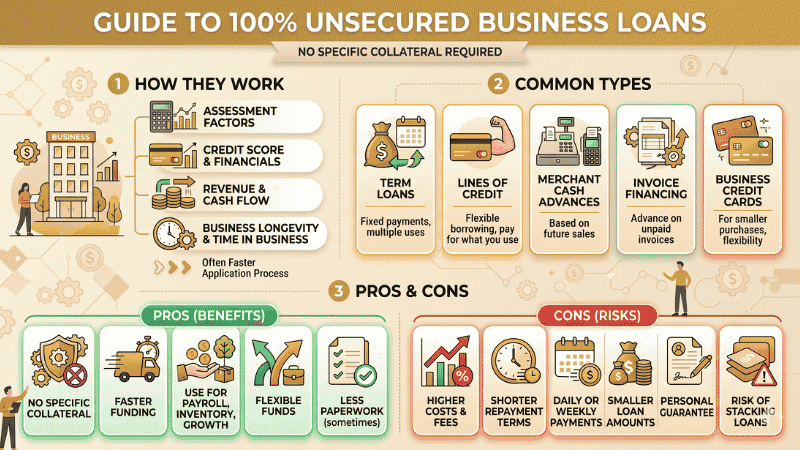
Unsecured business financing can come in several forms. Some options are true business loans, while others are alternative funding products based on revenue, invoices, or future sales. Before choosing a program, business owners should understand how each option works, how repayment is structured, and whether the funding fits their cash flow.
Unsecured Business Term Loans
An unsecured business term loan provides a lump-sum loan that is repaid over a set period. Payments may be made daily, weekly, biweekly, or monthly, depending on the lender. This option may work for business owners who need money for expansion, inventory, marketing, equipment, payroll, or working capital without having to pledge specific collateral.
Unsecured Business Lines of Credit
A business line of credit provides a business with access to a set credit limit. The borrower can take out money whenever they need it and typically only pays interest on the amount they actually use. This option may be helpful for short-term cash flow, seasonal expenses, emergency repairs, or unexpected business costs. A line of credit may be more flexible than a term loan because the business does not have to use the full amount at once.
Merchant Cash Advances
A merchant cash advance is not the same as a traditional business loan. It is usually an advance based on future sales or future receivables. Repayment may be taken from daily or weekly business revenue, debit card sales, or bank deposits. Merchant cash advances can provide fast funding, but they may come with higher costs and aggressive repayment schedules. Business owners should review the total payback amount before accepting this type of funding.
Invoice Financing
Invoice financing allows a business to access money based on unpaid customer invoices. This can help businesses that are waiting for customers or clients to pay. The business can get paid faster instead of waiting 30, 60, or 90 days for payment. Invoice financing is usually best for businesses that invoice other companies and have reliable customers with outstanding balances.
Business Credit Cards
Business credit cards are another form of unsecured business financing. They can help with smaller purchases, travel, supplies, subscriptions, and short-term expenses. However, credit cards may carry high interest rates if balances are not paid in full. They are usually better suited to short-term use than to long-term business funding.
Revenue-Based Financing
Revenue-based financing is a different way to get funding, where you pay back what you owe based on your business’s revenue. Instead of focusing only on credit score or collateral, the lender may review sales volume, bank deposits, and cash flow. This may help businesses with strong revenue but limited collateral. However, repayment can become expensive if the terms are not reviewed carefully.
Startup Business Funding
Some unsecured business financing programs may be available for startups, but they are usually harder to qualify for than funding for established businesses. A startup may need strong personal credit, a clear business plan, projected revenue, industry experience, or other compensating factors. Business owners should understand that startup funding may come with lower loan amounts, higher costs, or stricter approval conditions. The best option depends on the business’s revenue, credit profile, time in business, funding needs, repayment ability, and comfort with cost. A true unsecured term loan may be better for a planned expense, while a line of credit may work better for flexible cash flow needs. Merchant cash advances, invoice financing, and revenue-based financing may help in certain situations, but they should be carefully compared because repayment structures and total costs can vary widely.
Pros of 100% Unsecured Business Loans
100% unsecured business loans can be helpful for business owners who need funding without pledging real estate, equipment, vehicles, or other specific assets as collateral. This type of financing may be useful when a business needs money quickly and does not want to go through a long traditional bank loan process.
No Specific Collateral Required
One of the biggest benefits of unsecured business financing is that the borrower does not have to pledge a specific asset to secure the loan. This can help business owners who do not own commercial real estate, expensive equipment, or other assets that a lender would normally use as collateral.
Faster Access to Business Funding
Unsecured business loans may move faster than traditional secured loans because the lender does not have to appraise collateral or review property values. This can help when a business needs money for urgent expenses, such as emergency repairs, payroll, inventory shortages, or unexpected operating costs.
Useful for Payroll and Short-Term Cash Flow
Many businesses deal with timing gaps between incoming and outgoing cash. Unsecured funding may help cover payroll, rent, utilities, vendor payments, or other short-term cash flow needs. At the same time, the business waits for customer payments or seasonal revenue.
Can Help Buy Inventory or Supplies
A business may need extra cash to buy inventory before a busy season, stock up for a large order, or take advantage of supplier discounts. An unsecured business loan or line of credit may help the business purchase inventory without tying up all available cash.
Can Support Marketing and Business Growth
Business owners may use unsecured financing to invest in advertising, website updates, new equipment, hiring, or expansion. For example, a company may use the funds to launch a marketing campaign, open a second location, add staff, or buy tools needed to serve more customers.
Flexible Use of Funds
Unlike some loans that restrict how the funds can be used, unsecured business loans often offer greater flexibility. Depending on the lender and program, funds may be used for working capital, repairs, payroll, inventory, marketing, expansion, or other approved business needs.
May Be Available Without Traditional Bank Requirements
Some business financing options that don’t require collateral need less paperwork than what you’d deal with for a regular bank loan. Depending on the lender, approval may be based more on business bank deposits, revenue, and cash flow than on tax returns, financial statements, or collateral. This can help business owners with strong deposits who do not fit a traditional bank’s lending box.
Cons of 100% Unsecured Business Loans
A 100% unsecured business loan can be a helpful funding option, but business owners should understand the risks before applying. Since the lender is not using specific collateral to secure the loan, unsecured financing can be more expensive. It may have tighter repayment terms than traditional secured business loans.
Higher Rates and Fees
Unsecured business loans usually come with higher costs because the lender is taking on more risk. The cost may include interest, origination fees, underwriting fees, processing fees, or other lender charges. Some alternative funding options may use a factor rate instead of a traditional interest rate, so business owners should compare the total payback amount, not just the advertised rate.
Shorter Repayment Terms
Many unsecured business loans have shorter repayment terms than bank loans or SBA loans. Instead of repaying the loan over several years, the business may need to repay it over months or a shorter fixed term. A shorter term can increase the payment amount and put more pressure on cash flow.
Daily or Weekly Payments
Some unsecured business financing programs require daily or weekly payments rather than monthly. This can be difficult for businesses with uneven revenue, seasonal income, slow-paying customers, or tight cash flow. Before accepting funding, business owners should ensure the payment schedule aligns with their typical deposit schedule.
Smaller Loan Amounts
Because there is no collateral, lenders may offer lower loan amounts than they would with secured financing. A business may qualify for enough funds to cover short-term working capital, payroll, inventory, or repairs, but not enough for a major expansion, a large equipment purchase, or a long-term project.
Stricter Approval Review
Even though unsecured loans do not require specific collateral, lenders still review risk. They may look at monthly bank deposits, average daily balance, time in business, credit history, existing debt, overdrafts, NSFs, industry type, and repayment ability. A business with weak deposits, frequent overdrafts, or too much existing debt may be denied or offered less favorable terms.
Risk of Stacking Multiple Business Loans
One of the biggest risks is stacking multiple business loans, merchant cash advances, or short-term funding products at the same time. Each new payment can reduce cash flow and make it harder to keep up with payroll, rent, suppliers, and taxes. Stacking debt may also make it harder to qualify for better financing later.
Personal Guarantee or Other Conditions May Still Apply
No collateral does not always mean no responsibility. Some lenders may still require a personal guarantee, business bank review, UCC filing, automatic payments, or other approval conditions. Business owners should read the loan agreement carefully and understand what happens if the business cannot repay the loan.
May Not Be the Cheapest Option
Unsecured business funding can be useful when speed and flexibility matter, but it may not be the cheapest option. Businesses with strong credit, steady revenue, collateral, or more time to wait may want to compare SBA loans, secured business loans, business lines of credit, invoice financing, or other lower-cost options before choosing unsecured funding.
Is a 100% Unsecured Business Loan Right for Your Business?
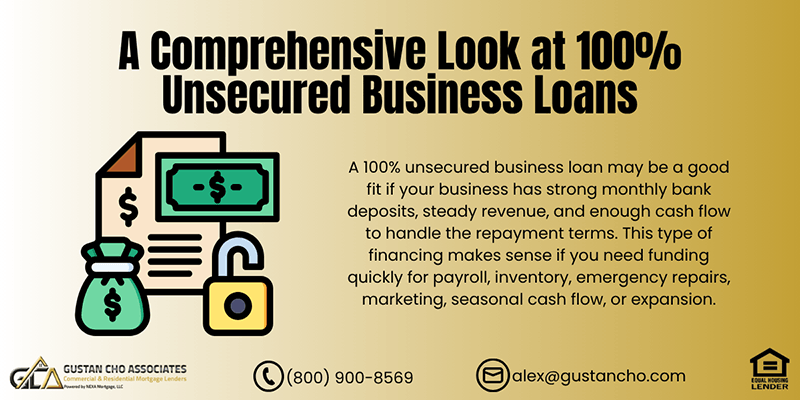
A 100% unsecured business loan may be a good fit if your business has strong monthly bank deposits, steady revenue, and enough cash flow to handle the repayment terms. This type of financing makes sense if you need funding quickly for payroll, inventory, emergency repairs, marketing, seasonal cash flow, or expansion. You do not want to pledge real estate, equipment, vehicles, or other specific assets as collateral. Unsecured business loans may also work well for business owners with a clear plan for how to use the funds. For example, if the funds will help purchase inventory before a busy season, cover a temporary cash flow gap, repair equipment needed to keep the business running, or support a growth opportunity, the loan may create value for the business.
The key is making sure the expected benefit is greater than the cost of borrowing.
A 100% unsecured business loan may not be the right fit if the business has weak cash flow, inconsistent deposits, frequent overdrafts, or too much existing debt. It may also be risky if the business is already using multiple merchant cash advances, short-term loans, or high-interest funding products. Adding another payment can make it harder to cover payroll, rent, vendors, taxes, and daily operating costs. Business owners should also consider other options if they qualify for cheaper financing. If your business has strong credit, collateral, steady financials, and time to wait, an SBA loan, a secured business loan, a traditional business line of credit, or another lower-cost option may be a better choice. Before applying, compare the total repayment amount, payment schedule, fees, funding speed, and how the new payment will affect your cash flow.
FAQs About 100% Unsecured Business Loans
Can You Get A Business Loan Without Collateral?
Some lenders will give you business loans without needing to back them up with stuff like real estate, vehicles, or equipment. However, no collateral does not always mean no lender protection. Some lenders may still require a personal guarantee, review business bank deposits, or place other conditions on the approval. The SBA also explains that lenders may reduce risk through collateral, personal guarantees, or business liens.
Are Unsecured Business Loans Hard To Get?
Unsecured business loans can be harder to get than secured loans because the lender is not relying on collateral. Approval may depend on business revenue, time in business, credit history, cash flow, existing debt, and the lender’s risk requirements. A business with steady deposits and clean bank activity may have more options than a business with weak revenue or frequent overdrafts.
Can I Get An Unsecured Business Loan With Bad Credit?
Bad credit can limit your options. Some lenders may focus more on revenue, bank deposits, or sales activity rather than just credit scores, but the loan may come with higher costs, lower funding amounts, or shorter repayment terms. Business owners should compare the total payback amount before accepting a bad-credit unsecured business loan.
Do Unsecured Business Loans Require A Personal Guarantee?
Some unsecured business loans may still require a personal guarantee. A personal guarantee means the business owner may be personally responsible if the business does not repay the debt. This is why borrowers should read the loan agreement carefully before signing, even when the loan is advertised as unsecured.
What Is The Difference Between An Unsecured Business Loan And A Merchant Cash Advance?
An unsecured business loan is borrowed money repaid over a set term. A merchant cash advance is usually an advance based on future sales or receivables. Merchant cash advances can be funded quickly, but repayment may be taken daily or weekly from business revenue, which can put pressure on cash flow.
Are SBA Loans Better Than Unsecured Business Loans?
SBA loans might be a good pick for businesses that can meet the qualifications and don’t need cash right away. They’re often easier on the wallet, since they usually offer longer repayment terms and lower costs than many quick, unsecured funding options. However, SBA loans may require more documentation, stronger underwriting, and, in some cases, collateral or personal guarantees. Unsecured business loans may be better when speed, flexibility, and the absence of specific collateral are more important than the lowest possible cost.
This article about “100% Unsecured Business Loans: A Comprehensive Look” was updated on May 27th, 2026.