This guide covers how to prepare for a mortgage as a first-time homebuyer. The best way to prepare for a mortgage is to first consult with a loan officer. Do not just talk to one loan officer, but to many loan officers, and do your own research. Dale Elenteny, a senior mortgage loan originator at Gustan Cho Associates, says the following about how to prepare for a mortgage for first-time homebuyers:
Follow mortgage prep steps for first-time buyers: improve credit, budget hidden costs, compare lenders, and avoid rookie mistakes for homeownership success.
As you talk to more loan officers, you will get different answers to your questions, so that is where doing your own research comes in. In the following paragraphs in this guide, we will discuss and cover how to prepare for a mortgage as a first-time homebuyer. In the following paragraphs, we will cover how to prepare for a mortgage as a first-time homebuyer.
How to Prepare for a Mortgage
Start by checking your credit, setting a realistic home budget, paying down debt, and gathering your key financial documents. Don’t make big financial changes or open new credit cards. Next, explore mortgage options and get preapproved so you know what you can afford as a first-time buyer.
How to Prepare for a Mortgage Before Buying a Home
Buying your first home can seem overwhelming, but preparing for a mortgage is usually simpler than you think. You don’t need to know everything; just get your finances organized before you make an offer.
Knowledge Check
- What should be done to organize your finances for a first-time mortgage?
- What should be avoided before preparing to obtain a first-time mortgage?
- It is okay to open new lines of credit before obtaining your first mortgage, true or false?
- What should be reviewed before making a mortgage offer?
Answer Key:
- Your credit and finances should be reviewed.
- Before taking out a first-time mortgage, you should also create an affordable housing budget, eliminate excess debt, and prepare your finances.
- Any major financial changes or the opening of credit accounts should be avoided.
- It is false.
- Mortgage programs should be compared, and a preapproval should be obtained.
- You should also be able to obtain a first-time mortgage offer.
If you start early, you can check your credit, save money, and pay down debts to keep your monthly budget comfortable. You’ll also have more time to find a mortgage program that fits you best. Lenders look at your credit, income, job, debts, savings, and the home you want to buy. Getting these things ready ahead of time makes the mortgage process much smoother.
You Start Searching for Homes
A lot of first-time buyers start looking for homes before they know what they can truly afford. This often leads to falling in love with a dream home, only to realize the payments are too high. Make your mortgage plan before you start looking. Here are a few things you should know before you seriously shop for a home:
Understanding the Whole Picture of Your Credit
- Knowing how much income qualifies you for a mortgage.
- Knowing how much you spend every month.
- Knowing how much money you are able to put down for a house.
- Knowing the maximum amount of payment you are willing to spend each month for your house.
- Knowing which programs will work for you.
- Know you. Be aware of your financial challenges.
- You don’t need perfect finances to speak with a loan officer. time homebuyer.
- First-time homebuyers should contact a loan officer no matter their current financial situation.
- Loan officers can help with problems such as high debt relative to income, credit issues, job changes, self-employment, bankruptcy, foreclosure, and other financial challenges.
It’s Ahead of Time is So Important for Your Mortgage Application
Credit is a major factor in getting a mortgage. Lenders review both your credit scores and your credit reports. Credit reports show your payment history, credit card balances, loans, collections, write-offs, recent checks by lenders, bankruptcies, foreclosures, and other. Checking your credit reports early lets you fix problems before they affect your mortgage application. Check your credit reports for information that does not belong to you or accounts that are reporting incorrectly. Examples include a late payment recorded incorrectly, an account that isn’t yours, an incorrect balance, or a debt reported incorrectly.
Errors in Credit Reports
Credit reports containing inaccurate information should be addressed through a thorough review. You don’t have to dispute every negative item on your credit report just because you disagree with it.
Credit disputes perform differently in mortgage underwriting, depending on the mortgage program, the account, the remaining balance, the results of automated underwriting, and the lender’s requirements.
When you’re getting ready for a mortgage, talk to your loan officer about any major credit problems before making changes. When applying for a mortgage, your recent payment history matters. If you have big credit problems, talk to your loan officer before making changes.
Late Payments in the Past 12 Months
Older credit problems can be easier to explain to your mortgage lender if your recent payment history shows that you have established financial stability. A new late payment can negatively impact your mortgage application. If you have had credit issues in the past, a recent record of on-time payments can help explain your situation to a lender.
Many buyers pay off credit cards before applying for a mortgage to improve their finances. It’s wrong to think you must use all your cash to pay off credit cards.
You need to think about the down payment, closing costs, savings, moving costs, and other unexpected expenses after buying your home. Consider your unique financial situation.
When Do You Really Need Perfect Credit to Buy a House?
This is not universally accurate. Not all mortgage applicants need excellent credit. Different mortgage programs and lenders have different credit requirements. Lenders also look at other parts of your application, like your payment history and the overall strength of your loan file. This matters most for buyers who think a certain credit score is the only ticket to a mortgage. This assertion is incorrect. A borrower who doesn’t meet the requirements for a particular mortgage program may qualify for another program. A lender may consider your financial status, credit score, and payment history.
Ready to Prepare for Your First Mortgage?
Complete a quick application or send your scenario. We’ll review your credit, income, debts, assets, budget, and best mortgage path from pre-approval to closing.What Should You Know Before You Start Looking For Houses?
Qualifying for a mortgage and being able to afford it are not the same thing. Lenders set limits based on their rules to decide if you qualify for a certain mortgage amount. Even if you qualify for a larger loan, focus on a monthly payment you can comfortably afford, not just the biggest loan you can get.
Examine What a Complete Monthly Housing Payment Includes:
Affordability is not just about principal and interest.
Your Potential Housing Expense Can Consist of:
- Principal
- Interest
- Property taxes
- Homeowners insurance
- Mortgage Insurance
- Flood Insurance
- HOA Fees (Homeowners Association)
Remember that taxes and insurance can change over time. The mortgage payment is not the only expense the homeowner is responsible for.
Homeowners Are Also Responsible for:
- Utility Expenses
- Maintenance and Repairs
- Expenses to Replace or Update Appliances
- Landscaping
The Importance of Debt-to-Income Ratio
A house that meets the lender’s requirements might still be too expensive for your budget. The debt-to-income ratio (DTI) is an important metric lenders use when reviewing mortgage applications. Besides your housing payment, other monthly debts like car loans, student loans, credit cards, and child support are also considered. There isn’t a single DTI ratio that works for everyone. Just because you see a certain DTI percentage online doesn’t mean you are above or below the limit for every mortgage program. Writing tools have their drawbacks when determining eligibility, and manually underwritten loans are reviewed on a case-by-case basis.
Your credit history, savings, special factors, loan type, property, and lender rules all affect your eligibility. Don’t assume you’re disqualified just because of a high debt-to-income ratio. Talk to a mortgage expert about your situation.
Some obligations will be evaluated differently based on the loan program and supporting documentation. Avoid new debt when applying for a mortgage. Keep your finances steady and strong as you prepare. New credit cards, car loans, and personal loans can change your debt-to-income ratio and how much mortgage a lender will offer. Even tiny monthly payments can tip the scales on your mortgage approval.
Actions That Affect Debt-to-Income Ratios
There are limits to how much a borrower can do. Don’t make big purchases before closing without first talking to your mortgage lender. These purchases are just a small part of the total cost of buying a home. buy a home. Buyers can also incur closing costs, prepaid expenses, moving costs, escrow expenses, and inspection fees. Plenty of hidden costs come with buying a home.
Myth of The 20% Down Payment
The ability to buy goods outright is the ideal scenario. When it comes to buying a home, many believe the only options are to buy outright or find a cash buyer. That belief is a big myth. There are mortgage programs designed for Homebuyers that do not require a 20% down payment.
Lower down payment, more competitive interest rates. Some conventional programs offer low down payment options, and so do some FHA loan programs.
VA loans are available to certain veterans, active-duty military, and even some other eligible borrowers. There are also USDA loans, which enable eligible borrowers to buy properties that meet USDA loan program requirements. Each program relies on verified information rather than general assumptions.
Facts versus Myths
There are many myths about buying a home. You might think you can’t buy without a 20% down payment, but there are loans for people with less saved. Talk to a lender to see your options.
Mortgage Closing Costs
A down payment is not the only cost associated with a mortgage. Closing a mortgage also costs money. Buying a home can be expensive, and you should expect your closing costs to be at least a few thousand dollars, depending on the property, lender fees, taxes, insurance, and other costs. Your lender must provide you with a breakdown of your closing costs once your loan is preliminarily approved.
You Need a Little Cash After You Buy
Buying a home is a big investment, but make sure you have cash left over after closing. If you use up all your savings, you might not have enough for repairs or surprise expenses that pop up after you move in. Keeping a financial cushion is always wise.
Bank Accounts Should Be Easy to Document
Mortgage lenders need to ensure that the funds used to purchase a home are verified. This often includes the down payment, closing costs, funds to cover any required reserves, and money to cover other related transaction costs.
When your finances are tidy, proving your assets for the mortgage process becomes much simpler. Avoid making large, mysterious cash deposits or shifting money between accounts without clear paperwork.
If you have sold an asset and plan to use the proceeds to purchase the home, make sure you have documentation of the sale and the transfer of funds. If you plan to use gift funds, let your loan officer know before transferring the money. Gift fund requirements will be different depending on the program and the transaction. The lender must be able to determine the source of the funds and whether they comply with mortgage guidelines.
Stable Income and Employment Are Important
Lenders need to assess whether the qualifying income meets the program’s criteria. Although mortgage approval can be obtained with a new job, the main focus is on how a job change affects qualifying income.
Notify Your Loan Officer If You Are Changing Jobs
Prior to making the job change, notify your loan officer, if possible. A change in employment from a salaried position to another may not be handled the same way as a change to a self-employed position, taking a commission-based job, reducing the time you work to part-time, a change from W-2 income to contract work, or a change to another income with a variable compensation structure.
Mortgage applicants should avoid quitting or changing jobs during the mortgage process. Even if you get a better job or a higher salary, it doesn’t always mean you’ll qualify for a mortgage right away.
Mortgage income must fulfill documentation and eligibility requirements. If you switch jobs while processing your mortgage, notify your lender. Don’t wait until the last minute to share this with your lender.
Our Mortgage Documents Well In Advance
Mortgage underwriting entails a significant amount of documentation. Gather the documents your lender will need before you apply. This can speed up the whole process. The documents required may vary depending on you and your mortgage program.
A wage-earner may be required to present pay stubs, W-2s, bank statements, ID, and other related financial documents. Additionally, more extensive documentation may be required of self-employed borrowers.
Buyers using Social Security, pension income, disability income, rental income, overtime, bonuses, commissions, child support, alimony, or other income may also require supporting documentation. If you are uncertain about the required documentation, your lender can provide a comprehensive list tailored to your loan application. Your lender can give you a full list of the documents you’ll need for your loan application. It is essential to respond promptly and submit complete, unaltered documentation.
Consider Multiple Programs When Choosing A Mortgage Program
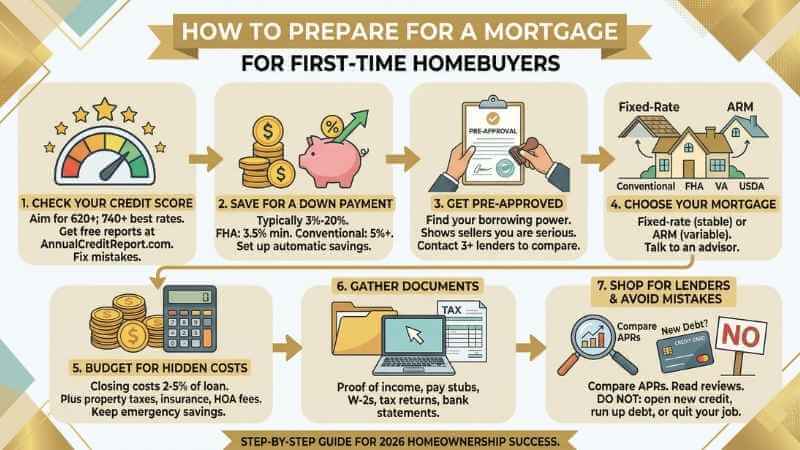
First-time buyers can choose from many loan options. The lowest rate or smallest down payment is not always the best fit for your situation. Look at the total cost of the loan, not just the rate or down payment. Think about the down payment, monthly payments, insurance, closing costs, loan term, and how each piece fits your long-term financial goals.
Conventional Loans
Conventional mortgages may include loans that can be purchased by Fannie Mae or Freddie Mac. Low-down-payment conventional options may be available for eligible borrowers. Conventional financing has various advantages for buyers, but qualification is based on credit, income, debt, assets, property, and underwriting evaluations. Private mortgage insurance may apply.
FHA Loans
FHA loans are government-backed, also known as government-insured loans. They are typically utilized by first-time and repeat buyers. FHA loans are good for buyers who wish to make a smaller down payment or who have credit weaknesses and do not qualify for specific conventional loans. FHA loans have their own credit, property, mortgage insurance, occupancy, and underwriting qualifiers. Each lender may have provisions outside of the minimum FHA guidelines.
VA Loans
VA loans are backed by the U.S. Department of Veterans Affairs and extended to eligible veterans, service members on active duty, and other qualified borrowers. VA financing may offer various benefits, including the potential to make a zero-down purchase for qualified borrowers who meet specific conditions. VA loans have their own credit, income, residual income, occupancy, appraisal, and underwriting requirements. USDA Loans USDA loans enable eligible applicants to acquire financing to purchase a qualified primary residence in participating areas. USDA loans are not restricted to first-time home buyers. USDA loans are structured with household income ceilings and limits on location, occupancy, and other program parameters. Down Payment Assistance Down payment assistance may also be available to some first-time buyers and is offered by state or local housing finance agencies, employers, nonprofits, or lenders. The structure of assistance may depend on the program. There are programs that offer grants. Other programs offer forgivable or deferred loans or mortgage credit. The conditions may vary. Determine whether the program conditions are income-restricted, whether there are limits on household size or the price of the house, and whether the program requires homebuyer education and occupancy. Get preapproved to know how much you can afford before you start looking for a home or a mortgage, and to understand how much you can spend on a home. A preapproval shows how much the lender is willing to loan you based on the information that fits your budget. This enables real estate agents to concentrate on properties that align with your budget. Sellers are more likely to consider offers from buyers who have already obtained preapproval.
Prequalified and Preapproved Mean Different Things
Even mortgage lenders use these words differently. A preapproved loan may actually mean that automated underwriting has been completed and reviewed. Ask your lender exactly what they reviewed during your preapproval.
Preapproved Does Not Mean Approved
Getting preapproved means you’ve taken some steps, but it doesn’t guarantee you’ll get the loan. Things that may have been preapproved can change during the process. This may mean your final loan is different from what you expected. Lenders Most first-time buyers spend hours searching for the perfect house, but barely any time hunting for the right mortgage. Finding the right mortgage matters just as much as finding the right home.
You have to compare different loan programs, interest rates, points, lender fees, mortgage insurance, estimated monthly payments, closing costs, and loan terms at closing.
While lenders’ experience with your unique situation matters, this is more applicable to borrowers with challenged credit, manual underwriting, a high debt-to-income ratio (DTI), bankruptcy, self-employment, or variable. A lender might offer a great rate, but their mortgage may not be the best fit for your overall financial situation.
Consider What Mortgage Underwriters Review
Mortgage underwriters base their decisions on more than just one single number. The underwriter decides whether the submitted mortgage file meets all required criteria. This review covers the credit history, the borrower’s qualifying income, employment, monthly obligations, and assets, as well as the closing funds, occupancy, and the property.
The review may include the loan program and the automated underwriting system. In some cases, borrowers may receive an automatic approval decision, while others may have loans that require a full review or even manual underwriting.
This is one of the reasons two borrowers with the same credit score can have vastly different mortgage outcomes. One borrower may have a stable income, a good housing history, reasonable debt, and even good reserves. Another borrower may have poor credit, unstable income, and high monthly debt obligations with little savings. Underwriting reviews the entire file.
What to Avoid: Proper Preparation for a Mortgage
Most mortgage hiccups occur when borrowers change their financial circumstances mid-process. Stick with the habits that got you preapproved.
- Maintain the discipline you used to obtain preapproval.
- Avoid opening credit accounts unnecessarily.
- Think carefully before opening new credit for big purchases, before closing, and always check with your lender first.
- Don’t co-sign a loan for someone else without first talking to your loan officer.
- Avoid making large bank deposits that you can’t document.
- Be honest about your employment.
- If you move a large amount of money around, keep all the supporting documentation.
- Always be honest with your mortgage professional about any financial changes.
- A change in your finances does not automatically mean your mortgage will be denied.
- Your lender may simply need more information or a different approach.
Case Scenario of a First-Time Homebuyer
Let’s say a buyer doesn’t have much saved and has high credit card balances, but has good, stable employment and has made on-time rent payments. Rather than making an offer on a home right away, the buyer begins by getting their credit reports and meeting with a mortgage professional. The mortgage professional determines which programs may be available and explains which debts may be affecting qualification. Lastly, the buyer continues to pay obligations on time and saves money. The buyer avoids new credit and ensures money for the down payment remains in a safe, undocumented account.
Things to Do Prior to Putting an Offer on a Home
Before actual house hunting begins, updated income and assets documents are submitted along with a pre-approval. The buyer estimates an approximate monthly payment based on work-related and personal expenses and sets upper spending limits that still allow for saving. Preparing for a mortgage is about more than just getting approved. Sometimes, you might qualify for more than you can truly afford. The real win is closing on a loan with payments you can handle month after month.
Get Your Mortgage Documents Ready Early
Pay stubs, W-2s, tax returns, bank statements, IDs, rent history, and asset documents may be needed for approval. Get a checklist before underwriting starts.Reviewing Your Financial Position
Before completing a mortgage application, individuals should review their financial position. Potential mortgage applicants need to be aware of what is reported to credit reporting agencies about them.
- Make sure to continue paying all your existing obligations on time.
- Review your current monthly financial obligations.
- New credit should be avoided.
- Funds should be set aside to pay the costs associated with purchasing a home (down payment, closing costs, etc.)
- Savings should be documented to support bank statements.
- Records should be gathered to document income and assets.
- Your loan officer should be notified of any material changes in employment or income.
- Comparison of the various mortgage programs is advised.
- Determine your preferred, affordable monthly payment.
- Buyers should be preapproved prior to making an offer.
- Keep your finances, credit, job, debts, and assets steady all the way through closing on your mortgage.
- Take a close look at your finances and make a plan to fix any issues that could affect your mortgage approval.
Monthly Housing Expenses for Homeowners
When learning how to prepare for a mortgage, it’s essential to consider more than just the loan payment. Your overall monthly expenses for housing may consist of principal, interest, property taxes, homeowners’ insurance, and, if required, mortgage insurance.
Reviewing your full monthly budget before you apply can help you choose a payment that feels comfortable and avoid becoming house-rich and cash-poor.
You’ll want to account for homeowners’ association dues, utilities, internet, cable, and routine maintenance. Many first-time buyers focus only on the estimated mortgage payment, but the real cost of owning a home is often higher once other expenses are factored in.
Ask Questions Before You Apply for a Mortgage
When learning how to prepare for a mortgage, it’s essential to ask clear questions early in the process. Inquire with lenders about the credit score you may need, the required down payment, expected closing costs, and the documents you’ll need to gather. Determine how much the monthly payment fits your budget and how long the pre-approval lasts. You should also ask about any programs that may suit your financial situation.
The more you understand before applying, the more confident and prepared you will be during the mortgage process. Preparing for a mortgage takes time, planning, and the right information.
Knowing how to prepare for a mortgage involves reviewing your credit, organizing your finances, building savings, and comparing lenders early on. By taking these steps, you can approach the mortgage process with more confidence. If you’ve got more questions about your mortgage options, speaking with a friendly loan officer can help you figure out what to do next for your situation.
Shopping for Lenders: How to Get Best Mortgage Rates
If you’re a first-time homebuyer, comparing lenders is one of the smartest moves you can make before you buy a house. Start by asking a mix of banks, credit unions, online lenders, and mortgage brokers for quotes. Zero in on the annual percentage rates (APRs) since these numbers include both the loan cost and the fees.
Don’t forget to ask if you can get a break to set up autopay or join a special first-time buyer program. Many experts think rates might drop in 2026, so carefully timing your search could pay off.
Take a few minutes to read reviews and check lenders’ records on the Better Business Bureau or the Consumer Financial Protection Bureau (CFPB) database. If you opt for a mortgage broker, ask them up front what they charge to avoid surprise costs. Being a smart shopper might lower your interest rate by half a percent or more, which means you could save a ton of money over the life of the loan.
How to Compare Lenders
Comparing lenders is crucial when learning how to prepare for a mortgage, as rates, fees, and qualifying criteria can vary significantly among lenders. Getting quotes from different lenders can help you find a mortgage that better fits your credit situation, budget, and financial goals.
Comparing lenders and shopping for the best rate and terms on your home mortgage loan is essential for ensuring that you make an informed decision during the mortgage loan process.
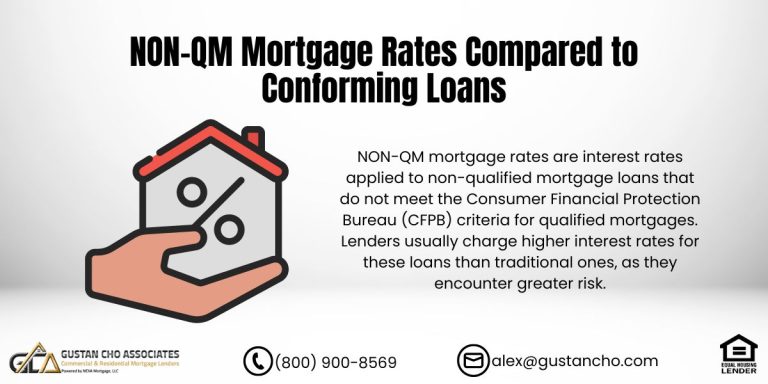
Not all mortgage lenders have the same rate and terms on FHA, VA, USDA, Conventional and Non-QM loans. Many borrowers with bad credit and lower credit scores think they do not have many options in shopping for better rate and terms. They are wrong. Even if you have lower credit scores and prior bad credit, you do have options. There are lenders that cater towards lower credit score borrowers. Comparing lenders is important because rates, fees, and qualifying flexibility can vary from one lender to another. Getting quotes from more than one source can help you find a mortgage that better fits your credit profile, budget, and goals.
Final Thoughts on How to Prepare for a Mortgage
Buying a home can feel overwhelming, but getting mortgage-ready ahead of time makes everything smoother. Start by reviewing your finances, savings, budget, income, credit, debts, and the true cost of owning a home.
Keep your job, credit, and bank accounts steady throughout the process. Explore different mortgage programs and get preapproved before you make an offer.
It is important to recognize that approval for a specific loan amount does not obligate you to borrow or spend the full amount. Mortgage approval is based on the underwriting requirements. Your personal finances will determine whether a mortgage makes you a homeowner. Careful preparation is the secret to success for first-time homeowners.
Frequently Asked Questions About How to Prepare for a Mortgage:
What Should I Do First When Preparing for a Mortgage?
The first step is to review your credit report, check your credit score, and fix any errors you find. After that, review your monthly budget, estimate the payment you can realistically afford, and start gathering the basic documents lenders typically request.
How Much Money Should I Save Before Applying for a Mortgage?
You should prepare for more than just the down payment. Buyers also need money for closing costs, and many mortgage prep guides recommend keeping emergency savings in place so you do not stretch your budget too thin after closing.
What Credit Score do I Need to Prepare for a Mortgage?
There is no single score that works for every mortgage program, but your credit score has a major effect on approval options and pricing. In general, a stronger score can improve your loan choices and help you qualify for better terms, so it is smart to work on your credit before you apply.
What Documents Do I Need to Prepare for a Mortgage Application?
Most lenders will want recent pay stubs or other proof of income, bank statements, W-2s or tax returns, identification, and details about your debts and assets. Getting these documents organized early can make the mortgage process smoother and help prevent delays.
Should I Get Pre-Approved Before I Start Shopping for a Home?
Yes. Getting pre-approved early can help you understand how much you may be able to borrow and give you a clearer price range before you start house hunting. It can also make you look more prepared when you are ready to make an offer.
What Should I Avoid Doing While Preparing for a Mortgage?
When considering how to prepare for a mortgage, it’s very important to avoid opening new credit accounts, taking on large debts, missing payments, or making financial moves that could destabilize your budget before you apply. Mortgage preparation guides consistently highlight the importance of maintaining stable finances during this time.
This Guide About “How To Prepare For a Mortgage For First-Time Homebuyers” Was updated on August 28, 2026.