This guide covers manual underwriting versus automated approval. There are two types of Automated Underwriting Systems (AUS): Fannie Mae’s Automated Underwriting System is referred to as Desktop Underwriting (DU), and Freddie Mac’s AUS is known as Loan Prospector Advisor (LPA). All government and conventional loans need to go through either DU and/or LPA Automated Underwriting System for the following:
- Approve/Eligible
- Refer/Eligible
- Refer/Ineligible
Manual underwriting versus automated approval are two different methods used in the process of evaluating and approving loans or credit applications. In the following paragraphs, we will cover a brief overview of manual underwriting versus automated approval. Human Involvement: In manual underwriting, human underwriters review and assess the loan application. They analyze various aspects of the borrower’s financial situation and creditworthiness.
Manual Underwriting versus Automated Approval Findings
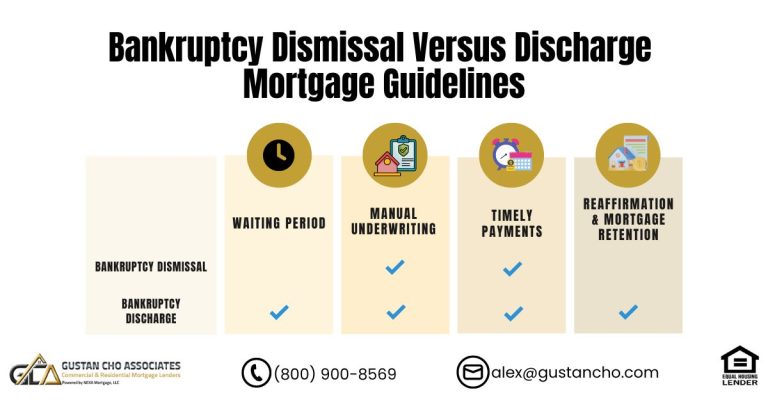
- Borrowers Who Are One Year Into a Chapter 13 Bankruptcy Repayment Plan
- Mortgage Borrowers Who Just Had a Chapter 13 Bankruptcy Discharge But The Discharge Has Not Been Seasoned 2 Years
- Assets Listed On The Mortgage Application Is Not Sufficient For Cash To Close
- Debt-to-Income Ratios Are Higher Than Required By Automated Mortgage Approval
Understanding the distinctions between manual underwriting and automated approval enables homebuyers to pursue alternative options if a lender issues a status indicating that automated approval was not provided. Manual underwriting allows for more flexibility in considering unique or non-traditional factors that may not be easily captured by automated systems. Flexibility in manual underwriting can be beneficial for individuals with complex financial situations. The process of manual underwriting is generally more time-consuming compared to automated approval, as it involves a detailed review of documentation and individualized decision-making.
What Is the Difference Between Manual Underwriting and Automated Approval?
Automated underwriting uses a computer program to assess the information provided in the mortgage application and credit report. Once the program has analyzed the data, it prepares an underwriting recommendation for the lender, along with a list of requirements or conditions the recommendation stipulates. Manual underwriting requires a human underwriter to exercise greater discretion and responsibility. The underwriter reviews the borrower’s complete financial history and determines whether the loan meets the requirements and guidelines of the relevant mortgage program.
The Loan Officer or Processor Submits Information, Such As:
- Income and employment
- Credit history and credit scores
- Monthly debt payments
- Proposed mortgage payment
- Cash needed to close
- Verified assets and financial reserves
- Loan amount and down payment
- Property type and occupancy
- Loan-to-value ratio
- Bankruptcies, foreclosures, and other major credit events
- The system compares this information with the rules and risk standards for the selected mortgage program.
- Fannie Mae states that Desktop Underwriter reviews credit history, users of revolving credit, collections, public records, reserves, loan purpose, occupancy, and property type, debt-to-income ratio, housing expense, risk factors, and other factors.
Common Automated Underwriting Systems
The system used depends on the loan program and the lender. Algorithmic Decision-Making: Automated approval relies on algorithms and predefined criteria to evaluate loan applications. The decision is made based on factors such as credit score, income, debt-to-income ratio, and other quantitative metrics.
Automated systems are faster and can process a large number of applications in a short period. This can lead to quicker decisions and responses for borrowers.
Automated approval systems ensure consistency in decision-making, as they follow predetermined rules and criteria. This reduces the likelihood of human error or bias. Manual underwriting versus automated approval is only used as a last resort with a refer/eligible findings.
Fannie Mae Desktop Underwriter
- Desktop Underwriter, or DU, is Fannie Mae’s automated underwriting system.
- It helps lenders determine credit risk and if a mortgage is eligible for delivery to Fannie Mae.
Freddie Mac Loan Product Advisor
- Loan Product Advisor, or LPA, is Freddie Mac’s automated underwriting system.
- It evaluates whether a mortgage meets Freddie Mac eligibility requirements and provides a feedback certificate to the lender.
- The former name, “Loan Prospector,” should not be used as the primary name in updated mortgage content.
TOTAL Scorecard & Mortgage Automated Underwriting System (AUS)
FHA lenders use AUS connected to FHA’s TOTAL Mortgage Scorecard. The scorecard provides a suggested level of underwriting and documentation. However, lenders must still comply with the HUD Handbook 4000.1 for FHA Loans. USDA Guaranteed Underwriting System (GUS)
GUS is USDA’s Guaranteed Underwriting System. It evaluates credit, capacity, property, income, and program eligibility. GUS may return findings such as Accept, Refer, Refer with Caution, or Ineligible.
USDA states that borrowers should not be approved or denied solely on the basis of the GUS risk assessment. The approved lender remains responsible for the decision.
VA Automated Underwriting
VA lenders may submit eligible applications through an approved AUS. However, the system remains a tool rather than the final decision-maker. VA training guidance specifically states that an AUS is not the decision-maker and that an underwriter is still required to underwrite the loan.
Does an Automated Underwriting Result Mean the Loan Is Approved?
No. An automated underwriting result is not the same as a final mortgage approval. An AUS may use the income entered by the loan officer. The human underwriter must still determine whether that income is stable, documented, likely to continue, and calculated in accordance with the correct program rules.
Recommendations Can Change Whenever the Lender Modifies the Following:
- Income
- Credit balances
- Interest rates
- Loan amounts
- Property taxes
- Homeowners’ insurance
- Employment
- Reserves
- Source of down payment
- New debts
- Credit inquiries
A loan with “good” AUS results can still be suspended or denied if the supporting documents do not validate the submitted data. Fannie Mae instructs the lender to verify the accuracy of the AUS data, satisfy all findings and conditions, review the credit report, and investigate any contradictory or derogatory information.
What is Manual Mortgage Underwriting?
Manual mortgage underwriting is a detailed assessment performed by a human underwriter following published loan program guidelines and the lender’s requirements. The underwriter reviews the borrower’s financial profile rather than depending mostly on the automated risk recommendation.
This Assessment May Include:
- The reason for making late payments
- Credit patterns in the last 12 to 24 months
- Rent payment history
- Nontraditional credit accounts
- Employment stability
- Overtime, bonus, commission, or self-employment income
- Housing payment shock
- Cash reserves after closing
- Debt-to-income ratios
- Bankruptcy payment history
- Compensating factors
- Letters of explanation
- Court or bankruptcy trustee approval
- Manual underwriting does not imply that the lender disregards established rules.
- Instead, it typically requires the underwriter to document additional details and personally confirm that the borrower meets the applicable guidelines.
Automated Underwriting vs. Manual Underwriting: What’s the Difference?
The difference is in the assessment of mortgage risk.
Manual Underwriting Takes Longer Due to a Higher Cognitive Load
- Manual underwriting requires the underwriter to review and fully document the file.
- Automated underwriting, in contrast, requires only a quick review.
Automated Underwriting Is Commonly Used When the Borrower Has:
- Established Traditional Credit
- Stable Income That Is Documented Easily
- Acceptable Debt-to-Income Ratio
- Funds To Cover the Closing Costs
- No Major Unresolved Credit Events
- A Standard Property with a Standard Loan
Manual Underwriting
Manual Underwriting may be required to complete the analysis when the following conditions are not present.
- More Bank Statements (e.g., Six Months vs. Two Months)
- Verification of Rent
- More Employment Documentation
- Bank Documents That Show Proof of Timely Bankruptcy Payments
- Documents That Show Proof of Financial Reserves
- Bank Statements Documenting a Lower Debt-to-Income Ratio
- Bank Statements Documenting Closing Costs (e.g., Funding Received Via Wire Transfer)
- Documents That Show Proof of Compensating Factors
Automated underwriting provides initial findings rapidly, as an AUS can analyze substantial volumes of data efficiently. Manual underwriting requires more time because a human underwriter must review and document the entire file. There is no typical timeline for manual underwriting. It may take several days or longer, depending on the lender’s workload, the complexity of the application, and how quickly the borrower provides the requested documents.
What Do Common AUS Findings Mean?
AUS terminology is not the same across every mortgage program. Borrowers should ask which system was used and request an explanation of the actual findings.
Fannie Mae Approve/Eligible
An Approve/Eligible recommendation means DU found that the loan meets its credit risk assessment and appears eligible for Fannie Mae based on the submitted data. The lender must still verify the submitted information, satisfy every condition, and complete the human underwriting review.
Fannie Mae Approve/Ineligible
Approve/Ineligible generally means the credit risk evaluation was favorable, but the mortgage does not meet one or more eligibility requirements. Possible problems may involve the loan product, property, transaction structure, loan amount, or another guideline. The lender must identify whether the ineligible condition can be corrected.
Fannie Mae Refer With Caution
A Refer with Caution recommendation does not meet Fannie Mae’s acceptable DU risk level. The lender should first check the application and credit data for errors. The file may be resubmitted after valid corrections. When the result remains Refer with Caution, manual underwriting is possible only when the specific product and transaction allow it.
Freddie Mac Accept or Caution
Freddie Mac’s LPA generally assigns a risk class such as Accept or Caution. A Caution result may require manual underwriting when the loan is otherwise eligible for that path. Some property types and transactions have restrictions that do not permit manual approval.
USDA Refer or Refer With Caution
USDA GUS files that receive Refer or Refer With Caution findings require lender underwriters to conduct manual underwriting evaluations. The underwriter must document the credit decision, mitigating circumstances, and applicable compensating factors.
FHA Refer Finding
An FHA Refer finding means the loan did not receive an automated acceptance through the TOTAL Mortgage Scorecard. It is not always a final denial. The lender must determine whether the loan is eligible for FHA manual underwriting and whether the lender offers that service.
Why Is a Mortgage Sent to Manual Underwriting?
A mortgage may require manual underwriting for several reasons.
The AUS Did Not Produce an Acceptable Recommendation
The application may have received Refer, Refer with Caution, Caution, or another result requiring further review. This does not automatically mean the borrower cannot qualify. The next step depends on the loan program, the reason for the finding, and the lender’s manual underwriting policy.
Limited or Nontraditional Credit
Some borrowers pay their bills on time but have few accounts reporting to the credit bureaus.
The Lender May Need to Document Payments For:
- Rent
- Utilities
- Cellphone service
- Auto insurance
- Internet service
- Private loans
- Other recurring obligations
Not every program or lender accepts nontraditional credit in the same way.
Chapter 13 Bankruptcy
Borrowers making payments under an active Chapter 13 repayment plan may qualify for certain government-backed mortgages when all program requirements are met. These files typically require an in-depth review of bankruptcy payment history, current credit, trustee or court approval, income, and debt-to-income ratio.
Recent Derogatory Credit
Recent late payments, collections, charge-offs, or other credit problems may prevent an automated acceptance.
A Manual Underwriter May Examine:
- Why did the problem happen
- Whether it was temporary
- Whether the borrower has recovered
- How credit has been managed since the event
- Whether the problem is likely to happen again
- A letter of explanation does not erase bad credit.
- The explanation must match the documents and the borrower’s actual payment history.
High Debt-to-Income Ratio
Manual underwriting typically has lower or more limited DTI thresholds than automated underwriting. A borrower who received an AUS approval at a higher ratio may not qualify at the same ratio after the file is downgraded to manual underwriting.
Incorrect or Incomplete Application Data
An AUS finding is only as reliable as the information entered. Missing debts, overstated income, incorrect assets, wrong property taxes, or an inaccurate mortgage payment can produce a result that cannot be substantiated during underwriting.
A Required Manual Downgrade
Some loan programs require a manual downgrade even when the system initially produces an acceptable recommendation. This can happen when the underwriter identifies credit, income, documentation, or eligibility issues that the automated system did not fully analyze.
FHA Manual Underwriting Guidelines
FHA permits manual underwriting when the loan meets FHA requirements, and the lender offers the option. Under the current FHA Single Family Housing Policy Handbook, the lender cannot rely solely on an automated result.
Get an Automated Underwriting Review Before You Shop
AUS approval can make the mortgage process smoother, but it still requires document verification. We’ll help you understand your findings and next steps.FHA Manual Underwriting DTI Ratios
HUD’s Standard Benchmark for a Manually Underwritten FHA Mortgage is Generally:
- 31% housing expense ratio
- 43% total debt-to-income ratio
Higher ratio levels may be permitted when the borrower has the compensating factors required by HUD. FHA guidance includes possible tiers of 37%/47% and 40%/50% under specified conditions. Reaching a higher ratio is not automatic. The underwriter must document acceptable compensating factors.
FHA Manual Underwriting Compensating Factors
Depending on the File, Acceptable Factors May Include:
- Verified cash reserves
- Limited increase from the borrower’s current housing payment
- Significant additional income not used to qualify
- A strong history of saving
- Conservative use of credit
- Stable employment
- Ability to make a larger down payment
- Only compensating factors recognized under the applicable FHA guidelines should be used.
FHA Lender Overlays
A borrower may meet FHA’s minimum requirements and still be declined by a lender with stricter internal rules.
For Example, a Lender May Require:
- A higher credit score
- A lower DTI
- More time after late payments
- Additional reserves
- An automated approval
- No active Chapter 13 bankruptcy
- These added rules are commonly called lender overlays.
VA Manual Underwriting DTI Ratios
VA loans can be manually underwritten when the lender and loan circumstances permit it. VA Underwriting Evaluates a Veteran’s Capacity to Repay. Credit History Alone Does Not Mean a Veteran Will Qualify. VA will not establish a Minimum Credit Score. Selling Institutions could adjust their own Overlays. According to the VA, the Use of non-traditional credit may be allowed in Certain Situations.
VA Underwriting and Residual Income .
Residual income is the amount that Remains After the Veteran Pays the Estimated Monthly Housing Expense, Monthly Debt Service, other household expenses, and deductions that would typically decrease the veteran’s available income.
The Amount Needed Depends on Such Elements as:
- Household Size
- Property Location
- Amount of the Loan
- Family Commitments
A Veteran could have a Higher DTI and a financially strong VA File when Residual Income is substantially above the Threshold.
VA Compensating Factors.
Factors such as the Residual Income of the Applicant and/or the Presence of Significantly Financially Liquid Assets could be Allowable Compensating Factors.
VA Residual Income
- The Underwriting Evaluates the Capacity of the Veteran to Repay.
- Credit History Alone Does Not Mean the Veteran Will Qualify.
- VA will not establish a Universal Minimum Credit Score.
- Selling Institutions could adjust their own Overlays.
- According to the VA, the Use of non-traditional credit may be permitted in Certain Situations.
VA Underwriting and Residual Income
Residual income is the amount that Remains After the Veteran Pays the Estimated Monthly Housing Expense, Monthly Debt Service, and real estate taxes
The Underwriter Must Verify:
- Income that is stable and predictable
- Income that meets the eligibility requirements
- Credit history
- Current employment
- Current assets
- Property that meets the eligibility requirements
- Ability to repay
- Other factors that may compensate
- Other supporting documentation
Manual Underwriting versus Automated Approval on USDA Loans
USDA states that the lender must not approve or deny the request based solely on the GUS risk result. (Rural Development) USDA loans also have household income limits and property location requirements. A good credit score cannot make an ineligible property or income that exceeds the program limit eligible.
Traditional Manual Underwriting
Manual underwriting is possible for some conventional mortgages, but the options are more limited than many borrowers assume. A Fannie Mae Refer with Caution file may be manually underwritten only when the loan product and transaction permit manual underwriting. It does not automatically become eligible just because a human underwriter reviews it.
Freddie Mac also permits manual underwriting in qualifying situations, subject to its product, credit, occupancy, property, and transaction requirements.
Some second homes, investment properties, high-LTV transactions, and specialized products may require an acceptable AUS recommendation and may not have a manual alternative.
Jumbo and Non-QM Manual Underwriting
Jumbo and non-qualified mortgage programs commonly use lender-specific or investor-specific underwriting rules.
These Programs May Evaluate Income Through:
- Personal or business bank statements
- Profit-and-loss statements
- 1099 income
- Asset depletion
- Rental property cash flow
- Debt-service coverage ratio
- Full tax-return documentation
- The presence of manual underwriting does not mean the program is easier.
- Some alternative mortgage programs require larger down payments, stronger reserves, or higher interest rates to offset additional risk.
Factors Taken Into Account By AUS
Manual Underwriting is mortgage loan applications that need to be manually underwritten by a mortgage underwriter. This is because the automated system cannot render an automated approval per Automated Underwriting System. Re-established credit is taken all into account.
The Automated Underwriting Systems Computes All of These Items and Renders a Decision as Follows:
- Approve/Eligible
- Refer/Eligible
- Refer/Ineligible
AUS will also determine whether or not collection accounts or charge offs need to be paid off. In the event, if a mortgage application gets a referred/eligible from the Automated Underwriting System, the mortgage application is not completely dead. There are lenders that can and will do Manual Underwrites on mortgage loan applications.
Why Manual Underwriting versus Automated Approval
The automated mortgage approval system will pick up whatever is listed on the application as well as the information on the borrower’s credit report. Automated Underwriting System will pick up errors on the credit report. So if the loan officer needs an accurate AUS Approval, then the borrower’s credit report needs to be corrected prior to the AUS submission.
Rapid Rescores by the loan officer can fast track and expedite errors on the credit report. Once the errors are updated, the loan officer needs to re-pull credit with the correct updated credit report.
Unfortunately, very few mortgage lenders are able to do Manual Underwriting. Gustan Cho Associates is a national mortgage company licensed in multiple states with no overlays and does Manual Underwriting on FHA and VA loans. Manual underwriting versus automated approval is often preferred for complex cases where individual circumstances require a more personalized evaluation.
Types of Loans That Require Manual Underwriting versus Automated Approval
 Over 80% of our borrowers at Gustan Cho Associates are folks who either gotten a last-minute mortgage loan denial or are stressing during their mortgage process with their current lender. A large percentage of our borrowers are home buyers who are planning on buying a home during a Chapter 13 Bankruptcy repayment plan or those who recently were discharged of a Chapter 13 Bankruptcy.
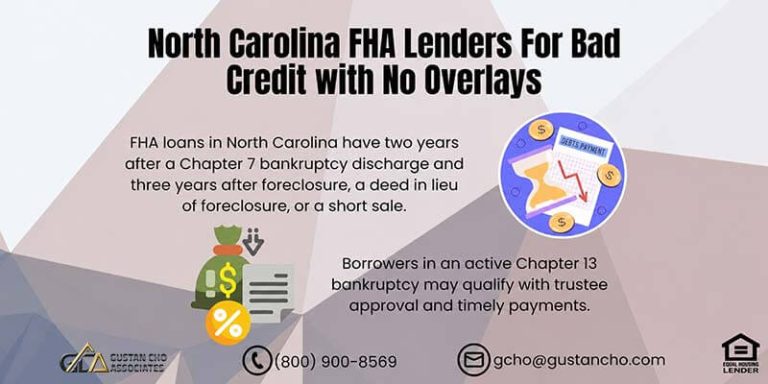
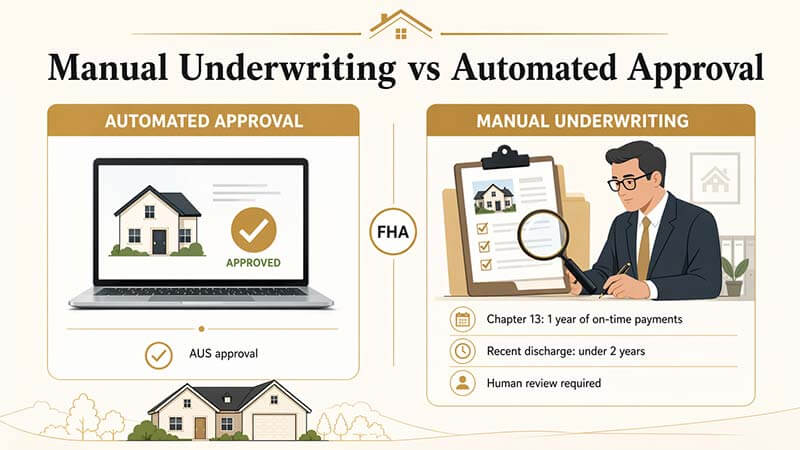
Under FHA Guidelines on Chapter 13 Bankruptcy, a borrower can qualify for FHA loan one year into a Chapter 13 Bankruptcy repayment plan with proof of on-time payments for the past 12 months.
There is no waiting period after the Chapter 13 Bankruptcy discharged date. However, all FHA loans during a Chapter 13 Bankruptcy and any borrower who had a Chapter 13 Bankruptcy discharge but the discharged date has two years or less in seasoning, it needs to be manually underwritten.
Qualify Today for FHA and VA Manual Underwriting Versus Automated Approval
In practice, financial institutions often use a combination of both methods. Automated systems may handle routine applications, while manual underwriting is reserved for cases that don’t fit standard criteria or require a more in-depth analysis.
The choice between manual and automated processes depends on the specific needs, risk tolerance, and priorities of the lending institution.
Borrowers who need to qualify for FHA and VA loans via manual underwriting versus automated approval, contact us at Gustan Cho Associates at 800-900-8569 or text us for a faster response. Or email us at gcho@gustancho.com. We are direct lenders with no overlays licensed in multiple states with a five-star national reputation. The team at Gustan Cho Associates is available 7 days a week, evenings, weekends, and holidays.
Frequently Asked Questions on Manual Underwriting versus Automated Approval
Does Manual Underwriting Mean My Mortgage Will Be Denied?
No. Manual underwriting means a human underwriter must complete a more detailed review. The application may be approved, approved with conditions, suspended for more information, or denied.
Can a Human Underwriter Override an AUS Decision?
An underwriter cannot ignore the mortgage program’s rules. However, the lender may manually underwrite a file when the program and transaction allow it. Corrected information may also be resubmitted to the AUS for a new recommendation.
Does Manual Underwriting Result in a Higher Mortgage Rate?
Manual underwriting alone does not automatically set the interest rate. Pricing depends on the loan program, credit profile, loan amount, property, occupancy, down payment, market conditions, and lender requirements.
Can I Go Through Manual Underwriting Without a Credit Score and Still Qualify?
Some mortgage programs allow borrowers to use non-traditional credit when qualifying. So long as a credit report is generated, the mortgage lender has the authority to review rent, utilities, insurance, and other types of recurring monthly payments.
Does Manual Underwriting Involve Verifying Rent Payments?
This answer depends on the borrower’s credit history. If a borrower has little or no credit and recently experienced a significant credit event, verifying rent payments may be required. If this is the case, the mortgage lender has the right to request canceled checks, bank statements, and/or verification of rent payment from a property management company.
Can a Large Down Payment Ensure I Will Be Approved for Manual Underwriting?
A large down payment can help reduce the risk, but ,on its own, it cannot address an unacceptable credit rating, a volatile income, high debt, missing supporting documents, and/or an unacceptable property.
Can Gift Funds be Utilized with a Manually Underwritten Mortgage?
Gift funds may be permitted for a loan program when the donor, transfer, source, and receipt are properly documented. Gift funds are not a substitute for any required borrower reserves unless the applicable guidelines allow it.
Can I Apply to Different Lenders After Being Declined for Manual Underwriting?
Yes. There is nothing preventing a borrower from shopping around for a lender and/or loan program. If a borrower is shopping around for a mortgage lender and/or loan program, changing lenders will not circumvent a rule that applies to every lender using a specific mortgage program.