Buying again after bankruptcy, foreclosure, or a short sale can feel confusing—especially with so many outdated articles referencing an old HUD pilot. This guide breaks down FHA back to work versus other loan programs, explains what that historical program was, and shows today’s real paths to approval with FHA, Conventional, VA, and Non-QM options. In a few minutes, you’ll know the current waiting periods, costs (MIP vs. PMI), and the fastest route from pre-approval to clear-to-close.
Key Takeaways (Read This First)
- The pilot is over. Understanding FHA back to work versus other loan programs is useful historically, but approvals today rely on current FHA/Conventional/VA/Non-QM rules.
- Today’s FHA basics: Typically 2 years after Chapter 7 discharge, possible during Chapter 13 with manual underwriting, and 3 years after foreclosure/deed-in-lieu/short sale.
- Conventional: Often 4–7 years after major credit events; PMI can be canceled later, which can reduce lifetime cost.
- VA: No monthly PMI; flexible for eligible Veterans with strong residual income.
- Non-QM: Portfolio options with little to no waiting period in some cases; higher rates/fees but powerful for “buy-now, refi-later” strategies.
- Action step: If your timeline is tight, compare the FHA back to work versus other loan programs side-by-side (payment, cash to close, and approval odds).
What Was “Back to Work” and Why People Still Ask About It

The original “Back to Work – Extenuating Circumstances” concept let certain borrowers buy as soon as 12 months after a bankruptcy, foreclosure, deed-in-lieu, or short sale if they:
- Proved a 20%+ household income loss tied to an economic event, and
- Completed HUD-approved housing counseling at least 30 days before application, and
- Demonstrated re-established credit and ability to repay.
Although the pilot is gone, consumers still search for FHA back to work versus other loan programs. The promise—a faster path back to homeownership—remains incredibly compelling. Today, the “spirit” of buying sooner lives on through FHA manual underwriting for Chapter 13 and Non-QM alternatives that fill gaps when agency timelines are too long.
FHA Back to Work Versus Other Loan Programs: The 2025 Reality
To fairly compare the FHA back to work versus other loan programs in 2025, we need to evaluate what you can do now:
FHA (Current Rules)
- Chapter 7 Bankruptcy: Typically, 2 years after discharge with re-established credit and clean recent payment history.
- Chapter 13 Bankruptcy: Possible during the plan after 12 on-time payments, trustee permission, and manual underwriting; no set federal wait after discharge, but files discharged under 2 years generally require manual underwriting.
- Foreclosure / DIL / Short Sale: Commonly 3 years from the recorded/transfer date.
- Down payment: 3.5% with 580+ FICO.
- MIP: Mortgage insurance is required and may last the life of the loan, depending on the down payment and term.
- Use case: Credit is rebuilding, DTI needs flexibility, and the property meets FHA standards.
When buyers ask about FHA back to work versus other loan programs, FHA remains the go-to for many recovering credit profiles because it blends reasonable down payment, flexible DTI, and manual underwriting options.
Conventional (Fannie Mae / Freddie Mac)
- Post-event waits: Typically 4–7 years, depending on the event and whether extenuating circumstances are documented.
- Down payment: Often 3%–5%+ depending on program and profile.
- PMI: Private mortgage insurance applies below 20% down but can be removed later—an important lifetime-cost advantage over FHA.
- Use case: Stronger scores and credit depth, or buyers who want PMI that eventually falls off.
When weighing FHA back to work versus other loan programs, Conventional can win long-term because PMI can be canceled, and pricing improves with higher scores.
VA (For Eligible Veterans/Service Members/Some Surviving Spouses)
- Major perks: No monthly PMI, competitive rates, and underwriting emphasizing residual income.
- Down payment: Often $0 for eligible borrowers, subject to county limits and entitlement.
- Use case: Eligible borrowers seeking low monthly payments and strong approval odds given income/residual guidelines.
In the debate of FHA back to work versus other loan programs, VA is often best for those eligible—lower monthly cost due to no PMI and flexible qualifying.
Non-QM (Portfolio / Alternative Documentation)
- Timelines: In many cases, little to no waiting period after bankruptcy/foreclosure if you have compensating factors (larger down payment, reserves, and clean recent payment history).
- Documentation: Bank-statement loans (12–24 months), 1099-only, asset-depletion, and DSCR for investors.
- Trade-off: Higher rates/fees than agency, but it can be the bridge to buy now, refi later into FHA/Conventional once you season.
For shoppers comparing FHA back to work versus other loan programs, Non-QM is the “speed lane” when timelines are the obstacle.
FHA Back to Work Program vs. Other Loan Programs: Let’s Find the Best Option for You!
Reach out now to compare it with other loan options and find the perfect fit for your needs.
Counseling, Credit Re-Establishment, and Manual Underwriting (What Matters Now)
One reason FHA back to work versus other loan programs drew attention was its mandatory HUD counseling. While that special counseling is no longer required for standard FHA approvals, education still helps—especially if you’re rebuilding credit.
- Counseling benefits: Budgeting, debt management, and homeownership education can translate into better loan terms and fewer surprises.
- Re-establishing credit: On-time payments across a few tradelines, low utilization on credit cards, and no new derogatory events are critical.
- Manual underwriting: For Chapter 13 scenarios or marginal files, manual underwriting looks at compensating factors—reserves, low payment shock, verified rent, stable income, and minimal discretionary debt.
Understanding these ingredients is essential when judging FHA back to work versus other loan programs, because strong compensating factors can unlock approvals sooner than many think.
The Cost Angle: MIP vs. PMI vs. Funding Fee vs. Non-QM Pricing
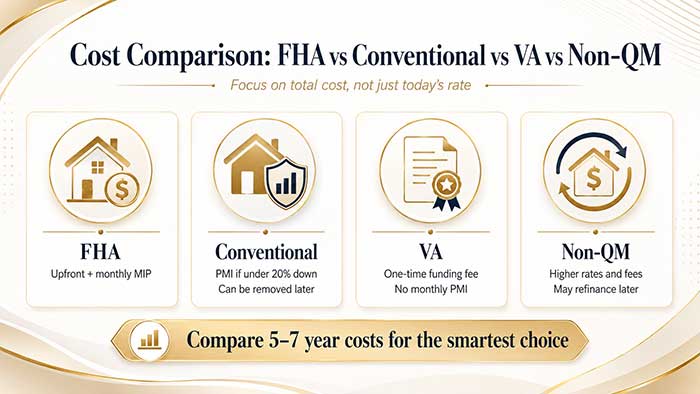
A smart comparison of the FHA back to work versus other loan programs isn’t complete without a cost lens:
- FHA MIP: When you obtain an FHA loan, you must pay an initial fee and a monthly charge known as MIP. Depending on your down payment and the loan duration, you may be obligated to pay MIP for the full term of the loan.
- Conventional PMI: If you choose a conventional loan and pay less than 20% upfront, you’ll have to pay PMI, an extra monthly cost. The good news is that once you pay down your loan to about 78–80% of its value or get an appraisal, you can get rid of PMI.
- VA Funding Fee: For VA loans, there’s a one-time fee that you can often add to your loan amount unless you qualify for an exemption. Your monthly payments generally stay lower because VA loans don’t have monthly PMI.
- Non-QM Pricing: Non-QM loans often have higher interest rates and fees. However, they can help you buy a home quickly. If the value of your home goes up later on, you could refinance to a cheaper FHA or conventional loan, which could save you some cash in the long run.
We routinely model the total cost of FHA back to work versus other loan programs over 5–7 years, including refinance assumptions, so you can make a decision based on real numbers—not just today’s rate.
Real-Life Scenarios (How We Compare Paths)
Scenario 1: Chapter 7 Discharge at 22 Months
- Question: Is there a way to buy now?
- Analysis: For the FHA back to work versus other loan programs, FHA would typically need 24 months after discharge. If the profile is otherwise strong, Non-QM may close now with a plan to refi into FHA in a few months when the clock hits 24.
Scenario 2: In an Active Chapter 13 with 14 On-Time Payments
- Question: Can I qualify without waiting for discharge?
- Analysis: FHA manual underwriting can work during the plan with trustee permission, verified rent, and strong compensating factors. Here, the FHA back to work versus other loan programs tilts toward the FHA immediately.
Scenario 3: Foreclosure Recorded 32 Months Ago, 10% Down Saved
- Question: Do I have to wait a full 36 months?
- Analysis: FHA typically looks for 36 months. If waiting is costly (rents rising, limited inventory), Non-QM may bridge the gap now; we’d plan a refinance to FHA after month 36. A conventional path likely remains further out.
These examples show how comparing the FHA back to work versus other loan programs is practical—not theoretical.
Step-by-Step: Your Fastest Path Back to Homeownership
- Snapshot Call: 10–15 minutes to map your credit event(s), dates, income type, assets, and target payment. We immediately frame the FHA back to work versus other loan programs for your profile.
- Side-by-Side Quotes: FHA vs. Conventional vs. VA (if eligible) vs. Non-QM with payment, APR, cash-to-close, and conditions.
- Approval Strategy: We design a 30–90-day credit/asset tune-up if agency approval is close. If not, we use Non-QM as a bridge.
- Documentation Pack: ID, pay stubs, W-2s/1099s or bank statements, two months’ assets, and BK/foreclosure papers. Chapter 13 needs trustee permission and payment history.
- Clear-to-Close: We aim for fast closings. Then, we calendar your refi window if you used a Non-QM stepping stone.
This process turns the idea of FHA back to work versus other loan programs into a specific, winnable plan.
Final Word and Next Step
Even though the pilot ended, the decision framework of FHA back to work versus other loan programs is still the best way to navigate post-bankruptcy or post-foreclosure financing. The right path balances timeline, payment, cash to close, and approval likelihood—and it often includes a refinance strategy to lower costs later.
We’ll build your personalized FHA back to work versus other loan programs plan and compare FHA, Conventional, VA, and Non-QM side-by-side—so you can buy sooner and smarter.
Borrowers who need a five-star national mortgage company licensed in 48 states with no overlays and who are experts on VA cash-out eligibility guidelines, please contact Gustan Cho Associates at 800-900-8569, text us for a faster response, or email us at alex@gustancho.com.
Frequently Asked Questions About FHA Back to Work Versus Other Loan Programs:
Is “Back to Work” Still Available?
No. But comparing FHA back to work versus other loan programs remains valuable because today’s FHA/VA/Conventional/Non-QM paths can still get you home sooner than you might think.
How Soon After Chapter 7 Can I Buy with FHA?
Usually, 2 years after discharge with re-established credit. If you’re earlier than that, we’ll compare the FHA back to work versus other loan programs and see if Non-QM is a short-term bridge.
Can I Get Approved for Chapter 13?
Yes, often, with manual underwriting after 12 on-time payments and trustee permission. In our FHA back to work versus other loan programs comparison, FHA often wins here.
What About After a Foreclosure or Short Sale?
FHA commonly looks for 3 years. If you’re 24–35 months, our FHA back to work versus other loan programs review will include a Non-QM-now, FHA-later plan.
Why Would I Choose Conventional Instead of FHA?
If you qualify, PMI can be removed later—often cheaper long-term. We’ll show the math in the FHA back to work versus other loan programs worksheet.
What Makes VA so Strong for Eligible Borrowers?
There is no monthly PMI and competitive pricing. In the FHA back to work versus other loan programs, the VA usually wins for those with entitlement.
Is Non-QM Too Expensive?
It’s pricier than agency loans, but speed and flexibility can justify it. We compare the total cost in our FHA back to work program to that of other loan programs so you can clearly decide.
Do I Still Need Special Counseling?
That counseling was tied to the retired pilot. Today, it’s optional but smart; we’ll still cover education tips in our FHA back to work versus other loan programs session.
How do I Raise Approval Odds Fast?
Lower card utilization, verify rent, build reserves, and avoid new lates. These moves help any path in the FHA back to work versus other loan programs.
Can You Really Close Fast?
Yes. We’re known for TBD underwriting and fast tracks. We’ll time closings and future refi windows directly from your FHA back to work versus the other loan programs roadmap.
Related> FHA Back To Work Extenuating Circumstances Mortgage Program
Not Sure If FHA Back to Work Is Right for You? Compare It to Other Loan Options!
Contact us today to compare your options and make an informed decision.
This article about “FHA Back to Work Versus Other Loan Programs” was updated on August 7th, 2025.