This article will cover underwriting credit guidelines during the mortgage process. Mortgage borrowers should not stress during the mortgage process. There is no reason for any pre-approvals to get a last-minute mortgage denial. The main reason for a last-minute mortgage loan denial or stress during the mortgage process is the borrower’s inability to qualify properly with the loan officer.
With a lending network of 300 wholesale lending partners, there is no loan program we do not have at Gustan Cho Associates.
Even with a lower credit score, you might qualify for some loan programs if the rest of your application is strong. On the other hand, a high score does not guarantee approval if you have recent late payments, disputed accounts, undisclosed debts, or unresolved credit issues. As long as the borrower can be properly qualified and pre-approved, all mortgage loans should close 100%. There should not be any stress during the mortgage process. In the following paragraphs, we will cover underwriting credit guidelines during the mortgage process.
What Are Lender Overlays on Mortgage Loans

Mortgage lenders can have lending requirements higher than the minimum agency mortgage guidelines of HUD, VA, USDA, Fannie Mae, and Freddie Mac called lender overlays. It is not illegal for a lender to have higher mortgage guidelines above the minimum agency guidelines on government and conventional loans.
Mortgage Loan Originators Need to Follow Two Important Underwriting Credit Guidelines:
- Federal Minimum Underwriting Credit Guidelines
- Lender Underwriting Credit Guidelines are also known as overlays.
Gustan Cho Associates are mortgage brokers licensed in 48 states, including Washington, DC, Puerto Rico, and the United States Virgin Islands. We have a reputation for being able to do mortgage loans other mortgage companies cannot do.
Underwriting Credit Guidelines During the Mortgage Process
Mortgage approval is not about your credit score. The people who decide if you get a mortgage look at your credit history to see if you can pay back the loan. They check your payment history. If you made any late payments. They also look at accounts and if you have any collections or charge-offs. They even check for bankruptcies and foreclosures.
They also look at disputes and credit inquiries. How much debt you have. They want to know about any changes you made before you closed the loan. Mortgage approval is a deal and underwriters have to follow rules.
You should know how these rules affect your mortgage approval and credit score. Late payments and collections can hurt your chances of getting a mortgage. Disputes and loan conditions are also important.
Fannie Mae says lenders have to check your credit report to make sure it is correct. They have to make sure the information they use to decide if you get a mortgage is accurate. The Federal Housing Administration uses a book called Handbook 4000.1 to make rules about credit and mortgages, for single family homes. Fannie Mae and the Federal Housing Administration have rules that lenders must follow when they give out mortgages.
What Are Underwriting Credit Guidelines?
Underwriting credit guidelines are the rules that lenders use to check the credit risk of a borrower when they are trying to get a mortgage. These rules help lenders figure out if the borrower can get a mortgage what kind of loan they can. If they need to give more documents or explanations. A lot of borrowers are surprised when they get credit conditions even after they have been pre-approved.
The first step is pre-approval. Then the loan gets approval. This happens after the underwriter checks a lot of things. The underwriter checks the credit the income, the assets, the property and the loan program. The underwriter wants to make sure all these things meet the rules of the lender and the agency. The lender and the agency have rules that the credit, the income, the assets, the property and the loan program must follow.
When lenders do credit underwriting they are not just saying yes or no to a loan. They are looking at how the borrower handles their credit. They want to know if late payments were one time mistakes if the borrower has fixed past credit problems and if they are managing their current debts in a responsible way.
Why Credit Matters During the Mortgage Process
Credit matters because it shows how well you managed your money in the past. Lenders want to know that you can handle debt make payments on time and manage a mortgage.
The underwriters look at your credit along with your income, assets, debts, job and the property you want to buy. Credit is one part of the application but it can affect almost everything, about getting approved for a mortgage.
For example your credit can affect what kind of loan you can get the interest rate you pay how much you have to pay upfront if you need mortgage insurance if you need to go through underwriting and how many conditions you have to meet before you can close the deal on your mortgage. Underwriting credit guidelines and credit are very important when you are trying to get a mortgage.
What Do Mortgage Underwriters Review on a Credit Report?
Mortgage underwriters check the credit report, not just the credit score in the middle. The credit report shows how you pay your bills how you manage your debt and what you have been doing with your money lately.
Credit Scores
Credit scores help lenders figure out how risk they are taking.. The score alone does not tell the whole story. Underwriters also look at the accounts that made your score high or low. Fannie Mae has rules about credit scores and credit reports when you use credit. If you do not have traditional credit information there are other rules for nontraditional credit history.
Your Payment History Matters
Payment history is one of the important things that underwriters look at. They want to know if you pay your bills on time. They also want to know if you have made any payments recently.. They want to know if you have been able to get your credit back on track. If you have made payments recently that is a bigger problem than if you made late payments a long time ago. This is because recent late payments might mean you are having problems right now. Underwriters pay attention to late payments on your mortgage than they do to late payments on smaller debts.
How Much Credit You Use
Credit utilization is the amount of credit you use compared to how credit you have available. If you have credit card balances that can hurt your credit score. It can also make lenders worry about how you manage your debt. If you keep your credit card balances low that looks better to lenders than if you have maxed-out credit cards. This is true even if you make your payments on time.
Collections And Charge-Offs
Having collections or charge-offs on your credit report does not always mean you will not get a mortgage.. Underwriters have to look at them. How much they affect your application depends on the type of loan you want the type of account how much you owe and when the collection happened. Different kinds of collections like bills or credit card debt might be treated differently depending on the loan and the lender.
Public Records And Big Credit Problems
Things like bankruptcy, foreclosure or mortgage charge-offs are deals. They usually mean you have to wait a while before you can get a mortgage. You might also need to provide paperwork and show that you have gotten your credit back on track. Fannie Mae requires lenders to check your credit report and public records to find any credit problems. This includes things like bankruptcy, foreclosure or mortgage charge-offs.
Credit Inquiries
If you have applied for credit recently you might need to explain why. Lenders want to know if you have taken on debt since they checked your credit report. This is important because new debt can change how money you have available to pay your mortgage.
Disputed Accounts
If you have disputed accounts, on your credit report that can make things complicated. The credit score might not accurately show how risk you are. You might need to resolve the dispute before you can get a mortgage.
Underwriters look at what you’re disputing how much you owe and how you have been paying your bills. They also want to know if the disputed account affects the automated underwriting system.
Automated Underwriting Versus Manual Underwriting
Most mortgage applications start with automated underwriting. These systems review your credit, income, assets, and debts to give an initial decision. The system may return results such as approve, eligible, accept, refer, or caution, depending on the loan program.
Automated approval does not guarantee full loan approval. The underwriter must still review all documents to ensure consistency and compliance.
Manual underwriting is different. Here, a person reviews your file more closely if you do not get automated approval or if the loan program allows manual review.
Reasons for Considering Manual Underwriting
Manual underwriting may be used if you have little or no credit, recent negative credit, a high debt-to-income ratio, or if your file cannot be reviewed by automated systems. Manual underwriting does not represent a simpler process. It often requires additional documentation and explanations, as well as risk-mitigating factors such as verified rental history, stable employment, reduced payment shock, and additional savings.
Compensating Factors in Credit Underwriting
Compensating factors include a history of on-time housing payments, savings, steady income, low payment shock, and stable employment. These elements can help offset certain risks within the application. VA credit underwriting considers a borrower’s overall financial picture. VA also states that automated underwriting is just a process, and the underwriter still plays a key role in the evaluation. Lack of credit is not unfavorable in VA’s view, and VA will also consider explanations for bad credit.
How Mortgage Underwriters View Borrowers with Late Payments
Underwriters evaluate the frequency and sequence of late payments, as well as whether timely payments have resumed, when making loan decisions. Late payments hurt your application more than older ones. Underwriters pay close attention to late payments on your mortgage, rent, or loans because these are big financial commitments.
Recent multiple late payments have a greater negative impact than older late payments. Underwriters focus on late mortgage, rent, and loan payments because they are major financial obligations.
Fannie Mae requires lenders to account for borrowers’ past payment experiences, the severity of their past mortgage payment delinquencies, and the recency of those delinquencies. Fannie Mae says that a borrower has a history of paying mortgages if they were late with their payments by at least 60 days more than once in the year before they applied for a loan.
Credit Guidelines for FHA, VA, Conventional, and Non-QM Loans
Each type of loan has its rules for credit. The borrowers credit score, the kind of credit they have and how debt they have compared to their income along with the down payment the type of property and how risky the loan is, all help decide which loan is best for them.
Federal Minimum Underwriting Credit Guidelines
Credit / Underwriting guidelines in the mortgage application process: Federal Minimum Underwriting Credit Guidelines are the minimum mortgage guidelines set by specific mortgage programs. There are government loans and conventional loans. Government Loans are owner-occupant mortgage loan programs guaranteed by a government agency.
Got Credit Conditions? Clear Them Faster
Upload your conditions list and we’ll explain what the underwriter needs and how to respond correctly the first time to avoid delays.
Underwriting Credit Guidelines on Government Loans
Here are the Three Government Loan Programs:
- HUD, the parent of FHA, insures and guarantees all FHA loans to lenders who originate and fund FHA loans.
- The United States of Veteran Affairs (VA) insures all VA loans that are originated and funded by VA-approved private banks and lenders.
- Department of Agriculture is the federal agency that insures and guarantees against loss on all USDA loans.
For the government agency to guarantee government loans, the financial institution must follow its minimum federal Underwriting Credit Guidelines.
Fannie Mae Underwriting Credit Guidelines on Conventional Loans
Any government agency does not guarantee conventional loans. Any conventional loans with less than 20% equity require private mortgage insurance. Any conventional loans that banks and private lenders originate need to conform to Fannie Mae and Freddie Mac Underwriting Credit Guidelines for Fannie/Freddie to purchase these loans on the secondary market.
Credit Report and Credit Scores
All government loan programs and conventional loans have minimum credit score minimum requirements. Just because borrowers meet the minimum credit score requirements does not automatically qualify them for a loan program. The Automated Underwriting System will thoroughly review and analyze each borrower’s credit report. A tri-merge credit report is required on all mortgage loan programs.
FHA Credit Underwriting Guidelines
People who do not have a lot of money saved and have low credit scores often use FHA loans. When someone applies for an FHA loan the lender looks at their credit history how money they make what they own how much debt they have and if they can pay back the loan. They do this with a computer and also by hand. If someone has a time paying bills on time and does not have a lot of credit history they usually have to give the lender more information and show that they are responsible in other ways. This is because they are considered a risk for not paying back the loan. FHA loans are often used by borrowers with credit scores and the FHA loan guidelines are very specific. The FHA loan guidelines include the credit history, income, assets, debt-, to-income ratio and repayment ability of the borrower and these guidelines are used for both automated and manual underwriting of FHA loans.
VA Credit Underwriting Guidelines
VA loans are available to qualifying veterans, active service members, and certain surviving spouses. VA underwriting relies heavily on residual income and credit history. Unlike other lending programs, the VA does not establish a minimum credit score. As a result, different lenders may reach different decisions about the same VA applicant or VA borrower.
Typical Credit Underwriting Standards
For loans lenders follow rules set by Fannie Mae or Freddie Mac. These loans mainly use computer underwriting results, your credit score, mortgage payment history, debt compared to income, savings and overall credit strength. Regular loans can be more strict if you’ve had credit problems like bankruptcy, foreclosure, short sale or deed-in-lieu. If you’ve had mortgage payments you might have fewer choices.
Non-QM Credit Underwriting Standards
Non-QM loans help borrowers who don’t fit loan rules. This includes self-employed people, real estate investors, those who’ve had credit issues and those who need different ways to show income. Non-QM loans can be more flexible. Each lender or investor has their own rules. They might want a down payment or stricter pricing than government or regular loans.
Assistance is Available for Understanding Credit Prior to Underwriting.
Gustan Cho Associates can analyze your credit, income, and assets, and help identify loan options before you get too far into the mortgage process. Call 800-900-8569 or go to www.gustancho.com. Speak to a licensed mortgage loan originator.
What are Common Credit Conditions during Underwriting?
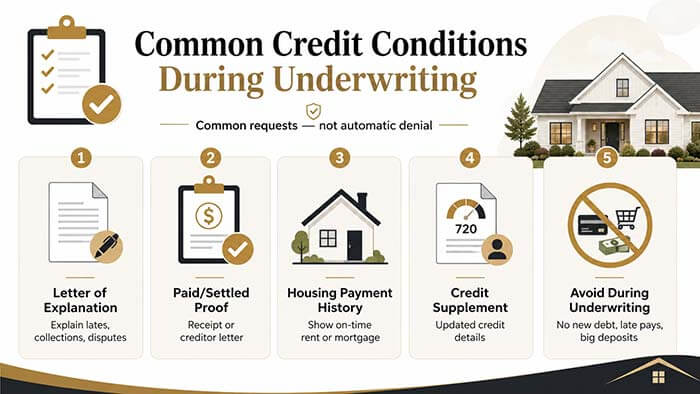
Underwriters give credit conditions when they need information or papers. This happens a lot during the mortgage process. It doesn’t mean the loan is in trouble.
What is a Letter of Explanation for Credit Issues?
A Letter of Explanation is needed to explain credit problems, like payments, collections, charge-offs, disputes, inquiries, bankruptcy, foreclosure or missing credit history. Letters of explanation should be short and truthful clearly stating what happened why it happened and what was done to fix it.
Paid/Settled Accounts
The underwriter may request proof that an account was paid, settled, or resolved. This could include a paid receipt, an updated credit report, a letter from the creditor, or other proof of payment. Collections should NOT be paid by a borrower during the mortgage process unless specifically instructed to do so by a loan officer/underwriter. Old accounts can be reported with a new activity date and can negatively impact the credit score.
Verification of Housing Payment
When you are applying for a mortgage, a consistent history of paying your housing payments on time is really important. This is especially true when your application is being reviewed manually by the lender. The lender might ask you to prove this by filling out a rent form or by showing them records from your property manager or by giving them copies of canceled checks and bank statements.
Credit Supplement or Revised Credit Report
A lender might request a credit supplement for more details after an account is updated. This could happen after a payment, a balance change, a dispute removal, or an account verification.
What Borrowers Should Avoid During Underwriting
Applicants should exercise caution with credit activity between pre-approval and closing. Changes in credit during this period may delay or adversely affect the loan process. Opening new credit accounts during the mortgage process, including car or furniture purchases on finance or co-signing, should be avoided.
Payments should be made on time, unexplained funds should not be deposited, and credit card balances should not increase.
Even small changes can make a difference in the mortgage process. For example if your monthly payments change it can affect how debt you have compared to how much money you make. If there are changes in your credit history you might have to write a letter explaining what happened.. If you have high balances on your credit cards it can lower your credit score.
The Underwriter’s Perspective on Credit Risk
Underwriters assess multiple layers of risk.
- While a single issue may be acceptable, multiple issues can complicate the application.
- The owner may be acceptable despite a lower credit score due to several positive factors, like sufficient savings and a positive history.
- Conversely, a high-credit-score borrower may present several negative factors, such as high credit card debt and insufficient savings, and therefore be more likely to be declined.
-
The main goal of the person reviewing your mortgage application is to figure out if you can really afford to pay back the loan. So it is an idea to work on improving your credit before you even apply for a mortgage. This can help you avoid any surprises and make it more likely that your application will be approved.
-
First you should check your credit reports to make sure all the information is correct. Shows your real history. Then you should make sure to pay all your credit accounts on time and keep your credit card debt low, as possible.
- Avoid incurring new debt. Resolve credit report disputes in consultation with a mortgage professional to prevent potential negative effects on the mortgage application.
Underwriting Credit Guidelines on Tri-Merger Mortgage Credit Reports
A Tri-Merge Credit Report is a Credit Report from all Three Major Credit Bureaus:
For FHA and VA Streamline Refinance Mortgage transactions, it is used solely to validate the credit score.
Credit Scores Used by Mortgage Lenders
Lenders Use the Middle Credit Score of Borrowers:
- If there are multiple borrowers, whether they are co-borrowers or non-occupant co-borrowers, then the lowest borrower’s middle credit scores are the credit scores used for qualification purposes
- If a borrower has three credit scores and two out of the three credit scores are the lower scores, those lower duplicate credit scores are used for qualification purposes by underwriters
- If a borrower has only one credit score, then that score is used to qualify by mortgage underwriters.
Lender Overlays Versus Agency Underwriting Credit Guidelines
As mentioned, there are two types of underwriting credit guidelines:
- Federal Minimum Underwriting Credit Guidelines
- Lender Overlays
Gustan Cho Associates has no lender overlays on government and conventional loans. So lender overlays are not an issue with our borrowers. However, most lenders have overlays. What overlays are additional mortgage guidelines above and beyond those of federal minimum underwriting credit guidelines.
Common Overlays by Mortgage Lenders
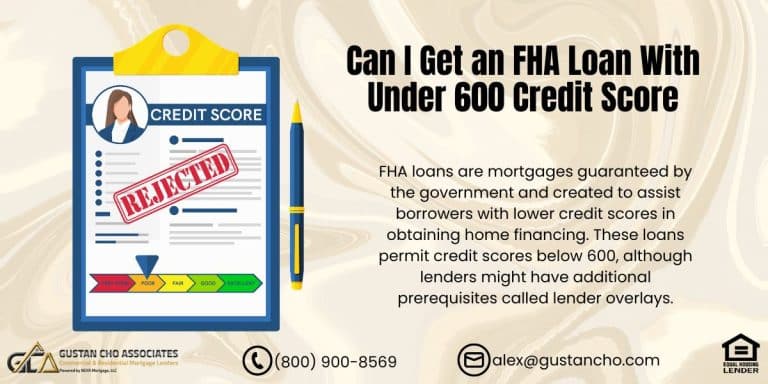
In this section, we will cover common overlays imposed by mortgage lenders. HUD, the parent of FHA, requires a minimum credit score of 580 to qualify for FHA Loans with a 3.5% down payment on home purchases.
A lender can require a higher than 580 credit scores, such as 620 or 640, for a 3.5% down payment FHA home purchase loan. In the above example, the lender has overlays on credit scores. Another example is that most lenders have FHA DTI Overlays requiring a maximum of 45% to 50% debt-to-income ratio caps. However according to HUD rules a borrower can get approved through an Automated Underwriting System with a front-end debt-to-income ratio of 46.9% and a back-end debt-to-income ratio of 56.9%.
For example HUD does not require borrowers to pay off collections and charge off accounts to qualify for FHA loans no matter how much they owe. However, most lenders have overlays on collections and charge-off accounts where they require them to have it paid off and a cap on the maximum outstanding balance they can have, even though HUD does not require it.
Best Lenders for Bad Credit with No Overlays
Gustan Cho Associates is a full-service mortgage broker licensed in 48 states with no overlays on government and conventional loans. Borrowers who need a five-star lender with no overlays can contact us at 800-900-8569 or text us for a faster response.
Most lenders require a minimum of 620 credit scores on VA loans. However, VA does not have any credit score requirements on VA loans.
Most VA lenders have debt-to-income ratio requirements on VA loans, such as a cap of 41% to 50% DTI. However, VA does not have any debt-to-income ratio requirements on VA loans, you can email us at gcho@gustancho.com. The FHA Bad Credit Lenders team is available seven days a week, evenings, weekends, and holidays. We are proud to say that we have closed 100% of our pre-approvals and have zero mortgage lender overlays. We go off automated findings.
Importance of Lender Overlays
Agency guidelines set the rules for mortgages. Lender overlays are rules that individual lenders may add. Some loan programs have credit requirements.. A lender might still ask for a higher credit score. They might want a payment history. They might want a debt-to-income ratio.. They might want more savings. This explains why one lender may approve an application. While another does not. An applicant may meet agency guidelines.. Not a specific lenders additional requirements.
How Gustan Cho Associates Can Help Borrowers with Credit Issues
Gustan Cho Associates reviews the borrower’s complete profile to determine which loan program is the best fit. This may include the borrower’s credit score, payment history, collections, bankruptcies and foreclosures, rental history, income and assets, reserves, and DTI ratio. Many of these files may even be eligible for manual underwriting and/or another loan program.
The objective is to put the borrower on the most appropriate and realistic loan path, based on actual facts, not on speculation. Some files may even meet requirements with automated underwriting.
If you are facing credit challenges and seeking a plan for mortgage approval help is available. You can contact Gustan Cho Associates at 800-900-8569. Visit www.gustancho.com. A licensed mortgage professional will review your situation. They will assist in identifying the suitable path forward.
Final Thoughts on Underwriting Credit Guidelines
Underwriting credit guidelines are very important. They help lenders assess repayment risk. Underwriters evaluate more than the credit score. They review payment history. They look at account balances. They check for payments. They look at collections. They review records. They check for disputes. They look at inquiries. They review credit events.
To minimize the risk of delays prepare in advance. Make sure your credit history and scores are accurate. Avoid debts. Bring all payments up to date. Work with a mortgage team. They should be familiar, with loan programs. A organized file is more likely to be approved by the underwriter.
Frequently Asked Questions for Underwriting Credit Guidelines
Can I Be Denied a Mortgage After an Underwriter Reviews My Credit?
Yes, a mortgage can be denied after underwriting reviews the credit. If late payments are documented, debts were not disclosed, the credit score changed, disputes are still pending, new debt was incurred, or negative credit was documented in a major way, the file would not be in compliance with the loan program, lender, or investor.
Will the Underwriter Pull a Credit Again Before the Mortgage is Closed?
Some lenders run a credit check before closing the loan. Some lenders do not do a credit check until after the loan is closed. During that period, the potential borrower is advised against incurring new credit. A new late payment, a new debt, or a higher debt would require the loan to be reviewed again.
Will I Be Approved with Collections on My Credit Report?
Yes, you can still be approved with collections. However, which collections you have, the collection balance, when the collections were incurred, the nature of the collections, and the rest of your credit report will affect your approval status. Some collections can be documented or explained to be no longer collection accounts, while others will require payment.
Do Underwriters Consider Late Payments from the Distant Past?
Old late payments are not as important as the ones but they can still hurt your credit score. When people check your payments they look at how long it has been since you paid late how often you paid late and if you have been paying on time lately.
Do Disputed Accounts Cause a Delay in Mortgage Approval?
Definitely. Because of the abbreviated credit history and disputed accounts, the full scope of risk may not be presented. To proceed, the lender may require that some disputes be withdrawn or documented. During the mortgage process you should talk to your loan officer about any problems, with your accounts.
What Will Happen if My Credit Score Declines During the Underwriting Process?
If your credit score gets worse while they are checking your loan the lender might have to look at whether you can get the loan how much it will cost, if you need mortgage insurance and what the rules are. If your credit score gets worse during this time it does not mean you will not get the loan.
Can I Still Apply for a Mortgage if I Don’t Have a Credit Score?
Some people get a mortgage even if they do not have a credit score. It is not weird for this to happen. However, the file will need to be better substantiated. Some lenders will accept a non-traditional credit score, again substantiated by other documented credit history, including timely payments for housing, utilities, insurance, and telecommunications, and verified payment histories. The acceptance of non-traditional credit scores depends heavily on the lender and the mortgage being sought.
Last Updated: June 3, 2026
Ready to Move Forward? Get Pre-Approved the Right Way
Complete a quick application or upload documents. We’ll confirm the best program and guide you through underwriting with fewer surprises.