Temporary unemployment mortgage guidelines help homebuyers understand how a job loss, layoff, furlough, or employment gap can affect mortgage approval. In most cases, borrowers cannot qualify for a mortgage while unemployed unless they have another acceptable source of income. Mortgage lenders need to verify stable income, current employment, credit history, debt-to-income ratio, and the ability to repay the new home loan.
The good news is that temporary unemployment does not always end your homebuying plans. If you return to work, start a new job, or have another qualified income source, you may still qualify for FHA, VA, USDA, conventional, or non-QM mortgage options.
The key is documenting your employment gap, showing that your income is stable, and avoiding late payments while you are out of work.
In this guide, we will discuss how temporary unemployment mortgage guidelines work, whether unemployment income can be used for a mortgage, how long you may need to be back at work, what documents lenders may ask for, and what steps you can take to protect your mortgage approval after a temporary job loss.
How Temporary Unemployment Affects Mortgage Approval

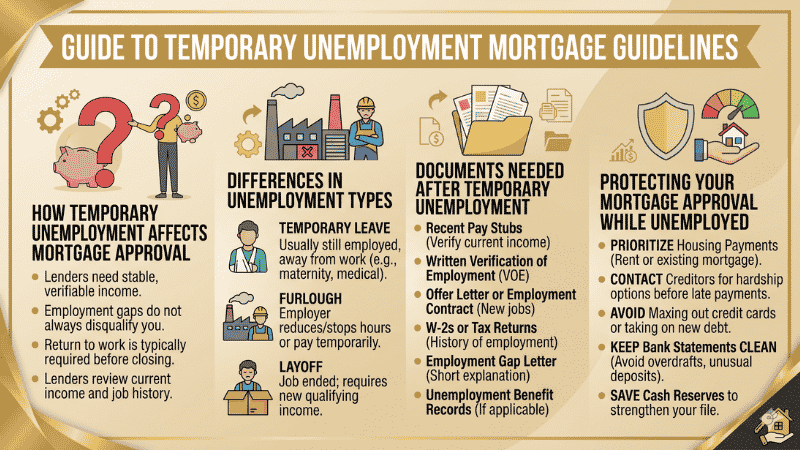
Temporary unemployment can affect mortgage approval because lenders must verify that you have stable income and the ability to repay the new home loan. A past layoff, furlough, or short employment gap does not automatically disqualify you from buying a home. What matters most is your current income, your return-to-work status, and whether the lender can document that your income is likely to continue.
In most cases, borrowers need to be back to work before they can close on a mortgage. Lenders may ask for recent pay stubs, a written verification of employment, an offer letter, or a letter explaining the employment gap. If you returned to the same employer, the process may be easier because your job history is more consistent. If you started a new job, the lender will review your new income, job stability, and whether the employment gap creates additional risk.
Under temporary unemployment mortgage guidelines, the main question is not only whether you were unemployed, but also whether you were unemployed for a certain period. The bigger question is whether you now have a stable, documented, and qualifying income. Borrowers who protect their credit, avoid new late payments, maintain cash reserves, and return to steady employment may still qualify for FHA, VA, USDA, conventional, or non-QM loan options after temporary unemployment.
Temporary Leave vs. Furlough vs. Layoff: Why It Matters
Temporary leave, furlough, and layoff are not the same thing in mortgage underwriting. This matters because lenders do not review every
the same way. Under temporary unemployment mortgage guidelines, the borrower’s situation must be clearly documented before the lender can decide whether the income can be used to qualify.
Temporary leave usually means the borrower is still employed but temporarily away from work. This may include maternity, medical, family, short-term disability, or another approved leave of absence. The borrower may still have a job to return to, even if the income is reduced during the leave.
Furlough usually means the employer temporarily reduces or stops the borrower’s work hours or pay. The borrower may expect to return to work, but the income may not be active at the time of underwriting. This can create a problem because lenders need stable, current, and verifiable income.
A layoff usually means the job ended. Even if the employer hopes to rehire the borrower later, the lender may treat this differently from an approved temporary leave. A borrower who was laid off may need to return to work, start a new job, or qualify with another acceptable income source before getting mortgage approval.
Seasonal unemployment can be different. Some workers have predictable off-season periods during which they receive unemployment benefits. This may apply to certain construction workers, school employees, union workers, or other seasonal jobs. Seasonal unemployment may be considered only when it is normal for the borrower’s line of work, properly documented, and supported by a history of receiving that income.
Permanent job loss is different from temporary unemployment. If the borrower does not have a job to return to, the lender will usually need to see new qualifying income or another acceptable income source. A return-to-work date alone may not be enough if the borrower cannot document stable income.
Fannie Mae has specific guidelines regarding temporary unemployment for mortgage applications. If a borrower is on temporary leave at the time of closing and their income is essential to qualification, the lender must assess whether that income can be used and whether the borrower will return to work by the due date of the first mortgage payment.
It’s important to note that Fannie Mae classifies employer-initiated leave, like furloughs or layoffs, as distinct from temporary leave, even if there’s an anticipated return date. Freddie Mac offers similar guidance, indicating that its temporary unemployment mortgage guidelines do not apply to employer-initiated furloughs and layoffs.
Therefore, borrowers should avoid vague statements like, “I was temporarily unemployed.” Lenders require precise information about the situation. A borrower on maternity leave, a furloughed employee, a laid-off worker, or a seasonal staff member will all undergo different evaluations. Providing the correct documentation can significantly improve the smoothness of the approval process, reducing delays in the loan file.
Can You Get A Mortgage While Unemployed?
Most borrowers cannot qualify for a new home loan solely on unemployment benefits. Mortgage lenders need stable, verifiable income that can be documented and is expected to continue. If the borrower has no current job and no other acceptable income source, it will usually be difficult to get approved for a mortgage.
However, being unemployed does not always mean the entire household cannot qualify. A borrower may still qualify if there is another eligible source of income.
This may include income from a spouse or co-borrower, retirement income, disability income, rental income, investment income, alimony, child support, pension income, or other documented income the lender can use for qualification.
Seasonal unemployment may also be treated differently. For example, some seasonal workers receive unemployment benefits during the normal off-season. In that case, the lender may review the borrower’s history of seasonal work, tax returns, unemployment income history, and whether the income pattern is likely to continue.
Under temporary unemployment mortgage guidelines, the key issue is not just whether you are unemployed today. The real question is whether the lender can document enough stable qualifying income to show you can afford the new mortgage payment. Fannie Mae states that the income used to qualify must be stable, documented, and reasonably expected to continue.
Temporary Unemployment Mortgage Guidelines for Homebuyers
When a borrower encounters temporary unemployment, mortgage lenders have established guidelines and considerations for approving or modifying an existing mortgage loan. These temporary unemployment mortgage guidelines typically require lenders to obtain documentation verifying the borrower’s unemployment status, such as termination letters, severance agreements, or statements of unemployment benefits.
Employment History
A solid employment history prior to the unemployment period can work in the borrower’s favor. Lenders prefer to see at least 2 years of consistent employment before the job loss. Lenders will evaluate any alternative income sources the borrower may have, such as severance pay, unemployment benefits, investment income, or spousal income.
For existing mortgages, lenders may offer loan modifications or forbearance plans to temporarily reduce or suspend payments until the borrower regains employment.
If the borrower has already secured a new job, lenders will assess the income continuity and stability of the new employment. A strong credit history and low debt-to-income ratio before unemployment can increase the lender’s confidence in the borrower’s ability to recover financially. Borrowers may need to provide a detailed plan outlining their job search efforts and prospects for new employment.
Waiting Period Guidelines After Unemployment
Some lenders may require 6 to 12 months of steady income from new employment before approving a mortgage. Temporary unemployment mortgage guidelines can vary significantly across loan programs—FHA and VA loans often offer more lenient standards than conventional loans. While specific requirements vary by lender, they generally focus on evaluating the borrower’s capacity to resume mortgage payments within a reasonable timeframe after temporary unemployment. Maintaining open communication with the lender and supplying thorough documentation are essential during these circumstances.
The Importance of Credit and Employment
Credit and employment are the two main factors when it comes to qualifying for a home mortgage. The borrower’s credit history and scores show the past pattern of the borrower’s payment patterns over time. This is how lenders determine the borrower’s potential payment on a new home mortgage by judging their prior payment history.
Employment history and employment are important due to income and the ability to repay. The ability of the borrower to be employed for the next three years is taken under serious consideration.
What good is it if a borrower gets laid off as soon as he or she closes on their home mortgage. It will be impossible to get a mortgage if you are unemployed. This holds true whether it is temporary or permanent unemployment. However, right after the borrower starts a new job, they can qualify for a home mortgage.
Mortgage Employment Gap Guidelines After Temporary Unemployment
Mortgage employment gap guidelines after temporary unemployment depend on the loan program, the length of the job gap, the borrower’s current employment, and whether the income is stable enough to continue. A short layoff, furlough, or temporary job loss does not always stop a mortgage approval. However, lenders will review the full employment history. They may ask for a written explanation if the borrower was unemployed.
Under temporary unemployment mortgage guidelines, the most important issue is current qualifying income. Lenders want to know whether the borrower is back to work, earning a stable income, and able to make the new mortgage payment. If the borrower returned to the same employer, the file may be easier to document. If the borrower has started a new job, the lender may review the job offer, the borrower’s first pay stub, written verification of employment, and whether the new job is in the same or a related line of work.
Conventional Loan Employment Gap Guidelines
Conventional loans may require closer review when the borrower has an employment gap during the most recent 12 months. Fannie Mae states that borrowers with employment gaps in the most recent 12 months may appear to have unstable employment, so lenders must carefully review the borrower’s current employment and ensure it is likely to continue.
This does not mean every employment gap is a denial. A borrower who has returned to work and can document stable income may still qualify. The lender might ask for a letter of explanation, recent pay stubs, W-2s, tax returns, and verification of employment. The stronger the borrower’s current income, credit profile, assets, and overall file, the easier it may be to overcome a temporary employment gap.
FHA Loan Employment Gap Guidelines
FHA loans may be more flexible for borrowers with temporary unemployment, but lenders still need to verify stable, reliable income. FHA lenders review the borrower’s employment history, current job, income stability, and ability to repay the mortgage. The borrower generally needs to be back to work and earning qualifying income before the loan can close.
If the borrower had a job gap, the lender may ask why the gap happened, how long the borrower was unemployed, and whether the borrower is now working again. FHA does not automatically deny a borrower just because there was a past employment gap, but the income used for qualification must be documented and acceptable under FHA underwriting rules. HUD’s FHA Single Family Housing Policy Handbook is the main source lenders use for FHA underwriting requirements.
VA Loan Employment Gap Guidelines
VA loans focus heavily on stable and reliable income, residual income, and the borrower’s ability to afford the mortgage after paying regular monthly obligations. The VA lender must determine that income is verifiable, stable, reliable, and expected to continue.
A temporary job loss does not automatically prevent a veteran or eligible borrower from qualifying for a VA loan. However, the borrower generally needs qualifying income at the time of approval. The lender may review the borrower’s current job, work history, credit, debt-to-income ratio, residual income, and any explanation for the employment gap. A strong residual income position can help support the file, but it does not replace the need for acceptable qualifying income.
USDA Loan Employment Gap Guidelines
USDA loans also require stable and dependable repayment income. USDA guidance explains that repayment income is the stable and dependable income of the applicants who will be parties to the note.
For borrowers who have had temporary unemployment, the USDA lender will review whether the borrower has returned to work, whether the income is reliable, and whether the borrower can afford the new housing payment. The lender may request pay stubs, W-2s, written verification of employment, tax returns, and a letter explaining the job gap. USDA loans also have household income and property eligibility rules, so the employment gap is only one part of the full approval review.
Simple Rule For Borrowers After Temporary Unemployment
The safest rule is this: do not assume a job gap automatically disqualifies you, but do not assume unemployment income alone will qualify you either. Most borrowers need to be back to work with stable, documented income before closing on a mortgage.
A borrower may have a stronger chance of approval after temporary unemployment when they can show:
- They returned to work or started a stable new job.
- They can provide recent pay stubs.
- They can explain the employment gap.
- They avoided late payments during unemployment.
- They kept debt under control.
- They have enough income to meet debt-to-income requirements.
- They have reserves or savings after closing.
This is why temporary unemployment mortgage guidelines should be reviewed before applying. The right answer depends on the loan program, the length of the employment gap, the borrower’s current income, and the overall strength of the mortgage file.
Documents Needed After Temporary Unemployment
After temporary unemployment, lenders need documents that prove you are back to work, earning a stable income, and able to afford the new mortgage payment. Having these documents ready can make the mortgage process smoother and reduce delays.
Recent Pay Stubs
Provide recent pay stubs after returning to work. This helps the lender verify your current income, hours, pay rate, and year-to-date earnings.
Written Verification Of Employment
The lender may contact your employer or request a written verification of employment. This confirms your job status, start date, position, and income.
Offer Letter Or Employment Contract
If you just landed a new job after being out of work, the lender might want to see your offer letter or job contract. This can help document your new income before you have a long history of pay stubs.
W-2s Or Tax Returns
W-2s and tax returns help show your past employment and income history. Self-employed borrowers may need personal and business tax returns.
Employment Gap Letter
You may need to write a short letter explaining why you were unemployed, how long the gap lasted, and when you returned to work.
Unemployment Benefit History
If you received unemployment benefits, keep records of the payments. This may help explain the income gap, especially for seasonal workers.
Termination, Layoff, Or Furlough Notice
If available, provide the letter from your employer showing whether you were laid off, furloughed, temporarily released, or permanently terminated.
Bank Statements Showing Reserves
Bank statements can show cash reserves after unemployment. Extra savings may help strengthen the file.
Proof Of Rent Or Mortgage Payment History
Lenders may want to see that you kept your housing payments current during unemployment. This may include canceled checks, bank records, rent receipts, or a rent verification.
Bottom Line
Under temporary unemployment mortgage guidelines, documentation matters. The stronger your paper trail is, the easier it is for the lender to understand your employment gap and verify that your income is stable again.
How To Protect Your Mortgage Approval During Unemployment
Protecting your credit during unemployment is one of the most important steps you can take if you plan to buy a home after returning to work. Under temporary unemployment mortgage guidelines, lenders will review your employment history, income, credit, debt-to-income ratio, and overall ability to repay the mortgage. A temporary job loss may not automatically disqualify you, but new late payments, higher debt, overdrafts, or unstable bank activity can make approval more difficult.
If money is tight, try to protect your housing payment first. A recent late rent payment or mortgage payment can create a major underwriting concern because lenders want to see that you can manage housing debt.
If you cannot pay everything in full, contact creditors before accounts become late and ask about hardship options. Do not ignore bills; if there is another option, let late payments report.
Avoid maxing out credit cards while unemployed. Higher credit card balances can lower credit scores and increase your debt-to-income ratio. Even if you make the minimum payments, higher balances may make the loan harder to approve. Try to keep available credit open and avoid using credit cards for large purchases before applying for a mortgage.
Keep your bank statements as clean as possible. Lenders may review recent bank statements for overdrafts, unusual deposits, insufficient funds, and large unexplained withdrawals. Overdrafts do not always mean a denial, but they can raise questions about financial stability. Saving cash reserves during unemployment can also help strengthen your file once you return to work.
Do not take on new debt before applying. A new auto loan, personal loan, credit card, or large monthly payment can hurt your buying power. Even a small new debt can affect your debt-to-income ratio if the file is already close to the limit.
Finally, document the reason for the job gap. Keep layoff notices, furlough letters, unemployment benefit records, return-to-work letters, offer letters, and recent pay stubs. A clear paper trail helps the lender understand that the unemployment period was temporary and that you now have a stable income again. This is a more helpful approach than assuming one late payment automatically ruins your mortgage chances. Late payments are serious, but the impact depends on the loan program, credit history, timing, severity, AUS findings, and whether the loan needs manual underwriting.
Final Thoughts On Temporary Unemployment Mortgage Guidelines
Temporary unemployment does not always end your homebuying plans. The key is whether you are back to work, have a stable qualifying income, can explain the employment gap, and meet the credit, debt-to-income ratio, asset, and loan program requirements.
Before applying, gather your recent pay stubs, employment documents, bank statements, and a short letter explaining the job gap. The cleaner your documentation is, the easier it is for the lender to review your file and determine your next step.
Under temporary unemployment mortgage guidelines, every borrower’s situation is different. A borrower who returned to the same employer may be reviewed differently from someone who started a new job, changed industries, was furloughed, or experienced seasonal unemployment.
If you were temporarily unemployed and want to buy a home, Gustan Cho Associates can review your mortgage options and help you understand whether you may qualify now or need more time back on the job.
FAQs: Temporary Unemployment Mortgage Guidelines
Can I Get A Mortgage After Being Temporarily Unemployed?
- Yes, you may be able to get a mortgage after temporary unemployment if you are back to work and can document a stable, qualifying income. Lenders will review your current job, employment gap, credit, debt-to-income ratio, assets, and whether your income is likely to continue. Fannie Mae says borrowers must qualify with income that the lender can reasonably expect to continue.
Can I Get A Mortgage While Unemployed?
- Most borrowers cannot qualify for a mortgage solely on unemployment benefits. However, you may still qualify if you have another acceptable income source, such as a co-borrower’s income, retirement income, disability income, rental income, investment income, pension income, or documented seasonal unemployment income.
How Long Do I Need To Be Back At Work After Unemployment To Get A Mortgage?
- It depends on the loan program, the length of the employment gap, and the strength of your file. A short job gap may be easier to explain if you returned to work and have current pay stubs. A longer employment gap may require additional documentation, such as a written explanation, verification of employment, and proof of your current income stability.
Does An Employment Gap Hurt Mortgage Approval?
- An employment gap can lead to additional underwriting review, but it does not always result in denial. Lenders want to know why the gap happened, how long it lasted, whether you are back to work, and whether your income is likely to continue. A clear letter of explanation and supporting documents can help the lender understand the file.
Can Unemployment Income Count For A Mortgage?
- Usually, temporary unemployment income cannot be used as regular qualifying income. Seasonal workers may be different if unemployment income is normal for their line of work and has been documented over time. FHA guidance allows unemployment income to be considered for borrowers with effective income from seasonal employment when the required history and documentation are met.
What Documents Do Lenders Need After Temporary Unemployment?
- Lenders may ask for recent pay stubs, a written verification of employment, an offer letter, W-2s, tax returns, bank statements, a letter explaining the job gap, unemployment benefit records, and proof of rent or mortgage payment history. A lender may also verify employment directly with your employer before closing.
This article about “Temporary Unemployment Mortgage Guidelines” was updated on May 13th, 2026.
Temporarily Unemployed and Worried About Your Mortgage?
Learn how temporary unemployment mortgage guidelines really work before you panic