Can you get a conventional loan with a down payment of 3%?
Yes. Qualified borrowers may obtain a 3 percent down payment conventional loan to purchase a one-unit primary residence. Available options include Fannie Mae Standard 97 and HomeReady, as well as Freddie Mac HomeOne and Home Possible. Eligibility depends on the program and may include first-time homebuyer, income, property, homebuyer education, and automated underwriting requirements. Because the loan finances 97% of the home’s value, private mortgage insurance is generally required.
What Is a 3 Percent Down Payment Conventional Loan?
A 3 percent down payment conventional loan allows an eligible borrower to finance up to 97% of a home’s value with a mortgage purchased by Fannie Mae or Freddie Mac. When it comes to a purchase, the loan-to-value ratio typically relies on whichever is lower: the purchase price or the appraised value.
These programs are intended for eligible one-unit primary residences. They are not permissible for the purchase of secondary residences or properties intended for investment. Depending on the program, eligibility may be affected by first-time homebuyer status, household or qualifying income, property type, homebuyer education, and automated underwriting findings.
The 3% down payment does not include closing costs or prepaid expenses. Borrowers must account for those costs separately, although eligible gift funds, down-payment assistance, seller concessions, or lender credits may help. Private mortgage insurance is generally required because the loan exceeds 80% of the property’s value.
Who Is Considered a First-Time Homebuyer?
For conventional mortgage purposes, a first-time homebuyer generally is someone who has not held an ownership interest—individually or jointly—in a residential property during the three years before the new home purchase. A borrower may therefore qualify as a first-time buyer even if they owned a home more than three years ago. First-time homebuyer status matters because certain 3 percent down payment conventional loan programs require it. Fannie Mae Standard 97 and Freddie Mac HomeOne generally require at least one borrower to be a first-time homebuyer. HomeReady and Home Possible may be available to both first-time and repeat buyers, provided the applicable income and program requirements are met. First-time buyer status may also trigger a homeownership-education requirement. The lender must review each borrower’s recent property ownership history and determine which 3% down payment program best fits the transaction.
Fannie Mae Standard 97 Requirements
Fannie Mae Standard 97 allows eligible borrowers to purchase a home with 3% down and finance up to 97% of its value. Unlike HomeReady, Standard 97 does not impose a program income limit. However, the borrower and transaction must satisfy Fannie Mae’s standard underwriting requirements. Key requirements include:
- At least one borrower must be a first-time homebuyer.
- The property must be a one-unit primary residence.
- The mortgage must have a fixed interest rate and a term of no more than 30 years.
- Desktop Underwriter must issue an eligible recommendation.
- Adjustable-rate mortgages and high-balance loans are not eligible.
- Private mortgage insurance is generally required.
- Reserve requirements, if any, are determined by Desktop Underwriter.
- Homeownership education is required for at least one borrower when all occupying borrowers are first-time buyers, and the LTV exceeds 95%.
Eligible properties may include single-family homes, condominiums, cooperative units, planned-unit developments, and qualifying MH Advantage homes. Standard manufactured homes are limited to 95% financing. Eligible gift funds, down-payment assistance, and Community Seconds may also be permitted.
Fannie Mae HomeReady Requirements
HomeReady is designed for eligible low-income borrowers and may be used by first-time or repeat homebuyers. A HomeReady conventional loan allows a 3% down payment and can finance up to 97% of the purchase price for an eligible one-unit primary residence. Key HomeReady requirements include:
- Total qualifying income cannot exceed 80% of the area median income for the property’s location.
- First-time homebuyer status is not required.
- The home must be occupied as the borrower’s primary residence.
- Financing above 95% LTV requires a fixed-rate mortgage with a term of no more than 30 years.
- Desktop Underwriter is required for 97% financing.
- High-balance loans and adjustable-rate mortgages are not eligible for LTVs above 95% LTV.
- Private mortgage insurance is required when the LTV exceeds 80%.
- Homeownership education is required when all borrowers occupying the property are first-time homebuyers.
HomeReady does not require a minimum personal contribution toward the down payment for an eligible one-unit home. The borrower may use permitted gifts, grants, down-payment assistance, or Community Seconds. Although HomeReady can finance certain two- to four-unit primary residences, the 3% down option is limited to eligible one-unit properties.
Freddie Mac HomeOne Requirements
Freddie Mac HomeOne offers eligible first-time buyers a 3 percent down payment conventional loan without program income limits or geographic income restrictions. It can finance up to 97% of an eligible home’s value. Key HomeOne requirements include:
- At least one borrower must be a first-time homebuyer on a purchase transaction.
- The property must be a one-unit primary residence.
- Only fixed-rate mortgages are eligible.
- The maximum LTV, total LTV, and combined LTV for home-equity lines are generally 97%.
- Private mortgage insurance is required when the LTV exceeds 80%.
- Homeownership education is required when all borrowers are first-time homebuyers.
- The borrower must meet Freddie Mac’s credit, income, asset, and underwriting requirements.
Eligible properties may include detached homes, townhouses, condominiums, and qualifying planned-unit developments. Manufactured homes are not eligible unless they meet Freddie Mac’s CHOICEHome requirements. HomeOne may also be combined with an eligible Affordable Seconds mortgage, allowing the total LTV to reach 105%. However, the first mortgage itself remains limited to 97% LTV.
First-Time Homebuyer? You May Not Need 20% Down
A 3 percent down payment conventional loan can help eligible buyers get into a home with less cash upfront while still using conventional financing.Freddie Mac Home Possible Requirements
Home Possible is Freddie Mac’s affordable mortgage program for eligible low- and very low-income borrowers. It is available to first-time and repeat buyers. A 3 percent down payment conventional loan through Home Possible can finance up to 97% of the purchase price for an eligible one-unit primary residence. Key requirements include:
- Total annual qualifying income cannot exceed 80% of the area median income for the property’s location.
- First-time homebuyer status is not required.
- At least one borrower must occupy the property as a primary residence.
- The loan amount must remain within the applicable conforming loan limit.
- The borrower must satisfy Freddie Mac’s credit, income, asset, and underwriting requirements.
- Private mortgage insurance is required when the LTV exceeds 80%.
- Homeownership education is required when all borrowers occupying the property are first-time homebuyers.
The 97% LTV option is limited to eligible one-unit properties with fixed-rate financing. Adjustable-rate mortgages, standard manufactured homes, and transactions involving a non-occupying borrower are generally limited to 95% LTV. Home Possible permits flexible funding sources, including gifts, grants, employer assistance, sweat equity, secondary financing, and Affordable Seconds. An eligible Affordable Second can increase the total LTV to 105%, although the first mortgage remains limited to 97% LTV.
Income Limits for 3% Down Programs
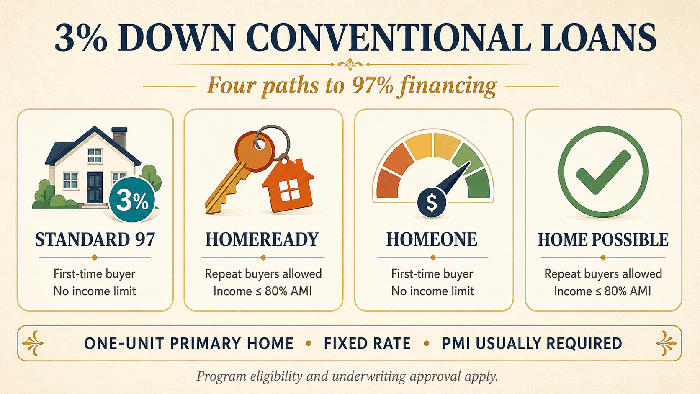
Income limits depend on the specific 3 percent down payment conventional loan program:
- Fannie Mae Standard 97: No program income limit.
- Freddie Mac HomeOne: No program income limit.
- Fannie Mae HomeReady: Total qualifying income cannot exceed 80% of the area median income.
- Freddie Mac Home Possible: Total qualifying income cannot exceed 80% of the area median income.
For HomeReady and Home Possible, the income limit depends on the property’s location, not the borrower’s address. Lenders compare the loan’s qualifying income to the area’s AMI limit. Income from household members who are not borrowers is usually excluded from this calculation. Having no program income cap does not remove normal underwriting requirements. Standard 97 and HomeOne borrowers must still document stable income and qualify with their proposed housing payment and other debts. Down-payment assistance programs may also impose separate income limits or count household income differently.
Eligible Homes and Occupancy Requirements
The 3% down option is generally limited to an eligible one-unit primary residence. The borrower must genuinely intend to occupy the home as their principal residence rather than use it as a vacation home, rental, or investment property. Eligible homes may include:
- Detached single-family homes
- Townhouses and planned-unit developments
- Approved condominium units
- Eligible cooperative units
- Certain qualifying manufactured homes
Manufactured-home eligibility is more restrictive. Fannie Mae generally requires the property to qualify as an MH Advantage home for 97% financing, while Freddie Mac HomeOne permits eligible CHOICEHome properties. Standard manufactured homes are generally limited to 95% LTV. Two- to four-unit homes are not eligible for the 3% down option. HomeReady and Home Possible may finance qualifying multiunit primary residences, but a larger down payment and additional requirements apply. The property must also meet appraisal, condition, title, insurance, and project-eligibility standards. Adding a non-occupying borrower may reduce the maximum LTV or make the transaction ineligible for 3% down, depending on the program. Properties intended for second homes and investment purposes are prohibited.
Credit, DTI, and Automated Underwriting
Qualifying for a 3 percent down payment conventional loan depends on the entire application—not on a single credit score or debt-to-income ratio. The underwriting system reviews credit history, revolving balances, late payments, income stability, monthly debts, reserves, occupancy, property type, and the 97% LTV.
Fannie Mae no longer applies a universal minimum credit score to loan casefiles evaluated through Desktop Underwriter. However, lenders and mortgage insurers may establish their own minimum scores, and credit can still affect approval, interest rate, loan fees, and private mortgage insurance pricing. Freddie Mac eligibility is determined under its applicable credit and underwriting requirements.
DTI compares the borrower’s recurring monthly debts and proposed housing payment with gross monthly qualifying income. Fannie Mae permits a maximum DTI of 50% for loans underwritten through DU, but a borrower may need a lower ratio to receive approval. Freddie Mac Loan Product Advisor evaluates DTI as part of the complete risk profile, rather than treating a single ratio as a guaranteed approval threshold. Standard 97 and HomeReady transactions with LTVs above 95% require DU. Freddie Mac loans are commonly evaluated through the Loan Product Advisor. An eligible AUS result is conditional; the lender must still verify the information submitted and satisfy all findings before closing.
PMI and the Total Monthly Payment
A 3 percent down payment conventional loan generally requires private mortgage insurance because the first mortgage finances 97% of the home’s value. PMI protects the lender—not the borrower—if the mortgage defaults. The PMI premium depends on factors such as the borrower’s credit profile, loan-to-value ratio, loan term, coverage level, and mortgage insurer. HomeReady and Home Possible offer reduced mortgage insurance coverage requirements at certain LTV levels, but that does not guarantee the lowest premium for every borrower. Buyers should compare the complete monthly housing payment, including:
- Principal and interest
- Property taxes
- Homeowners insurance
- Private mortgage insurance
- Homeowners association dues, when applicable
- Flood insurance or other required property coverage
A low advertised interest rate does not always produce the lowest total payment. PMI, loan fees, taxes, insurance, and HOA dues can materially affect affordability. Borrowers may generally request PMI cancellation when the principal balance reaches 80% of the home’s original value and applicable payment-history, property-value, and lien requirements are met. PMI is generally scheduled to terminate automatically at 78% of the original value when the loan is current. Borrowers should review their PMI disclosure and contact the loan servicer for the specific cancellation requirements.
Gift Funds and Down Payment Assistance
Eligible gift funds and down-payment assistance may help a borrower obtain a 3 percent down-payment conventional loan without saving the entire down payment on their own. Depending on the program, assistance may also cover eligible closing costs and prepaid expenses. A gift must come from an acceptable donor and cannot require repayment. The lender generally requires a signed gift letter stating the amount, the donor’s relationship, and that there are no repayment terms. The transfer of funds must also be documented. Money described as a gift cannot be an undisclosed personal loan. Down-payment assistance may be provided through:
- Grants
- Forgivable second mortgages
- Deferred-payment second mortgages
- Repayable second mortgages
- Employer assistance
- Fannie Mae Community Seconds
- Freddie Mac Affordable Seconds
Each assistance program may have separate income limits, purchase price limits, occupancy rules, homebuyer education requirements, and geographic restrictions. If repayment is required, the lender must determine whether the payment affects the borrower’s DTI. The assistance must also comply with the first-mortgage program’s combined LTV and funding rules. Buyers should remember that 3% down does not necessarily equal the total cash needed at closing. Closing costs, prepaid taxes, insurance, escrow deposits, and required reserves may still apply.
3% Down Conventional Versus FHA
A 3 percent down payment conventional loan requires slightly less upfront than an FHA loan with 3.5% down, but the smaller down payment does not automatically make conventional financing the better option. Buyers should compare eligibility, mortgage insurance, loan limits, closing costs, and the complete monthly payment.
3% Down Conventional Loans
Conventional 97% financing is for eligible one-unit, primary residences (in most cases). Some programs require a first-time homebuyer designation or, in some instances, may have income limits. PMI applies, and the premium is based on the credit score and the risk of the loan. HUD 203(k) programs require PMI for any permanent financing. PMI is cancelable and may be removed once a certain amount of equity has been built.
FHA Loans
FHA generally permits 3.5% down with a credit score of at least 580 under HUD guidelines. Scores from 500 to 579 require at least 10% down, although lenders may impose higher minimums. FHA loans do not require first-time buyer status or impose a general program income cap. They may finance eligible one- to four-unit primary residences. FHA requires both an upfront mortgage insurance premium and a monthly mortgage insurance premium. With 3.5% down, FHA mortgage insurance generally remains in effect for the loan term unless the borrower later refinances or pays off the mortgage. Conventional financing may work well for borrowers with stronger credit profiles and eligibility. FHA may offer greater flexibility for borrowers with lower scores or past credit issues. Final approval depends on the complete loan file and the lender’s requirements.
Steps to Qualify for a 3% Down Conventional Loan
Follow these steps to determine whether 97% conventional financing fits your home purchase:
- Confirm your first-time buyer status. Determine whether you have owned residential property during the previous three years.
- Compare the available programs. Review Standard 97, HomeReady, HomeOne, and Home Possible based on first-time buyer and income requirements.
- Check the income limit. HomeReady and Home Possible limit qualifying income to 80% of the area median income. Standard 97 and HomeOne do not have program income caps.
- Choose an eligible home. The 3% option generally requires a qualifying one-unit primary residence within conforming loan limits.
- Review credit and DTI. Estimate the complete housing payment, including principal, interest, taxes, insurance, PMI, and HOA dues.
- Document funds for closing. Identify personal savings, eligible gifts, grants, or down-payment assistance. Account for closing costs and prepaid expenses in addition to the down payment.
- Obtain an AUS-reviewed preapproval. The lender should submit accurate income, asset, credit, debt, and property information through DU or LPA, as applicable.
- Maintain eligibility through closing. Avoid taking on new debt, changing jobs, moving money without documentation, or making large purchases before the mortgage closes.
Final Thoughts on 3% Down Conventional Loans
A 3 percent down payment conventional loan can make homeownership possible without waiting years to save a larger down payment. The right program depends on first-time buyer status, qualifying income, property type, credit history, DTI, available funds, and automated underwriting findings.
Standard 97, HomeReady, HomeOne, and Home Possible serve different borrower profiles. Buyers should carefully compare their eligibility rather than choosing a program based solely on the down payment percentage.
Remember that 3% down is not the same as total cash to close. Closing costs, prepaid expenses, escrow deposits, and reserves may also be required. The complete monthly payment—including taxes, insurance, PMI, and HOA dues—should remain affordable after closing. A program-specific preapproval can confirm the available loan options, estimated cash requirements, and monthly payments before the buyer makes an offer on a home.
Frequently Asked Questions About 3 Percent Down Conventional Loans
How Much Is a 3% Down Payment on a $300,000 Home?
A 3% down payment on a $300,000 purchase price is $9,000. This calculation does not include closing costs, prepaid expenses, escrow deposits, or any appraisal gap. Earnest money and eligible credits may reduce the remaining amount due at closing.
Does Earnest Money Count Toward the 3% Down Payment?
Yes. Earnest money credited to the buyer at closing may be applied toward the down payment or eligible closing costs. The lender may require evidence showing that the deposit cleared the buyer’s account and came from an acceptable source.
Can a Self-Employed Borrower Qualify With 3% Down?
Yes. Self-employment does not prevent a borrower from qualifying for a 3 percent down payment conventional loan. The lender must determine that the qualifying income is stable, adequately documented, and reasonably expected to continue. Tax returns, business returns, transcripts, and current business financial information may be required.
Can You Qualify for a 3% Down Loan With Student Loans?
Yes. Student-loan debt does not automatically disqualify a borrower, but the applicable qualifying payment must be included in the DTI calculation. The treatment of income-driven payments, deferred loans, forbearance, and accounts reporting a $0 payment depends on the applicable Fannie Mae or Freddie Mac guidelines.
Can You Use 401(k) or IRA Funds for the Down Payment?
Vested funds from an eligible 401(k), IRA, SEP, or Keogh account may be used for the down payment, closing costs, or reserves. The lender must verify ownership, vesting, accessibility, and the available amount. Borrowers should also consider possible taxes, penalties, and the effect of withdrawing retirement savings.
Can You Use a Temporary Interest-Rate Buydown With 3% Down?
A temporary buydown may be permitted when the loan program and transaction meet agency requirements. The buydown can reduce the borrower’s initial payments, but it does not change the permanent interest rate stated in the mortgage note. Under Fannie Mae guidelines, the borrower must qualify using the full note rate rather than the temporarily reduced payment.
Can a 3% Down Conventional Loan Finance Home Repairs?
A standard 97% purchase loan generally does not add future repair costs to the mortgage. However, an eligible Fannie Mae HomeStyle Renovation loan may provide financing up to 97% LTV for certain one-unit primary residences. Renovation financing has additional requirements for contractors, appraisals, escrow, and projects.
Can You Refinance After Buying a Home With 3% Down?
Yes. Making a 3% down payment does not prevent a later refinance. Approval depends on the home’s current value, remaining loan balance, credit, income, DTI, refinance purpose, and agency requirements at that time. Refinancing at LTVs above 95% may be restricted to certain limited or no-cash-out transactions. It may require that the existing mortgage be owned by Fannie Mae or Freddie Mac.
This article about “3 Percent Down Payment Conventional Loan Requirements” was updated on August 26th, 2026.
Ready to Buy With 3% Down Conventional Financing?
Complete a quick application or send your scenario. We’ll confirm your eligibility, payment estimate, PMI options, and next steps toward mortgage approval.