Waiting period mortgage guidelines describe the period of time, usually after bankruptcy, foreclosure, short sale, or deed in lieu, that is required before a borrower is eligible to apply for a new mortgage. The waiting period may vary depending on the credit event, loan programs, and how the file will be underwritten. Different loan programs, such as VA, FHA, USDA, and conventional loans, have different mandates. Some borrowers may qualify for exceptions and other loan programs more quickly than the standard waiting period.
Mortgage Waiting Periods at a Glance
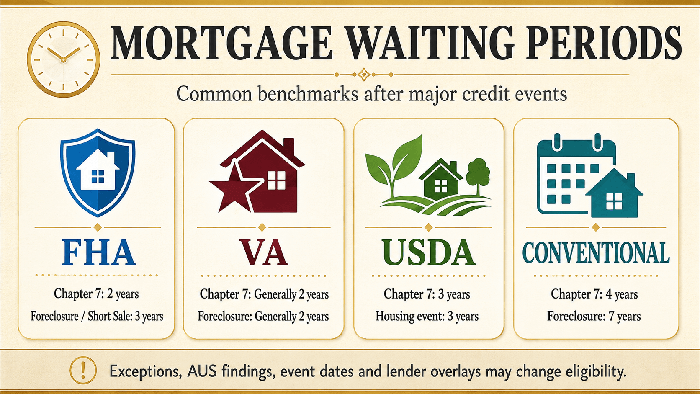
Mortgage waiting periods vary according to the previous credit event, the new loan program, and the date used to start the eligibility clock. The following chart shows common agency benchmarks. Exceptions, automated underwriting findings, re-established credit, lender overlays, and the circumstances surrounding the event can change the result.
| Prior credit event | FHA | VA | USDA | Conventional—Fannie Mae standard |
|---|---|---|---|---|
| Chapter 7 bankruptcy | Generally 2 years from discharge. A period of 12–24 months may be considered with documented extenuating circumstances.[1] | Generally 2 years from discharge. Approval between 1 and 2 years may be possible with re-established credit and documented circumstances beyond the borrower’s control.[2] | Generally 3 years from discharge. GUS may return an Accept recommendation sooner; other files require a documented credit exception.[3] | 4 years from discharge or dismissal; 2 years with acceptable extenuating circumstances.[4] |
| Chapter 13 bankruptcy | Possible during the plan after at least 12 months of satisfactory payments and written court permission. A recent discharge may require manual underwriting.[1] | Possible during the plan after at least 12 months of satisfactory payments and approval from the trustee or bankruptcy judge.[2] | An active plan requires on-time payments and applicable written permission. GUS Refer and manually underwritten files require documentation that 12 months of the plan has elapsed.[3] | 2 years from discharge or 4 years from dismissal. A 2-year period after dismissal may apply with documented extenuating circumstances.[4] |
| Foreclosure | Generally 3 years from the date title transferred from the borrower, subject to limited exceptions.[1] | Generally 2 years from completion, with the circumstances and re-established credit evaluated. A prior VA loss may also affect available entitlement.[2] | A foreclosure within the previous 3 years is considered significant derogatory credit. GUS findings or a documented credit exception may permit approval sooner.[3] | 7 years from completion. A 3-year exception may apply with documented extenuating circumstances and additional LTV, occupancy, and transaction restrictions.[4] |
| Short sale | Generally 3 years from the sale date unless the borrower meets a specific HUD exception.[1] | Commonly evaluated using a 2-year benchmark, but VA requires a complete review of the circumstances and subsequent credit.[2] | A short sale completed within the previous 3 years is considered significant derogatory credit. GUS Accept or a documented exception may permit approval sooner.[3] | 4 years from completion; 2 years with acceptable extenuating circumstances.[4] |
| Deed-in-lieu of foreclosure | Generally 3 years from the date ownership transferred to the lender, subject to limited exceptions.[1] | Generally evaluated under the same credit-risk standards used for a recent foreclosure.[2] | A deed-in-lieu recorded within the previous 3 years is considered significant derogatory credit. GUS findings or a documented exception may permit approval sooner.[3] | 4 years from completion; 2 years with acceptable extenuating circumstances.[4] |
Important notes and sources
- FHA requirements are outlined in the current HUD Single Family Housing Policy Handbook 4000.1. FHA generally measures bankruptcy eligibility from the discharge date and housing events from the applicable sale or title-transfer date.
- VA underwriting is based on the complete credit profile rather than the passage of time alone. The VA Credit Standards guidance explains that a bankruptcy more than two years old may be disregarded, while cases between one and two years old require additional documentation and re-established credit.
- USDA rules depend heavily on the Guaranteed Underwriting System recommendation. USDA HB-1-3555 Chapter 10 permits certain GUS Accept files to proceed without the credit exception required for manually underwritten, Refer, or Refer with Caution files.
- The conventional periods shown are Fannie Mae’s standard requirements. Fannie Mae B3-5.3-07 contains the complete rules and restrictions. Freddie Mac requirements are generally similar but should be verified under the current Freddie Mac Guide, especially when a mortgage was extinguished through Chapter 7 bankruptcy.
Meeting a waiting period does not guarantee mortgage approval. Borrowers must still satisfy the applicable credit, income, asset, debt-to-income, property, automated underwriting, and lender requirements.
How to Use the Waiting-Period Chart
Find the credit event that you experienced (bankruptcy, short sale, deed in lieu of foreclosure). Once you have that, review the standard waiting periods for all FHA, VA, USDA, and conventional loans. Check what the trigger date is for the waiting period. For some events and for some programs, this may be the bankruptcy discharge, dismissal, short sale closing, foreclosure, or the date of transfer of title. For exceptions, refer to the waiting periods chart; a loan officer will review the documents. Meeting the waiting periods does not mean the application will be approved.
Ready to Buy After a Housing Event?
Complete a quick application or send your bankruptcy, foreclosure, short sale, or deed-in-lieu details. We’ll confirm your waiting period and next mortgage steps..FHA Mortgage Waiting Period Guidelines
FHA waiting periods are defined by the type of bankruptcy or housing event and the time of completion. FHA underwriting rules in the U.S. Department of Housing and Urban Development (HUD) Single Family Housing Policy Handbook 4000.1 govern FHA mortgage waiting periods.
FHA After Chapter 7 Bankruptcy
An FHA mortgage is an opportunity for a borrower two years after the discharge date of a Chapter 7 bankruptcy. This applies to borrowers who have re-established credit or have chosen not to incur new credit obligations. HUD will consider a borrower before the two-year mark if the bankruptcy circumstances are outside the borrower’s control and 12 months have elapsed since the filing of Chapter 7.
FHA During or After Chapter 13 Bankruptcy
FHA financing may be available to a borrower after the bankruptcy case has been active for 12 months, so long as the borrower has received the bankruptcy court’s approval to secure a new mortgage. During this time, the lender may also approve financing if the borrower has satisfied plan payments and the new mortgage obligations.
FHA After Foreclosure, Short Sale, or Deed-in-Lieu
Typical FHA procedure is to set a three-year waiting period on foreclosure, short sale, or deed-in-lieu transactions. The transfer of title date is used to calculate the three years. FHA files involving these transactions within the three-year period will most likely be underwritten manually. FHA lending evaluation forms can differentiate among certain documented extenuating circumstances, but FHA underwriting standards and lender requirements remain the same.
VA Mortgage Waiting Period Guidelines
With VA loans, bankruptcy or foreclosure does not automatically result in disqualification. The lender looks at the reason for the event and the borrower’s payment record after the event.
VA generally has a two-year waiting period after discharge of Chapter 7 bankruptcy. VA may approve borrowers 1 to 2 years after discharge if they have re-established satisfactory credit and the bankruptcy was due to unlikely-to-recur events. A bankruptcy discharged in the last 12 months will be difficult to approve.
In Chapter 13 bankruptcy, a borrower is likely to obtain VA financing somewhat sooner than in Chapter 7, since the borrower has established a satisfactory payment record. A lender will weigh the payment history in a Chapter 13 bankruptcy, the borrower’s current credit, current income, adequate residual income, and the ability to repay the new mortgage. Approving a mortgage for a borrower under Chapter 13 is significantly easier after a one-year waiting period. Recent foreclosures require evaluation of the circumstances and whether the borrower has re-established satisfactory credit.
USDA Mortgage Waiting Period Guidelines
For USDA, a Chapter 7 bankruptcy that was discharged or dismissed more than three years ago is considered to be credit that is not adverse. However, a Chapter 7 bankruptcy that was completed within the last three years may still qualify, pending the Guaranteed Underwriting System (GUS) evaluation and the lender’s credit review. For GUS Refer, Refer with Caution, and manually underwritten files, USDA requires documentation that 12 months of the debt-restructure plan has elapsed. All required payments must be on time, with applicable permission to enter the transaction. To be considered adverse credit, a foreclosure, short sale, or deed-in-lieu must have been processed within the last three years. In cases of GUS Accept, no credit exception may be required, whereas for manually underwritten, Refer, and Refer with Caution files, additional credit analysis and a documented exception may be required.
Conventional Mortgage Waiting Periods
Conventional mortgage waiting periods depend on whether the loan follows Fannie Mae or Freddie Mac guidelines and how the derogatory event ended.
Fannie Mae
Under Fannie Mae guidelines, the standard waiting periods are:
- Chapter 7 or Chapter 11 bankruptcy: four years after discharge or dismissal.
- Chapter 13 bankruptcy: two years after discharge or four years after dismissal.
- Foreclosure: seven years after completion.
- Short sale, deed-in-lieu, or mortgage charge-off: four years after completion.
Documented extenuating circumstances may reduce certain periods to 2 years, or to 3 years for foreclosure, with additional loan restrictions. If a mortgage was discharged in bankruptcy but later foreclosed, the bankruptcy waiting period may apply when properly documented.
Freddie Mac
Freddie Mac’s standard recovery periods for manually underwritten loans are generally:
- Chapter 7 or Chapter 11 bankruptcy: four years after discharge or dismissal.
- Chapter 12 or Chapter 13 bankruptcy: two years after discharge or four years after dismissal.
- Foreclosure: seven years after completion.
- Short sale or deed-in-lieu: four years after completion.
With qualifying extenuating circumstances, Freddie Mac may reduce the period to two years for bankruptcy, short sale, or deed in lieu, and to three years for foreclosure. Loan Product Advisor findings and lender overlays may impose additional requirements.
When Does the Waiting Period Clock Start?
 The start date of the mortgage waiting period depends on the triggering event. One of the leading misconceptions is that borrowers believe that the waiting period begins when they move out of the house and/or cease payments. The date of the discharge is generally considered one of the triggers for a bankruptcy. For a foreclosure, a short sale, or a deed in lieu, the lender must use the applicable completion date required by the loan program. In situations where the borrower’s credit report dates are unclear, the borrower should provide bankruptcy documents, closing statements, foreclosure documents, and similar records.
What If the Mortgage Were Included in Bankruptcy?
The treatment of a mortgage in a Chapter 7 bankruptcy will be different from that of a mortgage that was foreclosed. Fannie Mae allows the use of the bankruptcy waiting period for mortgages whose debt was discharged in bankruptcy, provided the lender has documentation showing the mortgage was included and discharged in the bankruptcy. If this is not the case, the longer waiting period for the foreclosure or other housing event would apply. In these situations, the difference in the waiting period can significantly affect when a borrower becomes eligible for a conventional loan.
Can Extenuating Circumstances Shorten a Waiting Period?
Certain waiting-period mortgage guidelines allow a shorter waiting period for a serious event outside the borrower’s control that caused bankruptcy, foreclosure, etc.
Fannie Mae refers to exceptions as extenuating circumstances. These are structural and time-beyond-the-borrower-control events that lead to a sudden, significant, and prolonged loss of income or an unexpected major increase in financial obligations. A lender evaluates the event and its impact on the borrower’s finances.
Merely having financial hardship is not sufficient to meet the exception criteria. The exception, as specified in the particular mortgage program, must be satisfied, and not all waiting periods can be waived.
Why an AUS Approval Does Not Waive a Waiting Period
An automated underwriting system (AUS) result, such as Fannie Mae’s Approve/Eligible or Freddie Mac’s Accept, is an underwriting recommendation—not a waiver of mandatory mortgage waiting periods. The AUS evaluates the information submitted by the lender and available on the borrower’s credit report. It may not identify an event when dates are missing, inaccurate, or reported inconsistently. The underwriter must still verify the applicable bankruptcy discharge or dismissal date, foreclosure completion date, short-sale closing date, or deed-in-lieu execution date. Fannie Mae specifically states that even when Desktop Underwriter issues an approval recommendation, the lender must confirm that the required waiting period has elapsed. Freddie Mac loans must likewise satisfy the applicable Guide requirements and Loan Product Advisor conditions. If verified documents reveal an unreported event or an incorrect date, the loan may become ineligible and require resubmission. Extenuating-circumstance exceptions must also be fully documented and approved; an AUS recommendation alone does not establish the exception.
Lender Overlays and Additional Requirements
Meeting the requirements of FHA, VA, USDA, or conventional waiting-period mortgage guidelines doesn’t mean a lender will approve the loan. Mortgage lenders set their own, often higher, credit requirements, which they call lender overlays. If a borrower does not meet a lender’s requirements, for which meeting a requirement for an agency did not result in a loan approval, the borrower may qualify for a loan with a lender that follows the program requirements at the foundation.
Non-QM Loans After Bankruptcy or Foreclosure
Non-QM loans allow borrowers to apply if they have not met agency or conventional requirements for the waiting periods. Each Non-QM lender or investor issues a waiting period for credit events based on the borrower’s score, equity, reserves, income, loan characteristics, and other elements of the loan application. Non-QM means that the loan is not guaranteed, but lenders must still evaluate the borrower’s ability to repay under the Ability-to-Repay Rule.
Documents Required for Bankruptcy Verification and Housing Event
Credit reports do not always capture the correct dates of completion, discharge, or dismissal for bankruptcies. Verification of the correct dates may determine the waiting period. Borrowers provide lenders with:
- Bankruptcy discharge or dismissal papers
- Bankruptcy schedules as needed
- Foreclosure or deed-transfer records
- Short-sale or deed-in-lieu closing documents
- Mortgage statements and/or payment history
- Documentation of claimed extenuating circumstances
Providing all documentation requested by the lender early helps them determine the correct eligibility date and avoids delays in the underwriting process.
Examples of Waiting Period Calculations for a Mortgage
For mortgage programs, waiting periods start on the date specified in the program, not from the date of financial distress.
Example FHA Chapter 7
If a borrower gets their Chapter 7 discharge on January 15, 2025, the FHA’s two-year waiting period means that, assuming this borrower meets all other FHA requirements, they satisfy the waiting period on January 15, 2027.
Example Conventional Chapter 7
A borrower received a Chapter 7 discharge on September 10, 2022. This borrower would satisfy Fannie Mae’s four-year waiting period on September 10, 2026.
Example Conventional Foreclosure
For a foreclosure completed on March 1, 2020, the seven-year waiting period under Fannie Mae would end on March 1, 2027. The foreclosure date is used in determining the waiting period. The hypothetical examples illustrate only the waiting period calculations. Credit, income, debt, rating, the results of the automated underwriting system, and other loan requirements are subject to the waiting-period calculations.
Steps to Determine When You May Qualify
Use the following process to calculate mortgage waiting periods and identify your earliest potential eligibility date:
- Identify the derogatory event. Determine whether it involved bankruptcy, foreclosure, short sale, deed-in-lieu, or more than one event.
- Confirm how the event ended. Chapter 13 guidelines differ depending on whether the case was discharged or dismissed.
- Obtain the official completion date. Review bankruptcy court records, foreclosure documents, settlement statements, or recorded deeds. Do not rely only on the date shown on a credit report.
- Select the mortgage program. FHA, VA, USDA, Fannie Mae, and Freddie Mac can have different waiting-period requirements and exceptions.
- Apply the correct waiting period. Count from the controlling discharge, dismissal, completion, or execution date. When bankruptcy and foreclosure involve the same mortgage, additional documentation may determine which timeline applies.
- Request a lender review. Have a mortgage professional verify the dates, review possible extenuating circumstances, check for lender overlays, and submit the application through the appropriate automated underwriting system.
Meeting a waiting period does not guarantee approval. Credit, income, assets, debts, property eligibility, and current underwriting guidelines must also be satisfied.
Final Thoughts on Waiting Period Mortgage Guidelines
Bankruptcy, foreclosure, short sale, or deed in lieu does not disqualify people from purchasing a home. They do make it a little more difficult. Because of waiting periods, they need to find which loan programs they qualify for.
Applicants should have their dates and complaint files reviewed before applying to determine whether they meet eligibility criteria. If one lender says no, it may also be worth getting a second opinion, especially when lender overlays or underwriting differ.
When reviewing Waiting Period Mortgage Guidelines, each program is different, so the best policy, in this case, is to leave no page unturned in the credit review.
Frequently Asked Questions About Mortgage Waiting Periods
Can I Get Preapproved Before My Mortgage Waiting Period Ends?
Possibly. A lender may review your credit, income, assets, and event documents before the waiting period expires. However, a preapproval does not permit the loan to close early. The required period must be satisfied by the date specified under the applicable program, and all remaining underwriting conditions must be met.
Does Bankruptcy have to Disappear from My Credit Report Before I Can Qualify?
No. Credit-reporting timelines and mortgage waiting periods are different. A Chapter 7 bankruptcy can remain on a credit report for up to 10 years, but a borrower may qualify for certain mortgage programs much sooner. The lender will still verify the bankruptcy dates and evaluate the borrower’s re-established credit.
Can a Larger Down Payment Shorten a Mortgage Waiting Period?
Generally, no. A larger down payment may strengthen the overall application, reduce the loan-to-value ratio, or help satisfy requirements attached to an exception. However, it does not replace a mandatory waiting period. The borrower must still meet the standard timeline or qualify for a documented exception permitted by the mortgage program.
How do Multiple Bankruptcy Filings Affect Conventional Mortgage Eligibility?
Under Fannie Mae guidelines, more than one bankruptcy filing within the previous seven years generally requires a five-year wait from the most recent discharge or dismissal. That period may be reduced to three years when qualifying extenuating circumstances are documented. Freddie Mac’s standard recovery period for multiple filings is generally 60 months from the most recent discharge or dismissal.
Can My Spouse’s Bankruptcy or Foreclosure Affect My Mortgage Application?
It can. If your spouse will be a borrower, their credit event and waiting period must be reviewed. If your spouse will not be on the new mortgage, their bankruptcy or foreclosure does not automatically become your credit event. However, joint debts, jointly owned property, community-property laws, and whether you were liable for the previous mortgage can still affect underwriting.
Are Waiting Periods Different for Second Homes and Investment Properties?
The standard waiting period may be the same, but shorter exceptions can carry occupancy restrictions. For example, Fannie Mae’s reduced foreclosure period generally permits the purchase of a principal residence but not the purchase of a second home or investment property during the restricted period. Limited cash-out refinancing may be treated differently. The proposed occupancy and transaction type should be reviewed before applying.
Can CAIVRS Prevent Approval After the Waiting Period has Expired?
Yes. This is particularly important for FHA financing. FHA lenders must check borrowers through the Credit Alert Verification Reporting System. If the creditor agency confirms a valid, delinquent federal non-tax debt, the borrower is generally ineligible until the debt is resolved. A lender cannot deny the loan solely because of unverified CAIVRS information and must verify the debt with the reporting agency.
This article about “Waiting Period Mortgage Guidelines After Housing Events” was updated on August 24th, 2026.