This guide covers getting a home loan approved after a bank denies your mortgage application. There should be no reason for mortgage borrowers to be denied after getting pre-approved. The main reason a pre-approved borrower gets denied for a mortgage loan after pre-approval is that they weren’t properly qualified in the first place. Most mortgage lenders have lender overlays on government-backed and conventional loans..
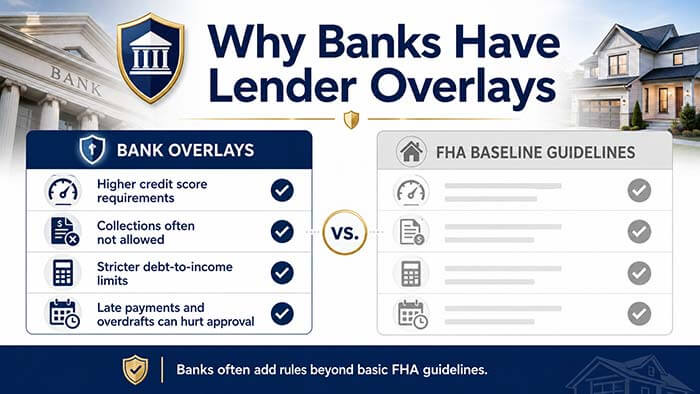
What overlays are is mortgage guidelines that are on top of the minimum lending guidelines set by FHA, VA, USDA, Fannie Mae, and Freddie Mac.
Most loan officers will run a mortgage applicant through Fannie Mae or Freddie Mac Automated Underwriting System (AUS). An approve/eligible per AUS is pretty much a done deal ONLY with lenders with no lender overlays. Many loan officers make mistakes in issuing pre-approval letters once they get an approve/eligible per AUS without checking with their company’s lender overlays. For example, HUD guidelines on collection and charge-off accounts state that borrowers do have to pay off outstanding collections and charge-off accounts.
Can I Get a Mortgage Approval With Outstanding Collection Accounts?
It’s tough to be turned down for a mortgage, especially if you thought things were on track. Maybe you had a pre-approval, your credit score seemed fine, and you’d already found a house, paid for an inspection, sent in documents, and started planning your move. Then the bank says no. If a bank denies your mortgage, don’t assume you can’t get a home loan at all. It just means the lender couldn’t approve your application because of their rules or requirements. Another lender might see your situation differently. Not every mortgage denial can be changed.
Sometimes, a real program rule or guideline blocks the loan for now. Other times, the issue is with the lender’s extra rules, the way the loan was set up, how income was calculated, missing documents, a property issue, or just a loan program that wasn’t the right fit.
After a mortgage denial, your first step is to find out exactly why your loan was turned down. Once you know the reason, you can see whether it can be fixed, whether another loan program might work better, or whether a different lender could help. At Gustan Cho Associates, we regularly work with borrowers who come to us after another lender has been unable to approve their mortgage.
Do All Lenders Have the Same Mortgage Guidelines on Government and Conventional Loans?
Mortgage companies do not all have identical lending requirements. FHA, VA, USDA, Fannie Mae, and Freddie Mac establish program requirements, but individual lenders may impose additional underwriting standards known as lender overlays. VA, for example, explicitly states that it does not set a minimum credit score, even though individual VA lenders may require one.
Whether you can get approved elsewhere depends on the reason the first lender said no. If you have a real eligibility issue, you might need to resolve it or wait until you meet the program’s eligibility requirements.
But if you were denied because of a lender’s extra requirements, you may have quicker options. This difference is important. Before you apply with another lender, find out why you were denied, review your whole file, and check if the issue is with your credit, debt-to-income ratio, income, assets, job, property, automated underwriting, paperwork, or the lender’s own rules.
What Should You Do After Your Mortgage Is Denied?
Don’t rush to apply with every lender you find. Begin by looking at the denial. Ask the lender or loan officer to explain precisely what stopped the mortgage from moving forward. If the creditor denies a completed credit application, federal rules generally require an adverse action notification explaining the principal reasons for the decision or how the applicant can obtain those reasons. If the decision was based on information from a credit report, additional credit-report disclosures may also apply.
The Reason for Denial can be Very Specific
At Gustan Cho Associates, we often help people who were turned down by another lender. Our aim isn’t to keep submitting the same loan and hope for a different result. Instead, we look at what stopped the first loan from closing and see if there’s a real way forward.
For Example:
- Your debt-to-income ratio may exceed that lender’s limit.
- Your credit score may fall below its internal minimum.
- The lender may not allow manual underwriting for your particular program.
- Your income may have been calculated differently than expected.
- Your overtime, bonus, commission, self-employment, or other income may not have been usable.
- A recent late payment may violate that lender’s guidelines.
- The property may not meet the program or investor requirements.
- Assets may not have been properly documented.
- The Automated Underwriting System may have returned findings that could not be satisfied.
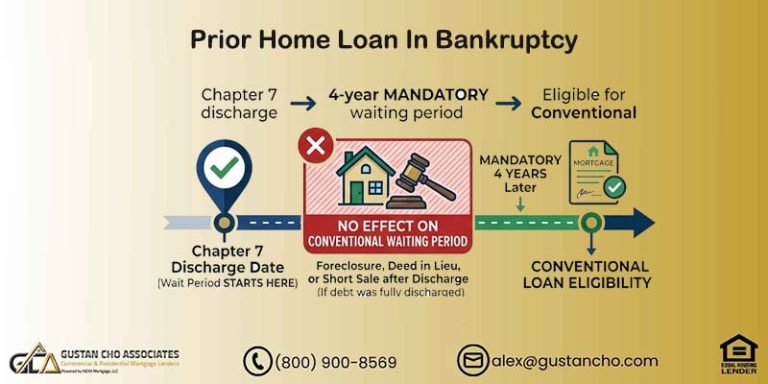
- There may be a waiting period after bankruptcy, foreclosure, deed in lieu, or short sale.
- Or the lender may simply have an overlay that another lender does not have.
- When you know the reason, you can focus on fixing the real issue instead of guessing.
Why One Mortgage Lender May Deny You While Another Approves You
Many borrowers are surprised to learn that underwriting can vary widely from one lender to another. An FHA loan is still an FHA loan. A VA loan is still backed by the Department of Veterans Affairs. Conventional loans sold to Fannie Mae or Freddie Mac must meet applicable agency requirements. But each lender also makes its own business and risk decisions. A mortgage lender may establish standards above the minimum requirements of a loan program. These additional requirements are commonly referred to as lender overlays.
What Is a Lender Overlay?
A lender overlay is an additional underwriting requirement imposed by an individual mortgage lender, in addition to the underlying program requirement. For example, a loan program may permit a certain credit profile, while a particular lender requires a higher score.
- A program may allow manual underwriting under qualifying circumstances, whereas a lender may choose not to offer it.
- A government agency may not set a specific minimum credit score, whereas the lender funding the loan may set one of its own.
- VA provides a clear real-world example.
- The Department of Veterans Affairs states that VA itself does not require a minimum credit score for its home-loan guaranty program, but lenders can impose their own credit-score requirements.
- That’s why being denied by a bank doesn’t always mean you can’t get the mortgage program itself.
A Mortgage Pre-Approval Is Not a Final Loan Approval
It can be especially tough to be denied after you’ve already received a pre-approval. It’s common to wonder, “How could I be denied if I was already approved?” The answer is that mortgage pre-approval and final underwriting approval are not the same. A good pre-approval looks closely at your credit, income, assets, debts, job, and the loan program. But the information can come up after you’re under contract. Your lender might receive updated credit info, your job situation could change, bank statements might show transactions that require additional paperwork, the appraisal could reveal property issues, or income calculations might change after all documents are reviewed. The underwriter might also find something that wasn’t clear during pre-approval. Automated underwriting matters, but it doesn’t replace the need for proper documentation.
Does an AUS Approval Guarantee the Mortgage?
No. Fannie Mae’s Desktop Underwriter and Freddie Mac’s Loan Product Advisor are important automated underwriting tools. FHA and VA transactions may also be evaluated through applicable automated systems.
An acceptable automated underwriting recommendation is valuable, but the information submitted to the system must still be accurate and supported by the loan file.
Fannie Mae’s guidance, for example, requires lenders to verify the accuracy and integrity of information supporting the underwriting decision and confirm that the loan satisfies applicable requirements. So, an AUS approval isn’t a guarantee that your loan will close.
Common Reasons Borrowers Get Denied by a Bank for a Mortgage
A denial usually traces back to one or more parts of the mortgage file. Knowing what caused the problem can save you a lot of time.
Mortgage Denied Because of a Low Credit Score
Credit-score requirements vary by loan program and lender. This is one of the most common areas where lender overlays become important. The program still falls below an individual lender’s minimum score. Don’t just look at your credit score.
Underwriters also check your recent payment history, mortgage or rent history, collections, charge-offs, judgments, bankruptcies, foreclosures, disputed accounts, and other details in your credit report.
If the bank says the score is too low, ask whether the minimum is set by the loan program or by that lender. Asking this can make a big difference in your next steps.
Mortgage Denied Because of Recent Late Payments
Recent late payments often matter more than older credit issues. The underwriter wants to know whether your financial problems are in the past or still ongoing. A single late payment due to a specific, documented reason is different from a pattern of missed payments.
Paying or settling a collection or charge-off account can affect your cash, credit report, or loan approval. Talk to your mortgage professional before moving money just because a lender denied your loan.
How a late payment is treated depends on the mortgage program, the type of account, how recent it was, the overall credit history, automated underwriting findings, and the lender’s own guidelines. A good letter of explanation can help, but it won’t erase your payment history. Your loan still needs to meet the underwriting rules.
Collections and Charge-Offs
Collections and charge-offs are other topics where borrowers often receive mixed advice. Another may say nothing needs to be paid. Neither answer is always right for everyone. Treatment depends on the loan program, the type and amount of debt, whether the account affects qualifying ratios, whether underwriting is automated or manual, and applicable lender policies. The best approach is to have the lender review your accounts under the loan program you’re using, rather than paying off old collections before you know whether it’s necessary or helpful.
Mortgage Denied Because Your Debt-to-Income Ratio Is Too High
The debt-to-income ratio, commonly called DTI, compares qualifying monthly debt obligations to qualifying gross monthly income. A high DTI can lead to a mortgage denial, even if you have good credit. But there is no single universal DTI limit that applies to every borrower, loan program, or lender.
Automated underwriting findings, compensating factors, loan type, credit profile, reserves, residual income, where applicable, and lender overlays can affect the allowable ratio.
You don’t always have to pay off thousands in debt to fix this. Sometimes the file can be restructured. A smaller loan amount may work. A debt scheduled for repayment may be treated differently under applicable guidelines. A co-borrower may alter the qualification. Correctly documented additional income may change the ratio. Or another mortgage program may simply fit the borrower better. That’s why your whole file should be reviewed before anyone says a high DTI means you can’t buy a home.
Mortgage Denied Because the Lender Did Not Accept Your Income
You can earn money and still have trouble qualifying. Mortgage underwriting isn’t just about how much money you make. The lender has to check if your income is allowed, properly documented, and likely to continue under the program’s rules.
Lenders have varying credit score requirements, debt-to-income ratio limits, and underwriting guidelines. Provide complete and accurate documentation to support your loan application.
Consider working with a mortgage broker who can shop your loan scenario with multiple lenders. It’s essential to communicate openly with lenders, understand the reasons for denial, and take steps to address any issues or concerns they have raised. With patience, persistence, and a willingness to improve your financial profile, you may increase your chances of securing mortgage approval from another lender.
This Frequently Affects Borrowers Who Receive:
- Overtime.
- Bonuses.
- Commissions.
- 1099 income.
- Self-employment income.
- Rental income.
- Seasonal earnings.
- Multiple-job income.
- Part-time income.
- Retirement income.
- Support income.
- Or other nontraditional sources.
You might say, “I make $120,000 a year,” but the lender could count much less as qualifying income after looking at your tax returns or income history. That doesn’t automatically mean the first calculation was wrong, but complicated income is a good reason to get a second review.
Case Scenario:
Someone may operate a profitable business and have substantial cash flow while reporting lower taxable income due to legitimate business deductions. That can create problems under traditional mortgage underwriting. This can cause problems with traditional mortgage underwriting.
When traditional documentation does not support the required amount of qualifying income, certain borrowers may consider non-QM alternatives such as bank-statement, 1099, profit-and-loss, asset-based, or other alternative-documentation programs.
These programs have different eligibility standards, rates, fees, down payment requirements, and underwriting standards. They should be compared based on your real needs, not just used as a one-size-fits-all solution.es more than qualifying income. The lender also has to verify the availability of funds for the down payment, closing costs, and any required reserves.
Problems Can Come Up if Your Money Isn’t Properly Documented
- A borrower might have plenty of cash but have recently deposited it into the bank.
- Funds may have been transferred from another account.
- A family member may be providing gift funds.
- The borrower may be expecting proceeds from the sale of an asset.
- Or the money may come from a source that cannot be used under the particular mortgage program.
- Before moving large amounts of money during the mortgage process, talk to your loan officer.
- Even a simple transfer can create more paperwork for underwriting.
Denied By a Bank? You Still Have Options
Home loan approval after denied by a bank for your mortgage is possibleMortgage Denied Because of Bank Statements or Overdrafts
Bank statements can bring up questions during underwriting even if the borrower has money for closing. Things like overdrafts non-sufficient funds big deposits with no explanation, hidden recurring payments or money coming from accounts that are not documented can lead to extra review. An overdraft does not mean a borrower will automatically be denied. The lender will look at how recent the overdraft was, whether it happened once or many times if there’s money in the account now and if the account activity is showing a bigger cash-flow issue. It’s best to talk about any problems instead of hoping the underwriter won’t notice.
Mortgage Denied Because of Employment History
A recent job change during the mortgage process does not always mean you will be denied a mortgage. Your employment and income must meet the rules of the loan program you are using.
Lenders need to check if your job history’s stable and dependable. They also want to know if your new job is likely to continue and if the income you are earning is something they can count.
Changing jobs is different from switching careers. Going from pay to commission income means you may need different documents. Starting a business is not the same as taking a salaried job in the field. If you recently graduated, training returned to work or changed jobs get your situation reviewed before you assume you must wait two full years to apply.
Mortgage Denied Because of Bankruptcy or Foreclosure
Bankruptcy, foreclosure, deed-in-lieu and short sale can affect your ability to get a mortgage. They do not mean you can never own a home.
The waiting time depends on the loan program, the type of credit event, the dates, the reason behind it and in some cases if you are still in a Chapter 13 repayment plan.
The date used to calculate eligibility matters. Don’t rely on advice like “You had a bankruptcy so you need to wait seven years.” Have your bankruptcy or housing event checked under the mortgage program you want to use.
Can You Get a Mortgage During Chapter 13 Bankruptcy?
In some situations yes. Some mortgage programs allow you to get a mortgage even if you are, in a Chapter 13 bankruptcy as long as you meet all the requirements. Court or trustee permission may be required depending on the situation, and payment history, underwriting method, and individual program requirements must be reviewed. Chapter 13 files require careful underwriting. You should provide your bankruptcy paperwork, payment history, trustee information, and any required authorizations early in the process. Waiting until the end to mention an active bankruptcy can cause delays.
Mortgage Denied Because of the Property
Sometimes you qualify, but the house doesn’t. Mortgage approval depends on both you and the property. Possible issues include problems with the appraisal, health and safety issues the condition of the property, title issues, a property type that’s not acceptable condominium eligibility requirements for manufactured homes, acreage, mixed use, incomplete construction or other restrictions specific to the program.
If the property you want to buy does not meet the lenders rules think about finding a property or fixing any problems that were found in the appraisal or inspection.
Changing lenders will not necessarily cure a genuine property eligibility problem. However, another loan product may finance a property that does not fit the first lender’s program. That’s why you should find out if the denial was about you or the property before starting over.
FHA Loan Denied by a Bank
An FHA loan is insured by the Federal Housing Administration but originated and underwritten by approved private lenders. HUD publishes the FHA Single Family Housing Policy Handbook 4000.1, which contains FHA program requirements. HUD issued an updated version of the handbook in August 2026. Each lender can still make its own credit and risk decisions within the program.
Denied, ask whether the problem came from FHA requirements, automated underwriting findings, manual underwriting requirements, or the lender’s own overlay. That answer will show if switching lenders could help.
Most banks have tougher lender overlays than mortgage bankers or correspondent lenders. The majority of mortgage companies require a minimum credit score of 640 FICO on FHA borrowers. This holds true even though FHA minimum credit score requirements are 580. Most lenders and banks will not accept outstanding collections and charge-offs.
Lender Overlays on VA Loans
VA borrowers should pay particular attention to lender overlays. The Department of Veterans Affairs does not set a minimum credit score for the VA home loan guaranty program, although lenders can set their own minimums. VA still requires acceptable credit and sufficient income, and the private lender ultimately has to approve the mortgage.
Most lenders have lender overlays on credit and income requirements. Lender overlays are higher lending requirements than HUD, VA, USDA, Fannie Mae, and Freddie Mac.
So, if a veteran is denied because one lender wants a certain score, it doesn’t mean the VA itself has rejected them. Retirement belongs to VA or the lender. VA borrowers should also have residual income, debts, recent credit history, entitlement, occupancy, and other eligibility requirements reviewed as part of the complete file.
Conventional Mortgage Denied by a Bank
Conventional mortgages commonly involve Fannie Mae or Freddie Mac guidelines. Desktop Underwriter and Loan Product Advisor are important components of conventional underwriting, but the lender must still properly document the loan and satisfy applicable conditions.
A denial can result from credit, DTI, reserves, income, property eligibility, occupancy, previous housing events, or other underwriting issues.
If a conventional loan doesn’t work, you might try a different conventional setup, FHA or VA financing if you qualify, or a non-QM product. The right solution depends on why conventional financing didn’t work.
Help After a Mortgage Denial?
Sometimes. Automated systems do not approve every otherwise viable borrower. Depending on the mortgage program and circumstances, manual underwriting may offer an alternative. Manual underwriting means an underwriter performs a more detailed evaluation of the file under the program’s manual underwriting standards instead of relying solely on an automated approval.
Seek advice from multiple mortgage lenders because no two lenders have the same guidelines on government and conventional loans.
Manual underwriting isn’t a shortcut around mortgage rules. It involves additional documentation and closer examination of payment history, housing history, reserves, debt ratios, compensating factors, and the events that caused previous credit problems. Not every lender offers manual underwriting for every program. That alone can explain why one mortgage company may approve a borrower while another may not.
Should You Apply With Another Lender After Being Denied?
Often, it makes sense to get a second opinion. But don’t try to hide your first denial or keep applying without a plan. Tell your new mortgage professional the full story. Explain why the last lender said no. If you have them, share your adverse-action notice, credit report, income documents, asset statements, bankruptcy papers, purchase contract, appraisal info, and any underwriting conditions that caused the problem.
If your debt-to-income ratio is too high compared to your income try to pay off existing debts or look for an expensive property to reduce your housing costs. Explain any situations that are making your debt-to-income ratio high.
If your income was considered not enough or your job history was too short, think about increasing your income sources or staying in your job longer to build stability. Provide papers to prove your income like tax returns, bank records or letters from your employer.
An Experienced Loan Officer Can Then Determine Whether the Denial Appears to Involve:
- An actual program restriction.
- A lender overlay.
- An incorrectly structured loan.
- A documentation problem.
- An income-calculation issue.
- On AUS issue.
- A property problem.
- Something that needs to be corrected before reapplying.
- A second opinion helps most when the new lender knows exactly what went wrong before.
Credit Union, Mortgage Banker, or Mortgage Broker: Does It Matter?
Each can be a legitimate source of mortgage financing. The more useful question is whether the lender has a loan program and an underwriting approach that fit your financial profile. Banks may offer attractive products to their customers. Credit unions may provide competitive programs to eligible members. Mortgage bankers originate and fund mortgages using their available lending programs.
If you were denied a mortgage loan due to poor credit or low credit scores, improve your credit by paying down debts, disputing errors, and maintaining a good payment history.
Mortgage brokers connect with lenders and might be able to look at your situation across several lenders. None of these choices mean you will get a rate, easier approval or a better loan. The actual rate, percentage rate, lender fees, loan program, underwriting rules, service, closing time and total cost depend on your unique situation.
What Documents Should You Gather After a Mortgage Denial?
The fastest way to get a second opinion is to give the new lender enough information to really understand the issue. Start with your mortgage denial or the adverse-action notice. Then collect the papers that are related to the reason for the denial.
Being turned down for a mortgage by one bank does not mean another lender will not approve you. However it’s important to know why the denial happened and take steps to increase your chances of getting approved.
This might include pay stubs, W-2 forms, tax returns, bank statements, retirement statements, ID, bankruptcy papers, divorce papers, child-support documents, proof of rental history letters explaining things, employment details and the purchase contract. You might not need all the documents, on that list. The goal is to give the lender what they need to make a real decision, not just rely on a quick phone call.
Do Not Make Major Financial Changes After a Mortgage Denial
Some people react to a denial by quickly paying off debts, closing credit cards, opening new credit, moving money around, changing jobs, or depositing a lot of cash. These actions can cause new problems.
Before making a major financial move, ask the mortgage professional reviewing your second application how it could affect your qualification.
For example, paying down a revolving account can be useful in some situations. Closing that same account may have an unintended credit effect. Paying off a debt may improve DTI, but it also uses cash that may be needed for closing or reserves. Changing jobs may increase income, but the new form of compensation may not be immediately usable. Getting approved for a mortgage means reviewing your entire file, not just fixing one number.
What If the Information on Your Credit Report Is Wrong?

Check the credit information that was used in your denial. If a lender said no to your application because of your credit report, federal consumer protection rules give you important rights. The denial notice usually shows which credit reporting company was used, and you may have the right to get a free copy of that credit report within a set time. If you find a mistake, challenge the error with the credit-reporting company and, if needed, the company that provided the information. Don’t dispute accurate information just because it’s hurting your mortgage approval. The goal is to have an accurate credit report.
After Another Lender Says No
When someone contacts Gustan Cho Associates after being denied, the key question isn’t, “Which lender should we try next?” The first question is, “Why was the last loan denied?” You can’t fix it just by resending the same application. But if the loan was stopped because of a lender’s extra rules, the wrong loan type, how income was calculated, manual review limits, or another lender-specific problem, there might be other options. Gustan Cho Associates helps borrowers with many types of loans, like FHA, VA, USDA, conventional, jumbo, non-QM, bank-statement, DSCR, asset-based, and others, depending on who qualifies, property rules, investor guidelines, and availability. The goal is to find a loan that really fits your situation, not to promise approval before the full review is complete. Gustan Cho Associates is a DBA of Coast 2 Coast Mortgage Lending, LLC, NMLS 376205. Gustan Cho, NMLS 873293, is the National Managing Director. Licensing and program availability vary by state and borrower circumstances.
Questions to Ask Before You Apply Again
Before you apply for another mortgage, ask the new loan officer some clear questions.
- What specifically caused my previous denial?
- Is that requirement part of FHA, VA, USDA, Fannie Mae, Freddie Mac, or another program.
- Or was it the previous lender’s overlay?
- Does your company have the same overlay?
- Can my income be calculated differently under the applicable guidelines?
- Does my file qualify for automated underwriting?
- If not, is manual underwriting available?
- Will my recent credit history create a problem?
- Are there unresolved property issues?
- Do I have enough documented assets to close?
- Which documents should we review before another pre-approval is issued?
- These questions help a lot more than just asking, “ Can you approve me?
Final Thoughts on Getting Approved After Being Denied by a Bank for Your Mortgage
Being denied by a bank might stop one loan,, but it doesn’t have to stop your plans to buy a home. Start by finding out the exact reason for your denial. The problem was a real mortgage rule or just the lender’s own standards. Some borrowers require time to improve their credit, establish qualifying income, reduce debt, save additional funds, or satisfy a required waiting period. Others might already qualify with a different lender, underwriting method, or mortgage program.
It doesn’t help to act as if every borrower denied can be approved right away somewhere else. It’s also wrong to think one lender’s decision shows what the wholesale mortgage market thinks.
Get the facts. Look over your full file. Find out which rule caused the denial. Then decide what to do next. Borrowers who were denied by another mortgage lender can contact Gustan Cho Associates at 800-900-8569 or gcho@gustancho.com for a second review of their mortgage scenario.
Frequently Asked Questions About Being Denied by a Bank for Your Mortgage
Can Another Lender Approve My Mortgage After My Bank Denied Me?
Yes, it depends on why you were denied. Mortgage lenders have different extra rules, loan types, review methods, and risk limits. If the first lender said no because of their own extra rules and not a program rule, another lender might still offer a loan. But your full application still has to qualify.
Does a Mortgage Denial Hurt My Credit Score?
The denial itself does not add a negative mark just because the lender said no. But the credit check from your mortgage application can show up on your credit report. Credit scoring may treat mortgage shopping checks made within a certain time differently from other checks.
How Soon Can I Reapply After a Mortgage Denial?
There is no set rule that everyone must wait a certain time after a mortgage denial. You might be able to apply with another lender right away if the reason for the denial can be fixed or the new lender doesn’t have the same additional rules. But if the denial involves a required waiting period, unpaid credit issues, insufficient income, or other program rules, you may need to wait longer.
Why Did My Mortgage Get Denied After Pre-Approval?
A pre-approval is based on the information available at the time it is given and is not the same as final loan approval. Later, problems can come up with income checks, job status, credit, assets, property value, ownership, eligibility, paperwork, new debts, changes in your situation, or loan review rules.
Can I Get an FHA Loan After Another Lender Denied Me?
Maybe. The important thing is to find out why the first FHA loan was denied. If it was because of the lender’s own extra rules, another FHA lender might look at your file differently. But if you don’t meet an FHA rule, just changing lenders won’t fix it.
Can I Get a VA Loan After a Bank Says My Credit Score Is Too Low?
Maybe. The Department of Veterans Affairs does not require a minimum credit score for its VA home loan program, but individual lenders may have their own credit score rules. You still have to meet VA and lender loan review requirements.
Can a High Debt-to-Income Ratio Cause a Mortgage Denial?
Yes. Debt-to-income ratio (DTI) is an important factor when reviewing a mortgage. But there is no one maximum ratio that applies to all loans. The allowed ratio depends on the loan type, automated review results, credit history, additional positive factors, leftover income, manual review rules, and the lender’s additional rules.
Can I Qualify for a Mortgage With Collections?
It might be possible. How collection accounts are handled depends on the loan program, the type of account, the amount owed, the automated review results, the manual review rules, and the lender’s policies. Don’t assume you have to pay every collection before getting a loan review.
Can I Get a Mortgage With Recent Late Payments?
It depends on the loan type and your overall credit. The loan reviewer usually looks at how recent the late payments were, how serious and how often they occurred, the type of account, the reasons behind them, and your payment history since then.
Mortgage Broker Help After a Bank Denial?
A mortgage broker can help because they work with many lenders instead of just one. This doesn’t guarantee approval, but it might give you access to lenders with different extra rules or special loan programs.
Should I Pay Off Collections Before Applying With Another Mortgage Lender?
Not always. Have the new lender review your collection accounts first. Whether you need to pay them or if it helps depends on the loan type and your full financial situation. Paying off old collections might also lower the money you have for closing costs or savings.
Can Self-Employed Borrowers Get Approved After a Bank Denial?
Yes, it depends on why you were denied. Some self-employed borrowers qualify using standard loan reviews. Others may qualify through alternative programs that use bank statements or other proof of business income. Eligibility and terms vary by program.
Is an Automated Underwriting Approval a Guarantee That My Mortgage Will Close?
No. Automated underwriting results are an important part of loan review, but the lender must still verify the information used and ensure compliance with all loan conditions and program rules.
What Is the First Thing I Should Do After a Mortgage Denial?
Find out the exact reason for your denial. Look at the denial notice and ask the loan officer or lender to explain which rule you didn’t meet. Once you know the cause, another mortgage expert can decide if it can be fixed or if a different loan program or lender might work.
- Related> Denied By Your Bank For A Home Loan?
- Related> Denied By Bank?
- Related> Did You Get Denied For Mortgage By Your Bank?