Despite its long history, the term ‘yield spread premium’ still puzzles many mortgage professionals. In the past, wholesale mortgage lenders rewarded brokers with a yield spread premium for securing loans at interest rates above the base rate. The higher the rate, the bigger the broker’s payday. Federal regulations have changed broker and loan officer compensation. Loan originators no longer earn additional income when borrowers accept higher rates, higher APRs, prepayment penalties, or less favorable terms.
Mortgage brokers may be compensated by either the lender or the borrower. However, not all broker compensation is classified as a yield spread premium under current rules.
Historically, yield spread premium referred to broker compensation for arranging loans at higher interest rates or less favorable terms, increasing lender profits. Regulation Z now prohibits broker compensation based on a loan’s interest rate or terms. Today, brokers may be paid by lenders or borrowers, but this is no longer referred to as a yield spread premium.
What Is a Yield Spread Premium?
A yield spread premium (YSP) is an old mortgage term. It meant a lender paid a broker more for arranging a loan at a rate above the lender’s base rate. Today, Regulation Z does not allow broker pay to depend on the interest rate, APR, or other loan terms. The lender or borrower can still pay brokers, but this is no longer called a yield spread premium.
What Is a Yield Spread Premium in Mortgage Lending?
A yield spread premium was the payment made by a wholesale mortgage lender to a mortgage broker and depended on the interest rate at which the broker originated the loan. To understand historical practices, it is important to distinguish between par rates and above-par rates.
How the Yield Spread Premium Worked Historically
Wholesale lenders previously provided mortgage brokers with rate sheets listing various interest rates and their corresponding prices. A loan might come with no discount points or require the borrower to pay them in exchange for a lender credit. Choosing a higher rate could also mean a credit or bonus for the broker.
With the old yield-spread premium system, brokers pocketed more money by steering borrowers toward higher-rate loans. This raised red flags about brokers pushing pricier mortgages just to boost their own earnings.
The current compensation structure for loan originators was, at least in part, intended to remove that incentive. A broker or loan officer cannot be compensated solely because the borrower accepts a loan with a higher rate, higher fees, or less favorable terms.
What Was the Mortgage Par Rate?
The mortgage par rate was, for most lenders, the rate at which a loan was not assessed discount points, nor was a pricing credit provided.
The Mortgage Par Rate Was Not Static and Could be Influenced by:
- The mortgage market
- The specific loan program
- The specific loan term
- The property type
- The borrower’s credit profile
- Loan-to-value ratio
- The type of occupancy
- The rate-lock period
- Other risk and pricing factors
- Mortgage pricing can swing widely.
- What’s a par rate for one borrower might mean extra discount points for another, all depending on their unique loan profile.
- When interest rates climb, so do premiums, as lenders anticipate higher profits on those loans.
- Underwriters used to share this extra value with brokers via yield spread premiums.
For Instance, a Lender Might Have Once Offered These Pricing Choices:
- A lower interest rate that required the borrower to pay “discount points” A par rate, meaning no discount points, and no pricing credit
- A higher interest rate would result in a credit or a pricing premium.
- In the old compensation model, the broker’s payment increased if the borrower chose the higher interest rate.
- Current Regulation Z generally prohibits a loan originator’s compensation from being based on the interest rate or any other mortgage term.
How Brokers Used Yield Spread Premium
Yield Spread Premiums Were Used in Several Ways
- If the broker kept the premium, it became their paycheck.
- Sometimes, though, a portion could be used to lighten the borrower’s closing costs.
- This overlap in terminology often leads borrowers to confuse the following three concepts:
Yield Spread Premium
- Lender-paid mortgage broker compensation
- Lender credits
Although these terms have different meanings, they all tie back to how your mortgage is priced.al? Under current federal loan-originator compensation rules, the traditional yield spread premium, where the loan originator is paid because the borrower agrees to a higher interest rate or less favorable terms, is generally prohibited. Mortgage brokers can still receive payment from lenders. However, a lender’s payment cannot depend on or change based on the specifics of the mortgage transaction.
What Did the Dodd-Frank Act and Regulation Z Alter?
Federal mortgage compensation reforms primarily altered the system of payment to loan originators.
Regulation Z Now Incorporates:
- Payment based on the specifics of the mortgage
- Dual compensation
- Compensation and the steering of borrowers
- The qualification of a loan originator
- The licensing and registration of loan originators
- The policies of recordkeeping and compliance
- These rules apply to mortgage brokers, loan officers, and anyone else who qualifies as a loan originator.
The Compensation Cannot Be Related to the Mortgage Rate
Typically, a higher mortgage rate does not result in a larger commission for the broker or loan officer. Regulations prevent compensation adjustments due to the terms of a loan.
A Loan Originator’s Compensation Cannot Increase or Decrease Due to Considerations of:
- The interest rate
- The annual percentage rate
- Discount points
- A prepayment penalty
- The loan program selected
- The presence of certain fees
- Other terms of the transaction or a substitute for those terms
While one compensation plan may differ from another due to the loan amount, Regulation Z allows certain compensation based on the loan amount. For instance, a loan originator may be compensated with a fixed percentage of the loan amount, provided that the percentage remains the same across all loan amounts. The same reasoning may apply if a plan has a fixed monetary value that is either a minimum or a maximum.
Why Compensation Cannot Be Reduced to Change the Rate
One of the general rules of intermediation is that a mortgage broker cannot agree to a rate and then accept a lower rate for that particular loan as a result of a borrower requesting a lower rate or presenting a competing offer. The lender can change the mortgage loan.
The lender may adjust the loan’s pricing, but the loan originator’s compensation remains unchanged, even if loan terms are modified during negotiations.
There are a few select situations where, as a result of an unforeseen increase in settlement costs, compensation may be reduced in order to cure or absorb the unexpected cost, but these are very particular compliance situations and do not mean that there is a general ability to change compensation from one borrower to the next.
Provisions of Federal Law Prohibit Unethical Mortgage Steering Practices
The primary responsibility of a mortgage broker is to assist borrowers in identifying the most suitable loan for their financial circumstances. Regulation Z requires that, if a loan originator guides a borrower to a transaction for which the originator earns additional compensation, the transaction must otherwise comply with the rule to be in the consumer’s interest. With many loan options available, borrowers may qualify for different programs from various lenders. However, loan originators should not place borrowers in less favorable mortgages for personal gain.
How Do Mortgage Brokers Get Paid Today?
There are two ways to look at how mortgage brokers are compensated. One is a lender-paid compensation arrangement, and the other is a borrower-paid compensation arrangement. According to the CFPB, mortgage professionals typically receive a fee or commission for each loan, paid by either the borrower or the lender.
Mortgage brokers collaborate with multiple lenders, whereas loan officers at direct lenders can only offer their institution’s loan products.
A broker’s compensation does not increase if the borrower selects a higher interest rate. Likewise, compensation is not typically reduced if loan terms change. The cost of lender-paid compensation is recoverable by the creditor through the cost of the loans. Regulation Z permits a creditor to pass its transaction costs through points, fees, or a higher cost of money, or a combination thereof, as long as the loan-originator compensation rules are complied with.
Mortgage Loan Amount?
Yes. Regulation Z allows loan-originator compensation to be based on a fixed percentage of the amount of credit extended. The fixed percentage must be used consistently. The broker is not allowed to use a different percentage for small loans than for larger loans within the same compensation structure.
For example, a compensation structure may allow for 1% of the loan amount with a minimum of $1,000 and a maximum of $5,000. The minimum and maximum amounts are to be the same for each transaction.
Mortgage bankers normally only offer loans they offer such as government and conventional loans. Mortgage brokers can offer government and conventional loans like mortgage bankers but can also offer non-QM loans and other alternative financing loan programs. Mortgage brokers and mortgage bankers get paid a commission for their services. Mortgage bankers use their warehouse line of credit to fund loans they originate.
What Does Borrower-Paid Mortgage Broker Compensation Mean?
Under a borrower-paid arrangement, the mortgage broker’s compensation is paid by the borrower.
Such Compensation May Be Expressed As:
- An agreed-upon flat amount
- An agreed-upon flat percentage of the loan amount
- An agreed-upon flat percentage with a minimum or a maximum amount in dollars
In mortgage disclosures, borrower-paid compensation is generally referred to as a borrower-paid origination charge. Borrower-paid compensation can change your mortgage pricing compared to lender-paid options, but it does not always mean you’ll get the lowest rate or best deal overall. Borrowers should review the full loan offer, including cost, interest rate, APR, points, fees, lender credits, monthly payment, cash to close, and expected loan duration.
Are Brokers Allowed to Be Paid by Both Borrower and Lender?
Most federal regulations prohibit dual compensation for a single transaction. This means that, generally, if a loan originator is compensated by the borrower, the loan originator cannot be compensated by the lender or any other entity for the same mortgage.
Mortgage Brokers are licensed professionals who have access to multiple wholesale lending partners. Mortgage brokers enter into lending partnerships with wholesale lenders.
A mortgage brokerage may pay its internal loan originators while receiving borrower-paid compensation. This does not mean both the borrower and lender pay the broker for the same transaction. Mortgage brokers can help mortgage loan applicants who have special needs. For example, if a bank cannot help borrowers get a mortgage due to their lender overlays, a mortgage broker can possibly help. This is because mortgage brokers have outlets to specialty wholesale lenders.
Confused About Yield Spread Premiums? We’ll Break It Down
Understand how YSP affects your rate and what mortgage brokers are allowed to charge.Differences Between Yield Spread Premium and Lender-Paid Compensation
Yield spread premium and lender-paid compensation are distinct concepts.
Differences in Yield Spread Premium
In traditional models of the yield spread premium, brokers are compensated if they close a loan at an interest rate above par. In this model, there was a direct relationship between the rate a borrower received and the broker’s compensation. Because of this, brokers had the potential to place borrowers into expensive loans to their benefit.
Differences of Lender-Paid Compensation
In compliant lender-paid compensation models, brokers are not incentivized when a borrower chooses a higher or lower interest rate. Wholesale lenders may offer brokers various rate and cost options. Regardless of the option selected, broker compensation is determined by the agreement and does not depend on transaction terms.
Whether a Higher Rate Earned the Broker More
Generally, a higher rate does not mean a broker earned more. In fact, the borrower’s closing costs may be lower if a lender credit is provided at a higher rate. A higher rate may also be due to additional pricing factors, credit risk, loan-level pricing, and other adjustments.
- A higher rate does not result in a higher commission for the broker.
- In some cases, a higher rate may result in lower costs for the borrower.
- A higher rate does not mean the broker receives greater compensation.
- Lender credits and yield spread premiums are separate concepts.
- A lender credit is a monetary amount that the lender offers and may eliminate some or all of a borrower’s closing costs.
What is a Lender Credit?
A lender credit is a rebate that helps offset closing costs.
As for the Lender and the Loan, the Lender Credit May Satisfy Certain Closing Costs, Such As:
- Charges of origination
- Charges of appraisal
- Prepaid costs
- Recording costs
- Title and settlement costs
- Other costs as allowed
- The amount and application of a lender credit depend on applicable rules, the transaction, the loan, and the lender.
How Lender Credits Affect the Interest Rate
Lender credits typically involve a tradeoff.
The Borrower Can Have:
- A lower rate with a higher cost
- A rate with fewer points or credits, which is called par
- A higher rate with a lender credit, which means a lower.
- According to the CFPB, discount points lower the interest rate but increase closing costs.
- Lender credits reduce closing costs but result in a higher interest rate.t rate.
Is a Lender Credit the Same as Broker Compensation?
- No.
- A lender credit reduces the borrower’s closing costs, while broker compensation is payment for loan origination and arrangement.
- Although both relate to lender pricing, they serve different functions and are disclosed separately on the Loan Estimate and Closing Disclosure.
Does Mortgage Broker Compensation Affect the Interest Rate?
Mortgage broker compensation is part of the lender’s overall loan cost. When a broker is paid by the lender, Regulation Z permits the lender to offset that cost, along with other transaction costs, in whole or in part, by charging points, fees, or a higher interest rate. However, the broker’s compensation may not change based on the rate the borrower chooses.
Lender-Paid Pricing
- In lender-paid compensation, the wholesale lender pays the broker.
- When determining mortgage pricing, the lender considers total costs.
- Although the borrower does not pay the broker directly at closing, this compensation is not free.
- The cost may be included in the overall mortgage pricing.
Borrower-Paid Pricing
- In borrower-paid compensation, the broker’s fee is paid by the borrower and is stated as a borrower-paid charge.
- Since the broker is paid by the borrower, the lender can quote different pricing than in a lender-paid compensation scenario.
- The ideal pricing setup depends on your loan details and what you want to achieve as a borrowers.
Lower Rate vs. Lower Closing Costs
If you plan to keep your mortgage for many years, snagging a lower rate might matter more than saving on upfront closing costs. If you expect to sell, refinance, or move soon, weigh the pros and cons of paying more upfront versus keeping your costs low.
The Right Choice Will Depend on:
- the differential in interest rates
- the differential in cash to close
- the differential in the monthly payment
- the loan amount
- the expected time in the home
- the likelihood of refinancing
- the borrower’s cash available
- The best choice is not always the lowest rate if it comes with steep upfront costs.
- Likewise, a lender credit that bumps up your interest costs over time might not be the smartest move.
Yield Spread Premium or Broker Fee?
There is no federal rule requiring every mortgage broker to charge a 2.75% yield spread premium or commission. Regulation Z permits broker compensation to be structured as a fixed percentage of the loan amount, subject to a fixed minimum or maximum dollar amount. Section 1026.36 does not establish a universal 2.75% maximum for mortgage broker compensation.
Why Some Mortgage Brokers Use 2.75%
A mortgage brokerage may choose to operate under a lender-paid compensation plan of 2.75%. A wholesale lender may set its own compensation limits, but company policies or lender agreements are not universal federal standards.
Compensation Percentages Can Vary Depending on:
- the mortgage brokerage
- the wholesale lender
- the compensation agreement
- the state
- the transaction
- other applicable mortgage regulations
Qualified Mortgage Points-and-Fees Regulations
Some mortgage loans may be subject to additional points-and-fees regulations and limits that pertain to Qualified Mortgages and high-cost mortgages. These limits do not equate to a blanket limit on mortgage broker compensation. Whether and to what extent compensation is included depends on the recipient and payer of the compensation, as well as the specific regulation. Due to evolving regulations, mortgage companies should follow the latest compliance guidance rather than assume a specific percentage applies to all loans.
Here are some questions to address during the compensation portion of your meeting with your mortgage broker. Ask your mortgage advisor how they are paid. Before you finalize your lender and lock your rate, ask these questions:
Who Pays Your Compensation?
Ask if the compensation is paid by the lenders or by the borrowers. What Is the Total Broker Compensation? Ask for the specific dollar amount and how it is determined.
Does Your Compensation Vary Across Available Lenders?
- The broker should explain how the company is paid, confirm that its compensation follows applicable rules, and clarify whether the charge is a discount point or a broker fee.
- Discount points are paid to obtain a lower interest rate, while broker compensation is the cost for arranging the mortgage. These are distinct fees.
Does This Loan Include a Lender Credit?
Ask what the lender credit is and whether accepting it would increase the mortgage rate.
Can You Provide Another Rate-and-Fee Option?
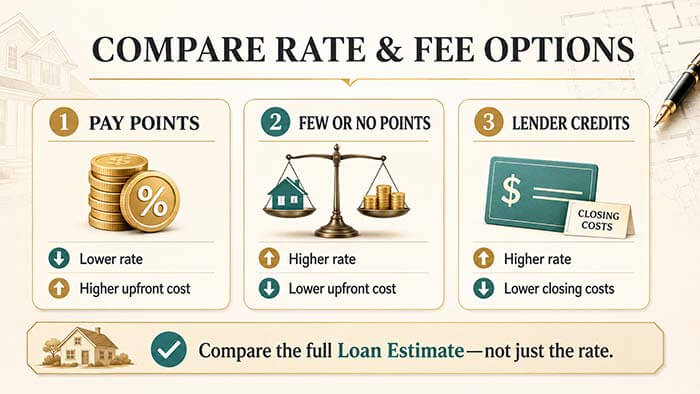
It Can Help to See a Mortgage Option:
- With lower interest, but a cost paid in the form of points
- With no or minimal points and a lower interest rate
- With lower up-front costs because the lender is offering the credit, and a lower interest rate
Where Will the Broker Compensation Be?
Ask the originator where the compensation will be documented on the Loan Estimate, Closing Disclosures, broker Agreement, and state-required disclosures.
How Long Will It Take to Recoup the Cost of Points?
To find your break-even point, divide the upfront cost by your estimated monthly savings. Mortgage brokers may charge higher fees than direct lenders, but they can be very helpful for borrowers with unique or complex finances. If your situation is not typical, a broker’s experience might be worth the extra cost.
Access to Several Wholesale Lenders
Mortgage brokers can compare loan programs from multiple wholesale lenders.
Many Lenders Can Have Differences With Regard to:
- Credits scores
- Debt-to-income ratio
- Underwriting policies
- Reserve requirements
- Property guidelines
- Income documentation
- Bankruptcy and foreclosure overlays
Help With Complex Mortgage Qualifications
Brokers Can Be Very Beneficial to Borrowers Who Have Any Combination of the Following:
- High debt-to-income ratio
- Recent credit problems
- Self-employment
- Income from commissions
- Recent bankruptcy
- Recent foreclosure
- Multiple properties
- Non-warrantable condo
- Non-conforming property
- Need for a non-QM mortgage
- Getting approved is not guaranteed.
- The broker still has to find a lender and a loan program that you qualify for.
Ability to Evaluate Several Programs
- Many borrowers can qualify for multiple mortgage programs.
- Brokers can compare FHA, VA, USDA, conventional, jumbo, and non-QM loans.
- The loan with the lowest advertised rate is not always the best option.
- You should also consider fees, funding requirements, down payments, closing costs, qualification criteria, and your long-term financial goals.
- Yield spread premium is an historic mortgage compensation term.
- Previously, YSP could increase broker compensation if borrowers accepted higher market interest rates.
- Today, most federal rules prohibit basing compensation on market rates, APRs, or other loan terms.
- Mortgage brokers may still receive lender-paid or borrower-paid compensation.
Key Considerations Include:
- Who pays the broker?
- How is the compensation determined?
- Is the compensation arrangement lawful?
- Where is the compensation?
- How do the costs and rate compare to other loans?
- When you look at mortgage options, review the full Loan Estimates.
- Don’t choose just based on the lowest rate or fee.
- The best mortgage is the one that fits your financial situation and goals, including closing costs and long-term plans.
- Broker compensation is not listed as a separate charge on the Loan Estimate.
- If the borrower pays it, it’s included in origination charges.
- If the creditor pays, it appears on the Closing Disclosure as a charge to the borrower.
Yield Spread Premium Frequently Asked Questions
What is a Mortgage Broker, and What are Yield Spread Premiums?
Mortgage brokers are licensed professionals facilitating mortgage loans between borrowers and wholesale lenders. They are compensated for their services through yield spread premiums and commissions paid by wholesale lenders for originating mortgage loans.
How do Mortgage Brokers Differ from Mortgage Bankers?
Mortgage brokers have access to multiple wholesale lending partners and can offer a wider range of loan options, including non-QM and alternative financing programs. On the other hand, mortgage bankers typically offer a narrower selection of loan products and fund loans using their capital.
What Factors Influence Mortgage Rates Offered by Brokers and Bankers?
Mortgage rates can vary based on the lender’s compensation structure. Mortgage brokers are limited by law to a maximum commission, which can lead to lower rates for borrowers. In contrast, mortgage bankers have more flexibility in their compensation and may charge higher rates.
Why are Mortgage Bankers Exempt from Certain Regulations on Compensation?
Mortgage bankers fund loans directly using their capital and are not required to disclose their compensation or adhere to maximum commission caps like mortgage brokers. This exemption is due to mortgage bankers’ different business models and risk profiles.
How Do Borrowers Benefit from Working with Mortgage Brokers?
Borrowers can benefit from mortgage brokers who can access a broader range of loan options and wholesale lenders, including specialty lenders that cater to unique financing needs, such as those with low credit scores or non-traditional income sources.
What Penalties do Mortgage Brokers Face for Misconduct or Violations?
Penalties for mortgage brokers may include fines, license suspension or revocation, legal action, and damage to their reputation. These penalties aim to enforce compliance with regulations and protect consumers from financial harm.
Is Yield Spread Premium the Same as Discount Points?
No. Discount points are paid to obtain a lower mortgage rate. Traditionally, the yield spread premium was compensation for delivering a loan above the lender’s par rate. Broker compensation in today’s market cannot be adjusted to compensate the borrower for accepting a higher rate.
Does a “No Closing-Cost” Mortgage Mean “No Costs”?
No. A “No Closing-Cost” mortgage does not mean there are no costs. In a “No Closing-Cost” mortgage, the lender pays certain closing costs, primarily by charging a higher interest rate. The costs can also be rolled into the loan, if allowed.
Can Borrower-Paid Compensation Equal a Lower Rate?
Maybe. Borrower-paid compensation can come with different pricing than lender-paid compensation. If you are shopping for a mortgage, look at the total cost, including the rate, APR, points, broker fee, lender credits, cash to close, and how long you expect to keep the mortgage.
Can a Mortgage Broker Lower the Commission to Match Another?
Generally, compensation for loan originators cannot be changed for a given transaction if the borrower chooses different mortgage terms or a competing offer. The credit can change the price, but the broker’s commission cannot be adjusted under the deal terms, except in exceptional cases. (Consumer Financial Protection Bureau)
Does a Mortgage Broker Need to Work with All Lenders?
No, a mortgage broker does not need to partner with every lender. Generally, a broker can work with the wholesale lenders the company partners with, for which the borrower has a good chance of qualifying. (Consumer Financial Protection Bureau)
How Can I Confirm Whether a Mortgage Broker Is Licensed?
Borrowers can check NMLS Consumer Access using the mortgage company name, the loan officer’s name, or an NMLS ID. Regulation Z mandates that loan-originator companies obtain the applicable federal and state licenses and registrations.
Should I Only Consider A Mortgage Based on APR?
No. APR is a helpful way to measure mortgage cost, but it shouldn’t be your only factor. You should also look at the cash-to-close amount, monthly payment, mortgage insurance, lender credits, and how long you plan to keep the loan.
All articles published must undergo a mortgage compliance review because they address disclosure requirements, Regulation Z, loan originator compensation, and potential state-level legal barriers. This Guide About “Yield Spread Premium Charged By Mortgage Brokers” was updated on August 3, 2026.