Mortgage approval for home purchase on acreage is possible with FHA, VA, USDA, conventional, and Non-QM loan programs. There is not always a simple maximum-acreage rule. Lenders and appraisers look at how the property is used, whether it is primarily residential, local zoning, comparable sales, outbuildings, marketability, and whether any portion of the land has a separate commercial or agricultural use.
Can You Get a Mortgage on a Home With Acreage?
Yes, there are mortgage options for homes with acreage, including conventional, FHA, VA, USDA, and Non-QM loans. The number of acres a home has is not the determining factor in whether or not a property can be financed. For Mortgage approval for home purchase on Acreage, the lender will consider whether the property will be used primarily for residential purposes and acceptable under the loan program guidelines being used. The lender and the appraiser will look at the zoning, the property’s current use, the buildings on the property, the property’s accessibility, whether utilities are present, comparable sales, and how easily an equivalent sale can be constructed. A home on 20 or 40 acres may qualify, but the acreage, use, appraisal support, marketability, and lender requirements must still be reviewed. Issues arise when a property is actively used as a commercial farm or ranch, or contains structures that do not lend themselves to easy sales comparisons.
Is There a Maximum Acreage for a Mortgage?
There is no single maximum acreage cutoff across all mortgage types. Agency guidelines may not impose the acreage caps borrowers commonly hear about, but individual lenders and investors can apply stricter limits. Freddie Mac states that it does not limit mortgage purchases based on property size. Fannie Mae’s appraisal guidelines also contemplate rural properties that have a large amount of acreage and require that the entire property be included in the appraisal. The size of a parcel isn’t the main concern when dealing with large parcels. The primary challenge is finding an acceptable residential property. Lenders will need the property, an appraisal, and the property’s value and marketability. Some individual lenders and Non-QM investors also have restrictions, so promising borrowers should have their parcels reviewed even if they think they should qualify.
What Mortgage Underwriters Look for on Properties With Acreage
Underwriters are not as concerned about the size of the parcel. Rather, they are concerned with whether the property is acceptable residential collateral for the mortgage program.
Residential Use vs Agricultural or Commercial Use
A large acreage residential property could, in fact, be a consideration. A property that is primarily a commercial farm, ranch, or business operation has other considerations. For example, as Fannie Mae notes, agricultural properties, including farms and ranches, are considered ineligible. Large barns, silos, other storage, or other types of farm improvements would require a lender to evaluate the property’s residential nature. Personal use acreage, a garden, or other farm building would not mean that a residential property would be considered a commercial agriculture property. Other aspects of the property need to be considered.
Zoning and Highest and Best Use
Agricultural zoning does not automatically mean a residential property is ineligible for financing. The lender and appraiser must determine if the property has legal definitions to allow use as a residence and if the property’s use is consistent with the program. Freddie Mac states that it is acceptable to consider agricultural zoning if a property retains its residential character, there is no commercial farming or ranching use, and there is a residential use. The appraisal must address the property’s highest and best use. There are additional underwriting concerns if the land has a more valuable or marketable use than as an improved residential property.
Marketability and Comparable Sales
Properties with large land areas are more difficult to appraise because comparable properties may sell infrequently in the surrounding area. This does not automatically make the property ineligible. Fannie Mae states that appraisers of rural properties may use comparable sales located remotely if no proximate sales are available; however, the appraiser must provide a narrative report explaining their selection. The objective is to substantiate marketable value and establish that there is a market for the property of like kind.
Fannie Mae Guidelines for Homes With Acreage
Fannie Mae does not require an appraiser to value a small portion of a larger residential parcel. The appraisal must report and value the actual property that is being offered as collateral.
For example, Fannie Mae states that an appraiser may not value only 5 acres of an unsubdivided 40-acre parcel. In that case, the appraisal would need to value the entire 40-acre site.
Fannie Mae appreciates that larger property sizes may be associated with rural sites. Lenders should analyze the site’s characteristics, zoning, current land use, highest and best use, and whether the site is typical in the market.
Freddie Mac Guidelines for Homes with Acreage
Freddie Mac states very clearly that there is no Freddie Mac mortgage purchase limit based solely on the size of the property site. The acreage must be identified by the appraiser, and comparable sales should be used for similar-sized sites when available. If there is a large variance in acreage between the subject site and the comparable sales, the appraiser should describe the variance and assess whether it will affect the property’s value or marketability. Freddie Mac does not automatically disqualify a property from consideration if it has an agricultural zoning. A property may be residential in nature and fully eligible if the central use of the property is not a commercial farming or ranching use. Site size, zoning, property use, comparable sales, access, utilities, highest or best use, and overall marketability are key considerations for property collateral.
FHA Guidelines for Homes With Acreage
FHA does not have a rule that limits financing to the house and the first 10 acres. They evaluate whether the site meets all the conditions set forth and whether the appraisal supports financing of the residential property. When a home site is a large parcel, the appraiser evaluates the entire parcel for possible excess land. Current FHA policy is published in the Single Family Housing Policy Handbook 4000.1, which HUD published on August 12, 2026.
FHA Excess Land Versus Surplus Land
FHA distinguishes between excess land and surplus land when evaluating a property with acreage. Excess land is land that is not needed to support the existing home or other residential improvements. It may have a separate highest and best use and may be legally divided and sold independently. Because it can have its own marketability, excess land may require additional appraisal and underwriting review. Surplus land is also not currently needed to support the home, but it cannot be separated and sold independently. It does not have a separate highest and best use, although it may still contribute to the property’s overall value. The appraiser must identify and analyze any excess or surplus land and explain how it affects the property’s value, use, and marketability. The total number of acres alone does not determine whether a property is eligible for FHA financing.
Will the House and Acreage Qualify for Financing?
The lender and appraiser may consider how much of the property’s value comes from the residence versus excess land, outbuildings, agricultural features, or other improvements.USDA Guidelines for Homes With Acreage
USDA has no formal maximum acreage limit for its Single-Family Housing Guaranteed Loan Program. The appraiser must determine whether the site size is typical for the area and explain adjustments when it differs from comparable properties. Where the Subject Property has substantially more or less land compared to similar properties sold within the area, the reasons for the differences and the adjustments must be explained by the appraiser. These requirements were also stated in the USDA’s 2026 lender training. USDA does not require that the house be valued at 70% of the total property value, nor does it require that the remaining land be valued at 30%. USDA states that there is no upper limit on the site value if sufficient comparable properties are available.
USDA Restrictions on Income-Producing Property
The greatest concern in financing with USDA is the use of the property. Property used primarily for farming or another commercial purpose is not eligible. Land or buildings primarily used to generate income can also bring an eligibility concern. A barn, workshop, greenhouse, or similar structure will not disqualify the property. USDA permits outbuildings when they are not principally used for income-producing purposes. Buildings or land currently identified as income-producing can make the property ineligible.
VA Guidelines for Homes and Farm Residences With Acreage
VA does not set a maximum acreage limit for a VA-guaranteed property. A veteran may use a VA loan to purchase a farm residence, provided the home will be the veteran’s primary residence and the loan is financing residential real estate rather than a farming business.
Acreage properties are appraised in much the same way as other residential properties. The appraiser should use recent sales of comparable acreage properties purchased primarily for residential use, when available.
Barns, sheds, corrals, stables, pastures, and similar improvements may be included at their fair market value. Livestock, crops, farm equipment, supplies, and the value of an operating business are not included in the VA appraisal. A property with farm-related improvements may qualify when it remains primarily residential, and the appraisal supports its value and marketability. Individual lender requirements may also apply.
Non-QM Loans for Homes With Large Acreage
There is no universal Non-QM acreage policy. Acreage limits and property-use requirements vary by investor. Different lenders have different criteria. The lender typically does an assessment:
- total acreage;
- property and land use;
- farming or commerce;
- land value;
- outbuildings;
- comparable sales;
- and overall marketability.
Borrowers considering mortgage approval for home purchase on acreage through a Non-QM program should have the property reviewed to avoid relying on a presumed acreage limit. Investor guidelines may vary drastically for rural properties.
Can You Finance a Home Zoned Agricultural?
Agricultural zoning does not mean the borrower is un-mortgageable.
The first thing to determine is if the property is intended for residential use rather than commercial purposes, like farming or ranching.
Agriculturally zoned property with a residence can sometimes qualify for traditional financing, provided residential use is permitted, and the property retains a residential character. This type of property differs from a working farm with significant commercial agricultural improvements, which may require a different type of financing. People buying property that is zoned agricultural should check the zoning and allowable uses as early as possible in the mortgage process to avoid discovering a problem after the appraisal order.
Homes With Barns, Horse Facilities, Workshops, and Outbuildings
Having a barn, stable, workshop, or storage building on properties eligible for residential mortgage financing is fairly common. The lender will consider the size, use, and value of the improvement. Small barns and stables that are typical of residential properties may be acceptable. Fannie Mae requires additional consideration of large outbuildings, such as barns, silos, storage, or animal farm outbuildings, as they may suggest the property is agricultural rather than residential. A personal-use workshop is quite different from a business-use workshop. The same holds true for horse properties. Having a personal-use horse does not create a commercial property, but conducting a horse business, such as providing board or operating a large equine enterprise, may affect the property’s financing. USDA allows personal use barns, storage, and non-commercial workshops when they are not primarily used in an agricultural or commercial enterprise.
Why Appraisals Can Be Difficult on Large Acreage Properties
Homes with substantial acreage can be difficult to appraise when few similar residential properties have sold nearby. The appraiser may need to use comparable sales from farther away or make larger adjustments for differences in acreage, outbuildings, location, or property features.
Using distant comparable sales does not automatically make the property ineligible. The appraisal must explain why those sales were selected and provide credible support for the property’s value and marketability.
Financing may become more difficult when the acreage is unusual for the area, a portion of the land has a separate highest and best use, or the property appears more agricultural or commercial than residential.
Can Multiple Parcels Be Included in One Mortgage?
A home on acreage may consist of more than one legal parcel. Multiple parcels can sometimes be included in the same mortgage, but they must comply with the applicable loan program. For example, Freddie Mac typically requires that multiple parcels pledged to secure the mortgage must be adjacent, covered by the first lien, and conveyed in their entirety. The mortgaged property must also contain only one residence, with the exception of an eligible accessory dwelling unit. USDA also allows multiple parcels if they meet the USDA property requirements, including being contiguous and covered by the mortgage lien. Some issues come up when:
- Parcels cannot be combined for a single construction;
- parcels are not connected;
- parcels are not all mortgaged;
- Another dwelling is located on a separate parcel;
- ownership of the parcels or rights to the parcels is different;
- parcels have different zoning; or
- Parcels have different rights of access, utilities, or amenities.
Borrowers purchasing multiple parcels should provide their lender with the parcel details before ordering the appraisal.
Common Reasons an Acreage Property May Not Qualify
A property is rarely denied because of its acreage. Issues generally relate to how the property is used, how its value is determined, and how it is configured, leading to various problems. Some examples of these issues are:
- The property’s use is more commercial, such as a farm or ranch;
- Commercial or agricultural buildings are present;
- The property’s use is not residential;
- The appraisal cannot justify the property’s value;
- Comparable residential sales are very limited;
- a part of the property has a separate Highest and Best Use;
- Multiple parcels do not comply with the program;
- private roads or legal access are not met;
- well or septic issues affect eligibility or marketability; or
- The lender or investor has more restrictive guidelines than the agency for which the lender is providing the loan.
Fannie Mae also requires the appraisal to discuss the site characteristics and access, utilities, and zoning issues; the highest and best use, site constraints; and how these may impact the property’s marketability. Finding one of these does not always mean the transaction is not possible. It may mean a different loan program or lender needs to be considered.
What We Review Before Ordering an Acreage Appraisal
At Gustan Cho Associates, we try to identify potential property issues before the borrower pays for an appraisal. We ask the borrower or real estate agent to send us the property listing and any available information about the land and improvements. Our preliminary review may include:
- Total acreage and number of legal parcels
- Current use and permitted use under local zoning
- Agricultural, rental, or business activity
- Barns, workshops, stables, silos, and horse facilities
- Legal access, easements, and private-road arrangements
- Available sales of similar residential acreage properties
- Whether each parcel will be included in the mortgage lien
- Whether the property remains primarily residential
This early review can help us identify concerns involving commercial use, income-producing land, multiple parcels, unusual outbuildings, or limited comparable sales. It does not replace the appraisal or guarantee property approval, but it may help the borrower avoid paying for an appraisal before an obvious eligibility issue is addressed.
How to Get Pre-Approved Before Making an Offer on Acreage
When considering the purchase of a property with sizable acreage, borrowers should inform the loan officer of pertinent information about the property before making an offer whenever possible.
Include in your submission to the lender the listing, total acreage, number of parcels, zoning classification, outbuildings, current use, and any known agricultural or business use of the property. Be sure to include any barns, workshops, horse facilities, additional parcels, or other unique improvements.
Reviewing the property can help the loan program selection prior to the borrower incurring the cost for the appraisal and inspection. Even though the loan is pre-approved, it doesn’t mean the acreage property will be approved for this program. There are still underwriting requirements that the borrower must meet: credit, income, assets, and total debt. There are additional requirements for the property, including Zoning and use.
Final Thoughts on Mortgage Approval For Home Purchase on Acreage
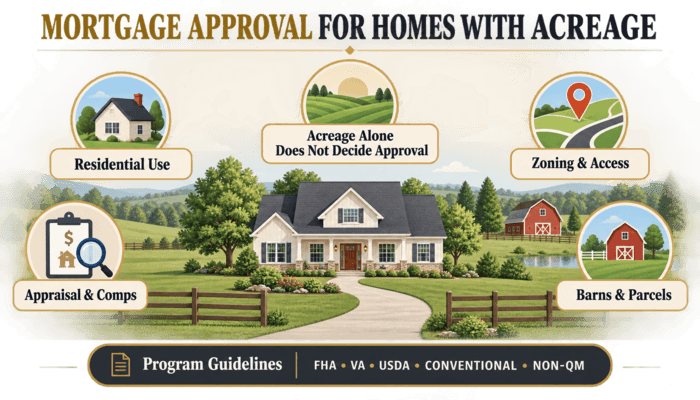
Buying a home with a decent amount of acreage does not automatically make mortgage approval difficult. In most cases, the number of acres is less important than how the property is used, whether it remains largely residential, and whether the appraisal supports the property’s value and marketability. The rules will fluctuate depending on the loan program. FHA, VA, USDA, Fannie Mae, Freddie Mac, and Non-QM Lenders do not all view acreage, agricultural use, outbuildings, and multiple parcels in the same way. For mortgage approval for home purchase on acreage, the best practice will be to have the property reviewed as early as possible. Providing the lender with the listing, number of acres, zoning, parish information, and the location of barns or other improvements on the property helps identify potential problems before the appraisal is completed. Acreage alone is rarely the deciding issue. Property use, appraisal support, legal configuration, and lender requirements usually determine eligibility.
Frequently Asked Questions About Mortgage Approval for Home Purchase on Acreage
Is There a Maximum Number of Acres for a Conventional Mortgage?
There is no single maximum acreage limit that applies to every conventional mortgage. Freddie Mac does not disqualify a property solely based on its size. In contrast, Fannie Mae requires the appraisal to reflect the entire property offered as collateral. The home must remain primarily residential, and the appraisal must support its value and marketability. Individual lenders and investors may impose additional acreage restrictions.
Can FHA Finance a Home With More Than 10 Acres?
Yes. FHA does not have a rule limiting financing to the house and the first 10 acres. The appraiser must evaluate the property’s residential use, comparable sales, marketability, and any excess or surplus land. A property with more than 10 acres may qualify when it meets the FHA property and appraisal requirements.
Does USDA Have an Acreage or Land-Value Limit?
USDA does not establish a specific maximum acreage limit or require the land to represent no more than 30% of the property’s value. The property must be primarily residential, typical for the area, and supported by appropriate comparable sales. Land or buildings principally used for agricultural, commercial, or other income-producing purposes can create an eligibility problem.
Can a VA Loan Finance a Farm Residence?
Yes. A VA loan may finance a farm residence when the veteran will occupy the home as a primary residence. VA does not set a maximum acreage limit, but the loan must finance residential real estate rather than a farming business. Livestock, crops, farm equipment, supplies, and business value are not included in the VA appraisal.
Can a House With Agricultural Zoning Qualify for a Residential Mortgage?
Agricultural zoning does not automatically make a property ineligible. The lender and appraiser must confirm that residential use is legally permitted and that the property remains primarily residential. A working farm, commercial ranch, or property dominated by income-producing agricultural improvements may require a different financing program.
Can Barns, Horse Facilities, or Multiple Parcels Affect Mortgage Approval?
Yes, but these features do not automatically prevent approval. The lender and appraiser will review how the buildings are used, whether they are typical for residential properties in the area, and how they affect value and marketability. When multiple parcels are included, the lender may also review whether they are contiguous, properly zoned, conveyed together, and covered by the mortgage lien.
This article about “Mortgage Approval for a Home Purchase on Acreage” was updated on September 22nd, 2026.