

In this guide, we will cover and discuss the gift of equity on home purchase mortgage guidelines. Many people want to keep the family home in the family. When the parents retire and downsize, mom and dad want to sell the home to one of their children at a discount. What does the gift of equity on home purchase mean? Alex Carlucci, an associate contributing editor of GCA Forums News and a senior mortgage loan originator at Gustan Cho Associates explains what gift of equity on home purchase means:
A gift of equity in the context of a home purchase occurs when a homeowner sells their property to a buyer with whom they share a close relationship, typically a family member or a dear friend.
This involves the seller offering the home at a discounted price, meaning the property is sold below its market or appraised value. By selling the home at a value lower than its market worth, the buyer acquires immediate equity in the property upon purchase. There are cases where a relative decides to sell their home to a relative. The down payment from the seller is gifted to the home buyer’s relative. Therefore, instead of giving the homebuyer cash for a gift, the seller gifts the equity in their home to the home buyer. In the following paragraphs, we will cover gift of equity on home purchase.
What Is A Gift of Equity On Home Purchase?
A gift of equity occurs when a family member, acting as the seller, transfers a home to the buyer at a price below its current appraised market value. At closing, the difference between the appraised value and the sale price becomes the gift of equity, which goes straight toward the buyer’s down payment or closing costs.
Unlike a cash gift, no money is actually moved; it just shows up on the closing paperwork. This works especially well for family sales, such as parents selling to their children or grandparents helping their grandchildren.
The gift of equity covers the buyer’s required payment and meets lender rules, making the process easy as long as all paperwork is done correctly. A gift of equity lets families help loved ones buy a home with little or no down payment. In this guide, you will learn the 2026 rules for using a gift of equity with FHA, conventional, VA, and USDA loans. Knowing these rules helps both buyers and sellers move through the process easily. At Gustan Cho Associates, our experienced mortgage team has helped families across the country achieve homeownership through creative gift-of-equity options.
Common Gift of Equity on Home Purchase Case Scenarios

Often, an older parent may express the desire to transfer the family home to their son or daughter at a price significantly below the market or appraised value. In instances like these, the seller is selling their property to a son, daughter, or relative at a value below the market rate. Dale Elenteny, a senior mortgage loan originator at Gustan Cho Associates, and an associate contributing editor at GCA Forums News, helps individuals eligible to provide a gift of equity in a home purchase:
Home sellers who can give a gift of equity on home purchase are eligible to offer a gift of equity on home purchase to a family member, including legal siblings, parents, grandparents, legal guardians, and/or their spouses.
Receiving a gift of equity when purchasing a home can assist the buyer in avoiding the need to provide the entire or a portion of the down payment, thereby easing constraints on the home purchase. Lenders typically mandate a formalized gift of equity letter, which must be signed and include specific language.
How Gift of Equity on Home Purchase Works
Typically, in purchase transactions involving a gift of equity, the seller disposes of the property to a buyer who is a relative at a discounted rate. The amount below the market price or appraised value can serve as a gift of equity for the homebuyer, thereby restricting the down payment required from them.
The loan officer will instruct the seller and buyer on how to structure the gift of equity real estate purchase contract and will structure the home purchase and mortgage process accordingly.
Obtaining a gift of equity for a home purchase is a straightforward process, akin to a standard home buying procedure. The mortgage company’s loan officer will collaborate with the seller, borrowers, and title company to facilitate the gift of equity on the home purchase.
How Is A Gift Of Equity Different From A Cash Gift?
Both a gift of equity and a cash gift can help with a down payment, but they work in different ways. With a cash gift, the donor must transfer the funds, and the buyer must provide bank statements. A gift of equity, on the other hand, lets the donor use the home’s value to help, so there’s no need to dip into savings.
Most lenders accept both gifts of equity and cash gifts for down payments. When giving equity, you need an appraisal and a lower sale price to document the gift.
The appraiser decides the home’s value, and the seller and buyer agree on a price below that value to create the gift. At closing, this difference is given to the buyer as a down payment or to cover closing costs. The seller only gets enough to pay off any loans, showing the equity is really a gift. Buyers still have to qualify for the loan, but a gift of equity can greatly reduce or even remove the need for cash at closing. For sellers, it is a good way to help family and avoid expensive loans or delays.
Gift of Funds vs Gift of Equity
A gift of equity does not involve moving any money, but a gift of funds does. With a gift of funds, the money must be tracked and held for a certain time, which can add more steps and rules.
A gift of equity is based on the home’s appraised value, but it does not always make the paperwork easier for family sales. Lenders usually accept both gifts of equity and gifts of funds, but a gift of equity is good for donors who want to keep their cash.
Consider a gift of equity if the seller owns the home and wants to add value without using their savings. This is a good choice for family sales, especially if the home has a large mortgage.
Take First Step Toward Making Your Dream A Reality
Apply Now And Get recommendations From Loan Experts
Gift of Equity Tax Consequences on Home Purchase
People who receive a gift of equity do not have to pay income taxes, and those who give the gift do not pay gift taxes unless the total gifts exceed $15 million in their lifetime. If the gift exceeds the annual gift limit, the giver must report it on IRS Form 709. For 2026, the yearly limit is $19,000 per person, or $38,000 for married couples who split gifts. Buyers should know that a gift of equity reduces their starting value for capital gains tax purposes. It is a good idea to consult a tax advisor.
What is the IRS Annual Exclusion and Lifetime Limit for 2026?
The IRS annual gift tax exclusion for 2026 is $19,000 per individual. Married couples can double this amount through gift splitting.
In 2026, the lifetime basic exclusion increased to $15 million, protecting most family transfers from taxation.
Common mistakes include selecting an ineligible donor, failing to obtain a current appraisal, or omitting the required gift letter. Always say the sale is between family, and make sure the seller only gets enough to pay off any loans. Working with an experienced mortgage broker can make things much easier.
How a Gift of Equity Works for Home Purchasers and Home Sellers
At Gustan Cho Associates, we specialize in helping families buy and sell homes to each other using gift-of-equity strategies for FHA, conventional, VA, and USDA loans. Our team has guided countless families and stays up to date on the latest 2026 mortgage rules. We handle the paperwork, loan setup, and tax planning so you can focus on your new home. To get started with a loan approval or explore a gift of equity, visit www.gustancho.com or reach out to us today.
Family Member Selling The Home Have To Do on Gift of Equity on Home Purchase
If there is a sufficient gift of equity, the home buyer will not be obligated to make a down payment. As previously mentioned, the seller must complete a gift of equity letter using the appropriate language provided by the mortgage lender. This letter or form explicitly declares that the seller is gifting equity to the borrower, and this gift is non-repayable under any circumstances. Additionally, the seller may choose to cover the closing costs for the home buyer. In cases where there is adequate equity in the home purchase, the buyer is not required to contribute any funds and must still qualify for a residential mortgage loan.
Step-by-Step Process of Using Gifted Equity in a Mortgage Transaction
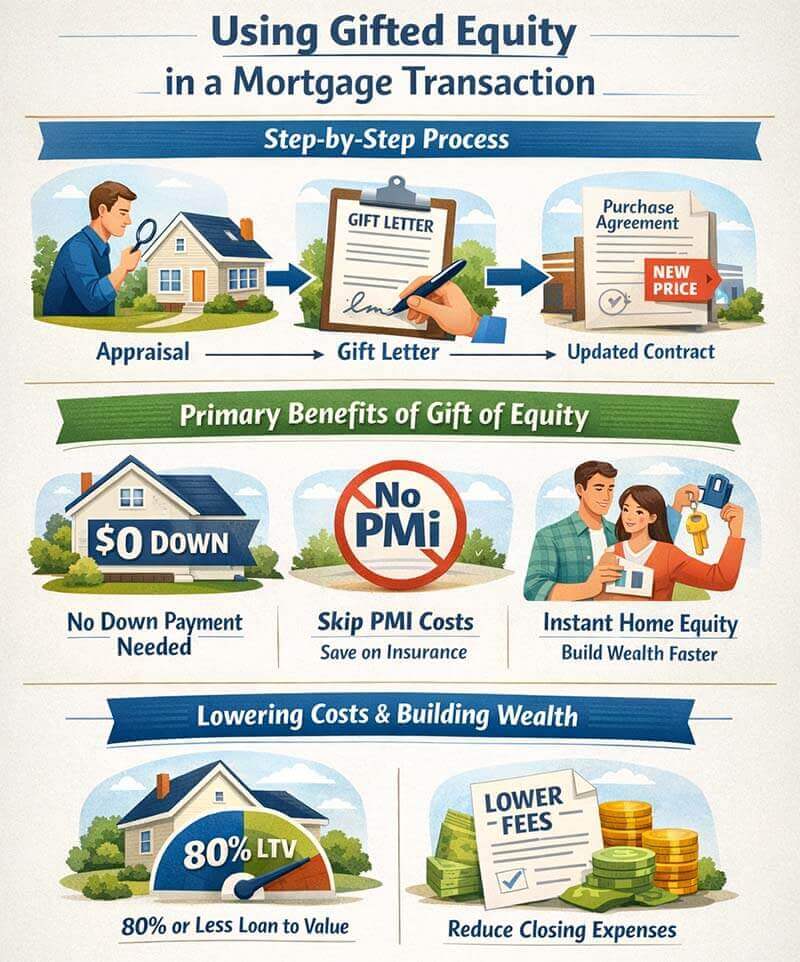
Start by getting a professional appraisal. Then, have the donor sign a formal gift letter. Adjust the purchase contract to reflect the new sales price and ensure the closing disclosure clearly shows the gift of equity. Lenders review these documents to confirm compliance with 2026 mortgage regulations.
Primary Advantages of Gift of Equity in Purchasing a Home
A gift of equity can help you buy a home faster by covering the whole down payment with many loan programs. If the gift is at least 20% of the price, buyers do not need to pay for private mortgage insurance (PMI) on conventional loans. This lowers closing costs, helps families build wealth over time, and lets donors keep their savings.
Sellers can help loved ones find stable housing, while buyers walk away with instant equity at closing. This strategy also gives first-time buyers a leg up in today’s competitive market.
Bypassing Private Mortgage Insurance and Minimizing Closing Costs
A large gift of equity can lower the loan amount to 80% or less of the home’s value on conventional loans, so buyers do not have to pay PMI. Even smaller gifts can lower closing costs, making it easier to afford a home.
Documents Needed for a Gift of Equity Mortgage
Lenders need clear proof of the gift. Important documents include the donor’s gift letter, which should list the property address, appraised value, sale price, gift amount, relationship to the buyer, and a note that no repayment is expected. You also need an independent appraisal to show the home’s value, and the closing paperwork must show the gift of equity. Some lenders may ask for proof of your relationship, like a birth or marriage certificate. The appraisal must be done by someone not connected to the buyer or seller. The loan file should include all required documents for approval.
2026 Gift of Equity Mortgage Regulations by Loan Type
Each loan program has specific guidelines for gifts of equity. All require the donor to be a family member or relative by marriage, and the gift must not be repaid.
Investment properties are generally not eligible.
Rules and Requirements Regarding FHA Loans: Gift of Equity
FHA loans are very flexible regarding the gift of equity. Gifts can only be made by family members, such as parents, children, grandparents, or legal guardians.
- Gifted equity can cover 100% of the 3.5% down payment requirement, and for single-family primary residences, no borrower contribution is required.
- For two-to-four-unit properties with 80% LTV, buyers usually need to contribute 5% of their own funds.
- The property must be the buyer’s primary residence, and the transaction is considered non-arms-length, so all parties must be fully disclosed.
- FHA gift-of-equity guidelines state that buyers can have a higher LTV if they have rented the property from a family member for at least 6 months.
Gift of Equity Guidelines for Conventional Loans (Fannie Mae and Freddie Mac)
Fannie Mae and Freddie Mac state that a gift of equity can be used for primary and secondary residences, but not for investment properties.
- Donors can be blood relatives, relatives by marriage, adopted children, or guardians, and may also include fiancés and domestic partners.
- A gift of equity may be used to pay all or part of the down payment and closing costs, but it may NOT be used to cover any required financial reserves.
- For second residences with a loan-to-value ratio exceeding 80%, the borrower must put down 5% from their own resources.
- The donor is not considered an interested party, so the gift is exempt from the usual contribution ban.
- Fannie Mae and Freddie Mac require the gift to be documented in the settlement statement.
Gift of Equity On Home Purchase For VA Loans
The VA loan program views a gift of equity as a reduction of the sales price, not as a gift fund.
- If family members reduce the price, the veteran applicant benefits, but the donor must be an unrelated party to the transaction.
- Gifted equity, unlike cash, does not influence VA funding fee calculations, which also apply to down payment contributions, covering optional down payments or closing costs.
- VA Gift of Equity guidelines focus on presenting documents to demonstrate that there is no expectation of repayment.
- Since no down payment is required for VA loans, a gift of equity provides flexibility with closing costs.
Gift Of Equity For USDA Loans
In USDA loans, a gift of equity must also comply with the rules of a non-arm’s-length transaction, and full disclosure must be provided to the appraiser.
- The equity reduction must be reflected in the closing documents, and the donor must provide a gift letter stating that no repayment is expected.
- The USDA guidelines allow gifts for down payment assistance and closing costs in eligible rural areas.
- Gifts are considered for other programs as well, provided the participants are family members or otherwise acceptable donors.
HUD Versus Conventional Guidelines on Gift of Equity on Home Purchase
The guidelines for HUD’s Gift of Equity on home purchases specify that if the buyer has not resided in the property being purchased through a gift of equity in the last 12 months, the seller is required to gift 15% equity. However, if the buyer has lived in the property for the past six months and is currently residing there, the seller can provide a gift of 3.5% for the down payment. In the case of conventional loans, there is no restriction on the amount that can be gifted, and it can be done by a relative regardless of whether the buyer has lived in the property before purchasing it.
Gift of Equity on Home Purchase Tax Consequences
Home Buyers and Sellers participating in the gift of equity home purchase transactions can have potential tax consequences. Both buyers and sellers should consult with their accountants or tax advisors concerning how the gift of equity transactions can affect their tax liabilities.
Take First Step Toward Making Your Dream A Reality
Apply Now And Get recommendations From Loan Experts
Consult With Tax Advisor on Gift of Equity on Home Purchase Transactions
It’s important to note that gifts of equity may have potential tax implications. Homebuyers and sellers are advised to engage in a conversation with a tax advisor or a certified accountant to grasp how these implications can affect their circumstances. Depending on factors such as tax brackets, the number of dependents, and marital status, there may be strategies available to mitigate the risk of substantial gift taxes or taxable gift taxes, offering a potential avenue to avoid such payments.
Allowable Gifts Between Sellers and Homebuyers
Gifts from family members are subject to certain allowances. For instance, an individual is authorized to bestow a gift to another individual amounting to $12,000 annually without having to report it to the Internal Revenue Service.
This H1 is set up to help people find it online by putting “Gift of Equity on Home Purchase” first, adding the year to keep it current, listing main loan types to reach more searches, and naming the firm to build trust.
There exists a cumulative gift limit of $1,000,000 for a recipient over their lifetime. In cases where a recipient is receiving gifts from both parents, each parent is entitled to gift the child $12,000, resulting in a combined total of $24,000 for that specific child. Any excess gift beyond this limit can be carried over to the subsequent year until the child reaches a maximum lifetime gift amount of $1,000,000.
Gift of Equity on Home Purchase For FHA and Conventional Loans
The U.S. Department Of Housing And Urban Development (HUD) which is the parent of The Federal Housing Administration (FHA) allows 100% gift of equity from the donor to a relative. However, on conventional mortgage loan programs, the mortgage lender wants to see that the person receiving the gift has 5% of their own funds for the down payment of the gift of equity home purchase.
Gustan Cho Associates specializes in effectively structuring gift of equity in home purchase transactions. As licensed mortgage brokers operating in 48 states, including Washington, DC, Puerto Rico, and the U.S. Virgin Islands,
Gustan Cho Associates has garnered a nationwide reputation for successfully securing mortgage loans that may pose challenges for other lenders. Please contact Gustan Cho Associates for more information on structuring a gift of equity mortgage loan at 800-900-8569 or text us for a faster response. Or email us at gcho@gustancho.com. The Team at Gustan Cho Associates is available seven days a week, evenings, weekends, and holidays.
FAQ: Gift of Equity on Home Purchase Mortgage Guidelines
What Is A Gift of Equity On Home Purchase?
- A gift of equity occurs when a homeowner sells their property to a close relative or friend at a discounted price, below the market or appraised value.
- The buyer gains immediate equity in the property upon purchase.
Who Can Provide A Gift Of Equity On A Home Purchase?
- Home sellers who can provide a gift of equity are typically eligible to offer it to family members, including legal siblings, parents, grandparents, legal guardians, and spouses.
What Is The Difference Between A Gift Of Equity And A Gift Of Funds For A Mortgage?
- A gift of equity is a transaction in which the seller/owner gives the buyer/owner a credit for the difference between the home’s appraised value and the sale price.
- A gift of funds for a mortgage is a transaction in which cash is transferred from the donor’s bank account to the buyer’s bank account.
- Equity gifts simplify family property transfers, and most 2026 mortgage guidelines permit both options.
Can A Gift Of Equity Cover The Full Down Payment On An FHA Loan?
- Yes. Family members can cover 100% of the 3.5% minimum down payment requirements on FHA loans on primary residences, so no borrower cash contribution is necessary.
Do Conventional Loans Allow The Gift Of Equity For Second Homes?
- Yes.
- Second-home gifts of equity are allowed under Fannie Mae and Freddie Mac guidelines, but a borrower contribution of at least 5% is required if the loan-to-value ratio exceeds 80%.
Are There Tax Consequences For The Seller Providing A Gift Of Equity?
- If the gift exceeds $19,000 in 2026, the seller must file IRS Form 709.
- However, no tax is due unless the $15 million lifetime exclusion is exceeded, and the buyer is not required to report the gift as income.
Is A Gift Of Equity Allowed On VA or USDA Loans?
- Yes, a gift of equity is allowed on VA loans, as long as there is appropriate documentation and it is treated as a sales price reduction.
- USDA loans allow gifts of equity, provided there is full disclosure and a signed gift letter.
- In both cases, the family member donor must be acceptable.
What Documents Are Needed For A Gift Of Equity Mortgage?
- Required documents are a gift letter, a professional appraisal, and a closing disclosure with equity credit.
- Most lenders require verification of the buyer-donor relationship.
Can Friends Do A Gift Of Equity?
- Most mortgage programs restrict gifts of equity to family members or certain relatives.
- Some conventional loans are less restrictive, but FHA loans require the donor to be a family member.
- Consult your lender for specific requirements.
Why Can A Gift Of Equity Mortgage Avoid PMI?
- If the gifted equity (i.e., equity in the home being purchased) pushes the down payment to 20% or more, PMI can be waived, saving buyers hundreds of dollars each month.
How Does A Gift Of Equity Work In A Home Purchase?
- In a gift of equity transaction, the seller sells the property to a relative at a discounted rate, serving as a gift of equity for the buyer, reducing their required down payment.
Is A Gift Of Equity A Complex Process?
- Obtaining a gift of equity is a straightforward process similar to a standard home-buying procedure.
- The mortgage company’s loan officer will assist in structuring the transaction.
Does The Homebuyer Need To Make A Down Payment In A Gift Of Equity Transaction?
- The buyer may not need to make a down payment if there is sufficient gift of equity.
- The seller must provide a gift of equity letter declaring the non-repayable nature of the gift.
Are There Different Guidelines For FHA And Conventional Loans Regarding Gift Of Equity?
- Yes, HUD guidelines specify gift amounts depending on the buyer’s residence history in the property, while conventional loans have no such restrictions and allow gifts from relatives regardless of the buyer’s history.
Are There Tax Consequences For A Gift Of Equity Transactions?
- Gift of equity transactions can have potential tax implications for both buyers and sellers.
- Consultation with a tax advisor or accountant is recommended to understand the impact on tax liabilities.
Are There Limits To The Amount Of Allowable Gifts Between Sellers And Homebuyers?
- There are annual and lifetime limits for gifts from one individual to another.
- An individual can gift up to $12,000 annually without reporting it to the IRS, with a maximum lifetime limit of $1,000,000.
How Can I Prequalify For A Mortgage Loan In Such Transactions?
- You can prequalify for a mortgage loan by filling out a quote form provided by your mortgage lender.
This blog about the Gift of Equity on Home Purchase Mortgage Guidelines was updated on March 22, 2026.
Take First Step Toward Making Your Dream A Reality
Apply Now And Get recommendations From Loan Experts