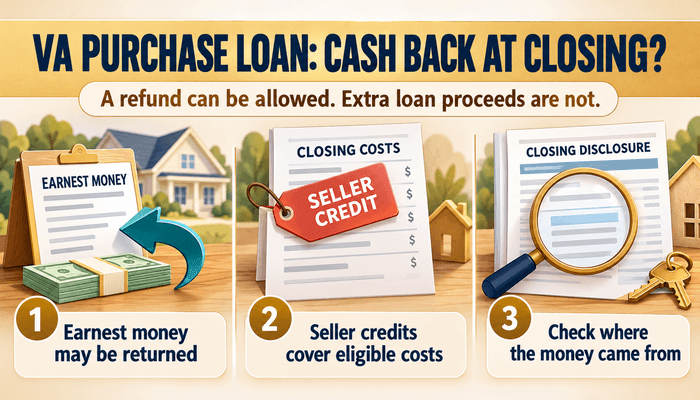
On a VA purchase loan, you generally cannot receive extra cash from the loan proceeds. You may, however, receive a properly documented refund of money you already paid into the purchase, such as earnest money that is no longer needed at closing. Seller credits and tax adjustments can also change your final cash-to-close amount, but they do not automatically become cash paid to you. If you want to access equity in a home you already own, read our guide to VA cash-out refinance loans.
Can You Get Cashback at Closing on a VA Purchase Loan?
A VA purchase loan generally cannot be used to give the veteran extra cash from the mortgage proceeds.
What may be allowed is a return of money that the veteran already put into the transaction. This is why cashback at closing on VA loans is better understood as a refund in certain situations rather than cash-out financing.
The final amount depends on how the purchase is structured and how the funds are shown on the Closing Disclosure.
Cash Back vs. a Refund of Your Own Money
The difference is important.
Cash Back From Loan Proceeds
This would mean borrowing more than is needed for the eligible purchase transaction and receiving the excess as cash. That is generally not allowed on a VA purchase loan.
Refund of Borrower Funds
A refund involves money the veteran already paid and can properly receive back at closing. The clearest example is documented earnest money on an eligible zero-down VA purchase when the veteran no longer needs those funds to complete the transaction.
Can Earnest Money Be Refunded on a VA Loan?
Yes, earnest money may be returned to the veteran if the transaction permits a refund. Suppose a veteran deposits $3,000 in earnest money and later obtains 100% VA financing. If eligible closing costs and other required amounts are covered, the veteran may be able to receive the documented $3,000 deposit back at closing. That money is not additional VA loan proceeds. It is the veteran’s own money being returned. The lender must be able to document the earnest-money deposit and verify its source.
Can Appraisal or Other Upfront Costs Be Refunded?
Paying for an appraisal, home inspection, credit report, or another service before closing does not, by itself, create a refundable amount. The payment may simply cover a service you received. If a charge you already paid is accounted for in the final transaction, ask your lender and settlement agent whether it will be credited or reimbursed and how it will appear on the Closing Disclosure. Do not assume that a seller credit will return every expense you paid upfront.
VA Seller-Paid Closing Costs vs. Seller Concessions
Seller-paid closing costs and VA seller concessions are not the same thing.
Seller-Paid Closing Costs
A seller may pay eligible closing costs on the veteran’s behalf. These can include certain customary costs associated with completing the purchase. The amount paid toward normal allowable closing costs is not automatically subject to the VA seller-concession limit.
VA Seller Concessions
Seller concessions provide additional financial benefits beyond ordinary closing-cost payments. Examples may include payment of the VA funding fee, certain prepaid taxes or insurance, temporary interest-rate buydowns, or payment of certain borrower debts when permitted. VA generally limits seller concessions to 4% of the property’s established reasonable value. The 4% limit should not be described as a cap on every dollar the seller can contribute toward the transaction.
Avoid a Last-Minute VA Closing Surprise
Credits that are structured incorrectly can create underwriting or closing problems. We’ll review your Loan Estimate, Closing Disclosure, seller credits, and cash-to-close.What Happens to Unused Seller Credits?
Seller credits do not automatically convert to cash for the veteran.
If the credit exceeds the approved closing costs, the lender and the closing agent must decide, according to the contract, the VA regulation, and lender policy, how to handle the remainder.
The unused portion may need to be applied in whole or in part to another allowable closing cost, or the contract may need to be amended to resolve the unused credit. Borrowers should not assume that any unused portion of a large seller credit will be paid to them.
How Property-Tax Adjustments Affect Cash to Close
Property-tax prorations are different from seller credits and refunds of borrower-paid funds. Depending on local tax practices and the purchase contract, the seller may owe the buyer a credit for property taxes that have accrued but have not yet been paid. That adjustment can change the amount of cash the veteran needs to bring to closing. Because tax practices vary by location and transaction, borrowers should review the final figures with the lender and settlement agent rather than treating a tax credit as automatic cashback.
Where Refunds and Credits Appear on the Closing Disclosure
 The Closing Disclosure shows how money moves between the borrower, seller, lender, and other parties at closing. Important sections may include:
- Deposit or earnest money already paid
- Seller credits
- Lender credits
- Adjustments for items unpaid by the seller
- Borrower-paid closing costs
- Final cash to close
These entries are not interchangeable. A refund of earnest money, a seller credit, and a tax adjustment can all affect the final amount due at closing, but each comes from a different source and follows different rules. Borrowers should review the Closing Disclosure before signing and ask about any amount they do not understand.
VA Purchase Loans vs. IRRRLs and Cash-Out Refinances
The rules for money received at closing depend on the type of VA loan.
VA Purchase Loan
A VA purchase loan generally cannot provide extra cash from the mortgage proceeds. Any money returned to the veteran must come from a permitted refund or closing adjustment.
VA IRRRL
A VA Interest Rate Reduction Refinance Loan is designed to refinance an existing VA mortgage, not to take equity out of the property. Limited closing adjustments may result in a small refund, but an IRRRL is not a cash-out loan.
VA Cash-Out Refinance
A VA cash-out refinance is designed to allow an eligible borrower to refinance and potentially access property equity, subject to VA and lender requirements. That is fundamentally different from cashback at closing on VA loans used to purchase a home.
Hypothetical VA Earnest Money Refund Example
Assume a veteran purchases a home for $400,000 using eligible 100% VA financing. The veteran previously paid a documented $4,000 earnest-money deposit. Assume the seller is paying enough eligible closing costs that the veteran does not need the $4,000 deposit to complete the transaction. The veteran may be able to receive the $4,000 back at closing. The important point is that the veteran is not borrowing an extra $4,000 through the VA loan. The money being returned is the veteran’s own documented earnest-money deposit that was already invested in the purchase.
Common VA Cash-to-Close Problems Before Closing
The Seller Credit Exceeds Eligible Costs
Unused seller credits cannot simply be paid to the veteran as cash. If the credit is larger than the costs it can cover, ask your lender and settlement agent whether it can be applied to another permitted charge or whether the contract needs to be revised.
The Earnest-Money Deposit Is Not Documented
If you expect to receive earnest money back, give the lender the deposit receipt and any requested records showing where the money came from. Missing documentation can delay the final closing figures.
Zero Down Is Mistaken for Zero Cash Needed
A VA loan may require no down payment, but you could still owe closing costs or prepaid expenses. Ask for an updated estimate before closing so you know how much, if anything, you need to bring.
The Final Figures Change
Property tax adjustments, insurance, prepaid interest, and other closing charges may change before signing. Compare the final Closing Disclosure with your earlier estimate and ask about any unexpected amount due or amount shown as coming back to you.
What to Review Before Your VA Closing
Before signing the final forms, review the Closing Disclosure. Compare the form to the purchase contract and the earlier loan estimates. The following items deserve your focus:
- Earnest money
- Seller and lender credits
- Property-tax adjustments
- Borrower-paid costs
- VA funding fee (if applicable)
- Final cash to close
- Amount returned to the veteran.
If the Closing Disclosure shows money coming back to you, ask the lender or settlement agent to explain exactly where it came from. Understanding the source of funds is especially important with cashback at closing on VA loans, because a permitted refund differs from receiving additional VA loan proceeds.
Final Thoughts on Cashback at Closing on VA Loans
A VA purchase loan generally cannot provide extra cash from its loan proceeds. Money returned at closing must be supported by the transaction’s final figures. If your Closing Disclosure shows money coming back, ask which documented payment or permitted adjustment produced it.
FAQs About Cashback at Closing on VA Loans
Does Receiving a Permitted Refund at Closing Reduce My VA Entitlement?
Unless a portion of the closing funds is unallowable, properly documented closing funds do not affect VA entitlement. There must be a correctly documented VA loan for VA entitlement to apply to recouped closing funds.
Can I Get My Earnest Money Back if the VA Appraisal is Below the Purchase Price?
If the contract price exceeds VA’s established reasonable value, the VA escape clause allows you to leave the purchase without forfeiting your earnest money. You can negotiate a lower price or pay the difference to proceed. Review the contract and escrow instructions with your agent or settlement company to understand how the deposit will be returned.
Are Deposits for Builder Upgrades Protected by the VA Escape Clause?
No. VA does not treat deposits paid to a builder for upgrades as earnest money protected by the escape clause. Before paying for upgrades, read the builder agreement to see whether the deposit is refundable if the purchase does not close.
Can the VA Purchase Closing Costs be Added to the Loan Amount?
On a VA purchase loan, you can generally finance the VA funding fee if you owe one. Other closing costs cannot be added to the purchase loan amount. They must be covered with borrower funds, permitted seller contributions, lender credits, or another approved source.
If I Use the VA Escape Clause, Will My Appraisal and Inspection Fees be Refunded?
The VA escape clause protects your earnest money if the contract price exceeds the VA’s established reasonable value and you choose not to buy the home. It does not automatically refund costs for services already performed. VA says that incurred appraisal and credit report charges are not refunded when a loan does not close. Check your home-inspection agreement for its payment and cancellation terms.
This article about “Can You Get Cashback at Closing on VA Loans?” was updated on September 28th, 2026.