This blog will cover Fannie Mae and Freddie Mac guidelines on qualifying for a conventional loan with non-occupant co-borrower. Non-Occupant Co-Borrowers can be added to Conventional and FHA loans. The United States Department of Veteran Affairs does not allow non-occupant co-borrowers on VA home loans. Only married spouses of veteran borrowers can be added as co-borrower. USDA does not allow non-occupant co-borrowers.
When Are Co-Borrowers Needed
Homebuyers who cannot provide enough documented income cannot qualify for a mortgage loan, no matter how high their credit scores are. Borrowers can get a mortgage loan with sufficient documented income and lower credit scores. But borrowers cannot qualify for home loans with perfect credit but not enough documented income. Many home buyers who are self-employed or write off a lot of expenses on their tax returns normally have issues with providing documented income and qualifying for a mortgage.
Conventional Loan with Non-Occupant Co-Borrower Debt-To-Income Ratios
There are caps on debt-to-income ratios depending on the mortgage program. For example, conventional loan programs’ debt-to-income ratio caps are generally capped at 50%. HUD debt-to-income ratios on FHA loans are capped at 56.9% to get an approved/eligible per Automated Underwriting System Approval. USDA loan programs are capped at 41%. VA loans have no credit score requirements and no debt-to-income ratio caps.
Government and conventional loans have their own debt-to-income ratio agency guidelines. Non-prime loans debt-to-income ratio guidelines depends on the individual lender.
I have gotten AUS FINDINGS Approval on VA Loans with higher than 60% DTI. Jumbo mortgage loan programs have debt-to-income ratio limits, ranging from 40% to 45%. It depends on who you borrow from. A non-occupant co-borrower is someone related to the borrower. They are not the ones living in the house. A non-occupant co-borrower income can be used to qualify for conforming loans.
Conventional Loan With Non-Occupant Co-Borrower Versus FHA Loans
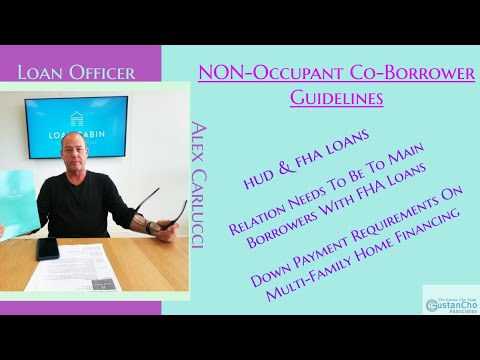
HUD, the parent of FHA, allows non-occupant co-borrowers that are related to marriage, blood, or law to be added as non-occupant co-borrowers to the main borrower buying a house or refinancing with a 3.5% down payment or 96.5% loan-to-value. HUD allows close friends who are not related to marriage, law, or blood to be non-occupant co-borrowers, but the main borrower need to put 25% down payment or have 75% loan-to-value.
Fannie Mae and Freddie Mac allow borrowers to qualify for a conventional loan with non-occupant co-borrower that is not related to blood, marriage, or blood like HUD.
Conventional loan with non-occupant co-borrower guidelines allows co-borrowers unrelated by blood, marriage, or blood to be added to the main borrower. Both borrowers and co-borrowers need to meet mortgage guidelines. The middle credit score of the lower borrower/non-occupant co-borrowers is used for credit score qualification. This article will cover and discuss Fannie Mae and Freddie Mac Non-Occupant Co-Borrower Guidelines. FHA loan programs allow non-occupant co-borrowers for homebuyers who have little or no income for income qualification so they can meet the necessary debt-to-income ratios. HUD will allow more than one non-occupant co-borrowers. The main borrower can have zero income and use non-occupant co-borrowers’ income. Non-occupant co-borrowers normally need to be relatives who are related by blood, marriage, or law. The following folks can qualify to be non-occupant co-borrowers:
- son
- parent
- uncle
- aunt
- grandchild
- son in law
- daughter in law
- father-in-law
- mother-in-law
- brother-in-law
- sister-in-law can all be non-occupant co-borrowers
If non-occupant co-borrowers are not related to the main borrower by blood, marriage, or law, then a 25% down payment is required.
Can I Get a Conventional Loan with Non-Occupant Co-Borrower?
Freddie Mac does allow zero income by the main borrower, and the non-occupant co-borrowers income can be used. The answer to whether or not you can get a conventional loan with non-occupant co-borrower is yes with a Freddie Mac and Freddie Mac.
Both main borrower and all non-occupant co-borrowers must meet Fannie Mae and Freddie Mac’s mortgage lending guidelines about credit, income, and debt-to-income ratios. The main borrower and non-occupant co-borrower must get approved/eligible per DU or LP FINDINGS. Not all mortgage lenders are Freddie Mac-approved lenders.
Conventional Loan with Non-Occupant Co-Borrower: Guidelines to Make Your Home-Buying Journey Easier
Purchasing a home can be difficult if an applicant does not meet standard mortgage requirements. In these situations, a conventional loan with a non-occupant co-borrower allows an additional borrower to help with qualification, even if they will not live in the home.
This option is often used by first-time home buyers, adult children, parents, those assisting dependents, and separated buyers who need additional income to qualify.
The non-occupant co-borrower has to sign the mortgage and take on responsibility. They also have to go through a financial check. Fannie Mae allows -occupant borrowers for primary homes.. They have to sign the mortgage take on financial responsibility and not have any stake in the deal.
What Is a Conventional Loan with a Non-Occupant Co-Borrower?
A conventional loan, with a -occupant co-borrower is a mortgage. One borrower lives in the home. Is the main borrower. Another borrower is added to help with qualifying. The extra borrower does not live in the house. For example a parent might help their adult child buy a home. The child will live there.
How a Non-Occupant Co-Borrower Is Beneficial to the Main Borrower
The main borrower may lack the income to qualify for the loan but may have sufficient credit strength. In this case, a non-occupant co-borrower can assist the main borrower, as the additional co-borrower’s income can help improve the total debt-to-income ratio and qualify the main borrower for the loan, even though it requires manual underwriting. If the co-borrower has a lot of credit card or loan debt it might not be an idea to include them in the loan application because their debt could hurt the chances of getting the loan.
Difference Between a Non-Occupant Co-Borrower and a Co-Signer
A non-occupant co-borrower is not merely a casual reference. A non-occupant co-borrower is not simply a reference or someone providing a support letter. They are a borrower on the mortgage loan. Who is not the first borrower named in the loan agreement.
A borrower is someone whose credit report will be checked to see if they can get the loan and what conditions they need to meet.
The important thing to remember is that if the mortgage payment is late it will affect the credit of the -occupant co-borrower and if the loan defaults the non-occupant co-borrower will be responsible along with the borrower.
Who Can Qualify as a Non-Occupant Co-Borrower for a Conventional Loan?
Non-occupant co-borrowers are usually family members. Other people can qualify too if they meet the lenders and agency’s requirements.
Common Non-Occupant Co-Borrower Examples
Non-occupant co-borrowers are frequently parents when a home buyer is a first-time buyer with secure employment but insufficient income to qualify for the mortgage on their own. In some cases, adult children assist their parents in home purchases. Other cases may be a loan spouse not occupying the property due to work, other assignments, or family issues. Each case is viewed in the context of the complete loan profile.
Who Does Not Qualify as a Non-Occupant Co-Borrower?
A non-occupant co-borrower cannot be involved in the transaction if they have an interest, in it. Fannie Mae says that a non-occupant co-borrower cannot be the seller, builder or real estate agent of the property.
Conventional Loan Non-Occupant Co-Borrower Guidelines
Conventional loans require answers to key questions: Does the loan make sense? Will the occupying borrower live in the home? Can all borrowers repay the mortgage? Fannie Mae allows non-occupant borrowers for purchase, refinance (limited cash-out), and refinance (cash-out) transactions. The complete loan file and underwriting, LTV, borrower’s credit, and the lender’s requirements will determine the loan’s approval.
Occupancy Rules for the Main Borrower
At least one of the borrowers must make the home their primary residence. The non-occupant co-borrower has no obligation to reside in the home. The main borrower, however, must reside in the home. This is to avoid situations where non-occupant co-borrowers are used to make a borrowers investment property look like a residence. The borrower must live in the home as their residence.
Credit, Income, and Debt Requirements
The lender will look all proposed borrowers as one unit. Adding a co-borrower with credit can help the application but it won’t fix all problems. If the co-borrower is removed issues like payments, high debt, low credit scores or not enough reserves may still cause denial. The loan-to-value rules can vary depending on whether the loan’s underwritten using Desktop Underwriter or through a manual underwrite.
Need Help Qualifying? Add a Non-Occupant Co-Borrower
If your income or credit is a little short, a non-occupant co-borrower may help you qualify for a conventional loanCo-Borrower Eligibility, Self-Employed, Early Career, Recent Graduate, & High-Cost Market
Main borrowers who are early in their careers, self-employed with limited income, recent graduates, or purchasing in high-cost markets may require a co-borrower’s support.
High Debt-to-Income Ratio
A borrower may have a self-employed job but a high debt-to-income ratio because of a car loan, student debt, credit cards or other debt that affects their ability to pay a mortgage.
A non-occupant co-borrower is employed, has a job and has low debt. The lender will include their income in the loan application. They have future income potential but currently don’t have enough qualifying income.
Buyers may fall into this category if they are college graduates, recent professionals or have recently changed jobs. Adding a -occupant co-borrower can help the application but the main borrower must still meet all other lender requirements. The lender must also confirm that the co-borrower can take on home-ownership responsibilities.
First-Time Home Buyers
One common situation involves a parent or relative serving as a -occupant co-borrower when buying a first home. This situation may help address the challenges posed by mortgage payment history. First-time home buyers should think about all home ownership expenses, including insurance, property taxes, maintenance and potential HOA fees in addition, to the mortgage.
How Lenders Calculate Income and Debt
When a lender sees an application with a non-occupant co-borrower, they assess the complete financial profile of all applicants, not just income. It is unlikely to help, but the borrower’s debts will also be considered. This includes housing, car and student loans, credit card debt, personal loans, monthly support obligations, and alimony.
Analysis of the Combined File
The lender will review the application as a single file. This means they will look at the borrower and non-occupant co-borrower as a unit. This will.
Applications are typically stronger when the non-occupant co-borrower is financially stable. If any applicant has significant negative credit or high debt, a different strategy may be needed.
Is of Debt is required for the non-occupant co-borrower Some applicants mistakenly believe the co-borrower’s income is considered without factoring in their debts. This is not corrected non-occupant co-borrower has a mortgage, car payment, credit card debt, or student loans; all of these will be included in the debt calculation. It is wise to review the non-occupant co-borrower’s complete debt picture before applying.
Explanation for Denial Despite Strong Income
The borrower’s income is just one component of the application. The credit and payment history, down payment and reserves, property, automated underwriting, and lender-specific rules will affect the outcome of the application. High debt levels can complicate the loan process, even for borrowers with strong credit and income, particularly if there are recent late payments.
Requirements for Down Payments with Non-Occupant Co-Borrowers
Depending on the loan program, property type, underwriting method, occupancy, credit score, and automated underwriting findings, the down payment requirements may differ. For many conventional loans underwritten through the Fannie Mae Desktop Underwriter, transactions involving non-occupant borrowers may allow higher financing than those underwritten through the manual underwriting process, but the Fannie Mae Eligibility Matrix imposes specific restrictions on the use of non-occupant borrowers.
Conventional Loan Down Payment Options
Some conventional loans may allow a lower down payment for eligible borrowers, but not all lower-down-payment options function the same way when a non-occupant co-borrower is present. The Fannie Mae 97% LTV options must be one-unit, fixed-rate, principal residences and underwritten through Desktop Underwriter. Standard 97% purchase transactions must include at least one first-time home buyer, while the HomeReady product has its own rules regarding income and the program.
Gift Funds and Borrower Contribution Rules
Many conventional loans may allow gift funds; the source, the manner in which they are documented, and the rules concerning the borrower’s contribution must be examined closely. For loans that are manually underwritten, Fannie Mae indicates that if a co-signer, guarantor, or non-occupant borrower’s income is used in the underwriting of the loan, the borrower who occupies the residence typically must contribute the first 5% of the required down payment from their own funds, unless other specific situations apply.
Manual Underwriting’s Potential for Stricter Standards
Compared to automated underwriting, manual underwriting can be more restrictive in general, and even more so when a non-occupant co-borrower is used. Do not assume approval terms are identical across all underwriting methods. The loan officer should determine if the file will be approved by Desktop Underwriter or through manual review.
Conventional Loan Credit Score Standards
In a conventional loan, a credit score is more important than in other lending scenarios. It impacts both approval and the terms of the loan, such as mortgage insurance, interest rates, and loan-level price adjustments. When a non-occupant co-borrower is used to supplement income, credit risk may still remain. The lender may review the credit history of all applicants and those in the household and may consider recent delinquencies, charge-offs and cancellations, payment defaults, bankruptcies, foreclosures, other insolvencies, short sales, judgments, and accounts in dispute.
Impact of the Lower-Middle Credit Score
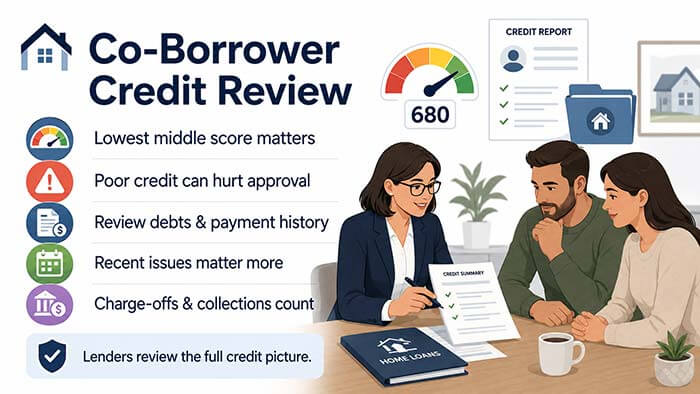 When there are multiple applicants, the lender may be more concerned with the lower-middle credit scores of the group. The impact of a co-borrower on loan approval is diminished when that co-borrower has poor credit. The loan officer should review the scores, debts, and payment history of potential co-borrowers.
Not all credit issues result in an automatic denial, but the cumulative view may be important, especially when one applicant has multiple recent credit issues compared to applicants with older, isolated payment issues.
The loan officer should review potential co-borrowers’ credit scores, debts, and payment history, and address any credit issues before adding them to the application. The ability to manage the proposed monthly payment may warrant the review of charge-offs and collections.
The Benefits of Strong Credit
Higher credit scores may lead to favorable outcomes in automated underwriting. Stronger credit scores may positively impact rates and mortgage insurance. New debt can negatively affect approval. During the mortgage process, avoid taking on new debt, increasing credit card balances, or making late payments.
Types of Properties with a Non-Occupant Co-Borrower
Generally, a mortgage with a non-occupant co-borrower will be for a loan securing a transaction on a borrower’s primary residence. The property will meet the requirements for a conventional loan and will be acceptable to the lender. Examples of eligible properties will be single-family residences, some manufactured homes, eligible condominiums, and some Planned Unit Developments. The property will also be subject to an appraisal and will meet the lender’s eligibility requirements.
Must be a Primary Residence
It is essential to the loan that the primary borrower intends to occupy the property as the primary residence. Non-occupant co-borrowers cannot be used to circumvent investment property guidelines.
One-Unit Dwellings, Condos, and Eligible Property
Typically, a borrower will use a non-occupant co-borrower for a one-unit primary residence. A condominium may also qualify if the condominium project meets the conventional requirements. Property type may affect the underwriting process, as well as loan-to-value, down payment, and reserve requirements. Therefore, the type of property should be assessed as soon as possible, particularly if the borrower is purchasing a manufactured home, a condominium, or a multi-unit dwelling.
Investment Property Issues
A lender could question a file if an occupying borrower appears to have weak ties to a property, has no identifiable reason for living there, or if a non-occupant co-borrower appears to be the actual property buyer. The borrower’s employment, family, and personal circumstances should be sufficient to indicate the reason for the purchase of the property as a primary residence.
Common Reasons for Denial of a Conventional Loan
A conventional loan with a non-occupant co-borrower can still be denied, even with their addition to the application. Common reasons for denial include high debt-to-income ratios, poor credit, late payments, no income, no savings, issues with the property, or an automated underwriting result that is a denial.
Weak Borrower Profile of Occupying Borrower
The profile of the occupying borrower is important. If the main borrower has low income, poor credit, no housing history, and recent negative credit history, the file will be difficult to approve. The lender is interested in whether the person living in the home is able to assume the responsibilities of home ownership.
Excessive Debt of Non-Occupant Co-Borrower
If a non-occupant co-borrower has a large income but a large debt burden, then the co-borrower’s income is of no value. A large mortgage, auto loan, student loan, business loan, and credit card bill will all affect the co-borrower’s income. The co-borrower should fully disclose all debts before applying, allowing the loan officer to accurately assess debt service capacity.
Lender Overlays and Automated Underwriting
In addition to the Fannie Mae or Freddie Mac guidelines, some lenders add their own rules or overlays. These overlays could restrict loan eligibility. For example, an applicant might meet the relevant agency guidelines and still be denied financing by a lender because of that lender’s stricter rules. The applicant’s file may need to be underwritten by a lender with flexible conventional guidelines.
What Can Be Done to Help Get an Approval?
Ensure your file is complete before searching for a home by verifying income, credit, assets, and debts in advance. An applicant may have a better chance of getting approved for a loan. Applicants improve their approval chances when all aspects of the application, not just income or credit score, are reviewed and verified during pre-approval. occupy the property must have the following ready: paychecks, W-2s, bank statements, proof of ID, and letters of explanation if there are issues with your income or credit. Co-borrowers who are self-employed will likely need to provide further documentation.
Pay Down Debt
Credit cards may need to be paid down to improve the applicant’s debt-to-income ratio. Paying down credit cards can improve your debt-to-income ratio. Consult a loan officer for the best strategy.
Conventional Loan with Non-Occupant Co-Borrower with More Than One Co-Borrower Guidelines
There can be multiple non-occupant co-borrowers on conventional loans. Fannie Mae does not allow the main borrower with zero income and only has a non-occupant borrower’s income. The main borrower must show some qualified income and cannot have zero income. The non-occupant co-borrower will go on the mortgage note, but the non-occupant co-borrower will not go on title to the property.
Homebuyers who make cash and do not declare income or self-employed borrowers who write off a lot of expenses normally need non-occupant co-borrowers to qualify for mortgages.
Conventional home buyers or homeowners who need to qualify for a conventional loan with non-occupant co-borrower with no mortgage overlays on government or conventional loans, please get in touch with us at Gustan Cho Associates Mortgage Group at 800-900-8569 or text us for a faster response. Or email us at alex@gustancho.com.
Both Conventional and FHA Loans Allow Non-Occupant Co-Borrowers, But Each Has Different Rules. Make Sure to Look into Both Options Before Deciding.
Conventional loans are a good fit for people with strong credit, low debt, and who meet standard underwriting guidelines. FHA loans are designed for those who meet FHA’s specific credit and debt requirements. A conventional loan works well for people with excellent credit, enough savings for a down payment, and who want to avoid FHA mortgage insurance. If automated underwriting approves a Non-Occupant Co-Borrower, a conventional loan is often the best choice.
Circumstances Favoring FHA Loans
FHA loans are helpful for people with credit challenges, higher debt-to-income ratios, or those who may pay more for FHA mortgage insurance. FHA has its own rules for Non-Occupant Co-Borrowers, who can help first-time buyers, families, or anyone needing extra support to qualify. Some believe adding a co-borrower makes approval easier, but lenders still review all financial details, including credit, income, debt, assets, and property type. Both borrowers need to fully understand and agree to the legal and financial responsibilities.
Recommendation: Obtain a Comprehensive Conventional Loan Review Prior to Application
Gustan Cho Associates can help with Conventional, FHA, VA, USDA, and non-QM loans for those who need a non-occupant co-borrower. To learn more, visit www.gustancho.com.
Frequently Asked Questions About Conventional Loans with Non-Occupant Co-Borrowers
Can A Parent Be On A Conventional Loan Without Living in the Home?
A parent can be a non-occupant co-borrower on a conventional loan. They just need to show proof of credit, income, and debt. The parent does not have to live in the home. The main borrower must live there.
Does A Non-Occupant Co-Borrower Have Ownership In The Home?
A non-occupant co-borrower might have an ownership interest in the property. It depends on the title and lender rules. If they sign the mortgage note, they are responsible for paying back the loan. Adding a non-occupant co-borrower can make your application stronger.. It does not guarantee a lower interest rate. For loan rates, they depend on things like risk. They also depend on mortgage insurance, property type, who lives in the home, credit score, and how much you borrow compared to the home’s value.
Can I Take Out A Non-Occupant Co-Borrower After We Close?
You can only take a -occupant co-borrower off the loan by refinancing. This is only if the main borrower qualifies alone. During refinancing the lender reviews credit, income, debt, property value and payment history.
Will The Mortgage Impact The Non-Occupant Co-Borrower’s Credit?
Yes it will. When a non-occupant co-borrower signs the mortgage they are responsible for the loan. It will appear on their credit report. Payment history affects both the borrower and the non-occupant co-borrower. For a loan the lender will require income verification. This is from both the self-employed borrower and the co-borrower.
Is A Non-Occupant Co-Borrower The Same As A Gift Donor?
No they are not. A gift donor gives money for the transaction. This is if it is properly documented as a gift. They are not responsible, for the loan. A non-occupant co-borrower is listed on the loan. They must help repay it. One person can have than one role.. The lender must clearly show each role.