Securing a mortgage is still within reach, even if your Chapter 13 bankruptcy is ongoing. You do not always have to wait for your bankruptcy to be discharged before exploring mortgage opportunities. FHA, VA, and some USDA mortgage programs can help qualified borrowers who are making regular Chapter 13 payments. But approval involves more than meeting the lender’s requirements. You will also need legal approval before taking on a new mortgage. That is why getting Chapter 13 Trustee Mortgage Approval is a crucial step on your path.
Depending on your bankruptcy court, trustee rules, and loan program, you might need written permission from the court, approval from the Chapter 13 trustee, or a court order before taking on new debt.
Once you have legal approval, the mortgage lender will review whether you meet the loan program’s requirements. To sum up, you can buy or refinance a home while your Chapter 13 bankruptcy is still active. FHA usually looks for at least 12 months of on-time payments and written court approval. VA may approve your application after a year of steady payments and approval from a trustee or judge. USDA can also be an option if you meet their specific conditions. Remember, getting trustee or court approval is just one piece of the puzzle—it does not guarantee your mortgage will be approved.
Can You Get a Mortgage While in Chapter 13 Bankruptcy?
Yes. An active Chapter 13 bankruptcy does not slam the door on your mortgage dreams. Chapter 13 works differently from Chapter 7 bankruptcy. The U.S. Courts describes Chapter 13 as a repayment plan for people with steady income.
Borrowers usually repay all or part of their debts over three to five years while remaining under the court’s protection and oversight.
The U.S. Courts also advise that a Chapter 13 borrower should not take on new debt without first speaking with the trustee, because additional debt could affect their ability to complete the repayment plan.
This is Why Borrowers Must Handle Three Key Parts of the Process:
- The bankruptcy requirements must be satisfied.
- The mortgage program guidelines must be satisfied.
- The lender’s underwriting requirements must be satisfied.
- Passing one test does not automatically meet all the requirements.
- Understanding these differences is important for anyone hoping to get a mortgage during Chapter 13 bankruptcy.
What Is Chapter 13 Trustee Mortgage Approval?
Chapter 13 Trustee Mortgage Approval is your official permission to take on new mortgage debt while in bankruptcy. The terms used in this process can be confusing. For example, a loan officer might say, “We need trustee approval.”
A bankruptcy attorney might instead refer to permission to incur new debt, a motion to incur debt, an application to incur debt, or a bankruptcy-court order.
The exact steps depend on your bankruptcy court and its local rules. Above all, your lender wants written proof that you are legally cleared to get a mortgage.
Trustee Approval Is Not the Same as Mortgage Approval
Getting permission from the trustee or court does not mean your mortgage application is approved. The bankruptcy process determines whether the borrower may take on the new obligation. The mortgage lender determines whether the borrower qualifies for the loan. You can get permission from the bankruptcy court, but still be denied by the lender for reasons like income, debt-to-income ratio, credit history, insufficient funds, property problems, underwriting rules, or other eligibility issues. The reverse can be true as well. A lender might think you qualify for the mortgage, but the loan cannot be finalized until you get bankruptcy permission.
Trustee Permission Versus Bankruptcy Court Permission
There is no single nationwide procedure used in every Chapter 13 case. The U.S. Courts advises Chapter 13 debtors to talk to their trustee before taking on new debt. Different bankruptcy districts may have specific rules. Some areas require formal steps to request new debt, while others allow the trustee to handle certain matters first. It is wise to consult a bankruptcy attorney rather than relying solely on a lender’s pre-approval letter.
What Is a Motion to Incur New Debt in Chapter 13?
A motion to incur new debt is a request asking the bankruptcy court for permission to take on a new financial obligation while the Chapter 13 case is still active. A home mortgage is a major new debt that often requires this process.
Mortgage professionals should not give bankruptcy legal advice or tell you which motion to file. The mortgage team gives you the financing information, while your bankruptcy attorney handles the legal process.
The request may include details about the mortgage amount, interest rate, monthly housing payment, down payment, the source of funds, property, the reason for the transaction, current income, expenses, and the borrower’s ability to continue making Chapter 13 payments. Your bankruptcy attorney usually decides which documents need to be filed and what process applies in your district.
How Many Chapter 13 Payments Do You Need Before Getting a Mortgage?
Twelve months is an important milestone, but it’s important to explain what it really means. For FHA financing, HUD’s rule is not simply “make 12 trustee payments.” HUD says that when the FHA case number is assigned, at least 12 months of the Chapter 13 payout period must have passed.
During that time, payments must have been made on time, the borrower’s payment record must be good, and the borrower must have written permission from the bankruptcy court to get the mortgage.
This way gives a clearer picture than just saying you qualify after your twelfth payment. The VA standard is similar but worded differently. VA guidance says that if the applicant has satisfactorily made at least 12 months’ worth of Chapter 13 payments and the trustee or bankruptcy judge approves the new credit, the lender may give the application favorable consideration. USDA underwriting also has rules for Chapter 13 repayment plans that are still in progress. The exact requirements depend partly on the USDA underwriting recommendation, which is discussed below.
FHA Loan During Chapter 13 Bankruptcy
FHA loans are one of the primary mortgage options for borrowers seeking to buy or refinance while still in an active Chapter 13 repayment plan. HUD specifically states that a CHUD clearly says that having a Chapter 13 bankruptcy does not automatically stop a borrower from getting an FHA-insured mortgage. Bankruptcy itself does not automatically mean that FHA will deny your application. The borrower still has to meet FHA’s Chapter 13 requirements and all other applicable underwriting guidelines.
FHA Chapter 13 Bankruptcy Requirements
For an active Chapter 13 bankruptcy, HUD requires at least 12 months of the payout period to have elapsed by the time the FHA case number is assigned. The lender must determine that the borrower’s performance under the repayment plan has been satisfactory. All required payments during the applicable period must have been made on time.
HUD also requires the lender to show that the borrower’s current situation indicates the problems that caused the bankruptcy are unlikely to recur.
The borrower must also receive written permission from the bankruptcy court to enter into the mortgage transaction. Even if you meet these requirements, your loan is not guaranteed to close. Your home, credit, assets, debts, housing history, property eligibility, mortgage payment, and overall ability to repay must all pass the FHA’s underwriting review.
FHA Manual Underwriting During Chapter 13
An FHA mortgage with an active Chapter 13 bankruptcy is usually reviewed under FHA’s manual underwriting rules. Manual underwriting means a person reviews the full loan file rather than relying solely on an automated system. That’s why collecting complete documents is especially important. The underwriter looks at why the financial problems happened, how you’ve paid since filing bankruptcy, your Chapter 13 payment history, housing history, steady income, available money, debts, and other helpful factors.
How Does Manual Underwriting on FHA Loans Work
Manual underwriting does not mean more paperwork; it means your file will receive a closer, more detailed review. FHA manual underwriting has specific debt-to-income guidelines. For borrowers with a credit score of 580 or higher, HUD’s manual underwriting guidelines typically start at 31% front-end and 43% back-end debt ratios, without additional factors. These ratios can go up to 37%/47% with one qualifying factor, 40%/40% with no extra debt, or 40%/50% with two qualifying factors. If your credit score is between 500 and 579, you usually cannot exceed 31% front-end or 43% back-end ratios. These are limits, not guarantees of approval. A lender may also have stricter requirements than the FHA’s minimum rules.
Can You Buy a House With an FHA Loan During Chapter 13?
Yes, it is possible to obtain an FHA loan during an active Chapter 13 bankruptcy. If you meet FHA’s Chapter 13 requirements, you may be able to buy your next home before your repayment plan ends. You will still need a qualifying property, enough money to close, qualifying income, a reasonable debt-to-income ratio, and bankruptcy approval. The lender will also check if the proposed housing payment fits your current financial situation.
Denied Because You Are in Chapter 13? Get a Second Opinion
Some lenders will not work with active Chapter 13 borrowers, even when program guidelines may allow it. We’ll review your file and explain possible options.HUD Refinance Mortgage Guidelines During Chapter 13 Bankruptcy
You may also be able to refinance during an active Chapter 13 bankruptcy if you meet the bankruptcy requirements and the FHA’s refinance guidelines. Legal approval is very important here because refinancing creates a new mortgage and could affect your home equity or your Chapter 13 plan. If you are considering a rate-and-term or cash-out refinance, talk to both an experienced mortgage professional and a bankruptcy attorney before moving ahead. Using home equity during Chapter 13 is not guaranteed.
Mortgage Guidelines on VA Loans During Chapter 13 Bankruptcy
VA guidance provides that if an applicant has satisfactorily made at least 12 months’ worth of Chapter 13 payments and the trustee or bankruptcy judge approves the new credit, the lender may give favorable consideration to the mortgage application. The phrase ‘may give favorable consideration’ is important. This does not mean VA will automatically approve your mortgage after 12 months.
Eligible veterans, active-duty service members, and other qualified VA borrowers may also have a path to mortgage financing during Chapter 13.
VA lenders still need to decide if the borrower is a good credit risk and meets the other VA underwriting rules Liability, debts, residual income, credit history, housing expenses, Chapter 13 payments, and the borrower’s overall financial situation can affect approval. Individual VA lenders may also have additional requirements beyond the underlying VA guidelines.
USDA Loan During Chapter 13 Bankruptcy
USDA financing can also be a promising path for eligible borrowers. The USDA Single Family Housing Guaranteed Loan Program handbook specifically addresses Chapter 11, Chapter 12, and Chapter 13 bankruptcies that are still in progress. USDA says required bankruptcy payments must have been made on time, and the applicant usually needs written permission from the bankruptcy court or trustee to get the mortgage. USDA also says that if the bankruptcy court or trustee does not review or give permission, the lender may decide if the applicant is a good credit risk.
Gus Automated Underwriting System Findings
For GUS Refer, Refer with Caution, and manually underwritten files, USDA requires the lender to document that 12 months of the debt restructuring plan have elapsed. A GUS Accept or Accept with Full Documentation file is treated differently under USDA’s guidance and does not automatically require a downgrade simply because the bankruptcy payment was manually entered. So, it is not correct to say that only FHA and VA loans are options during an active Chapter 13 bankruptcy. USDA loans may also be available if you, the property, your household income, location, and underwriting results meet USDA requirements.
Can You Get a Conventional Loan During an Active Chapter 13?
Conventional loans are usually more difficult to get during an active Chapter 13 bankruptcy. Fannie Mae’s Desktop Underwriter states that a Chapter 13 bankruptcy that has been filed but has neither been discharged nor dismissed within the applicable four-year period results in an Ineligible recommendation.
Fannie Mae’s standard waiting period after Chapter 13 is generally two years from discharge or four years from dismissal. Freddie Mac similarly uses recovery periods following bankruptcy.
For Chapter 13, Freddie Mac’s guidance generally requires 24 months after discharge or 48 months after dismissal, subject to the applicable underwriting requirements. This is why most people in Chapter 13 choose government-backed mortgage programs before thinking about conventional loans.
How to Get Chapter 13 Trustee Mortgage Approval
The smartest strategy is The best approach is to coordinate your mortgage and bankruptcy steps instead of treating them as two separate processes. Before you ask your attorney for bankruptcy permission, first check if the mortgage you want is actually possible.
An experienced mortgage professional can review your income, credit, Chapter 13 payment, housing history, assets, proposed purchase price, loan program, and estimated new payment.
This step helps you avoid asking the bankruptcy court for approval on deals that wouldn’t meet mortgage program requirements anyway. Your lender will need evidence that the required Chapter 13 payments have been made as agreed.
What Type of Document is Required by Trustee For Home Purchase Approval
The exact documentation may vary, but a trustee payment history or similar bankruptcy record is commonly reviewed. Missing or making late Chapter 13 payments can cause big problems during underwriting. For FHA loans, required payments must be made on time during the term. HUD does not let lenders ignore late Chapter 13 payments just because the borrower catches up later.
Requesting Bankruptcy Trustee Permission to Buy House
Your bankruptcy attorney may need specific information before requesting permission. That can include the purchase price, loan amount, loan program, estimated interest rate, proposed monthly principal and interest, property taxes, homeowners’ insurance, mortgage insurance when applicable, homeowners association dues, and total monthly housing obligation.
A vague note like “wants to buy a house” usually does not give the trustee or court enough details to properly review your request.
The borrower should then provide the proposed mortgage information to the bankruptcy attorney handling the Chapter 13 case. Your attorney can decide if the trustee’s consent is enough or if you need a formal motion, application, updated budget, notice, hearing, or court order. Procedures vary by court.
Obtain Written Authorization
Mortgage lenders usually require documents showing that you are authorized to enter into the mortgage. For FHA, HUD specifically requires written permission from the bankruptcy court for an active Chapter 13 case that meets the 12-month rule. VA guidance refers to the trustee’s or bankruptcy judge’s approval of the new credit. USDA uses its own court/trustee permission framework. Your bankruptcy attorney and lender should work together to ensure the wording and documents are appropriate for your specific loan.
Complete Final Mortgage Underwriting
Bankruptcy approval is just one milestone on your mortgage journey. The lender still needs to complete underwriting, review all conditions, approve the property, verify your employment and assets if needed, review updated credit information, and grant final approval before closing.
What Does the Chapter 13 Trustee or Court Look at Before Approving a Mortgage?
The exact review varies by jurisdiction and individual case. In general, the main concern is whether taking on a new mortgage will affect your ability to finish your Chapter 13 plan.
The bankruptcy trustee or court may review the borrower’s current income, existing Chapter 13 payment, monthly expenses, proposed housing payment, down payment, source of funds, mortgage terms, and the reason the transaction is necessary or financially reasonable.
Some courts specifically require updated income-and-expense schedules or other evidence showing that the new debt will not make the Chapter 13 plan unworkable. This is another reason not to rely on generic internet advice about trustee approval. Every bankruptcy case is unique, and local rules matter.
What Documents Are Needed for a Mortgage During Chapter 13?
The lender normally needs both standard mortgage documents and bankruptcy-specific documentation. Standard mortgage documentation may include pay stubs, W-2s, tax returns when required, bank statements, identification, employment verification, asset documentation, and information concerning existing debts. Bankruptcy documentation may include the Chapter 13 petition, schedules, the confirmed repayment plan, the current trustee payment history, bankruptcy case information, and documents demonstrating the required permission to incur the new mortgage debt.
When Buying a Home, What Type of Information Does the Bankruptcy Trustee Require
If purchasing a home, the borrower may also need to provide the executed purchase contract and information about earnest money and the source of the down payment. VA borrowers will generally need appropriate VA eligibility documentation. USDA borrowers must also satisfy USDA household income, property location, and program eligibility requirements. Lenders may request varying documentation depending on their internal requirements. The underwriter may request additional information based on your specific file.
How Payment Shock Can Affect Chapter 13 Mortgage Approval

Payment shock is the difference between your current housing expense and the new mortgage payment you are considering. Suppose a borrower currently pays $1,800 per month in rent, and the proposed mortgage payment, including taxes and insurance, is only a slight bump in housing costs. in housing costs. Now imagine someone paying $1,200 per month in rent who wants to take on a $2,300 housing payment. That is a much bigger jump. While it does not mean automatic disqualification, both the mortgage underwriter and the bankruptcy process will take a close look at whether you can handle the higher payment. For FHA manual underwriting, a minimal housing payment increase can qualify as a compensating factor when HUD’s specific requirements are met.
Is It Difficult to Get Approval Permission by Bankruptcy Trustee?
The key takeaway: never assume a trustee will automatically approve or deny your request. Your Chapter 13 obligations must be properly documented and evaluated in accordance with the requirements of the applicable mortgage program. Mortgage underwriting does not ignore the bankruptcy just because the payment is made through a trustee.
The lender needs to know what debts remain, what is paid through the plan, whether some debts will continue after closing, and how to handle those debts under the loan program’s rules.
USDA specifically requires Chapter 11, 12, or 13 bankruptcy payment amounts to be reflected in the application’s liabilities when applicable. For FHA and VA transactions, the lender must likewise evaluate the borrower’s continuing obligations under the applicable underwriting rules. This is why it is important to have a full copy of your Chapter 13 plan handy. During Chapter 13, include applying for a mortgage before meeting the required eligibility criteria. A borrower may otherwise look financially strong but fail to meet the loan program’s required Chapter 13 payment-history period.
Late Chapter 13 Payments are Another Major Issue
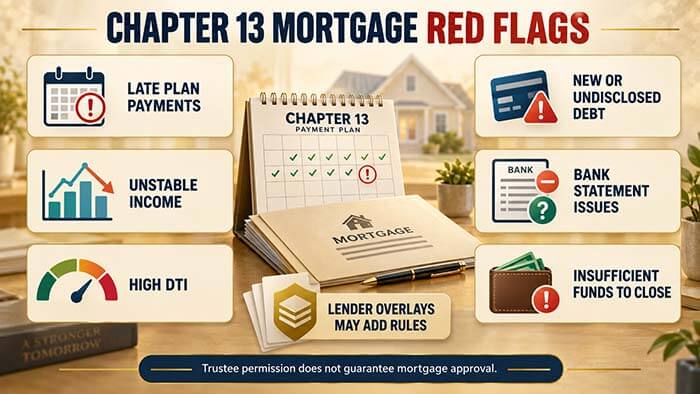
For FHA, the required payments during the applicable 12-month period must have been made on time. Unstable income can also cause the mortgage to fall through. A trustee may be willing to consider a request, but the mortgage lender still needs enough qualifying income to support the mortgage and other obligations.
Excessive debt-to-income ratios can prevent approval, especially since many active Chapter 13 FHA loans require manual underwriting.
Recent late payments, new collections, undisclosed debts, overdrafts, unexplained large deposits, insufficient funds to close, or obtaining new credit without the proper approval can also complicate the loan process. Another common obstacle is lender overlays.
Mortgage Agencies Establish Baseline Program Requirements
Individual banks, credit unions, mortgage companies, investors, and wholesale lenders may establish additional, more restrictive requirements. Those added requirements are commonly referred to as lender overlays.
For example, an FHA guideline may permit a properly documented active Chapter 13 borrower after the required 12-month period, but an individual lender may decide not to originate mortgages until the bankruptcy is discharged.
Another lender may require a higher credit score, lower debt-to-income ratio, additional reserves, or a longer waiting period. Consequently, one mortgage company may decline a Chapter 13 borrower while another may approve the same applicant under different internal guidelines. A denial from one lender does not preclude approval from all mortgage programs. At the same time, finding a lender without a certain overlay does not remove the basic FHA, VA, USDA, bankruptcy court, or underwriting requirements.
Buying a House During Chapter 13 Bankruptcy
Buying a Home While in Chapter 13 Bankruptcy requires careful planning and coordination. The borrower should first determine whether an FHA, VA, USDA, or other eligible mortgage program is appropriate for the situation. Next, the lender should review the borrower’s Chapter 13 history, income, credit, assets, debts, and estimated housing payment.
Once the lender has developed a realistic financing proposal, the borrower can work with the bankruptcy attorney to obtain the required permission.
Taking steps out of order can lead to major delays. For instance, getting permission for a $350,000 mortgage before confirming your income could cause headaches if you only qualify for a smaller loan.
Refinancing a Mortgage During Chapter 13 Bankruptcy
Homeowners can also explore refinancing options while their Chapter 13 case is still open. Some borrowers want a lower payment. Others want to change loan terms, refinance an adjustable-rate loan, remove another borrower when permitted, or access equity.
Remember, refinancing is a brand-new mortgage transaction. You will need to meet both the mortgage program’s requirements and any bankruptcy authorization rules.
Be cautious with cash-out refinancing, since tapping into your equity can affect your bankruptcy case and how creditors are treated. If you are considering a cash-out refinance during Chapter 13, talk to a bankruptcy attorney early, because access to home equity is never guaranteed.
Ready to Move Forward With Chapter 13 Trustee Approval?
Complete a quick application or send your scenario. We’ll review your Chapter 13 payment history, trustee approval needs, mortgage options, and next steps.Chapter 13 Trustee Approval Does Not Guarantee Closing
This is a crucial point to remember: Chapter 13 Trustee Mortgage Approval allows you to move forward with the debt, but it does not guarantee your mortgage will close. The lender remains responsible for determining whether the borrower qualifies. The mortgage can still be denied due to income, credit, debt-to-income ratio, property condition, appraisal issues, title problems, insufficient assets, loan program requirements, changes in employment, new debts, or other underwriting conditions. Likewise, a mortgage pre-approval does not give you permission to take on new debt while your Chapter 13 case is still active. All requirements of the transaction must be satisfied.
Is It Easier to Get a Mortgage After Chapter 13 Discharge?
In some cases, yes, because you no longer need permission to take on new debt once your repayment plan is over. However, a discharge brings up a different set of questions about mortgage waiting periods. Conventional loans generally have defined waiting periods after a Chapter 13 discharge. Fannie Mae generally requires two years from the Chapter 13 discharge date. Freddie Mac similarly provides a 24-month recovery period following discharge under its applicable bankruptcy requirements.
Government-Backed Mortgage Programs Use Different Rules
Do not assume that one loan program’s bankruptcy waiting period applies to FHA, VA, USDA, Fannie Mae, Freddie Mac, or every lender. Each program has its own rules for Chapter 13 mortgage loans. Chapter 13 mortgages are more complicated than your average home loan. The loan officer needs to understand the mortgage program. The underwriter needs to correctly apply bankruptcy and manual underwriting guidelines. The mortgage team may need to provide proposed terms to the bankruptcy attorney.
The borrower and the attorney must complete any approval process required by the bankruptcy court. Timing matters too. If the lender, borrower, attorney, trustee, and court are not aligned on the proposed loan terms, delays can occur.
It is beneficial. It pays to work with mortgage professionals who know the ins and outs of Chapter 13 cases, since not all lenders handle these situations the same way. Chapter 13 bankruptcy does not have to stop you from buying a home or refinancing. FHA guidelines permit qualified borrowers to be considered after at least 12 months of the payout period have elapsed, provided that required payments have been made on time and written permission from the bankruptcy court has been obtained. VA guidance may permit favorable consideration after at least 12 months of satisfactory Chapter 13 payments with approval from the trustee or bankruptcy judge. USDA also provides a pathway for certain borrowers whose Chapter 13 repayment plans are still in progress.
Fannie Mae and Freddie Mac Guidelines on Conventional Loans During and After Chapter 13 Bankruptcy
Conventional loans are usually much harder to get while your bankruptcy is still active. The best Chapter 13 mortgage applications show a steady record of on-time bankruptcy payments, stable income, good housing history, manageable debt, enough funds, accurate paperwork, and the right written authorization for new mortgage debt. Before asking your bankruptcy attorney for approval, make sure a lender has reviewed your mortgage eligibility. This way, everyone has a clear review and discussion of the mortgage proposal. Bankruptcy rules cannot change, and each court may have its own local practices. This guide is for general mortgage education only and is not legal advice. Always consult a bankruptcy attorney to find out the right steps, including permission to take on new debt, and to understand how a mortgage could affect your Chapter 13 case.
FAQ: Chapter 13 Trustee Mortgage Approval During Bankruptcy
Is It Possible To Obtain A Mortgage During Chapter 13 Bankruptcy?
Yes, it is possible to obtain a mortgage during Chapter 13 bankruptcy. Because a mortgage is new debt, you need trustee or court approval to maintain your bankruptcy status. You must have documented stable income, be current on your bankruptcy plan payments, and have written permission to incur new debt. Meeting FHA or VA guidelines means you are not automatically disqualified due to bankruptcy.
What Does Mortgage Approval From A Chapter 13 Trustee Mean?
Mortgage approval from a Chapter 13 trustee means that a Chapter 13 debtor has been given permission to take on new mortgage debt. Depending on the courtroom jurisdiction, approval may come from the trustee, or more commonly, a motion to incur debt is approved by the bankruptcy judge.
Do You Need Permission From A Trustee To Purchase A House During Chapter 13?
Most of the time, yes. Because a new mortgage is considered new debt, Chapter 13 debtors will need trustee or bankruptcy judge approval before they can close the loan. Borrowers are advised to contact their bankruptcy attorney as early as possible, as local court and trustee procedures differ.
How Many Chapter 13 Payments Before Applying For A Mortgage?
Typically, the industry standard is 12 months of Chapter 13 payments to be considered for a mortgage. More specifically, the VA guidelines require 1 year of payments and a trustee’s permission, while the FHA guidelines don’t state that.
Is It Possible To Obtain An FHA Loan While In Chapter 13 Bankruptcy?
Yes, some borrowers may qualify for an FHA loan while an active Chapter 13 bankruptcy is pending. Chapter 13 bankruptcies are not an automatic disqualification for FHA loans, but the other aspects of the file must meet eligibility criteria. Lenders also require written trustee or court approval before closing.
Can I Get A VA Loan During Chapter 13 Bankruptcy?
Perhaps. VA guidelines indicate that an individual may be eligible after one year of Chapter 13 payments, as agreed and with the trustee’s approval.
Does Trustee Approval Guarantee Mortgage Approval?
Not at all. Trustee approval simply addresses the borrower’s ability to take on additional debt within the bankruptcy case. The mortgage lender still must assess the file for credit, income, assets, debt-to-income ratio, housing history, and overall underwriting.
What Documents Do Lenders Need For Chapter 13 Mortgage Approval?
Requirements for Chapter 13 mortgage approval are somewhat consistent across lenders, though some may request a confirmed Chapter 13 plan, trustee payment history, the bankruptcy petition, court or trustee approval, income documents, and recent housing payment history, among other documents. Requirements are dependent on the lender and loan program.
Is It Simpler To Obtain A Mortgage Following A Chapter 13 Discharge?
In many cases, yes. Post-discharge, the borrower usually does not need trustee permission, plus the completed repayment history can strengthen the file. However, mortgage approval is also still dependent on present credit, income, assets, and program-specific criteria.
Can You Obtain A Mortgage While In Chapter 13 Bankruptcy?
Yes, in some instances. Refinancing may be permitted if the trustee or the court consents to the new debt and the lender can demonstrate that the borrower is qualified. This is especially pertinent if the refinance lowers the payment or improves the loan structure.
Can I Secure A Mortgage Approval While In Chapter 13 Bankruptcy?
Yes, homebuyers and homeowners can obtain Chapter 13 Trustee mortgage approval under the Chapter 13 Bankruptcy repayment plan. FHA and VA loans are accessible for individuals in this phase.
What Are The Loan Options Available During Chapter 13 Bankruptcy?
FHA and VA loans stand out as unique mortgage programs that allow borrowers to secure mortgage approval while navigating Chapter 13 Bankruptcy repayment plans.
What Are The Eligibility Requirements For FHA And VA Loans During Chapter 13 Bankruptcy?
Borrowers must have been engaged in Chapter 13 Bankruptcy for at least one year and demonstrated consistent and timely payments over the preceding twelve months to qualify for these loans.
What Is Manual Underwriting, And Why Is It Important?
Manual underwriting is a thorough evaluation process focusing on financial stability and responsible repayment behavior. It is particularly significant in the context of Chapter 13 Bankruptcy, ensuring borrowers meet eligibility criteria.
How Can I Obtain Chapter 13 Trustee Mortgage Approval?
To secure Chapter 13 Trustee mortgage approval, compliance with specific criteria and processes outlined by FHA and VA guidelines is essential.
What Documents Are Needed For The Mortgage Process During Chapter 13 Bankruptcy?
Necessary documentation includes bank statements, pay stubs, tax returns, driver’s licenses, Chapter 13 paperwork, and a Certificate of Eligibility for VA clients.
How Do I Initiate The Mortgage Process During Chapter 13 Bankruptcy?
Once you’ve gathered all the required documents, contact a loan officer to initiate the pre-approval procedure. Subsequently, consult your bankruptcy attorney to review the details, especially regarding Chapter 13 Trustee mortgage approval.
What Happens After Obtaining Pre-Approval For A Mortgage During Chapter 13 Bankruptcy?
The next step involves presenting your mortgage qualifications to the trustee and seeking permission for mortgage proceedings.
How Does The Trustee Assess Mortgage Eligibility During Chapter 13 Bankruptcy?
Trustees evaluate various factors, including current and proposed housing payments, to ensure borrowers can afford the mortgage within the bankruptcy framework.
Can I Pursue A Mortgage Even If My Housing Payments Increase During Chapter 13 Bankruptcy?
Although increased housing payments may prompt trustee review, borrowers can still pursue mortgage approval with appropriate financial planning and trustee consent.
How Can Gustan Cho Associates Assist In Obtaining A Mortgage During Chapter 13 Bankruptcy?
Gustan Cho Associates specializes in facilitating mortgage transactions amidst bankruptcy, providing guidance and support tailored to individual circumstances without lender overlays. Navigating the mortgage process during Chapter 13 Bankruptcy requires diligence and adherence to specific guidelines, but it’s feasible with the right support and understanding of the available options.
Please reach out to bankruptcy mortgage experts! If you are in a current Chapter 13 Bankruptcy repayment plan and need to qualify for a home purchase and/or cash-out refinance mortgage, please contact us at Gustan Cho Associates at gcho@gustancho.com or call us at 800-900-8569. Text us for a faster response. The team at Gustan Cho Associates is available 7 days a week, on evenings, weekends, and holidays.
This blog about Chapter 13 Trustee Mortgage Approval During Bankruptcy was updated on September 7, 2026.