
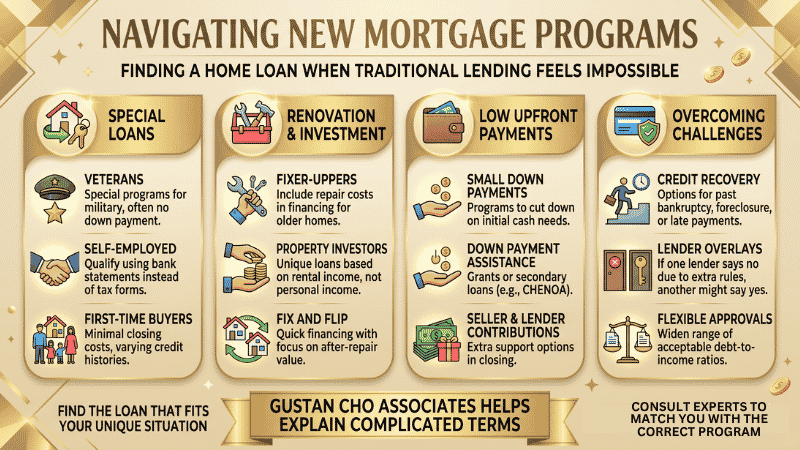
Getting a loan to buy or renovate a house can be hard right now. High property prices and big upfront payments make it tough for many applicants. Strict rules about credit history and debt-to-income ratios add to the challenge. However, new mortgage programs are appearing to help people who struggle with traditional loans. These programs are designed for different groups, including military veterans, gig workers, and homeowners who want to upgrade. They offer more flexibility than regular loans. For example, when traditional lenders might say no, these new programs may require only a small upfront payment or accept a wider range of credit histories. There are options for first-time buyers, those recovering from late payments, and self-employed individuals. Veterans often have special loan programs just for them. If you’re renovating an older home, some new mortgage programs focus on repair costs rather than just purchase prices. Investors flipping houses can also find unique loans that differ from typical loans for buyers. In some cases, the income shown on bank records can be enough for approval, instead of only relying on tax returns. Many people want clear answers about home loans. Gustan Cho Associates helps explain complicated terms. Different banks have different rules. One bank might deny a loan, while another might approve the same application with the same documents. This difference can greatly affect who gets approved, depending on which lender reviews the case.
New Mortgage Programs for Different Types of Borrowers
New mortgage programs are emerging to cater to various types of borrowers as the housing market continues to evolve. Many buyers and investors may not realize that there are alternatives beyond traditional options, such as FHA, VA, or USDA loans. Sometimes, applicants are rejected not because they don’t meet the standard requirements but because of stricter rules set by individual lenders, known as lender overlays. For instance, an FHA or VA loan approved by the federal government could still be denied by a specific bank due to its own policies.
For first-time homebuyers, new mortgage programs can provide valuable support. Self-employed individuals can qualify using bank statements instead of tax forms to prove their income, while veterans can access special terms to help them secure ownership. Even those with past credit problems may find options available.
If someone is looking to renovate an older home, certain loans allow repair costs to be included in the financing. Investors can benefit from new mortgage programs that focus on rental income rather than traditional income verification, offering more flexible funding options. These new mortgage programs can make it easier for borrowers to get loans with lower upfront payments or more lenient debt-to-income ratios. For homeowners looking to adjust their current mortgage rate, finance repairs, or access equity, updated loan options are available. The best mortgage path depends on various factors, such as credit history, income sources, and property type. Overall, as the landscape of home financing changes, new mortgage programs provide alternatives that help a broader range of individuals achieve their homeownership dreams.
New Mortgage Options for Various Borrower Situations
Not everyone handles their finances the same way, which is why home loan rules keep changing. For some buyers, getting help with upfront costs is super important. Self-employed borrowers often hit different roadblocks than regular employees. Veterans have some cool benefits when buying homes. Real estate investors have their own needs, too. Just because someone has had credit issues in the past doesn’t mean all hope is lost. If one lender says no, another might be willing to say yes. Lots of people could really use new mortgage programs that give them more options for buying a home. What works for someone really depends on their credit score, income, assets, the kind of home they’re looking at, whether it’s for living in or renting out, how monthly payments fit with their income, and the overall financial picture that could affect their chances of getting approved.
New Mortgage Programs for First Time Home Buyers
First-time homebuyers venturing into the market typically seek options that require minimal closing costs, accommodate varying credit histories, and keep monthly payments manageable. New mortgage programs, supported by federal initiatives, offer many qualified individuals a smoother path to homeownership than conventional methods. Additionally, standard loans designed for lower upfront costs offer similar benefits without government backing. Those living in rural areas may benefit from USDA programs that can cover the full purchase price under certain conditions. Veterans and service members can take advantage of favorable terms through VA-backed loans, often avoiding down payments when they meet specific criteria. Local assistance programs also contribute by reducing initial expenses through grants or, where available, shared equity arrangements.
New Mortgage Options for Buyers with Small Down Payments
Most people find it tough to gather cash up front even if they can handle the monthly house payment. Some help comes through special programs that cut what you need at closing. These include grants or extra loans that go away over time. Sellers might chip in too, sometimes offering money toward fees. Lenders occasionally add support as well. Where you live plays a role in what options show up. Your earnings and score shape which paths open. The kind of home and loan also tilt what fits.
New Mortgage Options for Self Employed
Some folks who work for themselves earn good money yet struggle to meet lender rules based on standard tax filings. When usual routes fall short, different paths open up – like using bank activity to prove earnings instead of W-2s. Lenders might look at monthly deposits through bank statement loans, or examine financial snapshots via profit-and-loss reports. Another option pulls from total assets, letting wealth serve as proof rather than paycheck stubs. Less common loan types exist just for these cases, built outside typical requirements. These alternatives can make space where old systems fail.
New Mortgage Options for Property Investors
Many real estate investors look for financing options beyond their own income. Instead of focusing on pay stubs, lenders may consider how much money a property earns from rent. New mortgage programs are now looking at things like cash flow metrics, including the debt service coverage ratio, to support these buyers. When financing rental properties, expected rental income often matters more than tax returns. For quick renovations, some mortgages look at the property’s value after repairs. Short-term fixes can qualify under fix-and-flip programs, while long-term plans may use portfolio-based terms. In this way, how well a property performs becomes more important than an individual’s financial history.
New Mortgage Programs for Veterans
Some folks can get into VA loan options without needing money down, thanks to loose rules on approved buys. Fix-up costs might slide right into the deal when buying or redoing a house, if you meet the bar.
New Mortgage Options for Borrowers Rejected Due to Lender Policies
One wrong turn at a bank doesn’t shut every door. Some get turned away – not due to bad credit or income, but because that lender tacks on its own hoops to jump through. Those extras sit outside the main rulebooks set by agencies like FHA or VA. Flip to a different lender, one that sticks close to official standards, and approval might still happen. Rules shift from desk to desk, so rejection today could just be a mismatch, not a dead end.
New Mortgage Programs for Borrowers With Recent Credit Events
Borrowers with r, foreclosure, short sale, late payments, collections, or other credit events may still have mortgage options. FHA loans, VA loans, manual underwriting, non-QM mortgage programs, and no-overlay lending options may help borrowers qualify after a financial setback, depending on seasoning requirements, payment history, credit recovery, income stability, and overall risk factors.
CHENOA Down Payment Assistance Mortgage Program
 Homebuyers who qualify might get help from the CHENOA program with their down payment on an FHA loan. When someone earns enough to handle monthly payments yet struggles with initial costs, this support could make a difference. Sometimes starting out is the hardest part – this step offers a way through. Homebuyers often pair CHENOA with their primary loan as a secondary mortgage. Whether repayment is needed hinges on the particular plan, who qualifies, and what lenders demand. Certain options can chip in for the required FHA down payment. Yet buyers ought to remember that even with aid, purchasing a house still brings expenses. Even with down payment assistance, borrowers may still need money for:
- Closing costs
- Prepaid property taxes
- Homeowners insurance
- Escrow setup
- Home inspection fees
- Appraisal fees
- Reserves, if required
- Any funds not covered by seller credits, lender credits, or assistance programs
Down payment assistance terms can vary by state, agency, credit score, income limits, property location, loan type, and lender overlays. Some programs have repayment terms. Others may be forgivable if the borrower meets specific requirements, such as making on-time mortgage payments for a required period.
TSAHC Down Payment Assistance Mortgage Program
Homebuyers in Texas may receive assistance with initial expenses through a program offered by a local agency. This program is provided by TSAHC, the Texas State Affordable Housing Corporation. When individuals qualify, they can receive support for their down payment or even a mortgage credit certificate. Purchasing a home in the state grants access to these options, with eligibility determining who can benefit. Texas homebuyers might find this program particularly valuable if they have a steady income but face challenges with upfront costs such as down payments or closing fees. Depending on current regulations and the specific lenders involved, those who qualify may be able to combine TSAHC support with new mortgage programs, including FHA, VA, USDA, or traditional loans. In some cases, this funding seamlessly fits into the overall financing plan. Borrowers should understand that state down payment assistance programs are not all the same. Program terms may vary based on:
- Property location
- Household income limits
- Credit score requirements
- Loan program type
- Homebuyer education requirements
- Debt-to-income ratio
- Repayment or forgiveness rules
- Lender overlays
The TSAHC program is a good example of how state-specific assistance may help homebuyers, but this article should not focus too heavily on Texas alone. Borrowers in other states may have access to similar down payment assistance programs through state housing finance agencies, local housing departments, nonprofit organizations, or approved participating lenders.
New Mortgage Programs for Homebuyers and Investors—See What Fits You
Loan options change often. Whether you’re buying a primary home, refinancing, or investing, we’ll review your credit, income, down payment, and goals to match you with the best available program.2% Grant Down Payment Assistance Mortgage Program
A small boost like a 2% grant could ease the burden for buyers needing help with upfront costs. Sometimes that support counts toward meeting the lowest down payment allowed under FHA rules. That shift might mean less cash straight from the buyer’s wallet. Fewer dollars at closing can open doors that seemed shut.
A case like FHA loans often means putting money down up front, yet a matching grant could handle some of it. Still, people getting loans must check if the option exists where they live, since not all lenders offer it nor apply it to each situation.
Securing a spot in new mortgage programs depends on several factors. Your eligibility may be influenced by your desired location, the type of loan that suits you, and your income level. Lenders also have a say in this process, with credit history playing a significant role. Not every option is available everywhere, and there may be specific requirements regarding home occupancy. Some programs require completing courses before finalizing the purchase. Price limits often dictate which homes are feasible, and your debt-to-income ratio might establish certain boundaries. Each mortgage offer comes with its own unique conditions. Here’s something borrowers often miss. A down payment grant might help, yet it rarely pays everything tied to buying a house. Just because the upfront chunk is taken care of doesn’t mean extra expenses vanish. Money could still be needed when closing happens. Taxes paid ahead of time add up too. So does insurance for the property. Setting up an escrow account takes cash on top. Appraisals come with their own fee. Inspections are another separate charge. And sometimes, lenders ask for backup funds just in case.
Additional Mortgage Programs Now Available
Fixing up a house? Some new mortgage programs allow qualified buyers to include repair costs in their mortgage when purchasing or renovating. Unlike regular home loans, these programs require additional assessments, including the planned work, the professionals handling it, and the property’s projected value once completed. Lenders carefully evaluate the property and the proposed upgrades before approving the loan. Different upgrade loans operate in various ways, and the choice often hinges on an individual’s specific loan category. For instance, having a military background may affect the available options. The condition of the house is also a significant factor. The necessary repairs influence the choices presented. Additionally, whether the buyer intends to live in the home impacts the available options, while credit history plays an important role in determining possibilities. Each lender has its own unique criteria.
VA Renovation Loans Available for Qualified Veterans
A home upgrade might be possible through a VA-backed loan, open to vets, those on active duty, survivors of military personnel – when buying or adjusting a current loan. Repairs can slide into the financing without needing separate cash. Qualifying folks could roll fixes right into their mortgage terms. This path blends property changes with borrowing under one roof. Some updates count toward what the loan covers naturally. Homebuyers who served might spot a place needing work. Yet they do not have to cover every fix themselves. If using VA loan benefits, certain updates can slide into the mortgage. Fixes must make the house safer, easier to live in, or working better. These changes could include roofing, plumbing, or electrical upgrades. The goal is clear: help veterans move in without huge upfront costs. Here’s what borrowers face. Lender checks might include the chosen contractor’s background. Repair estimates get examined closely too. Property state plays a role in approval. Meeting VA criteria matters just as much. Appraisal rules apply without exception. Work must be fully done before closing. Oversight wraps up only when everything is confirmed.
FHA 203k Loans Cover Home Repair Costs
A home needing fixes might still qualify under a special kind of financing. When approved, people can cover both the price and renovations within one payment plan. Some find it works well if they prefer this type of lending but choose houses requiring upgrades. Folks fixing up their own home might pick an FHA 203(k) loan when the place needs work. Since renovations differ, some projects call for estimates from contractors along with detailed plans. When changes get big, inspectors usually step in before anything moves forward. Paperwork piles up if the job involves major upgrades or structural fixes. Some people skip personal loans when fixing up a house post-closing – this option steps in. Instead of tapping credit cards or savings, folks might turn here first. It rolls repairs into one package, avoiding extra debt piles. Borrowers looking to simplify could find it fits. Not everyone uses cash for fixes; this fills that gap. When card limits feel tight, something like this makes sense.
Fannie Mae HomeStyle Renovation Loans
A Fannie Mae HomeStyle Renovation loan works like a standard mortgage but includes money for upgrades. It can cover repairs when buying a house or redoing an existing one. Some people qualify to roll renovation costs right into their loan amount. This option blends the price of fixes with the home financing itself. Some folks might find this fits if they’re buying a main house, vacation place, or rental and can get standard loan approval. These updates could be easier with a HomeStyle loan when certain upgrades are needed – more than what some federal options allow. Lenders look at credit history before saying yes. A steady paycheck matters just as much as savings on hand. The home must qualify, not just the person buying it. Renovation plans come under review too – paperwork has to match every change. Rules stay firm, even when money shifts hands.
Renovation Mortgage Programs How to Choose
Fixer-upper financing comes in several forms, yet each fits a unique buyer. VA upgrades target veterans, while FHA 203(k) suits those needing low down payments. The HomeStyle option opens doors for conventional loan seekers eyeing major remodels. Not every path works the same – borrowers match programs by need. A home upgrade option through the VA could suit those who served, if they meet requirements. When buyers live in the property and need repairs, an FHA 203(k) might cover both purchase and fixes under one plan. Borrowers using standard loans might fold rehab expenses into their deal with a Fannie Mae HomeStyle arrangement.
Homes for Heroes Offers Home Buying Assistance to Veterans First Responders Teachers and Healthcare Workers
Some folks who serve their communities might get savings on home purchases, sales, or refinance deals using approved partner services. Usually built with veterans, troops still serving, police, fire rescue teams, paramedics, medical staff, schoolteachers, and instructors in mind. Some folks think Homes for Heroes changes how mortgages get approved. Truth is, it doesn’t stand in place of FHA, VA, USDA, standard loans, or non-QM rules. What happens instead? Savings might show up – sometimes as credits or rewards. These come from certain helpers in the process: real estate agents who join, lenders on board, title firms involved, inspectors signed up, others approved along the way. Even if you meet initial criteria, lenders look at everything in your application before saying yes. A single detail might shift the outcome one way or another. Your income, debts, credit history – all of it gets reviewed closely. Nothing stands alone when they make a decision. The whole picture matters more than any single part Some folks might save money through Homes for Heroes when buying a home, though getting a mortgage isn’t automatic. Even if you’re a veteran or work as a teacher, cop, medic, firefighter, or nurse, lenders check your finances just like anyone else. Approval depends on meeting the rules of whatever loan type is picked.
Fix and Flip Mortgage Options for Property Investors
Most folks buying homes live in them. Not so with fix-and-flip mortgages. Investors use these to grab houses needing work. Renovations follow quickly after purchase. Then comes the sale – ideally for more than the total cost. Lenders look hard at the house itself. Past deals matter too. A clear plan to resell holds weight. So does how the rehab will unfold. Credit scores? Income checks? Less central here. The project drives the decision. Rules for regular home loans don’t fit this model. This type of financing fits a faster, hands-on approach. Experience can open doors otherwise closed. Borrowing for a flip might cover what you pay to buy, what it takes to upgrade, or sometimes even both – lender rules plus how solid the plan looks decide that. Houses needing work often lean on these loans, getting patched up, refreshed, or changed before hitting the market again. Lenders typically review several factors before approving a fix-and-flip loan, including:
- Investor experience
- Purchase price
- Current property value
- after repair value arv
- Renovation budget
- Contractor estimates
- Borrower liquidity
- Credit profile
- Timeline to complete repairs
- Exit strategy after the renovation is complete
When it comes to finishing the deal, having a clear plan matters a lot. Lenders who offer fix-and-flip loans usually ask how investors intend to repay – selling the home, switching to a longer mortgage for rentals, or trying some other route. Lending for fix-and-flip projects might suit seasoned buyers – though some newcomers could qualify too, based on the bank’s rules, the home’s condition, how much cash is put down, backup funds, and planned upgrades. Terms tend to shift from standard loans backed by FHA, VA, USDA, or typical mortgage paths, often bringing varied interest, costs, paperwork demands, and conditions instead. Start by adding up every dollar involved when planning a real estate deal. Not just what you pay to buy it, but also repairs, how long you’ll keep it, tax bills, coverage for damage, expenses at transfer time, charges from lenders, and what buyers may offer later. Approval alone won’t guarantee success – smart math does. Profit comes only if each stage adds up without surprises.
Final Thoughts on New Mortgage Programs
The right mortgage program is not always the one with the lowest advertised rate or the shortest approval promise. The best loan is the one that fits the borrower’s full situation, including credit history, income type, down payment, property condition, debt-to-income ratio, and long-term plans.
Many borrowers get denied because one lender has extra rules, not because they are truly out of options. A first-time buyer may need help with a down payment. A self-employed borrower may need a bank statement loan. A Veteran may qualify for VA financing with no down payment.
An investor may need a DSCR loan or a fix-and-flip loan. A homeowner buying a property that needs repairs may need a renovation mortgage instead of a regular loan. The key is to match the borrower with the correct program before giving up. One loan program may not work, but another may be a better fit. Borrowers should compare options, ask about lender overlays, review the full loan costs, and ensure the payment still makes sense after taxes, insurance, HOA dues, and closing costs. New mortgage programs can open doors, but they still require careful planning. Getting approved is important, but getting into the right loan is what protects the borrower after closing.
FAQs On New Mortgage Programs For Homebuyers and Investors
What Is The Easiest Mortgage Program To Qualify For?
The easiest mortgage program depends on the borrower’s credit, income, debt, assets, and property type. FHA loans are often easier for buyers with lower credit scores or smaller down payments. VA loans can be strong options for eligible Veterans and service members. USDA loans may help buyers in eligible rural areas. Non-QM loans may help borrowers who do not fit standard income rules, but they usually cost more.
Can I Get A Mortgage With No Money Down?
Some buyers may qualify for a no-down-payment mortgage through VA or USDA loan programs. VA loans are for eligible Veterans, active-duty service members, and certain surviving spouses. USDA loans are for eligible buyers purchasing in qualified rural or suburban areas. Even with no down payment, borrowers may still need money for closing costs, taxes, insurance, inspections, or reserves.
What Mortgage Programs Help With Closing Costs?
Some down payment assistance programs, state housing programs, lender credits, seller concessions, and community assistance programs may help with closing costs. The rules depend on the loan type, property location, income limits, credit score, and program availability. Borrowers should not assume that every cost is covered, as most programs have limits.
Can Self-Employed Borrowers Buy A House Without Tax Returns?
Yes, some self-employed borrowers may qualify without traditional tax return income if they use a non-QM loan, bank statement loan, profit-and-loss loan, or asset-based mortgage. These programs look at income differently than standard FHA, VA, USDA, or conventional loans. Rates, down payments, reserves, and documentation requirements are often different from those for regular mortgages.
Can Rental Income Help Me Qualify For An Investment Property Loan?
Yes, rental income may help investors qualify, especially with DSCR loans. A DSCR loan looks at whether the property’s rent can support the mortgage payment. This can help investors who may not qualify using regular personal income documents. The property’s cash flow, value, rent schedule, credit profile, down payment, and lender rules all matter.
What Loan Is Best For Buying A House That Needs Repairs?
FHA 203(k), VA renovation loans, Fannie Mae HomeStyle Renovation loans, and some conventional renovation loans may help buyers finance repair costs into the mortgage. The best choice depends on whether the borrower is using FHA, VA, or conventional financing, the type of repairs needed, the home’s condition, contractor requirements, and whether the borrower will live in the property.
Can I Still Get A Mortgage After Bankruptcy Or Foreclosure?
Yes, many borrowers can qualify after bankruptcy, foreclosure, short sale, or other major credit events, provided they meet the required waiting period and rebuild their payment history. FHA, VA, conventional, USDA, manual underwriting, and non-QM loans may each have different rules. Recent late payments, new collections, high debt, or weak income can still create problems, even after the waiting period ends.
Are Non-QM Loans Only For Bad Credit Borrowers?
No. Non-QM loans are not only for bad credit borrowers. They are often used by self-employed borrowers, real estate investors, high-net-worth borrowers, foreign nationals, borrowers with recent credit events, and individuals with income that does not meet traditional lending criteria. Non-QM loans can be useful, but they usually come with higher rates, larger down payments, and stricter reserve requirements.
This article about “New Mortgage Programs For Homebuyers And Investors” was updated on June 8th, 2026.