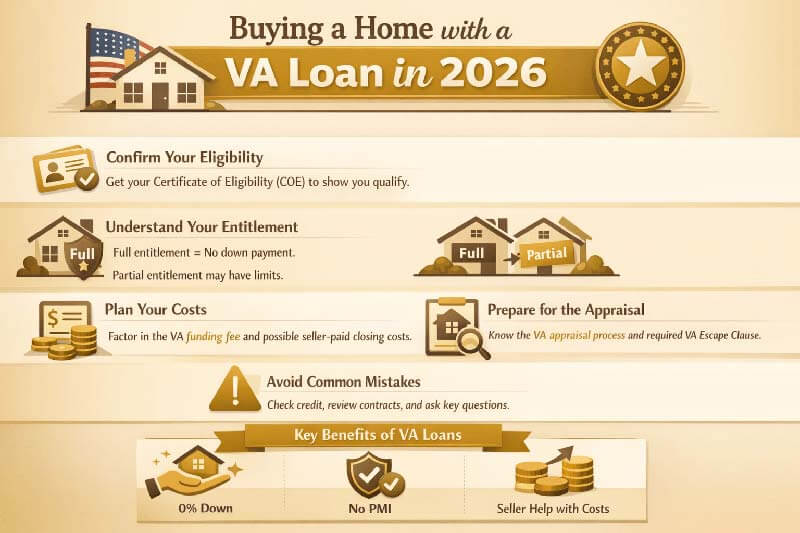
Buying a Home With a VA Loan in 2026: The Clear, No-Nonsense Guide
You served. You earned this benefit. Buying a home with a VA loan in 2026 can mean no down payment, no monthly PMI, and less cash needed at closing. This guide explains eligibility, entitlement, seller credits, funding fees, appraisals, and the steps to get from pre-approval to closing with fewer surprises.
Buying a home with a VA loan in 2026 can mean no down payment, no monthly PMI, and less cash needed at closing. Approval depends on your eligibility, income, debts, and the home’s appraisal. One of the biggest advantages is using seller credits and lender credits correctly to reduce what you bring to closing.
What a VA Loan Is
A VA loan is a mortgage backed by the Department of Veterans Affairs for eligible Veterans, active-duty service members, and surviving spouses. This loan can help you buy a home with no down payment, no monthly private mortgage insurance (PMI), and more flexible lending rules compared to other loan types.
When you buy a home with a VA loan, your cash to close usually includes upfront costs such as title fees, prepaid property taxes, homeowners’ insurance, and other closing expenses. The good news is that there are several ways to reduce those out-of-pocket costs if you structure the deal correctly.
Cash-to-Close Guide
- Ask for seller credits to help cover closing costs and prepaid expenses.
- Use lender credits, if needed, to reduce the amount you bring to closing.
- Close later in the month to lower prepaid interest.
How Seller Help Works on a VA Loan
One of the biggest ways to reduce your cash-to-close is to negotiate for the seller to pay some of your costs. On a VA loan, the seller may be able to cover certain standard closing costs and prepaid expenses, depending on how the contract is structured.
There is also a separate VA rule for seller concessions. This rule is often misunderstood. The 4% cap does not apply to all closing costs. It applies only to certain extra concessions, not to standard seller-paid closing costs. That distinction matters because it can help keep your out-of-pocket costs lower than many buyers expect.
Do I Qualify to Use My VA Loan in 2026? (Simple Eligibility Checklist)

If you’re buying a home with a VA loan, start here:
- Service: You’re a Veteran, active-duty service member, or eligible surviving spouse.
- COE: Your Certificate of Eligibility shows that you meet the service requirements for a VA loan.
- Occupancy: You’ll live in the home as your primary residence (you can buy up to a 4-unit if you occupy one).
- Ability to repay: We’ll review credit, income, debts, and residual income. No PMI. Competitive rates.
Here are the main points to understand. If you are buying a home with a VA loan, your loan officer will help you with any special situations, like if you still have a previous VA loan, have co-borrowers, are buying a multi-unit property, or need condo approval.
Common Mistakes to Avoid When Buying with VA
- Confusing concessions with closing costs. If you’re buying a home with a VA loan, don’t let the 4% rule scare you off—most closing costs can still be seller-paid.
- Ignoring partial entitlement math. If you still have a VA loan, get your entitlement calculated before offering.
- Forgetting prepaids. Taxes and insurance add up—plan credits to cover them.
- Low-balling timelines. Order a VA appraisal early and prep for Tidewater.
- Picking a lender with overlays. We underwrite to VA rules, not extra in-house hurdles.
If you’re buying a home with a VA loan, these simple moves keep your path clean.
Buy a Home With a VA Loan—$0 Down
Eligible veterans and active-duty service members may be able to buy with no down payment. Get a clear pre-approval plan, estimated payment, and next steps to start house hunting with confidence.
Full vs. Partial Entitlement: How Zero Down Really Works in 2026
Your VA entitlement is the amount of VA backing available for your loan. In simple terms, it helps determine whether you can buy with no down payment.
If you have full entitlement, there is no official VA loan limit for zero down as long as you qualify for the payment and the home appraises for the purchase price.
If you have partial entitlement, you may still be able to use a VA loan, but the amount you can borrow with no down payment may be smaller. This often happens when you still have another VA loan open or have not fully restored your entitlement from a previous home.
Simple example:
If you sold your old VA-financed home and that loan was paid off, you may have full entitlement again. If you still own a home with a VA loan, you may have partial entitlement, which could mean you need to make a down payment on your next purchase.
Seller Credits and the VA 4% Rule: What Buyers Need to Know
One of the biggest ways to lower your cash to close on a VA loan is to ask the seller to help pay some of your costs. These costs can cover regular closing fees and some upfront items like homeowners’ insurance, property taxes, and other bills that need to be paid at closing.
Here is the important part: the VA’s 4% limit does not apply to all seller-paid costs. It applies only to certain seller concessions, which are extra benefits beyond normal closing costs.
In simple terms, standard closing costs and prepaid expenses can often be paid by the seller without counting toward the 4% concession cap. That is why this rule matters so much when structuring a VA purchase contract.
The key is making sure the costs are categorized correctly so you understand what the seller can pay and how much cash you may still need to bring to closing.
How Some VA Buyers Keep Cash to Close Low
In some cases, a buyer using a VA loan may bring very little cash to closing by combining seller credits, lender credits, and a well-timed closing date. The exact amount depends on the home price, local taxes, insurance costs, and the structure of the purchase contract.
For example, a buyer with full entitlement and strong qualifying income may be able to reduce out-of-pocket costs significantly if the seller agrees to cover standard closing costs and the loan includes lender credits. However, results vary by market and transaction.
A buyer with full entitlement, solid income, and negotiated seller credits may be able to close with much less cash than expected. But the final amount will depend on local fees, prepaid taxes and insurance, and the terms of the contract.
What You May Pay With a VA Loan
Even with no down payment, you may still have some closing costs. These often include title charges, government recording fees, prepaid homeowners insurance, prepaid property taxes, and other standard closing expenses.
Some VA buyers also pay a funding fee, which is a one-time charge that helps support the VA loan program. Some borrowers are exempt, including many veterans with a qualifying service-connected disability.
The good news is that your out-of-pocket cost can often be reduced. Seller credits and lender credits may help cover some closing costs and prepaid expenses, depending on the deal structure.
Your final cash to close will depend on factors such as the purchase price, local taxes, insurance costs, and whether any credits are negotiated in the contract.
Step-by-step: from COE to Clear to Close
If you’re buying a home with a VA loan, we keep it simple:
- 5-minute intake + COE: We pull your COE, check entitlement, and confirm exemption status.
- Smart pre-approval: Full doc review (pay stubs/W-2s or LES, bank statements, IDs). You’ll know your max payment and price range.
- Offer strategy: We coach your agent on the credit structure to minimize cash.
- Appraisal & VA requirements: Order VA appraisal early; if value is tight, we manage Tidewater proactively.
- Underwriting: We approve your file and address any conditions fast.
- Final numbers: We lock the rate/credits and finalize seller and lender credits.
- Closing: Review your final Closing Disclosure; bring your ID and (if needed) minimal funds.
- Move in: You’re a homeowner.
With our no-overlay approach, if you’re buying a home with a VA loan, we aim for a fast, calm close—often while other lenders stall.
VA Appraisal, Tidewater, and Required Repairs
VA appraisals check value and minimum property requirements (safety, soundness, sanitation). If the appraiser thinks the value may come in low, Tidewater is triggered: we (and your agent) can submit comps to support the value. Modest repairs can be handled with seller credits or work before closing. The goal is the same—if you’re buying a home with a VA loan, protect your investment and keep the deal moving.
Multi-Unit, Condos, and New Construction with a VA Loan
You can be buying a home with a VA loan that’s a duplex, triplex, or fourplex—as long as you live in one unit. Some condos must be VA-approved (we’ll check the list or guide the spot-approval path). New builds are fine; just plan for appraisal timing and any builder requirements. If you’re buying a home with a VA loan, ask us to review condo docs early.
Buyer-Agent Fees on VA Loans in 2026: What Buyers Need to Know
In some markets, buyers may still need to understand how their real estate agent is being paid. If you are using a VA loan, the key is ensuring any buyer-agent fee is handled in accordance with current VA guidance and properly documented in the transaction.
What matters most for buyers is simple: before you make an offer, confirm whether your agent’s compensation will be paid by the seller, included in the contract terms, or handled another way in your local market. That can affect your cash to close and the deal’s structure.
Because local practices can vary, this is something your lender and real estate agent should review early to avoid surprises before closing.
What Documents Do I Need When Buying a Home With a VA loan?
If you’re buying a home with a VA loan, expect this short list:
- COE (we’ll retrieve it)
- ID (driver’s license or government ID)
- Income docs (LES/pay stubs, W-2s/1099s, tax returns if needed)
- Assets (60 days of bank statements)
- Homeowners insurance quote
- Purchase contract when you’re under contract
Upload your documents once, and we will take care of everything else. If you are purchasing a home with a VA loan, we will keep the paperwork simple and the process quick.
How We Lower Your Cash to Close When Buying with VA
When you are buying a home with a VA loan, the goal is to reduce your out-of-pocket costs by combining seller credits, lender credits, and smart timing whenever possible.
- Model the numbers before you offer (taxes, insurance, title, transfer).
- Targeted seller credit (right-sized to your market’s fees).
- Lender credit to mop up what’s left.
- Calendar timing to minimize per-diem interest.
- Accurate disclosures so adjustments don’t surprise you.
The result: If you’re buying a home with a VA loan, you’ll know exactly how close to $0 cash we can get—and how to structure your offer to make it happen.
What to Do Before You Make an Offer
Before buying a home with a VA loan, confirm your eligibility, review your entitlement, estimate your cash to close, and understand how seller credits may affect your upfront costs. It is also smart to gather your income and asset documents early, so your pre-approval process goes more smoothly.
If you want help reviewing your eligibility or estimating your cash to close, speak with a VA-experienced loan officer before you start house hunting.
Final Thoughts
Buying a home with a VA loan in 2026 can be one of the most affordable ways for eligible buyers to become homeowners. The most important steps are confirming your eligibility, understanding your entitlement, planning for closing costs, and carefully structuring your offer. When you understand how seller credits, funding fees, appraisals, and cash-to-close work, the process becomes much easier to navigate.
If you want help reviewing your eligibility or estimating your cash to close, speak with a VA-experienced loan officer before you make an offer.
Frequently Asked Questions About Buying a Home with a VA Loan:
Can I Really Buy a Home with a VA Loan with No Down Payment?
- Yes, many eligible buyers can purchase a home with a VA loan and no down payment. If you have full entitlement, VA says you generally do not have a loan limit, as long as you qualify for the payment and the appraisal supports the value.
What is Full Entitlement vs. Partial Entitlement on a VA Loan?
- Full entitlement usually means you can buy with zero down without a VA loan limit. Partial entitlement often applies when you still have a VA loan tied to another property or have not fully restored your benefit, which can affect how much you can borrow without making a down payment.
Do VA Loans have a Funding fee, and Can it be Rolled Into the Loan?
- Most VA purchase loans include a one-time VA funding fee. However, some borrowers are exempt, including many Veterans receiving compensation for a service-connected disability. VA’s current purchase-loan funding fee is 2.15% for first use with less than 5% down and 3.3% for subsequent use with less than 5% down.
Can the Seller Pay My Closing Costs on a VA Loan?
- Yes. VA allows sellers to pay many standard closing costs, which differ from seller concessions, which are subject to separate limits. This is one of the biggest reasons a VA buyer may be able to keep cash to close at a lower amount than expected.
What Happens if the VA Appraisal Comes in Low?
- If the home appraises below the purchase price, the deal may need to be renegotiated, the value may need to be challenged with better comparable sales, or the buyer may need to consider other options. VA also requires the VA Escape Clause on purchase contracts signed before the Notice of Value is issued, which helps protect the buyer in these situations.
Can I Use a VA Loan More Than Once?
- Yes. VA says the home loan benefit is a lifetime benefit, which means eligible borrowers can use it more than once. Whether you can buy again with zero down depends on whether you have full entitlement restored or are using remaining entitlement.
This article about “Buying A Home With A VA Loan With No Money Down” was updated on March 18th, 2026.
Close smoothly with a VA-savvy lending team
From appraisal to clear-to-close, we guide you every step of the way.