VA Loans During Chapter 7 versus 13 Bankruptcy Blocks: A Veteran’s Mortgage Approval Guide
In this blog, we will cover and discuss the agency mortgage guidelines from the U.S. Department of Veterans Affairs for qualifying for VA loans during Chapter 7 versus 13 Bankruptcy. For those who fell victim to our country’s economic collapse and lost their jobs, chances are that they are overwhelmed with debts.
VA loans during Chapter 7 and Chapter 13 bankruptcy: Learn about waiting periods, trustee approval, credit processing, and how to avoid lender overlays.
There are major differences in qualifying for VA loans during Chapter 7 versus Chapter 13 Bankruptcy which we will discuss throughout this article. All government and conventional mortgages have waiting period requirements after bankruptcy or foreclose on mortgage loan programs. This includes FHA 203k loans and VA construction loans.
VA Loans Chapter 7 versus 13 Bankruptcy: A Veteran’s Mortgage Approval Guide
Many veterans, service members, and their families worry that bankruptcy means they can never own a home again. In reality, each type of bankruptcy has its own rules, approval steps, and waiting periods for VA loans.
The VA loan program is designed to be flexible for veterans and military families. It protects lenders from losses, so you can get a loan even if you don’t have home equity, as explained in the VA’s buyer guide.
Gustan Cho Associates helps clients who have been turned down by other lenders due to credit issues. Most of the time, it’s not the VA loan program itself but extra lender rules that cause issues. This firm focuses on helping people with credit challenges become homeowners.
Getting a VA Loan After Filing Bankruptcy
Yes, it is possible to get approved for a VA (Department of Veterans Affairs) loan after bankruptcy, but there are certain requirements and waiting periods you need to be aware of. The specific guidelines can vary, and it’s essential to consult with a VA-approved lender for the most accurate and up-to-date information.
In this guide, we will cover some general guidelines. Many have lost high-paying jobs and compromised with lower-paying jobs with little or no benefits.
In the meantime, they are struggling with making minimum payments on high-interest credit cards. Other consumers had issues paying other debts where they cannot get ahead and do not see the light at the end of the tunnel.
VA Loan After Chapter 7 Bankruptcy
For Chapter 7 bankruptcy, you may need to wait at least two years from the discharge date before you can be eligible for a VA loan. Lenders will assess your overall financial stability, including your income, employment history, and debt-to-income ratio. It’s crucial to note that these guidelines can change, and different lenders may have their own requirements. Therefore, it’s advisable to contact a VA-approved lender who can assess your specific situation and guide you through the process.
VA Loans During Chapter 7 & 13 Bankruptcy
The treatment of VA loans in bankruptcy depends primarily on whether the bankruptcy is filed under Chapter 7 or Chapter 13. Chapter 7 bankruptcy is a process where debts are cleared after it ends. Most borrowers have to wait until this is finished to qualify for a VA mortgage. Chapter 13 bankruptcy means you follow a repayment plan, paying a trustee over three to five years. Veterans may qualify for a VA loan during Chapter 13 if they’ve made at least 1 year of on-time payments and have approval from the court or the trustee. Trustees usually decide individually. For Chapter 7 bankruptcy and foreclosure, you usually wait two years.
Strengths of a VA Loan With A Bankruptcy
VA loans are often easier to get after bankruptcy than regular loans. If you qualify, you can buy a home with no down payment, skip monthly mortgage insurance, and pick flexible options like fixed interest rates. Having a bankruptcy on your record doesn’t mean you can’t get a VA loan. Lenders look at your entire financial picture, including your income, debts, job stability, credit history, and payment history. Bankruptcy is just one part of the process.
Credit Scores and Loans
Every lender sets its own minimum credit score for VA loans, usually between 580 and 640. Even if you meet the VA’s rules, stricter lender rules may still result in a denial. Manual underwriting allows underwriters to look at your whole story, including how you bounced back from bankruptcy, your rent history, leftover income, and reasons for past credit problems.
VA Loan After Chapter 13 Bankruptcy
For Chapter 13 bankruptcy, you may be eligible for a VA loan during the repayment period if you have been making on-time payments for at least one year and have permission from the bankruptcy court to take on new debt.
Even after the waiting period, you will still need to meet the VA’s credit requirements. Lenders may have their own credit score requirements as well. You must still have VA loan entitlement available.
The VA loan entitlement is the portion of the loan amount that the VA guarantees. Additionally, it’s important to stay informed about any updates or changes in VA loan guidelines that may have occurred.
Filing Bankruptcy Can Give People a Fresh Financial Start in Life
Maybe the best solution for those who cannot seem to get ahead is to consider filing Chapter 7 bankruptcy. Chapter 7 Bankruptcy can get discharged 90 days from the filing date and give people have a fresh start. Borrowers can now qualify for VA loans after Chapter 7 Bankruptcy. This holds true as long as they meet the waiting period after bankruptcy on government and conventional loans. The waiting period to qualify for VA loans during Chapter 7 Versus 13 Bankruptcy is different.
Eligibility Requirements on VA Loans During Chapter 7 Versus 13 Bankruptcy
You cannot qualify for VA loans during Chapter 7 Bankruptcy until the Chapter 7 Bankruptcy has been discharged. The main difference between qualifying for VA loans during Chapter 7 versus 13 Bankruptcy is the bankruptcy needs to be discharged on Chapter 7 but not on Chapter 13 Bankruptcy to qualify for VA loans. Chapter 7 Bankruptcy normally gets discharged in 90 days.
What Is Chapter 13 Bankruptcy?
Chapter 13 Bankruptcy is a repayment plan that normally has a 5 year term. However, you can qualify for VA loans during Chapter 13 Bankruptcy after making 12 monthly timely payments during your payment plan. The Chapter 13 Bankruptcy does not have to get discharged to qualify for VA loans during Chapter 13 Bankruptcy repayment plan. This is the main difference between qualifying for VA loans during Chapter 7 versus Chapter 13 Bankruptcy.
Qualifying For VA Loans During Chapter 7 Versus 13 Bankruptcy
The minute an individual files for Chapter 7 bankruptcy, creditors cannot make contact and demand payment on past due bills from consumers. Petitioners of bankruptcy need to make a list of all creditors that want the bankruptcy court to relieve the debts owed to creditors. Petitioners can keep the auto loan and exclude it from bankruptcy and other credit items. Once Chapter 7 bankruptcy is discharged by the bankruptcy court, all of the debts get wiped out and consumers can have a fresh financial start.
How To Reestablish Credit in Qualifying on VA Loans During Chapter 7 Versus 13 Bankruptcy
Filing bankruptcy can plummet credit scores by more than 200 plus points. However, that drop is a temporary drop. Credit scores will gradually increase as bankruptcy ages. Consumers should start re-establishing credit as soon as Chapter 7 Bankruptcy discharge.
After bankruptcy, you typically need to wait two years before you can qualify for a VA loan again. During this time, focus on improving your credit, saving money, and paying all your bills on time.
Using VA Loans with Chapter 7
For Chapter 7 bankruptcy, the VA loan waiting period begins after the discharge date. Lenders use this date to determine eligibility.
In Chapter 13? You May Still Qualify for a VA Loan
Apply Online And Get recommendations From Loan ExpertsVA Loan After Chapter 7 Bankruptcy with Re-established Credit
To get a VA loan after Chapter 7 bankruptcy, it’s important to rebuild your credit. Pay your bills on time and use credit wisely. Making regular payments on loans, car payments, utility bills, and rent can help you build a strong credit record. Bankruptcy doesn’t have to stop you, but underwriters will look closely at your payment history after bankruptcy, especially any late payments, to see how you managed your money while recovering. Still, if you have strong compensating factors or your payment history has improved over time, you may still qualify for a VA loan.
VA Loan During Chapter 13 Bankruptcy
You might be able to get a VA loan while your Chapter 13 bankruptcy is still ongoing. This is a big benefit. Usually, you need at least 1 year of on-time payments and your trustee’s approval. These guidelines can let veterans buy a home while still making payments under a Chapter 13 plan.
Because Of The 12-Month Rule, Veterans May Buy A Home While Still Paying Off Their Chapter 13 Plan
Missing even one payment can hurt your eligibility, since lenders closely check if you are following your repayment plan. It is usually required to keep up with payments to qualify for a new mortgage during an active Chapter 13 bankruptcy. The bankruptcy court or trustee must approve the new mortgage to make sure it fits your repayment plan and does not change the bankruptcy terms. During Chapter 13, borrowers often go through manual underwriting. This can help if you have enough leftover income, a steady job, a good payment record, and a clear reason for your bankruptcy.
VA Loan After Chapter 13 Bankruptcy Discharge
Getting a VA loan after finishing Chapter 13 bankruptcy is often easier than many think. Completing your repayment plan and getting a discharge shows you’re responsible, and your credit is usually considered rebuilt. Lenders also check your debts, debt-to-income ratio, leftover income, loan size, and your interest in VA housing.
Once you’ve completed Chapter 13, VA loans are usually more flexible than other loans. Lenders mostly look at your credit history when reviewing your application. After Chapter 13
All loans have strict rules, and credit problems can be a challenge. After a Chapter 13 discharge, taking on too much new credit can actually lower your chances of approval. With shorter waiting periods, you might qualify for a VA loan even if your bankruptcy is still active, as long as you have made the required payments. Lenders want to see that you have paid off your debts and rebuilt your credit.
Chapter 13 Is Primarily About Payment
For Chapter 13, underwriters want to see at least 12 months of on-time payments to the trustee and official approval from the trustee for the new mortgage.
Applicants should provide a clear and honest letter explaining the reason for the bankruptcy, such as job loss, illness, divorce, business failure, or short-term financial problems.
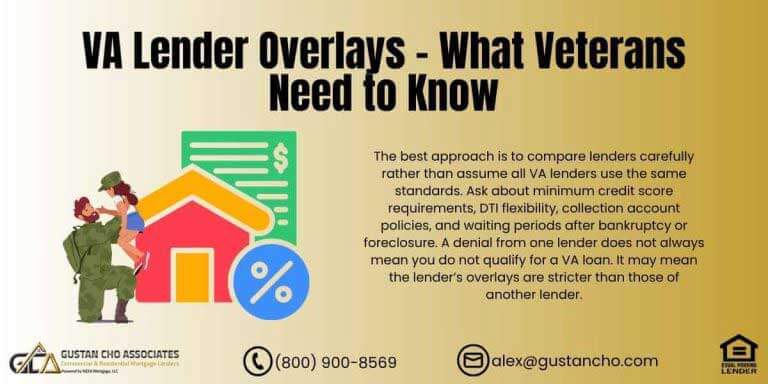
Many veterans are denied VA loans after bankruptcy because lenders add extra rules, even when VA guidelines are met. For example, the VA does not require a minimum credit score of 620, but many lenders do. The VA allows manual underwriting and lets Chapter 13 borrowers qualify after 12 months of payments, but some lenders want a full discharge first.
VA Lender Overlays After Bankruptcy
Some lenders want higher credit scores or longer waiting periods. Others do not allow manual underwriting or require you to open several new credit accounts.
Your application can be denied if your debt-to-income ratio is high, even if you have good leftover income. Gustan Cho Associates has no lender overlays on VA loans.
Gustan Cho Associates helps borrowers, especially veterans, who have been denied VA loans by other lenders due to additional rules on bankruptcy, credit scores, debt-to-income ratios, or manual underwriting. Having high leftover income can sometimes make up for other issues.
What Is Residual Income On VA Loans?
Residual income is the amount left Residual income is the money left each month after paying major bills. The VA uses this to see if borrowers can support their households. Good payment history and other positive factors are also looked at. More Important After Chapter 7 or 13 bankruptcy, lenders want to make sure the borrower isn’t heading back to money problems. High leftover income shows you can handle your budget after buying a home and helps with loan approval.
Common VA Lender Overlays After Bankruptcy
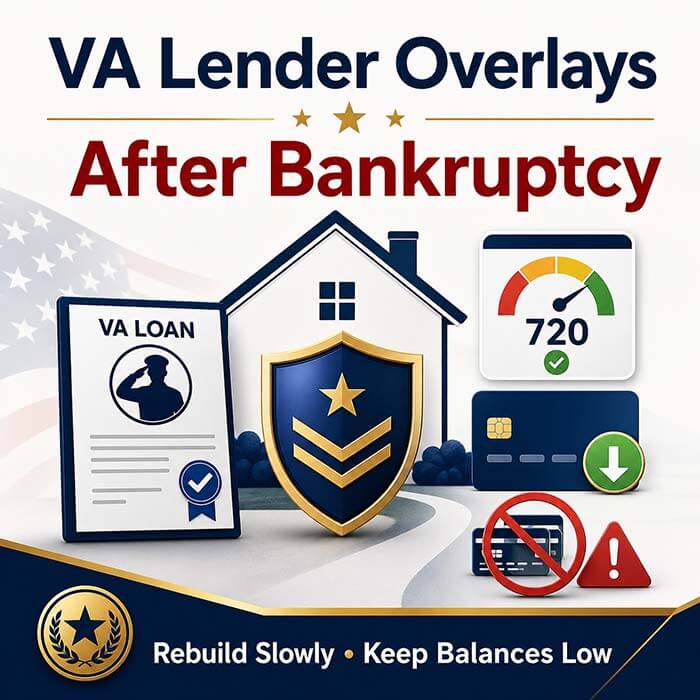
Depending on the lender and your full application, eligible veterans may qualify for VA loans, even with lower credit scores. Sometimes, a borrower with a past bankruptcy but perfect recent credit looks better to lenders than someone with no bankruptcy but recent late payments. Opening too many new accounts at once can raise red flags.
Take it slow and keep your balances low Rebuilding credit is important, but opening too many new accounts at once can hurt your chances.
Taking a slow approach and keeping your balances low works best. The waiting period may start on the bankruptcy discharge date or the foreclosure sale date, and delayed foreclosures may need extra review by a VA Regional Loan Center.
Bankruptcy And Foreclosure Dates Can Be Confusing
Borrowers might think the waiting period starts at bankruptcy discharge, but if the home was foreclosed later, lenders have to check both the discharge and foreclosure dates.
Title And Public Records Matter
Lenders review bankruptcy papers, credit reports, public records, foreclosure documents, and sometimes county records to determine the appropriate timeline for VA loan eligibility during Chapter 7 or 13 bankruptcy. Having all your documents ready is very important for getting a VA loan after bankruptcy. An organized file makes the loan review process easier and less stressful.
Documents Needed After Chapter 7 Bankruptcy
Gathering the right documents is key to getting a VA loan after bankruptcy. Your file should include proof of credit repair, records of rent payments, income documents, bank statements, and a letter explaining your bankruptcy.
Using Secured Credit Cards to Boost Credit
The easiest and fastest way to re-establish credit after filing bankruptcy is by getting three to five secured credit cards with at least $500 credit limits. Each one of those secured credit cards will boost credit scores by a minimum of 20 or more points. Consumer credit scores will gradually increase as time passes. There are many cases where people’s credit scores are in the 700’s after a year of bankruptcy discharge with the use of secured credit cards.
Tips In Qualifying For VA Loans During Chapter 7 Versus 13 Bankruptcy
There is a minimum of a 2 year waiting period after filing bankruptcy in order to qualify for FHA home loans after Chapter 7 bankruptcy. Just waiting out the 2 years mandatory waiting period does not guarantee a mortgage loan approval. Lenders do not want to see any late payments after Chapter 7 Bankruptcy. Lenders want to see the mortgage loan borrower has re-established credit.
Credit Score Requirements on VA Loans During Chapter 7 Versus 13 Bankruptcy
Most lenders like to see a minimum of three credit trade lines and no late payments after filing bankruptcy. Lenders also do not want to see any overdrafts in the borrower’s checking accounts in the past 12 months. Mortgage lenders want to see rental verification. It is very important that when paying monthly rent pay it with a check. Canceled checks are how lenders document rental verification.
FHA and VA Loans During Versus Chapter 7 Versus 13 Bankruptcy
Homebuyers can qualify for VA And FHA loans during and after Chapter 13 Bankruptcy. Homebuyers can qualify for VA and FHA Loans one year into a Chapter 13 Bankruptcy Repayment Plan with the approval of their Chapter 13 Bankruptcy Trustee. Most Trustees will approve a home purchase.
Trustee Approval on VA Loans During Chapter 7 Versus 13 Bankruptcy
Out of the countless VA and FHA loans during and after Chapter 13 Bankruptcy I have originated and funded, I did not have a single Trustee not approve Borrower from a VA or FHA Loan during a Chapter 13 Bankruptcy Repayment Plan. There is no waiting period to qualify for FHA loans after a Chapter 13 Bankruptcy discharged date. However, if the Chapter 13 Bankruptcy discharge has been seasoned less than two years, it needs to be a manual underwrite. Gustan Cho Associates does manual underwriting and is a direct lender with overlays.
VA Loans During Chapter 7 Versus 13 Bankruptcy Versus Other Government Loans
Government loans are owner-occupant home loans guaranteed by FHA, USDA, VA. Here is the waiting period to qualify for government loan programs after bankruptcy. Homebuyers should have no problem qualifying for FHA loans after two years of bankruptcy discharge date with re-established credit and no late payments after bankruptcy. Veteran homebuyers can qualify for VA loans after two years of their Chapter 7 Bankruptcy discharge date.
USDA Guidelines on Bankruptcy
USDA Guidelines on qualifying for USDA loans after Chapter 7 Bankruptcy is 3 years. With FHA & VA loans, homebuyers can qualify for home loans after one year into a Chapter 13 Bankruptcy Repayment Plan with the approval of Bankruptcy Trustee. There is no waiting period to qualify for FHA and VA loans after the Chapter 13 Bankruptcy discharge date. However, if the Chapter 13 Bankruptcy discharge is seasoned less than two years after the discharge date, it needs to be a manual underwrite.
Conventional Mortgage Loan After a Bankruptcy
There is a mandatory four-year waiting period to qualify for a conventional mortgage loan after a Chapter 7 Bankruptcy discharge date.
- 2 years after the Chapter 13 discharge date
- 4 years after the Chapter 13 dismissal date
Re-established credit and no late payments after the Chapter 7 bankruptcy is normally required to get an approve/eligible per Automated Underwriting System.
Credit Score Guidelines on Conventional Loans
Fannie Mae and Freddie Mac sets mortgage guidelines for conventional loans. Fannie and Freddie sets guidelines on conventional loans not because they insure conventional loans but rather they set it on loan they will purchase.
The secondary mortgage markets will not purchase any mortgage loans that do not conform to its guidelines. This is why conventional loans are often referred to as conforming loans.
Conventional loans are not backed by a government agency like HUD, USDA, and the Veterans Affairs. A minimum credit score of 620 FICO is required on conventional loans. The four-year waiting period starts from the discharge date of the Chapter 7 bankruptcy. New Fannie Mae Guidelines for consumers who had a mortgage as part of their bankruptcy that came into effect last August 2014.
Chapter 7 vs. Chapter 13 – Which One Affects VA Loans More?
Apply Online And Talk to an Expert TodayDocuments Needed During Chapter 13 Bankruptcy
After Chapter 13 discharge, applicants may need to provide discharge papers, payment history, proof of completed the plan, an updated credit report, income and asset documents, and any explanation letters the underwriter may require.
Getting approved for a VA loan after bankruptcy is not just about waiting times. You need to show a strong case. Prove your financial stability and be honest about past credit issues. High balances can lower your credit score and increase your monthly debt. Keeping those balances low helps your credit and keeps your debt-to-income ratio in check.e ratio in check.
Document Rent Payments
A strong record of paying rent on time shows you can manage future mortgage payments. This is especially helpful if your loan is reviewed manually.
Save Money For Reserves
While VA loans usually do not require a down payment, having extra savings can strengthen your application. Money left after closing improves your financial profile.
Getting pre-approved for a VA loan during or after bankruptcy takes careful planning. Not all lenders know the VA bankruptcy rules, offer manual underwriting, or accept lower credit scores.
Do not rely only on a quick online pre-qualification. A quick online pre-qualification might miss your bankruptcy. It is better to have your documents reviewed by a VA mortgage team with real experience.
Work With A VA Lender Experienced In Bankruptcy
Handling bankruptcy files takes skill and careful planning. Your lender should know how to check Chapter 7 discharge dates, Chapter 13 payment records, court approvals, leftover income, and manual underwriting rules.
Get Fully Reviewed Before Shopping For Homes
Before making an offer on a home, veterans should get a full review. A strong VA pre-approval can help you avoid surprises during the buying process.
Common Reasons VA Loans Are Denied After Bankruptcy
Many VA loan applications after bankruptcy are denied for reasons that could have been avoided.
Recent Late Payments
One main reason for denial is making late payments after bankruptcy. Applicants in an active Chapter 13 bankruptcy typically require approval from the trustee or court before closing on a loan. Even if your debt-to-income ratio looks good, low leftover income can still hurt your chances. Other payments, such as loans, child support, or IRS plans, can also affect approval. Many denials happen because lenders add extra rules, called overlays, that go beyond what the VA requires.
Why Choose Gustan Cho Associates For VA Loans During Chapter 7 Versus Chapter 13 Bankruptcy
Gustan Cho AssociatGustan Cho Associates helps veterans, active-duty service members, and eligible surviving spouses qualify for VA loans after major credit events like bankruptcy, foreclosure, short sale, tax liens, or low credit scores. Many clients come after being turned down elsewhere, not because they cannot qualify, but because of extra lender rules. This approach is especially helpful for borrowers with a bankruptcy history.
Manual Underwriting Is Common During Chapter 13
Manual underwriting can make a VA loan approval possible for some borrowers after bankruptcy. Gustan Cho Associates has the know-how to prepare and organize these files for success. View Option. If you’ve been denied recently, you can get a fast second opinion. Just because one lender says no doesn’t mean another won’t say yes.reVA loan eligibility works differently for Chapter 7 and
Chapter 13 bankruptcy. With Chapter 7, you usually need to wait after discharge. With Chapter 13, you might be able to buy a home after 12 months of on-time payments and trustee or court approval.
The most important factors are your payment history, residual income, rebuilt credit, steady income, trustee approval if needed, and choosing the right lender. Bankruptcy doesn’t have to stop eligible veterans from owning a home. With the right help, good documents, and a lender who follows VA rules, many veterans get a VA loan sooner than they expected.sible.
Fannie Mae Guidelines on Mortgage Included in Bankruptcy
That is great news for mortgage loan borrowers seeking a conventional loan or those whose foreclosures got recorded at a later date. Homebuyers who had a prior Chapter 7 or Chapter 13 Bankruptcy can now qualify for Home Loans After Bankruptcy with Gustan Cho Associates. For help with VA loans during Chapter 7 versus 13 bankruptcy, contact Gustan Cho Associates at www.gustancho.com for a full VA mortgage review.
For conventional mortgage borrowers who had a mortgage part of Chapter 7 bankruptcy, the waiting period start date starts from Chapter 7 bankruptcy discharge date and not the recorded date of the foreclosure.
For more information or to qualify, please contact us at Gustan Cho Associates at 800-900-8569 or text us for a faster response. Or email us at gcho@gustancho.com. The team at Gustan Cho Associates is available 7 days a week, evenings, weekends, and holidays.
- Related> Waiting Period After Bankruptcy And Foreclosure
- Related> Approval Prior To Waiting Period After Bankruptcy
FAQs About VA Loans During Chapter 7 Versus 13 Bankruptcy
Can I Get A VA Loan After Chapter 7 Bankruptcy?
Yes, eligible borrowers may be able to get a VA loan after a Chapter 7 bankruptcy. In most cases, borrowers need to wait 2 years from the Chapter 7 discharge date and demonstrate re-established credit, stable income, and the ability to repay the new mortgage.
Can I Get A VA Loan While In Chapter 13 Bankruptcy?
Yes, it may be possible to get a VA loan while in Chapter 13 bankruptcy. Borrowers generally need at least 12 months of on-time Chapter 13 trustee payments and written approval from the bankruptcy trustee or court.
What Is The Difference Between VA Loans During Chapter 7 Versus Chapter 13 Bankruptcy?
The main difference is timing. Chapter 7 usually requires a waiting period after discharge. Chapter 13 may allow a borrower to qualify after 12 months of on-time payments and trustee approval.
Does VA Require A Minimum Credit Score After Bankruptcy?
The VA does not set one universal minimum credit score. However, many lenders have overlays that require higher credit scores. Gustan Cho Associates works with borrowers who may not meet other lenders’ overlay requirements.
Do I Need Trustee Approval For A VA Loan During Chapter 13 Bankruptcy?
Yes, borrowers in an active Chapter 13 bankruptcy normally need trustee or court approval before taking on a new VA mortgage. The approval indicates that the bankruptcy court has allowed the borrower to incur new mortgage debt.
Can I Qualify For A VA Loan Right After Chapter 13 Discharge?
Some borrowers may qualify for a VA loan soon after Chapter 13 discharge if they have completed the plan, have stable income, meet VA residual income requirements, and have acceptable credit since the bankruptcy.
Are VA Loans Easier Than Conventional Loans After Bankruptcy?
For many eligible veterans, VA loans can be easier to obtain after bankruptcy than conventional loans because they have flexible credit standards, no monthly private mortgage insurance, and strong manual underwriting options.
Why Was I Denied A VA Loan After Bankruptcy?
You may have been denied due to lender overlays, recent late payments, weak residual income, a high debt-to-income ratio, missing bankruptcy documents, or a lack of trustee approval. A denial from one lender does not always mean you cannot qualify elsewhere.
Can Gustan Cho Associates Help With VA Loans During Chapter 7 Versus Chapter 13 Bankruptcy?
Yes. Gustan Cho Associates specializes in VA loans with no lender overlays, including VA borrowers with Chapter 7 bankruptcy, Chapter 13 bankruptcy, lower credit scores, manual underwriting, and prior mortgage denials.
Is A VA Manual Underwrite Bad After Bankruptcy?
No. A VA manual underwrite is not bad. It means a human underwriter reviews the file rather than relying solely on automated findings. Manual underwriting can help borrowers with high residual income, clean recent payment history, and good compensating factors.