VA and FHA guidelines during vs after Chapter 13 Bankruptcy is similar. You are eligible to qualify for a VA or FHA loan during Chapter 13 Bankruptcy, one year after filing the Chapter 13 Bankruptcy.
Learn FHA guidelines during vs after Chapter 13 bankruptcy, including trustee approval, manual underwriting, payment history, and FHA loan eligibility.
The major difference between VA and FHA loans when it comes to manual underwriting is that VA loans require one-year timely payments in the past 12 months to be eligible for a manual underwrite. HUD, the parent of FHA, require a two-year timely payment history to become eligible for manual underwriting. In the following paragraphs, we will cover FHA guidelines during vs after Chapter 13 bankruptcy.
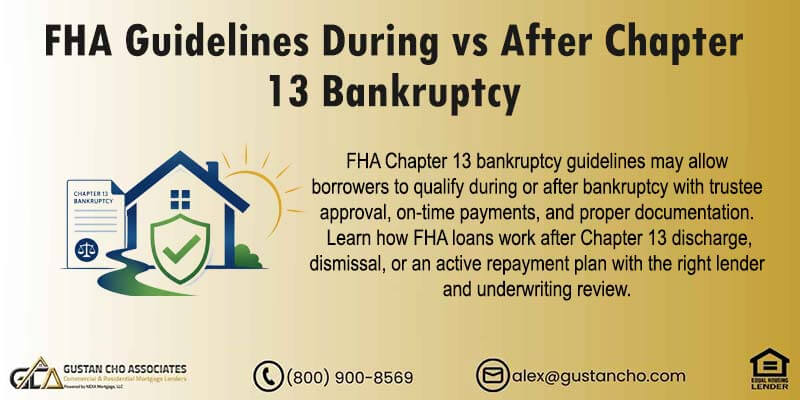
FHA Guidelines During vs After Chapter 13 Bankruptcy
Navigating FHA guidelines during and after Chapter 13 bankruptcy can feel overwhelming, as the rules shift depending on whether your bankruptcy is active, discharged, or dismissed. Many borrowers assume they must wait years after Chapter 13 to qualify for an FHA loan, but that is not always the case.
FHA loans can open doors for borrowers even while they are still making payments under a Chapter 13 plan, provided they meet certain requirements. I
In other situations, qualifying after Chapter 13 involves a different set of documentation and underwriting rules. Key factors include timing, a spotless record of bankruptcy payments, trustee or court approval, re-established credit, a manageable debt-to-income ratio, and whether your lender sticks to FHA guidelines without adding extra hurdles. According to HUD, Chapter 13 bankruptcy does not automatically shut the door on FHA-insured mortgages if you meet their requirements.
What Is Chapter 13 Bankruptcy?
Chapter 13 bankruptcy offers a court-approved roadmap for repaying some or all of your debts over time. This repayment journey typically spans several years and is closely overseen by the bankruptcy court or trustee.
Unlike Chapter 7 bankruptcy, which usually erases qualifying debts after liquidation or discharge, Chapter 13 lets borrowers reorganize what they owe while making regular payments.
This distinction is why FHA handles Chapter 13 cases differently from Chapter 7. Chapter 13 bankruptcy is important because FHA may consider a borrower for financing while the repayment plan is still active, but the file usually requires stronger documentation and manual underwriting.
FHA Guidelines During Chapter 13 Bankruptcy
Under FHA guidance, a borrower in Chapter 13 bankruptcy may be considered if at least 12 months of the pay-out period have elapsed, all required bankruptcy payments were made on time, and the borrower receives written permission from the bankruptcy court or trustee to enter into the mortgage transaction.
You may still be eligible for an FHA loan even if you are in the midst of a Chapter 13 repayment plan. The key is demonstrating a solid track record of responsible payments throughout the plan.
This means you do not always have to wait for your Chapter 13 bankruptcy to be discharged before applying. Still, qualifying during the repayment plan often involves more detailed scrutiny than qualifying after discharge.
FHA Manual Underwriting During Chapter 13 Bankruptcy
When applying for an FHA loan during an active Chapter 13 bankruptcy, expect your application to go through manual underwriting. This means a real person will carefully review your entire loan file, rather than relying solely on automated systems.
The underwriter will review the borrower’s income, employment, payment history, bankruptcy documents, trustee payment record, assets, credit history, housing payment, and overall ability to repay the new mortgage.
Manual underwriting does not guarantee approval. Instead, your file is measured against FHA’s manual standards, and strong compensating factors can make a real difference.
Trustee Approval or Court Permission Is Required
If you are in an active Chapter 13 bankruptcy, you will generally need written approval from your bankruptcy trustee or the court before moving forward with a new FHA mortgage. This approval shows you are allowed to take on new mortgage debt while still following your repayment plan. This step is crucial, as lenders cannot overlook your bankruptcy case. It is wise to consult your bankruptcy attorney before beginning the mortgage process.
On-Time Chapter 13 Payments Matter
Your Chapter 13 payment history is a cornerstone of your application. FHA expects at least 12 months of on-time, satisfactory payments under your plan. Missed or late payments can quickly become stumbling blocks. Lenders typically request your trustee payment history to verify that you have made all required payments. They may also check your bank statements to ensure the payments were made directly by you.
Manual Underwriting Guidelines on FHA and VA Loans
FHA and VA loans are the only two mortgage loan program that allow manual underwriting on home loans. There is no waiting period after Chapter 13 Bankruptcy discharged date on FHA and VA loans. If the Chapter 13 Bankruptcy has not been seasoned two years after the discharge, it needs to be manual underwriting. We will be covering FHA guidelines during vs after Chapter 13 Bankruptcy on FHA loans on this guide. Whatever the HUD guidelines in Chapter 13 Bankruptcy on FHA loans are, it is similar with VA loans. VA and FHA guidelines state that borrowers can qualify for an FHA and VA loan during a Chapter 13 Bankruptcy repayment plan.
When Can I Qualify For an FHA Loan After Filing Chapter 13 Bankruptcy
HUD Agency Guidelines vs Lender Overlays
All HUD-approved mortgage lenders originating, and funding FHA loans need to abide the minimum HUD agency guidelines on FHA loans if the funded and closed loans get insured by FHA. HUD will not insure any loans that does not meet HUD guidelines. Individual lenders are allowed and can implement higher lending requirements on FHA loans that is above and beyond the minimum HUD guidelines on FHA loans, called lender overlays.
Not all lenders will have the same lending requirements on FHA loans. There are lenders where they do not do manual underwriting or require a higher than a 580 credit scores as part of lender overlays.
We will cover this common topic that often confuses borrowers. In this article, we will cover and discuss FHA Chapter 13 Guidelines and qualifying for FHA Loans during and after Chapter 13. FHA (Federal Housing Administration) guidelines for home loans can vary depending on whether the borrower has completed a Chapter 13 bankruptcy or is still in the process of doing so. In the following paragraphs, we will cover a general overview on FHA guidelines during and after Chapter 13 bankruptcy.
FHA Guidelines During Chapter 13 Bankruptcy
Borrowers must typically wait at least 12 months after the Chapter 13 bankruptcy filing date before qualifying for an FHA loan. Borrowers must obtain court approval to take on new debt, including a mortgage, during the Chapter 13 repayment plan. Borrowers must have made all Chapter 13 payments on time for at least one year and may need to provide documentation to prove this.
The borrower’s credit report will be checked to ensure that there have been no new derogatory accounts or late payments since the bankruptcy filing.
Lenders will require proof of stable income to ensure the borrower can afford the mortgage payments alongside their Chapter 13 repayment plan obligations. Borrowers must provide extensive documentation, including proof of income, assets, and other financial obligations.
FHA Guidelines After Chapter 13 Bankruptcy Discharge
Borrowers typically need to wait at least two years after the discharge date of a Chapter 13 bankruptcy before they can qualify for an FHA loan with an approve/eligible per automated underwriting system. However, there is no waiting period requirements after Chapter 13 Bankruptcy discharge date on a manual underwriting.
Lenders will still check the borrower’s credit report to ensure no new derogatory accounts or late payments since the bankruptcy discharge.
Borrowers may need to meet minimum credit score requirements, which can vary but are often around 580 or higher for FHA loans. Proof of stable income will still be required to ensure the borrower can afford the mortgage payments. Similar to bankruptcy, borrowers must provide documentation of income, assets, and other financial obligations. It’s important to note that HUD mortgage guidelines during and after Chapter 13 Bankruptcy can vary depending on the lender and individual circumstances. Additionally, FHA guidelines are subject to change, so it’s essential to consult with a knowledgeable mortgage advisor or lender for the most up-to-date information and to determine eligibility.
Differences Between Chapter 7 Bankruptcy vs Chapter 13 Bankruptcy
There are two types of bankruptcies. HUD differentiates and has separate distinct qualification requirements for qualifying for FHA Loans during and after both types of bankruptcies. With FHA Guidelines During Vs After Chapter 13 Bankruptcy, there are many misunderstandings in qualifying for an FHA loan after a Chapter 13 Bankruptcy discharged date which we will discuss thoroughly.
Comparing HUD Bankruptcy Guidelines
We will compare FHA Guidelines During Vs After Chapter 13 Bankruptcy. We will discuss what Chapter 7 Bankruptcy is and the requirements for qualifying for FHA Loans with a Chapter 7 Bankruptcy. Chapter 7 Bankruptcy is called total liquidation. It benefits consumers who are overburdened in debt and has no or little income to ever pay their creditors. There is something called a Chapter 7 Bankruptcy means test.
Bankruptcy Means Test
Chapter 7 Means Test means that consumers need to qualify to file Chapter 7 Bankruptcy which means that a consumer cannot exceed a certain income limit. The purpose of a Chapter 7 Bankruptcy means test is to determine if income is low enough to be able to qualify to file a Chapter 7 Bankruptcy filing. It was created to make sure that consumers who have higher incomes from filing for a Chapter 7 Bankruptcy and file a Chapter 13 Bankruptcy instead where can pay back their creditors. If consumers fail to meet the Chapter 7 Bankruptcy means test, they need to file a Chapter 13 Bankruptcy Repayment Plan.
Cases Where You Cannot File Chapter 7 Bankruptcy
This is often the case for consumers making higher incomes than the median income for their geographical area. Chapter 13 Bankruptcy was designed for higher-income earners who need time to restructure their debts. Petitioners pay a portion of their income to their creditors, normally for 60 months. Whatever balance of debts that are left over after the 60 months is discharged by the Chapter 13 Bankruptcy Trustee. Borrowers can qualify for an FHA loan two years after a Chapter 7 Bankruptcy Discharged Date. No late payments after a Chapter 7 Bankruptcy discharged date and re-established credit are required to get an AUS APPROVAL.
Wondering If You Can Buy During Chapter 13?
Trustee approval, payment history, and manual underwriting all matterHUD Chapter 13 Guidelines For FHA Loans
Here is what a Chapter 13 Bankruptcy is and the requirements for qualifying for FHA loans during and after a Chapter 13 Bankruptcy Repayment Plan. A Chapter 13 Bankruptcy is when a consumer has employment but needs the U.S. Bankruptcy Courts to help in restructuring their debts. Need to be employed to file a Chapter 13 Bankruptcy. A consumer who needs to file a Chapter 13 Bankruptcy needs to make a list of all of their creditors and list the debts they owe and what the minimum monthly payments are. The U.S. Bankruptcy Courts will assign a Chapter 13 Bankruptcy Trustee.
The Role of The Bankruptcy Trustee
Most Trustees are private attorneys who will oversee the whole Chapter 13 Bankruptcy process from filing through the repayment period and through the Chapter 13 Bankruptcy discharge. A portion of income is set aside to pay creditors. The Bankruptcy trustee sets aside a payment schedule to pay the creditors for a certain term.
After the consumer makes the timely payment for the term of the Chapter 13 Bankruptcy repayment period, which is normally 60 months, the Trustee will discharge most of the consumer’s overall delinquent debt.
The consumer will be debt free after the discharge date. HUD does not allow borrowers to qualify for an FHA Loan during a Chapter 7 Bankruptcy process prior to a Chapter 7 Bankruptcy discharged date. Need to wait two years to qualify for an FHA after a Chapter 7 Bankruptcy discharged date. It is different when qualifying for an FHA Loan with a Chapter 13 Bankruptcy. Borrowers can qualify for FHA loans during a Chapter 13 Bankruptcy repayment period prior to being discharged.
Waiting Period Requirements After Bankruptcy
Borrowers can qualify for an FHA Loan with no waiting period after your Chapter 13 Bankruptcy discharged date according to FHA Guidelines During Vs After Chapter 13 Bankruptcy. Borrowers can qualify for an FHA Loan During A Chapter 13 Bankruptcy Repayment Plan. This holds true as long as they have made twelve timely payments to their creditors that are made timely.
Need approval from the Chapter 13 Bankruptcy Trustee. This can only be done as a manual underwrite. With all manual underwriting, rental verification is required
Verification of Rent or Rental Verification is 12 months of canceled checks or 12 months of bank statements that the renter has paid their landlord. This is mandatory unless the renter has rented their apartment or home from a registered property management company. VOR form is provided by the lender to the property manager. It is completed, dated, and signed by the property manager. A VOR Form from the property management company can be used in lieu of 12 months on time canceled checks and/or 12 months on time bank statement bank statements.
Shopping For Lender With No Overlays
Many of our viewers reading this BLOG is reading it because they probably were told they do not qualify for an FHA loan after a Chapter 13 Bankruptcy discharged date unless they wait a one or two-year waiting period. This is absolutely not true. HUD Guidelines in Qualifying for an FHA loan after a Chapter 13 Bankruptcy discharged date requires no waiting period.
How Soon After Filing Chapter 13 Bankruptcy is a Borrower Eligible For an FHA Loan
Borrowers can qualify one year into a Chapter 13 Bankruptcy repayment period BUT DO NOT QUALIFY after the Chapter 13 Bankruptcy has been discharged without meeting the one-year to a two-year waiting period. Does that make sense? Of course NOT.
The one-year waiting period after a Chapter 13 Bankruptcy discharge date is not HUD Guidelines on Chapter 13 Bankruptcy. It is an overlay by the lender on FHA loans
After the Chapter 13 Bankruptcy discharge date. There is no waiting period after Chapter 13 Bankruptcy discharge to qualify for an FHA loan under a manual underwrite. The reason it is a manual underwrite is because the borrower will not be able to get an approve/eligible per automated underwriting system without a two-year seasoning after the discharge date.
Qualifying With a Lender With No Overlays Experienced in Chapter 13 Bankruptcy
Homebuyers shopping for a national five-star lender that has no overlays on FHA loans during and after Chapter 13 Bankruptcy, please contact us at Gustan Cho Associates at 262-716-8151. Text us for a faster response. Or email us at gcho@gustancho.com. The team at Gustan Cho Associates is available 7 days a week, on evenings, weekends, and holidays.
FHA Guidelines After Chapter 13 Bankruptcy
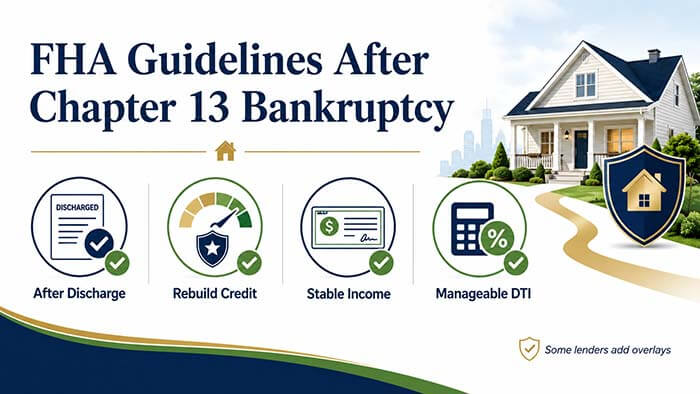 FHA guidelines shift after a Chapter 13 bankruptcy is discharged. Once discharged, you are no longer bound by an active repayment plan, and the rules for qualifying change accordingly. Repayment plan.
Some lenders might still impose extra waiting periods after discharge. These are called lender overlays and are not always part of FHA’s minimum requirements.
HUD views a Chapter 13 discharge differently than a Chapter 7. You may qualify after a Chapter 13 discharge if you meet FHA requirements, have rebuilt your credit, show stable income, and maintain a reasonable debt-to-income ratio.
Automated Underwriting After Chapter 13 Discharge
After a Chapter 13 discharge, you might qualify for automated underwriting approval through the FHA TOTAL Scorecard if the discharge date has been seasoned for two years from the discharged date. It also depends on your credit profile and the strength of your loan file. If the automated system gives your file the green light, the process can be smoother than manual underwriting. Still, your lender must document your bankruptcy discharge, credit history, income, assets, and all other FHA requirements.
Manual Underwriting May Still Be Needed After Discharge
Not everyone will receive automated approval after a Chapter 13 discharge. Some applications may still need manual underwriting due to credit history, high debt-to-income ratios, recent late payments, limited credit, Manual underwriting remains an option after discharge, as long as you meet FHA’s manual underwriting standards. Underwriting standards.
FHA Guidelines After Chapter 13 Bankruptcy Dismissal
A Chapter 13 dismissal is different from a Chapter 13 discharge. A discharge means the borrower successfully completed the plan or otherwise received a court discharge. A dismissal means the case was closed without discharge. A dismissal can make mortgage approval more challenging.
Lenders will closely examine why your case was dismissed, if debts became due again, and whether you have rebuilt stable credit your Chapter 13 was dismissed, be prepared to provide extra documentation.
Lenders may request your dismissal paperwork, an updated credit report, explanations for debts, payment history, and proof that you are paying all current debts on time. time.
FHA During vs After Chapter 13 Bankruptcy: Main Difference
The key distinction is whether you are still under court supervision. While in Chapter 13 bankruptcy, you typically need at least 12 months of on-time payments, trustee or court approval, and manual underwriting. After discharge, you may enjoy more flexibility, and automated underwriting could be possible depending on your overall credit profile. Both situations still require the borrower to meet FHA loan guidelines for income, credit, assets, property, and ability to repay.
FHA Credit Requirements After Chapter 13 Bankruptcy
FHA does not expect perfect credit after Chapter 13 bankruptcy. What matters is showing you have bounced back financially and are handling your current obligations responsibly.
The lender will review housing payment history, installment accounts, revolving accounts, collections, charge-offs, late payments, and any new credit opened after the bankruptcy filing.
Recent late payments after filing Chapter 13 can seriously hurt your chances. Lenders want to see a consistent record of on-time payments since you entered or completed bankruptcy.
FHA Debt-to-Income Ratio During and After Chapter 13
Your debt-to-income ratio plays a crucial role in FHA approval. Lenders compare your monthly debts to your gross monthly income to assess your ability to repay.
While in Chapter 13, your trustee payment often counts toward your monthly debts unless it is being paid off or excluded by underwriting rules.
Lenders also review your new mortgage payment, taxes, insurance, mortgage insurance, and other debts. After your Chapter 13 discharge, the trustee payment may no longer count, but lenders will still review all other debts listed on your credit report and loan application.
Documents Needed for FHA Loans During Chapter 13 Bankruptcy
If you are applying for an FHA loan during Chapter 13, be ready to provide more documentation than a typical FHA applicant. Common documents may include the bankruptcy petition, Chapter 13 repayment plan, trustee payment history, written trustee or court approval, pay stubs, W-2s, tax returns if required, bank statements, rent or mortgage payment history, and explanations for any credit issues after filing. The aim is to prove you can afford the new FHA mortgage while remaining in good standing with your bankruptcy plan.
Documents Needed After Chapter 13 Bankruptcy
After your Chapter 13 discharge, you should gather your discharge papers, bankruptcy schedules (if needed), explanations for your credit, income documents, bank statements, and proof that you are paying current debts as agreed the Chapter 13 was dismissed, the lender may ask for the dismissal order and proof that the debts are resolved or being paid as required.
Common Problems That Can Delay FHA Approval
Several roadblocks can delay FHA approval during or after Chapter 13 bankruptcy. These include missing trustee payment history, late payments after filing, lack of written trustee approval, errors on your credit report, unstable income, overdrafts, large unexplained deposits, and high debt-to-income ratios’ by gathering bankruptcy documents early, checking their credit report, avoiding new debt, and keeping all payments current.
FHA Loan Review During or After Chapter 13
Need help understanding your FHA options during Chapter 13 repayment plan? Are you looking for guidance on your FHA options during or after Chapter 13 bankruptcy, explain what documentation may be needed, and help determine whether FHA manual underwriting may be available.
Apply online or connect with a licensed mortgage loan officer today to get started. HUD sets minimum guidelines, but not all lenders stick to just those rules. Some add their own stricter requirements, known as lender overlays.
For instance, one lender might require a longer waiting period after Chapter 13 discharge, while another could consider your file under FHA manual underwriting if you meet the requirements. This is why two borrowers in similar situations can get very different answers from different lenders.
FHA Loan Approval Is Based on the Full File
FHA approval during or after Chapter 13 bankruptcy is never based on just one factor. The underwriter takes a close look at your entire financial profile.
Gustan Cho Associates is recognized for assisting borrowers with FHA manual underwriting and offering government loans without extra lender overlays when your file meets agency guidelines.
A strong application features stable income, steady employment, on-time housing payments, a clean payment history since bankruptcy, documented reserves, lower debt-to-income ratios, and clear explanations for your bankruptcy. A weaker application might show recent late payments, unstable income, high debts, limited assets, or missing bankruptcy documentation.
FHA Purchase and Refinance Options with Chapter 13
FHA financing can be available for both home purchases and refinances during or after Chapter 13 bankruptcy, as long as you meet FHA and lender requirements.
For a home purchase, you must qualify for the new mortgage payment and have the necessary funds for your down payment and closing costs.
For a refinance, you need to meet FHA refinance rules, equity requirements, payment history standards, and provide bankruptcy documentation. If you are in an active Chapter 13 repayment plan, do not assume you can refinance or buy a home without first getting permission from the court or trustee.
How To Improve FHA Approval Chances During or After Chapter 13
You can boost your approval chances by making every bankruptcy payment on time, avoiding new late payments, keeping your credit balances low, saving for reserves, maintaining steady employment, and gathering all bankruptcy paperwork before you apply. It also pays to work with a loan officer who understands FHA manual underwriting and Chapter 13 documentation. Files involving bankruptcy should be carefully organized before being submitted to underwriting.
Mistakes To Avoid Before Applying for an FHA Loan
Avoid taking on new debt, changing jobs without talking to your lender, missing trustee payments, making undocumented cash deposits, ignoring errors on your credit report, or applying before you have all the necessary documentation ready. Even a single new late payment after filing Chapter 13 can make FHA approval much harder. The cleaner your payment history after filing, the stronger your application will appear.
Final Thoughts on FHA Guidelines During vs After Chapter 13 Bankruptcy
FHA guidelines change between Chapter 13 bankruptcy and the period after, but both routes can offer mortgage opportunities for qualified borrowers. During an active repayment plan, FHA may allow financing after 12 months of on-time payments with trustee or court approval and manual underwriting.
After discharge, you may have more flexibility, and automated underwriting could be possible depending on your overall profile.
The safest strategy is to review your entire file before applying. Your bankruptcy status, payment history, income, credit, debt-to-income ratio, trustee approval, and any lender overlays can all influence the outcome.
Frequently Asked Questions About FHA Guidelines During vs After Chapter 13 Bankruptcy
Can a Borrower Use Gift Funds for an FHA Loan After a Chapter 13 Bankruptcy?
Yes, FHA may allow eligible gift funds for the down payment or closing costs if the gift meets FHA documentation rules. The donor must be an acceptable source, and the lender must properly document the transfer. Gift funds do not exempt you from meeting FHA credit, income, and underwriting requirements.
Does FHA Require All Old Collections to be Paid After a Chapter 13 Bankruptcy?
FHA does not always require every collection account to be paid, but the lender must review the credit report and determine how the accounts affect the borrower’s ability to repay. Some collection accounts may require explanation, payment arrangements, or debt calculation, depending on the type of debt and underwriting findings.
Can a Borrower Qualify for FHA if the Chapter 13 Included a Mortgage Foreclosure?
Possibly, but the lender must review the foreclosure date, bankruptcy documents, credit report, and FHA waiting period requirements. A foreclosure tied to a bankruptcy can be more complex, so the exact timeline and documentation matter.
Will HUD Allow a Co-Borrower After a Chapter 13 Bankruptcy?
Yes, FHA may allow a co-borrower if the full loan file meets FHA requirements. The co-borrower’s income, credit, debts, and occupancy status must be reviewed. Adding a co-borrower can help in some cases, but it does not erase serious credit or bankruptcy documentation issues.
Can Self-Employed Borrowers Get an FHA Loan After a Chapter 13 Bankruptcy?
Yes, self-employed borrowers may qualify after Chapter 13 bankruptcy if they meet the FHA income documentation rules. The lender will usually review tax returns, business income, income stability, and the borrower’s ability to repay. Self-employed files may take more documentation than W-2 borrower files.
Does HUD Require Reserves After Chapter 13 Bankruptcy?
FHA may not always require reserves for every borrower, but reserves can help strengthen a manually underwritten file. Reserves may be especially helpful when the borrower has higher debt-to-income ratios, limited credit depth, or other risk factors.
Can Disputed Accounts Hurt FHA Approval After a Chapter 13 bankruptcy?
Yes, disputed accounts can delay or affect FHA approval depending on the account type, balance, and automated underwriting findings. Some disputes may need to be removed or explained before the lender can complete underwriting.
Is an FHA Loan Easier Than a Conventional Loan After Chapter 13 Bankruptcy?
In many cases, FHA may be more flexible than conventional financing after Chapter 13 bankruptcy, especially for borrowers with lower credit scores or manual underwriting needs. However, the best loan option depends on the borrower’s full credit profile, income, down payment, property type, and timing after bankruptcy.
Last Updated: May 30, 2026