Common Mortgage Overlays on FHA, VA, USDA, and Conventional Loans Explained
This guide covers common mortgage overlays on government and conventional loans. There are two types of mortgage guidelines. All borrowers must meet Agency Guidelines by FHA, VA, USDA, Fannie Mae, and Freddie Mac—lender overlays by mortgage companies. Dale Elenteny a senior mortgage loan originator at Gustan Cho Associates says the following:
This article examines common mortgage overlays on FHA, VA, and conventional loans, analyzes how lender rules influence approvals, and outlines steps borrowers may take to improve qualification prospects.
Mortgage lenders can impose their lending requirements above and beyond the minimum agency guidelines called lender overlays. Most lenders have the second type of mortgage guideline lender overlays. In the following paragraphs, we will cover common mortgage overlays by lenders on FHA, VA, USDA, and Conventional Loans.
What Are Common Mortgage Overlays?
An overlay is not required by the loan program itself; rather, it is an additional restriction established by the lender. These requirements may include higher credit scores, lower debt-to-income ratios, greater cash reserves, longer employment history, fewer recent late payments, or more stringent documentation than mandated by the agency.
Mortgage overlays are additional requirements imposed by individual lenders beyond the national lending guidelines established by FHA, VA, Fannie Mae, or Freddie Mac.
This distinction often leads to confusion during the mortgage process. Borrowers may be aware that FHA, VA, or conventional loans permit certain criteria, yet still face denial from a lender due to the application of overlays rather than adherence to agency guidelines.
Mortgage Overlays Are Not the Same as FHA, VA, or Conventional Guidelines
This is important. FHA has established underwriting guidelines that include a 3.5% minimum required investment for many purchase transactions and manual underwriting ratio guidelines that are tied to credit score. The VA also has its own guidelines and is especially credit-flexible, with no minimum credit score required, as stated in the VA training materials. As for the conventional loans, both Fannie Mae and Freddie Mac have more flexible underwriting guidelines than many borrowers expect, including some non-traditional credit and AUS-driven approvals. Most mortgage overlays occur when a lender sets rules stricter than the official guidelines.
Importance of Mortgage Overlays to Homebuyers
Lenders sometimes deny applications because of mortgage overlays. Even if a borrower meets the basic guidelines for a loan, they might still be turned down because the lender has stricter internal policies than the FHA, VA, or conventional loan programs. This is especially true for first-time homebuyers, those with lower credit scores, self-employed borrowers, those with recent credit problems, or those with high debt-to-income ratios. These situations are most often affected by overlays.
Overlays Principally Impact Buyers Within Agency Guidelines
Overlays may also influence loan pricing. Even if an application is not denied, a lender may require a higher credit score or additional reserves to qualify for more favorable rates. Additional restrictions may apply to cash-out refinances, condominiums, manufactured homes, multi-unit properties, or loans subject to manual underwriting.
What Are Lender Overlays?
Lender overlays are additional mortgage lending requirements above and beyond agency guidelines lenders can impose. Lenders can impose lender overlays on just about anything. This is why not all lenders have the same FHA, VA, USDA, and Conventional mortgage guidelines.
Common FHA Mortgage Overlays Borrowers Face
While FHA loans are seen as flexible and accommodating, many borrowers encounter lender overlays. The FHA handbook says that maximum financing and underwriting treatment are determined by the borrower’s minimum decision credit score. HUD states that borrowers are required to put 3.5% down for maximum-insured purchase financing. FHA manual underwriting guidelines restrict 500-579 score borrowers to 31/43 ratios, which is a 31% front-end debt-to-income and a 43% back-end debt-to-income ratio, and 580 and up may be allowed to have more flexibility in ratios based on compensating factors.
FHA Lender Overlays versus FHA Minimum Standards
HUD requires most loans to be run through TOTAL Mortgage Scorecard; however, it specifies that the lender is responsible for the final underwriting decision and the final scorecard.
In practice, common FHA mortgage overlays include requiring credit scores of 580, 600, 620, or higher, not allowing manually underwritten FHA loans, setting lower debt-to-income ratio caps than FHA allows.
Additional lender overlays could include asking for more reserves than FHA requires, having stricter late payment rules, and limiting the types of properties that can be financed, such as manufactured homes, condos, or multi-unit properties.
Credit Score Overlays on FHA Loans
The most common FHA overlay is a higher minimum credit score than FHA requires. FHA guidelines allow lower scores, especially for manually underwritten loans, but most lenders set their own higher minimums. Even if a lender advertises FHA loans, they may still require a much higher score in certain situations, for larger loan amounts, or for certain types of occupancy.
Debt-to-Income Ratio Overlays on FHA Loans
Another common FHA overlay is a stricter debt-to-income (DTI) cap. FHA guidelines allow for different DTI ratios based on compensating factors, but many lenders set their own lower limits, especially for borrowers with lower credit scores, fewer reserves, recent late payments, or other risk factors.
Manual Underwriting Overlays on FHA Loans
There is a common misconception that FHA loans are always easy to obtain; however, lenders frequently exercise caution with manual underwriting. This caution typically results from overlays rather than FHA regulations. For instance, if a borrower experiences an AUS downgrade, possesses limited credit history, or requires compensating factors, lender overlays often determine eligibility.
Common Mortgage Overlays—Find Out What’s Really Blocking Your Approval
Many “denials” aren’t agency rules—they’re lender overlays. Get a quick review of your credit, income, and loan type to see what’s actually required and what options may still work.Solution For Borrowers After Mortgage Loan Denial by Lenders
Borrowers who one lender denies an FHA loan can qualify with a different lender with no overlays. Gustan Cho Associates Mortgage has no lender overlays on government and conventional loans. There are common mortgage overlays most lenders implement. We will discuss common mortgage overlays by lenders in this blog.
Common Mortgage Overlays By Lenders
Anyone with high credit scores, no derogatory credit tradelines, and low debt-to-income ratios can qualify for a mortgage with any lender. However, borrowers with less-than-perfect credit, lower credit scores, and a high debt-to-income ratio may need to find a lender with no overlays. Some lenders have tougher lending requirements than other lenders.
Types of Lender Overlays by Mortgage Companies

Finding Another Lender After a Mortgage Denial
Most lenders add their lending requirements to the minimum agency guidelines by FHA, VA, USDA, Fannie Mae, and Freddie Mac.
Overlays make it harder for borrowers with bad credit or high debt-to-income ratios to qualify for home loans. Mortgage denials are very common with lenders with overlays.
Over 80% of our borrowers at Gustan Cho Associates could not qualify at other lenders due to their overlays. Not all lenders have the same FHA, VA, USDA, and Conventional mortgage requirements. One lender may say no, while another will say yes.
Common Mortgage Overlays By Lenders
As mentioned, most lenders have overlays on government and conventional loans. Government loans are FHA, VA, and USDA loans. Conventional loans are often referred to as conforming loans. The following paragraphs will discuss common mortgage overlays on FHA, VA, USDA, and Conventional loans.
Lender Overlays on Government and Conventional Loans
Here are typical common mortgage overlays on government and conventional loans:
- Credit Scores
- Debt-to-income
- Waiting Period after bankruptcy or housing event
- Co-borrowers
- Types of properties
- Cash reserve requirements
- Overdrafts on bank statements
- Collections and charge-off accounts
- Gift funds
- Manual underwriting
Common Mortgage Overlays on FHA Loans
The minimum credit score for 3.5% down payment FHA loans is 580 FICO. However, common mortgage overlays on credit scores are lenders requiring a 620 to 640 FICO. The U.S. Department of Housing and Urban Development (HUD) creates FHA guidelines on FHA loans in the FHA Handbook 4000.1. Outstanding collections and charge-off accounts do not have to be paid to qualify for FHA loans. However, most lenders will require collections and charge-off accounts to be paid as part of their lender overlays.
Common Mortgage Overlays on Manual Underwriting
Many lenders do not accept manual underwriting on FHA loans as part of their overlays. FHA’s maximum debt-to-income ratio to get an approve/eligible per automated underwriting system is 46.9% front end and 56.9% back end. Most lenders will cap DTI to 50%. Gustan Cho Associates allows borrowers in a Chapter 13 Repayment Plan to qualify for FHA loans under manual underwriting.
Common Mortgage Overlays on Chapter 13 Bankruptcy
There is no waiting period after the Chapter 13 Bankruptcy discharge date. Many lenders require a one- to two-year waiting period after the discharge date of Chapter 13 bankruptcy to qualify for FHA loans. Some lenders have no gift funds allowed as an overlay. Borrowers can qualify for FHA loans with under 580 credit scores with a 10% down payment. However, most lenders will not accept borrowers under 600 credit scores as part of their overlays.
Most Common Borrower Challenges with VA Mortgage Overlays
 In this section, we are covering common mortgage overlays on VA loans. The requirement of minimum credit scores is 620 to 640 FICO, while the VA does not require any minimum credit scores. Many lenders will not honor a manual underwriting with refer/eligible automated underwriting system findings.
Most lenders will cap the debt-to-income ratio when the VA does not have a maximum debt-to-income ratio requirement. Many lenders will require collections and charged-offs to be paid off when the VA does not require it.
Many lenders will not allow active Chapter 13 Bankruptcy repayment plan borrowers to qualify for VA loans. Gustan Cho Associates allows borrowers in a Chapter 13 repayment plan to qualify for VA loans under manual underwriting. There is no waiting period after the Chapter 13 Bankruptcy discharge date to qualify for VA loans. Gustan Cho Associates has zero overlays on VA loans on FHA, VA, USDA, and Conventional loans.
VA Flexibility vs VA Lender Overlays
VA loans are also an area where common mortgage overlays create confusion. VA’s own home loan materials make this clear: with a VA loan, no down payment is required. However, the lenders may require certain borrowers to make a down payment.
The U.S. Department of Veterans Affairs sets the VA guidelines in the Lenders Handbook – VA Pamphlet 26-7. VA does not have a minimum credit score requirement. VA does not have a maximum debt-to-income ratio cap on VA loans.
Additionally, VA credit training materials state that there is no minimum credit score required by VA, that the absence of a credit score is not considered a negative, and that tradelines or scoring models may be considered. Therefore, most of the stringent requirements that borrowers encounter with VA loans are attributable to lender overlays rather than VA program guidelines.
Common VA Overlays Borrowers See
Some common VA mortgage overlays include lender-imposed minimum credit scores, stricter residual income or DTI requirements, additional reserve requirements, stricter rules regarding recent mortgage late payments, overlays on manual underwriting, and increased scrutiny of manufactured homes, condos, multi-unit properties, or cash-out refinances. Historically, VA has used both DTI and residual income analysis, and a 41% DTI benchmark is documented in VA documents, but VA also considers compensating factors and does not treat the ratio as an automatic hard stop in every situation. That is where lender overlays tend to take the most steps and become more conservative than the VA guidelines themselves.
Credit Score Overlays on VA Loans
Because the VA does not set a minimum credit score, lenders create their own minimums. This is why one lender might deny a VA loan based on credit score, while another lender might still consider it.
Recent Credit Event Overlays on VA Loans
Some lenders add overlays for recent late payments, collections, bankruptcy, or disputed accounts, even though the VA allows for explanations or case-by-case reviews.
FHA vs VA vs Conventional—Which Program Fits Your File Best?
If one program triggers overlays, another may be a better fit. Get a quick comparison based on your score range, down payment, and timeline.Common Mortgage Overlays on USDA Loans
USDA Loans offer 100% financing. The minimum credit score per USDA Guidelines to qualify for USDA loans is 580 FICO. However, most lenders will have overlays on credit scores. Lenders with overlays will require 620 to 640 credit scores as part of their mortgage overlays.
Common Conventional Loan Overlays Borrowers Face
Fannie Mae Single Family Selling Guide and Freddie Mac’s Seller/Servicer Guide set mortgage guidelines on conventional loans. Typical lending overlays on conventional loans are on second and investment homes. The minimum credit score requirement on conventional loans is 620 FICO. However, many lenders can require a higher credit score, such as 660 to 680 FICO, on second and investment homes.
Conventional Automated Approval vs Lender Restrictions
When using conventional financing, numerous overlays arise even when the loan meets Fannie Mae or Freddie Mac criteria. The Fannie Mae guide states that for manually underwritten loans, the maximum total DTI is typically 36%, but can rise to 45% if certain credit score and reserve conditions are satisfied; however, DU casefiles can permit a 50% DTI.
What Mortgage Overlays Are Conventional Loan Borrowers Dealing With?
As one of the major underwriters, Fannie Mae also offers pathways to credit-scoreless borrowers. Likewise, Freddie Mac guidance indicates that certain Loan Product Advisor mortgages are exempt from the minimum indicator score for Accept mortgages, and that certain transactions remain eligible even when not all borrowers have a usable credit score. Despite this flexibility, overlays remain prevalent among conventional lenders.
Common Mortgage Overlays on Debt-to-Income Ratio on Conventional Loans
Other common mortgage overlays by lenders on conventional loans are capping the debt-to-income ratio to 43% to 45%. Fannie Mae and Freddie Mac have a maximum debt-to-income ratio of up to 50% LTV. Some lenders will require a higher credit score and lower debt-to-income ratios on condos. Condos are viewed as a riskier investment by lenders.
Common Conventional Overlays
Common overlays for conventional loans include higher minimum credit scores for high loan-to-value loans, cash-out refinances, condos, second homes, and investment properties. Lenders may also require more reserves, set lower DTI caps than DU or LPA findings, look more closely at self-employment income, and impose additional rules on income from commissions, bonuses, overtime, or non-traditional sources. Property overlays can affect condos, manufactured homes, mixed-use properties, or homes in need of repairs.
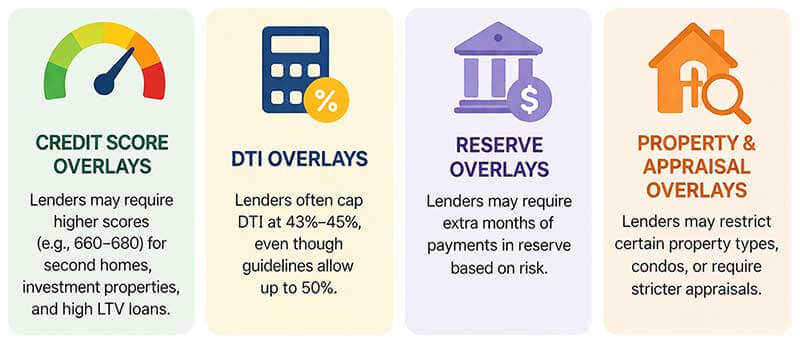
Reserve Requirement Overlays
Conventional lenders often have strict rules about reserves. Even if a loan is approved by automated underwriting, a lender might still require extra months of payments in the bank for borrowers with more risk, multiple properties, or lower credit scores.
Property and Appraisal Overlays
Conventional overlays also show up during property reviews. A lender might decline a condo project, require additional checks for non-warrantable features, request stricter appraisals, or exclude certain property types, even if agency guidelines allow them.
Overlays on Manufactured Homes
Manufactured homes are becoming increasingly popular. Most lenders do not want to lend on manufactured homes. VA and FHA borrowers often want to qualify for manufactured homes but run into lenders that have overlays. Contact us at Gustan Cho Associates at 800-900-8569 or text us for a faster response if you run into trouble qualifying for home loans due to lender overlays. Or email us at gcho@gustancho.com. The Team at Gustan Cho Associates has no overlays on government and conventional loans and is available seven days a week, evenings, weekends, and holidays.
Why Lenders Add Overlays on FHA, VA, and Conventional Loans
Lenders add overlays to manage risk, avoid buyback claims, make loans easier to sell, protect their profits, and simplify underwriting. Instead of reviewing borderline cases with many compensating factors, a lender might just set a higher minimum score or a stricter DTI limit. Overlays reduce lenders’ risk; however, they can pose additional challenges for borrowers seeking loan qualification.
Mortgage Overlays vs Agency Guidelines
A fundamental principle is that agency guidelines establish the minimum criteria, while mortgage overlays represent lender-imposed additional requirements.
While FHA may permit certain compensating factors, a lender may not. While VA may not require a universal minimum credit score, a lender may.
While Fannie Mae or Freddie Mac may approve a loan based on automated underwriting or alternative credit, borrowers should not assume that a denial from one lender means a loan program is unavailable. Differences in overlays may result in varying outcomes across lenders.am is unavailable. dit Scores, DTI, and Reserves
Credit Score Overlays
Most mortgage overlays are related to credit scores. Lenders might require higher scores for cash-out loans, manufactured homes, manual underwriting, multi-unit properties, or borrowers with recent late payments.
DTI Overlays
DTI overlays are also common. Lenders may set DTI limits below what FHA, VA, or conventional guidelines allow, even if the automated system would approve a higher ratio.
Reserve Requirement Overlays
UnLenders may require additional reserves if there are additional risk factors, such as lower credit scores, higher loan-to-value ratios, self-employment income, multiple properties, or investment properties. Overlays on Employment and Income Documentation Some lenders have stricter overlays for self-employed borrowers, especially if income is variable, has changed recently, or needs to be averaged. Even if the loan program allows it, the lender’s internal documentation requirements might result in a denial.
How To Find a Lender With Fewer Mortgage Overlays
While many borrowers eventually ask pertinent questions, it is advisable to do so early in the process. Prospective applicants should inquire whether the lender offers manual underwriting and if it applies to FHA or VA loans.
It is also important to determine whether the lender imposes credit score requirements higher than the program minimum or overlays for specific property types, cash-out loans, self-employed income, recent late payments, or other unique circumstances.
Additionally, clarifying whether a denial is due to agency guidelines or lender overlays can help assess whether the lender is equipped to manage more complex applications, thereby saving time for all parties involved.
Questions To Ask a Lender About Overlays
Many borrowers are unaware that a lender’s denial does not necessarily preclude obtaining FHA, VA, or conventional financing. Lender-specific rules may differ from program guidelines, and the loan program’s flexibility may not be reflected in the lender’s policies. Understanding the distinction between agency rules and lender overlays is therefore essential. This usually happens when borrowers are unaware of overlays. Without this knowledge, they cannot ask the right questions or compare lenders properly. One denial does not mean you cannot buy a home.
How To Qualify When Mortgage Overlays Make Approval Harder
Every mortgage overlay is different, so borrowers need to know what lenders look for. Lenders usually check for low revolving debt, no recent credit inquiries, clean and documented bank statements, and documented employment history.
Revenues and reserves must also be clearly documented. Be ready to explain any late payments, job gaps, disputed accounts, or large deposits. If a lender says no, find out whether it was due to agency rules or lender overlays.
Inquiring about the specific reason for denial can help borrowers avoid unnecessary complications and potentially circumvent restrictive overlays.
Frequently Asked Questions About Common Mortgage Overlays:
What Are Common Mortgage Overlays?
Lenders often impose additional mortgage overlays, specific rules that go beyond the standard guidelines established by agencies such as FHA, VA, USDA, Fannie Mae, and Freddie Mac. Understanding these overlays can help borrowers navigate their mortgage options more confidently.
Why Do Lenders Have Overlays On FHA, Called Overlays, On Credit Scores?
These score restrictions are why the requirements are for VA and conventional loans. Overlays are a lender’s way of exercising control. It helps manage risk, simplify the underwriting process, control exposure on loans that can be bought back, and tighten rules for more complex loans.
Do FHA Loans Have Lender Overlays?
Yes, overlays do exist. Many lenders impose additional restrictions, including higher minimum credit scores, lower DTI ratios, more money set aside (reserves) for a payment, a manual underwriter’s discretionary rules, and a host of other additional restrictions. The United States Department of Housing and Urban Development (HUD) handbook for FHA loans gives more flexibility than most lenders do.
Does VA Set A Minimum Credit Score?
The VA does not set a minimum credit score, but lenders impose additional restrictions that vary by lender.
Can A Conventional Loan Be Denied Even With AUS Approval?
Yes. Even if the findings from Desktop Underwriter (DU) or Loan Product Advisor (LPA) are good, the conventional loan can still be denied due to lender overlays on other reserves, property type, documents, recent credit issues, or layered risk.
How Can I Tell If I Was Denied A Lender Overlay?
Inquire with the lender whether the issue is a guideline from the agency or a lender policy. If it is the latter, other lenders will view the file differently.
Why Do Lenders Have Overlays?
Lenders use overlays to reduce risk by setting stricter requirements than the agency guidelines.
Can I Qualify for a Mortgage if One Lender Denies me Due to Overlays?
Yes, if one lender denies you, you may qualify with another with no overlays, like Gustan Cho Associates.
What Are Examples Of Common Mortgage Overlays?
Common overlays include higher credit score requirements, stricter debt-to-income ratio limits, mandatory collection payments, and restrictions on manual underwriting.
Do All Lenders Have Common Mortgage Overlays?
No, not all lenders have overlays. Some, like Gustan Cho Associates, follow only agency guidelines without adding overlays.
Can I Get An FHA Loan With A 580 Credit Score Despite Overlays?
Yes, while many lenders require a 620-640 credit score due to overlays, lenders with no overlays can approve FHA loans with a 580 score.
Are Overlays Common On VA Loans?
Yes, many lenders impose overlays on VA loans, requiring a minimum credit score of 620-640, even though the VA doesn’t have this requirement.
What Should I Do If My Loan Is Denied Due To Common Mortgage Overlays?
You can work with a lender with no overlays to increase your chances of approval.
Do Overlays Affect USDA Loans?
Common overlays for USDA loans include higher credit score requirements (620-640) and stricter debt-to-income ratio limits.
How Do I Avoid Issues With Common Mortgage Overlays?
Choose a lender like Gustan Cho Associates that offers loans without overlays, ensuring you only need to meet agency guidelines.
This Guide About “Common Mortgage Overlays On FHA, VA, Conventional Loans” Was Updated on April 8, 2026.