
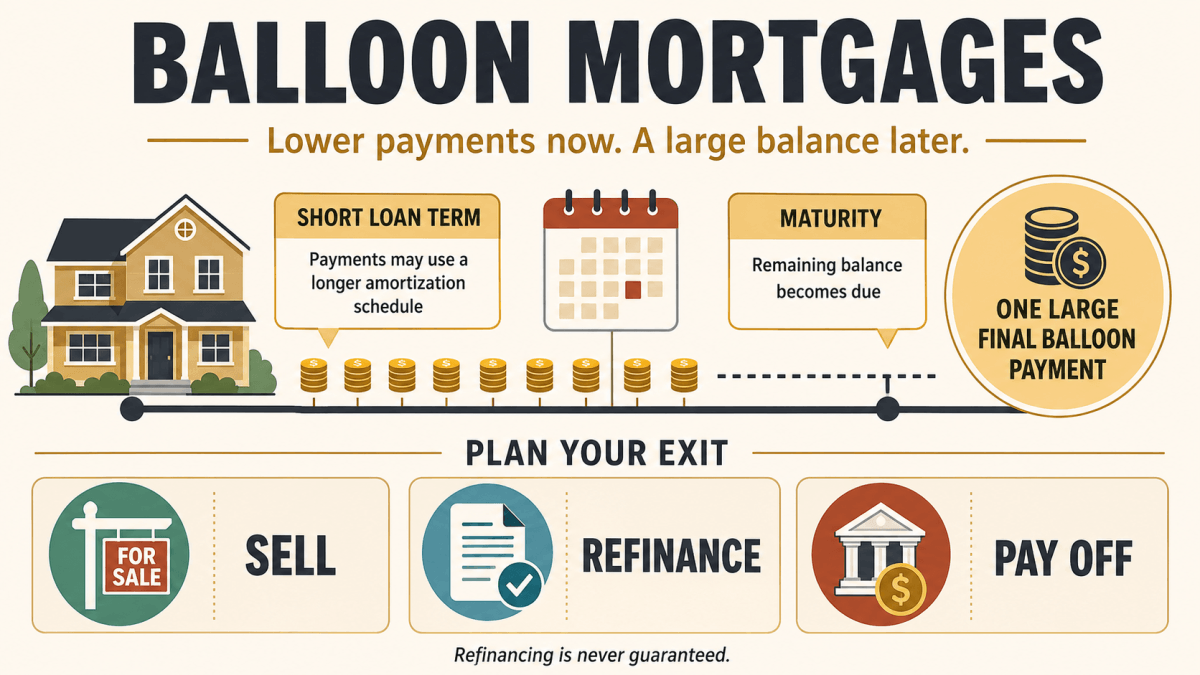
Balloon mortgages require monthly payments for a set period, followed by one large final payment for the remaining loan balance. The monthly payments may be based on a longer amortization schedule or structured as interest-only, so the debt is not fully repaid by the loan’s maturity. Balloon mortgages are most common in commercial real estate, investment property, bridge, and certain private-lending transactions. They can offer lower initial payments, but borrowers need a realistic plan to sell, refinance, or pay off the balance before it comes due. Refinancing is never guaranteed, so falling property values, higher interest rates, weaker credit, or reduced income can make the balloon payment difficult to manage.
What Is a Balloon Mortgage?
Bursting onto the scene late, balloon mortgages bring small, consistent installments at first. Only near the finish does it demand much more – that last chunk known as the balloon payment. Often spotted in deals involving office buildings or rental units, not homes. Anyone taking one must already know how they’ll handle the end – whether through selling, switching loans, or covering the cost outright.
Loan Term vs. Amortization Period
The loan term and amortization period are not always the same with balloon mortgages. The loan term is the time before the remaining balance becomes due, while the amortization period is the longer schedule used to calculate monthly principal-and-interest payments.
For example, a commercial balloon mortgage may have a five-year loan term with payments based on a 25-year amortization period. The monthly payments are calculated as though the borrower has 25 years to repay the debt. However, the loan matures after five years, leaving a substantial unpaid balance due as a balloon payment.
Borrowers should confirm both periods before closing. A longer amortization period may reduce the monthly payment, but it generally leaves a larger balance due when the loan reaches maturity.
How Balloon Mortgages Work?
Borrowers find their payments stay small each month when they take out a balloon mortgage. Yet at the close of those few years – say three, five, seven, or ten – the entire unpaid sum comes due all at once. That moment means coming up with a big chunk of money quickly. Often people sell what they bought, shift the debt elsewhere through new financing, or cover it another way entirely. The weight of that final amount looms even while early installments feel light.
Balloon Mortgage Example With Numbers
Suppose a borrower obtains a $500,000 balloon mortgage with the following terms:
- 7% fixed interest rate
- Five-year loan term
- 25-year amortization period
- Monthly principal-and-interest payment of approximately $3,534
Although the payments are calculated over 25 years, the loan matures after only five years. After making 60 monthly payments, the borrower would still owe approximately $456,000. That remaining balance would become the balloon payment due at maturity. The borrower would need to pay the balance with available funds, sell the property, or qualify for refinancing. Selling or refinancing is not guaranteed, so borrowers should also prepare a backup exit strategy. ***This example is for illustration only. Actual payments and balances depend on the loan amount, interest rate, amortization schedule, fees, and specific loan terms.
Types of Balloon-Payment Structures
Balloon mortgages can be structured in several ways. The payment schedule, interest rate, and remaining balance depend on the loan agreement.
Partially Amortizing Balloon Loan
Monthly payments include principal and interest but are calculated using an amortization period longer than the loan term. For example, payments may follow a 25-year schedule even though the loan matures in five years. The unpaid principal becomes the balloon payment.
Interest-Only Balloon Loan
The borrower pays only the interest for part or all of the loan term. Because little or no principal is repaid, most or all of the original balance may be due at maturity.
Fixed-Rate Balloon Loan
The interest rate remains unchanged during the stated term. This provides predictable monthly payments, but the remaining balance must still be paid when the loan matures.
Adjustable-Rate Balloon Loan
The interest rate may change according to the loan agreement before the balloon payment is due. The borrower, therefore, faces both changing monthly payments and a large remaining balance at maturity.
Hybrid Balloon Loan
Some loans combine different payment structures. A borrower might make interest-only payments initially and then begin making principal-and-interest payments before the final balloon payment becomes due. Borrowers should review the interest rate, amortization schedule, maturity date, and estimated final payment carefully. Two balloon loans with the same loan amount and term can produce very different monthly payments and balloon balances.
Need Help With a Balloon Mortgage?
Balloon mortgages may offer lower initial payments but require a large final payment. Gustan Cho Associates can help you compare available loan options, understand the risks, and choose financing that fits your goals.Where Balloon Mortgages Are Commonly Used
Balloon mortgages are typically utilized for commercial, investment, or short-term financing rather than for conventional owner-occupied home purchases. Common uses include:
Commercial Real Estate
Office buildings, retail properties, warehouses, apartment complexes, and other income-producing properties may be financed with balloon loans. The loan may mature in five, seven, or ten years while payments are calculated over a longer amortization period.
Investment and Rental Properties
Real estate investors may use balloon mortgages when they plan to renovate a property, increase its rental income, and refinance or sell it before the loan matures.
Bridge and Short-Term Financing
A bridge loan may include a balloon payment because it is designed to provide temporary financing. Borrowers generally expect to repay it after selling another property, completing construction, or securing permanent financing.
Construction and Renovation Projects
Developers may use balloon-payment financing to purchase, build, or improve a property. The intended exit strategy may be selling the completed project or refinancing based on its stabilized value and income.
Business-Purpose Property Loans
A business may use a balloon loan to purchase an owner-occupied office, storefront, warehouse, or other operating location. Lower initial payments can preserve working capital, but the business must prepare for the balance due at maturity.
Seller-Financed Transactions
A property seller may agree to accept monthly payments for a limited period, followed by a balloon payment. These transactions require carefully prepared loan documents and must comply with applicable federal and state laws. Balloon mortgages are less common for primary residences because consumer mortgage rules restrict balloon-payment features in many residential loans. Borrowers considering one should understand the maturity date, estimated final balance, refinancing requirements, and backup repayment plan before closing.
How Commercial Balloon Loans Are Evaluated
 Commercial balloon loans are evaluated based on both the borrower’s financial strength and the property’s ability to support the debt. Requirements vary by lender, property type, and loan purpose, but common underwriting factors include:
Property Income and DSCR
For income-producing real estate, lenders review the property’s net operating income and debt-service coverage ratio. The DSCR compares available property income with the required loan payments. A higher ratio gives the lender more confidence that the property can cover its debt.
Loan-to-Value Ratio
The loan-to-value ratio compares the loan amount with the property’s appraised value. A lower LTV gives the borrower more equity and reduces the lender’s risk. Maximum LTV requirements depend on the property type, occupancy, condition, and loan program.
Borrower and Guarantor Strength
Lenders may evaluate the borrower’s credit history, income, business financial statements, real estate experience, and record of managing similar properties. Personal guarantees may be required, especially when a business entity owns the property.
Liquidity and Cash Reserves
Borrowers may need sufficient funds for the down payment, closing costs, repairs, operating expenses, and unexpected vacancies. Lenders may also require post-closing reserves equal to several months of loan payments.
Property Condition and Marketability
The appraisal helps the lender assess the property’s value, condition, location, market demand, and potential resale risk. Environmental reports, property-condition assessments, or feasibility studies may be required for some commercial transactions.
Leases and Tenant Quality
For occupied properties, lenders review rent rolls, lease expiration dates, tenant payment histories, vacancy rates, and tenant concentration. A property dependent on a single tenant or on several leases ending soon may present greater risk.
Exit Strategy
Because balloon mortgages leave a substantial balance due at maturity, lenders closely examine how the borrower expects to repay it. The primary exit plan may involve selling the property, refinancing after increasing its income, or paying the balance with business or investment proceeds. A credible exit strategy strengthens the application, but lenders generally do not treat a future sale or refinance as guaranteed. They may also evaluate a backup plan in case property values fall, interest rates rise, or the property does not generate the expected income.
Advantages of Balloon Mortgages
Besides cutting down what you pay each month, a balloon mortgage leaves extra money free for things like fixing up buildings or covering company costs. Investors might find it useful if they intend to offload the asset before that big final payment comes around. Instead of stretching budgets now, some choose this route knowing a sale or new loan could cover the balance later.
Risks of Balloon Mortgages
Bursting into view near the finish line, a balloon mortgage demands a huge sum when the term ends. Should selling fall through, refinancing fail, or cash vanish, trouble follows fast. When interest climbs, home prices dip, or scores drop, reshaping the loan gets tougher without warning.
What Happens When the Loan Reaches Maturity?
When balloon mortgages reach maturity, the entire unpaid balance becomes due. Making all scheduled monthly payments does not satisfy the debt because those payments were not designed to repay the full principal during the loan term. Before the maturity date, the borrower generally must choose one of the following options:
- Pay the remaining balance with available funds
- Sell the property and use the proceeds to repay the loan
- Refinance the balance into a new loan
- Request an extension or renewal from the existing lender
A loan extension is not automatic. The lender may require a new appraisal, updated financial documents, satisfactory credit, sufficient property income, an extension fee, or revised loan terms. Refinancing is also not guaranteed and may become difficult if interest rates rise, property income falls, credit weakens, or the property loses value. If the balloon payment is not made by the maturity date, the loan generally enters maturity default. Depending on the loan documents and applicable state law, the lender may charge default interest and fees, pursue any guarantors, begin foreclosure, or take other collection action. Borrowers should contact the lender well before maturity—often six to twelve months in advance—to review their repayment options and address potential refinancing problems.
Can You Refinance or Extend the Loan?
Many borrowers refinance balloon mortgages before the remaining balance becomes due. Refinancing replaces the existing loan with new financing, which may offer a longer repayment period, a different interest rate, or a fully amortizing payment schedule. Approval is not guaranteed. The new lender may review:
- Credit history and payment record
- Current property value and loan-to-value ratio
- Property income and debt-service coverage ratio
- Borrower or guarantor income and liquidity
- Cash reserves
- Property condition and occupancy
- Current interest rates and lending standards
An extension keeps the existing loan in place for an additional period. The current lender may require updated financial statements, a new appraisal, an extension fee, additional principal reduction, or changes to the interest rate and other loan terms. The lender is not required to approve an extension unless the original agreement provides that right and the borrower satisfies its conditions. Borrowers should begin reviewing their options six to twelve months before maturity. Starting early provides more time to correct credit issues, improve property income, complete repairs, obtain an appraisal, or consider selling the property if refinancing is unavailable. A renewal or extension should be treated as a possible option—not a guaranteed exit strategy.
Balloon Mortgages vs. ARM vs. Fully Amortizing Loan
Although these loans can have similar initial payments, they create different long-term risks.
Balloon Mortgage
A balloon mortgage requires regular payments for a limited term, followed by a large final payment of the unpaid balance. The interest rate may be fixed or adjustable. The main risk is having to sell, refinance, or pay a substantial balance when the loan matures.
Adjustable-Rate Mortgage
An adjustable-rate mortgage, or ARM, has an interest rate that may change after an initial fixed-rate period. When the rate adjusts, the monthly payment can increase or decrease. A standard ARM does not necessarily require a balloon payment. However, a loan can include both an adjustable rate and a balloon feature.
Fully Amortizing Loan
A fully amortizing loan is structured so that scheduled principal-and-interest payments repay the entire loan by the end of the term. A traditional 30-year fixed-rate mortgage is a common example. If all required payments are made, no balloon balance remains at maturity. The primary difference is the type of future risk each loan creates. Balloon mortgages carry maturity and refinancing risk, while ARMs carry interest-rate and payment-adjustment risk. Fully amortizing fixed-rate loans offer a predictable repayment schedule, but they often have higher monthly payments than balloon loans with longer amortization periods. Borrowers should compare the maturity date, amortization schedule, rate-adjustment terms, estimated balloon payment, and total borrowing cost before choosing a loan.
Are Balloon Mortgages Allowed on Residential Homes?
Borrowers nowadays rarely choose balloon mortgages for homes they live in, especially compared to how things stood before the 2008 market crash – though a few still exist. Certain financial institutions like local banks or credit unions might provide them now and then if conditions line up just right. These kinds of loans? They’ve mostly shifted toward buildings meant to make money instead of houses people own themselves.
What to Review Before Signing
Before signing a loan with a balloon payment, review the complete loan agreement—not only the monthly payment. Balloon mortgages can have very different rates, fees, repayment schedules, and maturity requirements. Confirm the following details:
- Maturity date: Know the exact date the unpaid balance becomes due.
- Estimated balloon payment: Ask for an amortization schedule showing the projected balance at maturity.
- Loan term and amortization period: Confirm the loan term and the amortization period used to calculate the monthly payment.
- Interest-rate terms: Determine whether the rate is fixed or adjustable and when it may change.
- Payment structure: Verify whether payments include principal and interest or are interest-only.
- Prepayment restrictions: Review any step-down penalty, yield-maintenance provision, defeasance requirement, minimum-interest charge, or lockout period.
- Extension or renewal terms: Find out whether an extension is available, what conditions apply, and what fees or principal reduction may be required.
- Personal guarantee: Determine whether the lender can pursue the borrower or guarantors personally if the property does not cover the debt.
- Default provisions: Review default interest, late charges, legal expenses, foreclosure rights, and other consequences of missing the maturity payment.
- Refinancing requirements: Consider the property’s value, equity, income, credit, reserves, and any documentation needed to qualify for another loan.
- Primary exit strategy: Decide whether the balance will be paid through a sale, refinance, business proceeds, or available funds.
- Backup exit strategy: Prepare for the possibility that property values fall, interest rates rise, income declines, or refinancing becomes unavailable.
Borrowers should also compare the balloon loan with fully amortizing and other financing options. A lower initial payment may help cash flow, but it does not eliminate the remaining debt. An attorney or qualified financial professional can help review complex commercial loan documents before closing.
Final Thoughts About Balloon Mortgages
Balloon mortgages can be useful for commercial property owners, business borrowers, and real estate investors with a defined short-term strategy. However, lower initial payments do not eliminate the debt. A substantial balance remains due when the loan reaches maturity.
Before accepting a balloon mortgage, borrowers should understand the estimated final payment, prepayment restrictions, extension provisions, and consequences of a maturity default. Selling or refinancing may provide an exit, but neither option is guaranteed. Property values, interest rates, credit, income, and lending requirements can change before the balloon payment becomes due.
The right financing choice depends on the property, expected ownership period, available cash reserves, and repayment plan. Borrowers should have both a primary exit strategy and a realistic backup plan before signing.
Frequently Asked Questions About Balloon Mortgages
How Is a Balloon Payment Calculated?
The balloon payment is based on the unpaid loan balance at maturity. The amount depends on the original principal, interest rate, monthly payment, amortization period, and number of payments made. Borrowers should request an amortization schedule showing the estimated balance due.
Where Is a Balloon Payment Shown on a Loan Estimate?
For covered residential mortgages, Page 1 of the Loan Estimate identifies a balloon payment under “Loan Terms.” The estimated amount and payment year may also appear in the “Projected Payments” section. Business-purpose commercial loans may not require the same form, so borrowers should review the promissory note and payment schedule. Consumer Financial Protection Bureau
Can Extra Principal Payments Reduce a Balloon Payment?
Yes, additional payments applied directly to principal can reduce the balance due at maturity. However, borrowers should first check for prepayment penalties, minimum-interest requirements, or restrictions on extra payments. Additional principal payments may not automatically reduce the regular monthly payment.
Do Balloon Mortgages Build Equity?
Partially amortizing balloon mortgages build some equity as the principal is repaid. Interest-only balloon loans do not reduce principal during the interest-only period, although property appreciation could increase equity. Property values can also decline, so appreciation is never guaranteed.
Is a Balloon Payment the Same as a Prepayment Penalty?
No. A balloon payment is the unpaid balance due at maturity. A prepayment penalty is a separate charge that may apply when the borrower repays the loan early through a sale, refinance, or additional principal payment.
Does the Balloon Payment Include Property Taxes and Insurance?
The scheduled balloon payment generally represents the remaining loan debt, not future property taxes or insurance premiums. However, unpaid interest, lender-paid taxes, insurance advances, escrow shortages, default charges, or other amounts permitted by the loan documents could increase the final payoff.
Can a Buyer Assume an Existing Balloon Mortgage?
A buyer may assume the loan only if the agreement permits an assumption and the lender approves the new borrower. Many mortgages contain due-on-sale provisions requiring the balance to be paid when ownership changes. An assumption does not remove the balloon deadline unless the lender agrees to modify the terms.
Does a Balloon Mortgage Affect Your Credit?
Having a balloon mortgage does not automatically damage credit. Making payments on time may support a positive payment history. Missing the balloon payment, entering maturity default, or facing foreclosure can seriously harm the borrower’s personal or business credit.
This article about “Balloon Mortgages | What is a Balloon Mortgage Payment” was updated on July 21st,2026.