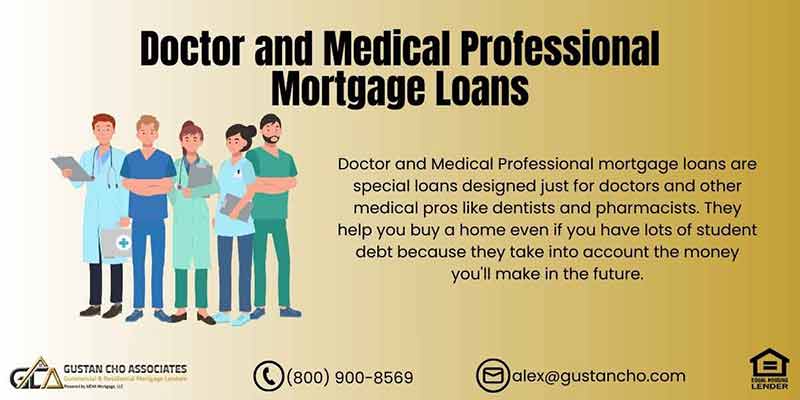
Doctors, dentists, nurses, pharmacists, and other medical professionals, unlock your dream home with doctor and medical professional mortgage loans offered at Gustan Cho Associates.
Licensed in 48 states, Washington, DC, Puerto Rico, and the U.S. Virgin Islands, we understand the challenges and advantages of your profession when it comes to homeownership.
Are you a medical professional dreaming of buying your first home but feeling overwhelmed by the weight of student loans? Gustan Cho Associates offers a tailored solution with our doctor and medical professional mortgage loans. These loan products are specifically tailored to meet the distinct financial needs of doctors, dentists, pharmacists, and various healthcare practitioners.
Doctor and Medical Professional Mortgage Loans: Home Financing for Physicians, Dentists, Residents, and Healthcare Professionals
Doctor and medical professional mortgage loans are structured for doctors, dentists, residents, fellows, veterinarians, pharmacists, nurse practitioners, physician assistants, and other healthcare professionals seeking to purchase or refinance a home.
A doctor mortgage loan helps qualified borrowers purchase a home by offering more flexible underwriting than standard programs.
Many medical professionals have strong future earning potential but face mortgage challenges early in their careers. These include substantial student loans, limited savings, new employment contracts, relocation for residency or fellowship, variable income, and short employment histories. Mortgage guidelines of doctor and medical professional mortgage loans vary by lender, investor, loan amount, credit profile, employment type, property type, and state.
What Are Doctor and Medical Professional Mortgage Loans?
Doctor and medical professional mortgage loans are specialized home loan programs for healthcare professionals. These loans often provide flexible options for eligible medical professionals with significant future earning potential who may not meet traditional mortgage criteria at the time of application.
Some physician mortgage programs may allow a lower down payment, limited private mortgage insurance, flexible student loan treatment, or the use of an employment contract before the borrower starts the new job.
These options depend on the lender and loan program. Doctor mortgage loans are often used by physicians, dentists, oral surgeons, medical residents, fellows, attending physicians, and other licensed professionals. Some lenders also include pharmacists, veterinarians, optometrists, nurse practitioners, physician assistants, and advanced practice registered nurses.
Why Medical Professionals May Need Special Mortgage Options
Medical professionals often have a distinct financial path compared to other homebuyers. Extended education and training delay full income, leading to higher student loans, limited savings, and frequent job changes.
Traditional mortgage underwriting considers income, employment history, credit, assets, debt-to-income ratio, and the borrower’s ability to repay.
Freddie Mac explains that lenders review income, employment history, savings, and monthly debts to assess repayment capacity. For doctors and healthcare professionals, the main challenges are documenting income, managing student loans, and finding a loan program suited to their current career stage rather than future earnings.
Who Can Qualify for Doctor and Medical Professional Mortgage Loans?
Eligibility depends on the lender. Some programs are limited to medical doctors and dentists. Others may include a broader group of healthcare professionals.
Physicians and Medical Doctors
- Medical doctors are commonly eligible for doctor mortgage loan programs.
- This may include Doctor of Medicine and Doctor of Osteopathic Medicine.
Dentists and Dental Specialists
- Dentists and dental specialists may qualify for physician mortgage programs with certain lenders.
- This may include general dentists, orthodontists, oral surgeons, periodontists, endodontists, and prosthodontists.
Residents, Fellows, and New Attending Physicians
- Residents and fellows may qualify even if they have not started full attending income.
- Some lenders allow a signed employment contract or offer letter if work begins within an acceptable time frame.
Veterinarians, Pharmacists, and Other Healthcare Professionals
Some medical professional loan programs may include veterinarians, pharmacists, optometrists, podiatrists, nurse practitioners, physician assistants, and other licensed healthcare professionals. Not all lenders include these professions, so program matching is important.
Common Features of Doctor Mortgage Loan Programs
Doctor mortgage loans are not standardized products; they are specific to each lender. The following features are common but not guaranteed by all programs.
Down Payment Options
- Certain doctor loan programs offer lower down payments than standard jumbo loans.
- This feature benefits medical professionals with high earning potential but limited savings due to extended education and training.
Possible No Private Mortgage Insurance Options
Some physician mortgage programs do not require monthly private mortgage insurance even with a lower down payment, improving monthly affordability. Borrowers should still carefully review interest rates, pricing, and total loan costs.
Some doctor mortgage loan programs may not require monthly private mortgage insurance, even with a lower down payment.
This depends on the lender, loan amount, credit profile, and program. Borrowers should compare the interest rate, closing costs, monthly payment, and total loan cost before deciding.
Flexible Student Loan Treatment
Student loans are a significant challenge for doctors and medical professionals. Some doctor loan programs calculate student loan obligations differently from standard programs, while others follow agency or investor guidelines. For FHA loans, lenders must follow HUD’s Single Family Housing Policy Handbook 4000.1, which is the main FHA policy source for origination, underwriting, and endorsement. Freddie Mac also has specific guidance for student loan payment treatment in the debt-to-income ratio.
Employment Contract Income
Some doctor loan programs allow income from a signed employment contract to be used before starting the new position. This benefits residents, fellows, and physicians relocating for work.
Higher Loan Amounts
Some medical professional mortgage programs may offer higher loan amounts than standard conventional loan limits. These programs may be useful for doctors buying in higher-cost markets.
Why Choose Doctor and Medical Professional Mortgage Loans?

Doctor and medical professional mortgage loans help physicians, dentists, residents, and healthcare workers buy homes with flexible income and student loan options.
We recognize that medical school can lead to significant debt, but we also consider your potential earnings as a doctor. This means we can provide more flexible lending options. For instance, we look at factors beyond just your current income. These loans come with benefits that can greatly impact your financial journey, helping you focus on your career instead of stressing over school loans.
No Private Mortgage Insurance (PMI):
- Unlike traditional loans that require PMI when you put down less than 20%, our loans eliminate this cost, saving you money.
Low to No Down Payment:
- Jumpstart your homeownership journey without the burden of a hefty down payment.
Flexible Debt-to-Income Ratios:
- We understand that your student debt doesn’t define your financial stability.
- Our loans are structured to consider the unique financial trajectory of medical professionals.
Updated Features
As we move forward, we’ve adapted our mortgage options to suit the evolving needs of medical professionals better:
Extended Rate Locks:
- To protect you from fluctuating interest rates, we now offer extended rate locks that give you peace of mind as you navigate your home-buying process.
Digital Application Process:
- We’ve streamlined our application process with digital tools that make it fast and hassle-free. You can apply from wherever you are, whenever you want.
Updated Eligibility Criteria:
- We continuously update our criteria to reflect the most current financial landscapes, ensuring that our loans remain accessible to as many medical professionals as possible.
How Do These Loans Work?
Simplified Application and Approval Process:
Initial Consultation:
- Start by talking to one of our knowledgeable loan officers, who specializes in medical professional loans.
Document Submission:
- Utilize our secure digital platform to submit necessary documents, such as your employment contract and proof of medical degree.
Loan Customization:
- We create tailored loan solutions that consider the value of your medical degree and the income you are expected to earn in the future.
- Instead of only looking at your current financial situation, we understand that as a doctor or medical professional, you have unique circumstances that deserve special attention.
- We aim to help you secure the right mortgage loan that fits your needs so you can focus on your career.
- In contrast, we help make your financial dreams a reality with doctor and medical professional mortgage loans.
Approval and Closing:
- With faster approvals, thanks to our specialized understanding of your profession, you’ll be on your way to owning your home sooner than you think.
Debt-to-Income Ratio: Why It’s Different for Doctors
Numerous healthcare practitioners begin their journeys with significant student loan debt. This can make traditional lenders hesitant to offer loans or provide the best terms because they often focus on the debt-to-income ratio. However, at Gustan Cho Associates, we see things a bit differently.
We understand that as a doctor or medical professional, you have a great potential to earn a good income in the future, which means that you can pay off that debt.
That’s why we offer doctor and medical professional mortgage loans designed to work with your unique financial situation. Our loans accommodate a higher debt-to-income ratio because we genuinely believe in your ability to succeed and thrive in your career. We want to help you achieve your goals without letting student debt hold you back from owning a home.
Down Payment Requirements: Tailored for You
We understand that medical school comes with a lot of expenses, and it can feel overwhelming when you think about all the costs involved. That’s why our loan programs are specifically designed to help ease those financial burdens.
When it comes to doctor and medical professional mortgage loans, many of them require little to no down payment. This means you can buy your home and start building your future immediately without waiting years to save up for a traditional down payment.
We want to help you make that leap into homeownership as smoothly as possible so you can focus on what really matters—your education and career.
Start Your Process Towards Your Professional Mortgage Loans
Apply Online And Get recommendations From Loan ExpertsWho Can Apply?
Eligibility for our doctor and medical professional mortgage loans extends to a wide range of medical professionals, including:
- MDs (Doctors of Medicine)
- DOs (Doctors of Osteopathic Medicine)
- DDS (Doctors of Dental Surgery)
- DMDs (Doctors of Medicine in Dentistry)
- Pharmacists
- Veterinarians
- And more – if you hold a professional medical degree, chances are you qualify.
Doctor Mortgage Loans Versus Conventional Loans
A conventional loan may be a good option for medical professionals with strong credit, stable income, manageable student loan payments, and enough funds for the down payment and closing costs.
Doctor mortgage loans may suit borrowers with limited savings, large student loan balances, new employment contracts, or a need for higher loan amounts.
The best choice depends on the borrower’s full financial profile. Conventional loans are usually underwritten through Fannie Mae or Freddie Mac guidelines. Freddie Mac’s public guidance notes that lenders review credit, income, employment, savings, and other monthly obligations when evaluating mortgage readiness.
When a Conventional Loan May Work Better
A conventional loan may be better for borrowers with a strong down payment, a lower debt-to-income ratio, an established employment history, and qualifying credit. Conventional loans may also offer competitive pricing for well-qualified borrowers.
When a Doctor Loan May Work Better
A doctor loan may be preferable when the borrower has high future income but limited cash reserves, large student loan debt, or a new employment contract. It also helps when a larger loan amount is needed without a traditional jumbo structure.
Doctor Mortgage Loans Versus FHA Loans
FHA loans are popular with borrowers who need flexible credit guidelines and a lower down payment. FHA loans are not limited to doctors or healthcare workers. They are available to eligible borrowers who meet FHA requirements. FHA may be a strong option for medical professionals with lower credit scores, limited savings, or past credit issues.
FHA rules are governed by HUD Handbook 4000.1, which is the official policy handbook for FHA single-family mortgage programs.
Doctor loans may be preferable for higher-income medical professionals seeking larger loan amounts, the potential for no monthly private mortgage insurance, or flexible student loan treatment. The appropriate loan choice depends on credit, income, student loans, down payment, and property value.
Doctor Mortgage Loans Versus VA Loans
VA loans may be among the best mortgage options for eligible veterans, active-duty service members, and eligible surviving spouses. VA loans may offer no down payment, no monthly mortgage insurance, and flexible underwriting. VA has specific guidance on student loans.
A VA circular explains that if student loan debt is deferred at least 12 months beyond the closing date, the monthly payment may not need to be included in the loan analysis.
If the student loan is in repayment or scheduled to begin within 12 months, the lender must consider the anticipated monthly obligation. For eligible military doctors, VA financing may be stronger than a doctor loan. However, the final decision should compare payment, closing costs, loan amount, property eligibility, and long-term plans.
Student Loan Debt and Doctor Mortgage Loans
Student loan debt is a critical factor in qualifying for a medical professional mortgage. Although doctors often carry substantial student loan balances, this does not automatically preclude homeownership. The key issue is how the monthly student loan payment is calculated in the mortgage debt-to-income ratio. Different loan programs may treat student loans differently.
Income-Based Repayment Plans
If a borrower is on an income-based repayment plan, some mortgage programs may allow the documented payment to be used. Other programs may require a calculated payment based on the balance if the payment is zero, deferred, or not fully documented.
Deferred Student Loans
Deferred student loans do not always disappear from underwriting. Some programs still count a monthly payment. VA allows exclusion if the loan is deferred at least 12 months beyond closing, but this applies only to VA loans and must be documented.
Large Student Loan Balances
A large student loan balance is not always the problem. The key issue is the monthly payment used for qualifying. A borrower with a large balance and manageable, documented payment may qualify more easily than one with unclear or high payments.
Employment Contracts for Doctors and Medical Professionals
Many doctors apply for a mortgage before starting a new job. This is common for residents becoming attending physicians, fellows moving into a permanent role, or doctors relocating to a new hospital or medical group.
Some lenders may accept a signed employment contract as documentation of future income. The contract usually needs to show the employer, job title, start date, income, and terms of employment.
The lender may also verify that the borrower is properly licensed or on track to be licensed. Some residents may qualify for doctor mortgage loans if they meet the lender’s guidelines. A signed employment contract, acceptable credit, funds for closing, and a clear start date for the job may help. Each lender has its own rules, so residents should review them before making an offer on a home.
Why Start Dates Matter
A lender may limit how far in advance a borrower can close before the new job starts. The borrower may also need reserves to cover the period between closing and the first paycheck.
Why Guaranteed Income Matters
Base salary is usually easier to document than bonus, production, overtime, or variable pay. If income is not guaranteed, the lender may require a history before using it for qualification.
Credit Score Requirements for Doctor Mortgage Loans
Credit score requirements vary by lender and program. Some doctor mortgage programs require stronger credit than FHA loans. Others allow more flexibility if the borrower has high income, reserves, and a clean recent credit history.
Credit is only one part of underwriting. Lenders also review payment history, collections, late payments, student loans, revolving debt, assets, employment, and overall repayment ability.
A medical professional with a lower credit score may still have options through FHA, VA, Non-QM, or other mortgage programs, depending on the full file.
Debt-to-Income Ratio for Medical Professional Loans
The debt-to-income ratio compares monthly debt payments to gross monthly income. For medical professionals, this calculation often includes student loan payments, car payments, credit card payments, installment loan payments, personal loan payments, and the new housing payment.
Doctor loan programs may offer flexible debt-to-income ratios, but approval is never based solely on income. The borrower must still show the ability to repay the mortgage.
Doctors may be able to buy a house with student loan debt if they meet the lender’s income, credit, asset, and debt-to-income requirements. The key is how the monthly student loan payment is calculated for mortgage qualification. A large student loan balance does not automatically mean the borrower cannot qualify.
Why Student Loans Can Affect DTI
Student loan payments can increase the debt-to-income ratio, reducing buying power unless the lender uses a lower documented payment or a program with more flexible treatment.
Why New Income Can Help
A resident moving into an attending position may see a major income increase. If the lender accepts a valid employment contract, the borrower may qualify based on future income instead of current residency income.
Down Payment Options for Doctor and Medical Professional Mortgage Loans
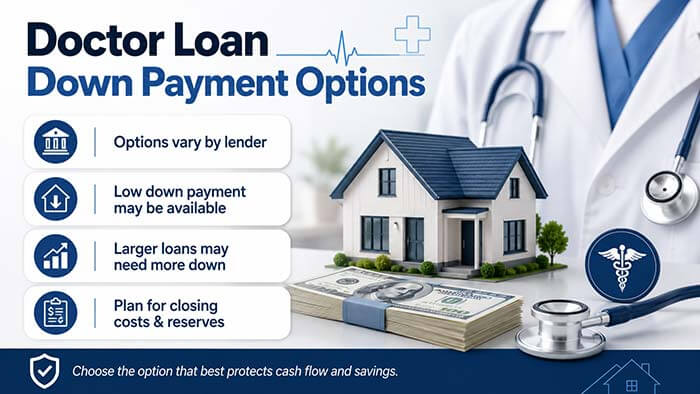
Down payment options depend on the lender, loan amount, credit score, property type, and occupancy. Some doctor loans may offer low down payment options. Others may require more money down for larger loan amounts or higher-risk files.
Borrowers should budget for closing costs, prepaid taxes, homeowners’ insurance, reserves, moving costs, and possible repairs or furniture.
A low-down payment can preserve liquidity but may not be the most cost-effective long-term solution. The optimal mortgage balances monthly payments, total cost, cash reserves, and financial stability.
Property Types Eligible for Doctor Mortgage Loans
Most doctor mortgage programs focus on primary residences. A primary residence is the home the borrower intends to occupy.
Single-Family Homes
Single-family homes are commonly eligible for medical professional mortgage programs.
Condominiums
Condos may be eligible, but the condominium project must meet lender or investor requirements. Condo reviews can add conditions to the mortgage process.
Townhomes
Townhomes are commonly eligible if the property meets standard lending requirements.
Multi-Unit Properties
Some programs may allow two-unit properties, but many doctor loan programs are more restrictive. If the borrower wants a multi-unit property, FHA, VA, conventional, or Non-QM options should also be reviewed.
Doctor Mortgage Loans for Residents and Fellows
Residents and fellows often have strong long-term income potential but lower current income. This creates a unique mortgage challenge.
A doctor loan may be available if the borrower has a signed contract for future employment, acceptable credit, manageable debt, and sufficient funds for closing.
The lender may review the borrower’s field, license status, training program, and start date. Residents and fellows should avoid exceeding their budget. While anticipated income increases may help qualify, monthly payments should remain manageable relative to living expenses.
Doctor Mortgage Loans for Self-Employed Medical Professionals
Self-employed doctors, dentists, and medical professionals may qualify for a mortgage, but documentation can be more detailed.
Traditional mortgage programs often review tax returns, business income, profit-and-loss statements, business debt, and income stability.
If tax returns do not show sufficient qualifying income, a Non-QM bank statement loan may be considered an alternative. Self-employed borrowers should prepare early. Lenders may need business and personal bank statements, tax returns, K-1s, corporate documents, year-to-date profit-and-loss statements, or CPA letters.
Doctor Mortgage Loans After Residency Relocation
Doctors often relocate after medical school, residency, fellowship, or a new job offer. Relocation can create timing issues with lease endings, moving costs, job start dates, licensing, and closing deadlines.
A comprehensive pre-approval should evaluate the new employment contract, student loans, credit, assets, and the anticipated closing timeline before starting the home search.
Documentation varies by lender, but medical professional borrowers should be prepared to provide income, asset, credit, and employment documents.
Employment and Income Documents
Borrowers may need pay stubs, W-2s, employment contracts, offer letters, verification of employment, or tax returns if self-employed.
Student Loan Documents
The lender may request student loan statements, repayment plan documentation, deferment proof, income-driven repayment information, or credit report details.
Asset Documents
Borrowers may need bank statements, retirement account statements, gift letters, or proof of funds for down payment and closing costs.
Professional Documents
Some lenders may require medical or dental licenses, residency or fellowship letters, or proof of professional status.
The Different Types of Properties for Investment
Invest in a variety of properties with our physician mortgage loans. While these loans are restricted to primary residences, this includes:
- Single-family homes
- Condominiums (certain restrictions apply)
- Townhouses
- Two-to-four-unit multi-family homes (if you occupy one unit)
What You Need to Know About Interest Rates and Terms
When it comes to doctor and medical professional mortgage loans, we have options for you. Some loans have interest rates that can change over time, which might start lower but can lead to higher payments later. However, we also provide fixed-rate loans, meaning your monthly payments stay the same. This way, you can have peace of mind knowing exactly what you’ll pay.
Potential Drawbacks
When you’re looking into doctor and medical professional mortgage loans, it’s good to keep in mind some possible downsides:
ARMs:
- If you choose a loan with an adjustable rate, your payments might start low, but they can go up later.
- This can make budgeting tricky if you’re not careful.
Zero Down Payment:
- While buying a home with no money down sounds great, it can be risky.
- If the value of your house goes down, you could owe more than it’s worth, which isn’t ideal.
- Always think about these factors before making a decision!
Common Problems That Can Delay Doctor Mortgage Approval
Doctor mortgage loan processes proceed efficiently when documentation is complete and accurate. Delays often occur due to missing or unclear documents.
Student Loan Payment Is Not Documented Correctly
- If the student loan payment is unclear, the lender may use a higher calculated payment, which can hurt the debt-to-income ratio.
Employment Start Date Is Too Far Away
- Some lenders may not allow closing too far in advance of the new job start.
- This can affect residents, fellows, and relocating physicians.
Contract Income Is Not Fully Guaranteed
- If income depends on production, a bonus, or future performance, the lender may not fully count it without a history.
- A borrower may qualify, but the condo project may not meet lender requirements, which can delay or stop approval.
Credit Report Shows Recent Late Payments
- Recent late payments can raise concern, even for high-income borrowers.
- The lender may require explanations, proof of recovery, or a different loan program.
How to Improve Approval Chances Before Applying
Medical professionals can improve their chances of mortgage approval by preparing early. Organize student loan documents, avoid new credit before closing, and notify the lender before job changes. Ensure sufficient funds for closing costs and reserves, review credit early, and make all payments on time. Consult a mortgage team experienced with doctor and medical professional loans.
Why Working with the Right Mortgage Team Matters
Doctor mortgage loans require more than a basic pre-approval. The lender should understand student loan calculations, employment contracts, residency transitions, jumbo loans, FHA, VA, conventional, and non-QM options. An effective mortgage team should evaluate multiple loan options rather than directing all borrowers to a single product. For some doctors, a physician mortgage loan is best, while others may prefer FHA, VA, conventional, jumbo, or non-QM loans.
Best Mortgage Options for Doctors and Healthcare Professionals
The best mortgage option depends on the borrower. There is no single loan that fits every doctor or medical professional.
Doctor Mortgage Loan
- A doctor mortgage loan may be useful for eligible medical professionals who need flexible down payment options, larger loan amounts, or special treatment for student loans.
Conventional Loan
- A conventional loan may be a good option for borrowers with good credit, stable income, and enough money for the down payment and closing costs.
FHA Loan
- An FHA loan may help borrowers who need more flexible credit guidelines or a lower down payment option.
- FHA guidelines are governed by HUD Handbook 4000.1.
VA Loan
- A VA loan may be one of the best options for eligible military doctors and medical professionals because of its no-down-payment and no-monthly-mortgage-insurance features.
Jumbo Loan
- A jumbo loan may be needed when the loan amount is above conforming loan limits.
- Jumbo loans often have stronger credit, reserve, and down payment requirements.
Non-QM Loan
- A non-QM loan may help self-employed doctors, dentists, or medical business owners whose tax returns do not show enough qualifying income for traditional mortgage approval.
Doctor Mortgage Loans for First-Time Homebuyers
Many doctors and medical professionals are first-time homebuyers. The process can feel overwhelming because medical training typically does not cover mortgage qualification, escrow, appraisals, title work, homeowners’ insurance, or closing costs.
The goal is not only to qualify but to secure a home with payments that fit the borrower’s lifestyle, career stage, and long-term objectives.
First-time buyers should begin with a comprehensive pre-approval, not just a quick quote. This process should review income, student loans, credit, assets, and long-term financial goals.
Doctor Mortgage Loans for High Student Loan Balances
High student loan balances are common for doctors, dentists, and other medical professionals. A high balance does not automatically mean denial.
The lender must determine the correct monthly payment to use. That payment may come from the credit report, a repayment plan, a student loan statement, or a program-specific calculation.
Given the variability of student loan rules across mortgage programs, borrowers should not assume denial based solely on the outstanding loan balance.
Doctor Mortgage Loans with Limited Savings
Many medical professionals earn a good income but may not have large savings early in their careers. Years of school, relocation, licensing costs, board exams, and student loan payments can limit available cash.
Some doctor loan programs may offer lower down payment options. However, borrowers should maintain emergency reserves, when possible, as homeownership involves ongoing expenses such as repairs, maintenance, insurance, taxes, and unexpected costs.
Previous credit issues do not necessarily prevent mortgage approval. Lenders consider the nature and timing of the issue, whether it was isolated, and if the borrower has re-established credit. Payments, collections, charge-offs, bankruptcy, foreclosure, or high credit card balances may require detailed review. FHA, VA, Non-QM, or other flexible programs may be considered depending on the situation.
How Gustan Cho Associates Helps Medical Professionals
Gustan Cho Associates assists borrowers whose profiles may not align with standard mortgage criteria. Medical professionals frequently require lenders who understand student loans, projected income, employment contracts, relocation, and diverse loan options. The right mortgage strategy may involve comparing doctor loans, FHA loans, VA loans, conventional loans, jumbo loans, and non-QM loans. The best answer depends on the borrower’s full file.
Final Thoughts on Doctor and Medical Professional Mortgage Loans
Doctor and medical professional mortgage loans facilitate homeownership for healthcare professionals, even when factors such as student loans, new employment, relocation, or limited savings complicate the process. The best mortgage is not always the one with the lowest down payment. The best mortgage is the one that fits your income, career stage, credit profile, student loan situation, cash reserves, and long-term plans.
Get Started Today!
Don’t let student loans hold you back from owning your dream home. At Gustan Cho Associates, we specialize in making homeownership accessible to medical professionals. Call or text us today at 800-900-8569 or email gcho@gustancho.com to explore how our doctor and medical professional mortgage loans can help you step into the home of your dreams or apply directly through our website for a fast, personalized quote. Let us help you advance your career and life with the right home loan solution.
Frequently Asked Questions About Doctor and Medical Professional Mortgage Loans:
Why Should I Pick a Doctor and Medical Professional Mortgage Loan Instead of a Regular Loan?
These loans are better for doctors and medical staff because they don’t require you to pay for private mortgage insurance (PMI) and allow lower down payments. Plus, they understand you might have student loans but still let you borrow based on your future earnings.
Do I Need to Pay a Down Payment with These Loans?
Often, you don’t! Many of these loans need little to no down payment, so you can start owning a home faster without waiting to save a big chunk of money.
Who Can Apply for These Mortgage Loans?
You likely qualify if you’re an MD, DO, DDS, DMD, pharmacist, or veterinarian. Basically, if you have a medical degree, these loans could be for you.
Can I Buy Any Property with This Mortgage?
Yes, but there’s a catch. You can buy single-family homes, condos (with some rules), townhouses, and multi-family homes—but you have to live in one of the units.
What’s the Application Process Like for These Loans?
It’s pretty easy! You’ll start by chatting with a loan officer, then send over documents like your job contract and medical degree proof through a secure online platform. They tailor the loan to your needs, and approval can come quickly.
This Guide About “Doctor and Medical Professional Mortgage Loans” Was Updated on June 1, 2026.